Mobile Navigation

  • National
    • Policy
      • High Expectations
      • Quality Choices
      • Personalized Pathways
    • Research
    • Commentary
      • Gadfly Newsletter
      • Flypaper Blog
    • Events
    • Scholars Program
  • Ohio
    • Policy
      • Priorities
      • Media & Testimony
    • Research
    • Commentary
      • Ohio Education Gadfly Biweekly
      • Ohio Gadfly Daily
  • Charter Authorizing
    • Application
    • Sponsored Schools
    • Resources
  • About
    • Mission
    • Board
    • Staff
    • Career
Home
Home
Advancing Educational Excellence

Main Navigation

  • National
  • Ohio
  • Charter Authorizing
  • About

National Menu

  • Topics
    • Accountability & Testing
    • Advanced Education
    • Career & Technical Education
    • Charter Schools
    • Curriculum & Instruction
    • ESSA
    • Evidence-Based Learning
    • Facilities
    • Governance
    • Personalized Learning
    • Private School Choice
    • School Finance
    • Standards
    • Teachers & School Leaders
    • Think Again
  • Research
  • Commentary
    • Gadfly Newsletter
    • Flypaper Blog
    • Gadfly Podcast
  • Events
  • Scholars Program

The Education Gadfly Weekly

Sign Up to Receive Fordham Updates

We'll send you quality research, commentary, analysis, and news on the education issues you care about.
Thank you for signing up!
Please check your email to confirm the subscription.

The Education Gadfly Weekly: Public education is drifting from its founding ideals and public purpose

Volume 22, Number 47
11.17.2022
11.17.2022

The Education Gadfly Weekly: Public education is drifting from its founding ideals and public purpose

Volume 22, Number 47
view
High Expectations

With affirmative action before the Supreme Court, here’s the state of diversity among high achievers

America’s high-achieving students in our elementary and secondary schools are more racially diverse today than two decades ago. But Black high achievers in particular have made only incremental gains. Given affirmative action's original purpose, such trends are more than a little disappointing.

Michael J. Petrilli 11.17.2022
NationalFlypaper

With affirmative action before the Supreme Court, here’s the state of diversity among high achievers

Michael J. Petrilli
11.17.2022
Flypaper

Public education is drifting from its founding ideals and public purpose

Robert Pondiscio
11.17.2022
Flypaper

Parent groups win big despite Republican losses

Daniel Buck
11.17.2022
Flypaper

How to turn children into financially-literate adults: Evidence from Brazil

Jeff Murray
11.15.2022
Ohio Gadfly Daily

Education Gadfly Show #846: What do the midterm elections mean for the parents’ rights movement?

11.15.2022
Podcast

Cheers and Jeers: November 17, 2022

The Education Gadfly
11.17.2022
Flypaper

What we're reading this week: November 17, 2022

The Education Gadfly
11.17.2022
Flypaper
view

Public education is drifting from its founding ideals and public purpose

Robert Pondiscio 11.17.2022
Flypaper
view

Parent groups win big despite Republican losses

Daniel Buck 11.17.2022
Flypaper
view
Long term effects of financial planning education SR image

How to turn children into financially-literate adults: Evidence from Brazil

Jeff Murray 11.15.2022
Ohio Gadfly Daily
view
iStock/Getty Images Plus/cglade

Education Gadfly Show #846: What do the midterm elections mean for the parents’ rights movement?

Michael J. Petrilli, David Griffith, Ph.D., Amber M. Northern, Ph.D., Virginia Gentles 11.15.2022
Podcast
view

Cheers and Jeers: November 17, 2022

The Education Gadfly 11.17.2022
Flypaper
view

What we're reading this week: November 17, 2022

The Education Gadfly 11.17.2022
Flypaper
view

With affirmative action before the Supreme Court, here’s the state of diversity among high achievers

Michael J. Petrilli
11.17.2022
Flypaper

At last month’s Supreme Court hearing about affirmative action policies at Harvard and the University of North Carolina, several justices inquired about whether these schools would ever be able to meet their diversity goals without relying on race as a factor in admissions. After all, former justice Sandra Day O’Connor famously wrote in her 2003 Grutter v. Bollinger opinion that “we expect that twenty-five years from now, the use of racial preferences will no longer be necessary” to further universities’ interest in diversity—the rationale that the policies’ constitutionality rests upon. As Joshua Dunn wrote in his analysis for Education Next, attorneys for the schools refused to give a straight answer.

Sad but true: Higher education seems to assume that racial disparities in achievement among the nation’s top high school graduates—those gunning for admission at America’s highly-selective universities—are both large and permanent. Were students accepted in colorblind fashion, incoming classes wouldn’t “look like America.” And that would have negative consequences for our leadership class in business, politics, the military, and much else.

Set aside for now the many policy debates over affirmative action, including whether a race-based system should be replaced by one focused instead on socioeconomic status. Let’s examine: Was Justice O’Connor’s optimism misplaced, or has the composition of America’s highest-achieving students become more racially diverse in the two decades since her 2003 opinion? The answer to both questions is both yes and no.

Yes, America’s high-achieving students in our elementary and secondary schools are more racially diverse than they were two decades ago. (So, of course, is the overall pupil population.) But Black high achievers in particular have made only incremental gains. Given that affirmative action was originally conceived as a way to level the playing field for the descendants of enslaved people and those mistreated by Jim Crow, such trends are more than a little disappointing.

The top 10 percent over time

For this analysis, I’m looking at the composition of the subset of eighth grade students who score at the 90th percentile or above on the National Assessment of Educational Progress (NAEP), a.k.a. The Nation’s Report Card, in math and reading. These top-10-percent students are the ones with the best shot at getting into America’s most selective colleges. Of course, that hugely oversimplifies things, given that we’re talking just about test scores and not grades, extracurricular activities, musical or athletic talent, etc. But if we want to find a nationally representative metric of pure academic achievement, this is the best we’ve got.

I’m using eighth grade scores simply because we don’t have post-pandemic scores for twelfth graders. (The last time NAEP assessed that grade level was in 2019.) So keep in mind that we’re comparing eighth graders in 2003 to eighth graders in 2022—so the high school graduating classes of 2007 and 2026 (this year’s high school freshmen).

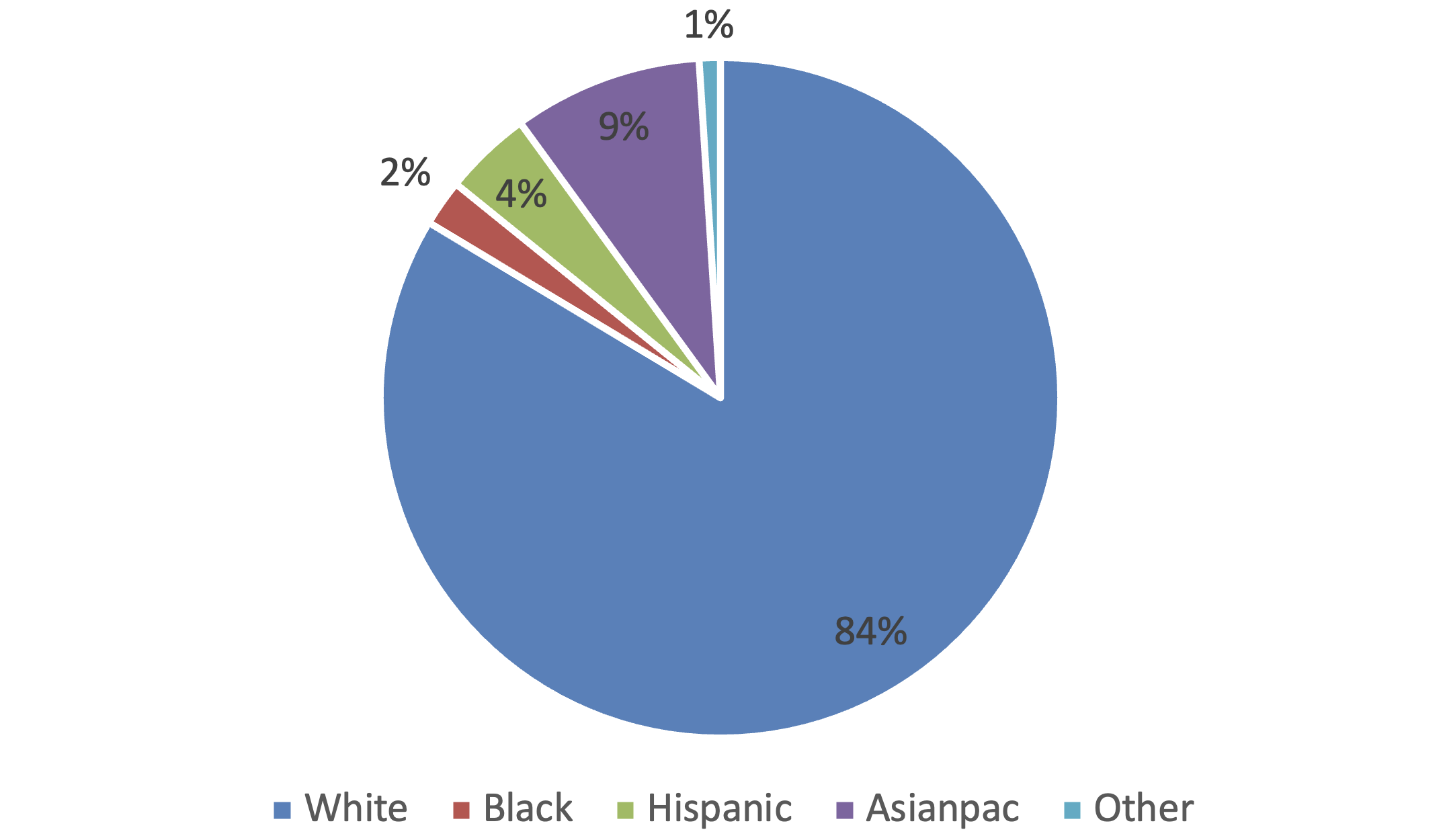
On to the numbers. Here’s what our top math students looked like in 2003:

Figure 1. Racial composition of eighth grade students at the 90th percentile or above in math, 2003
1

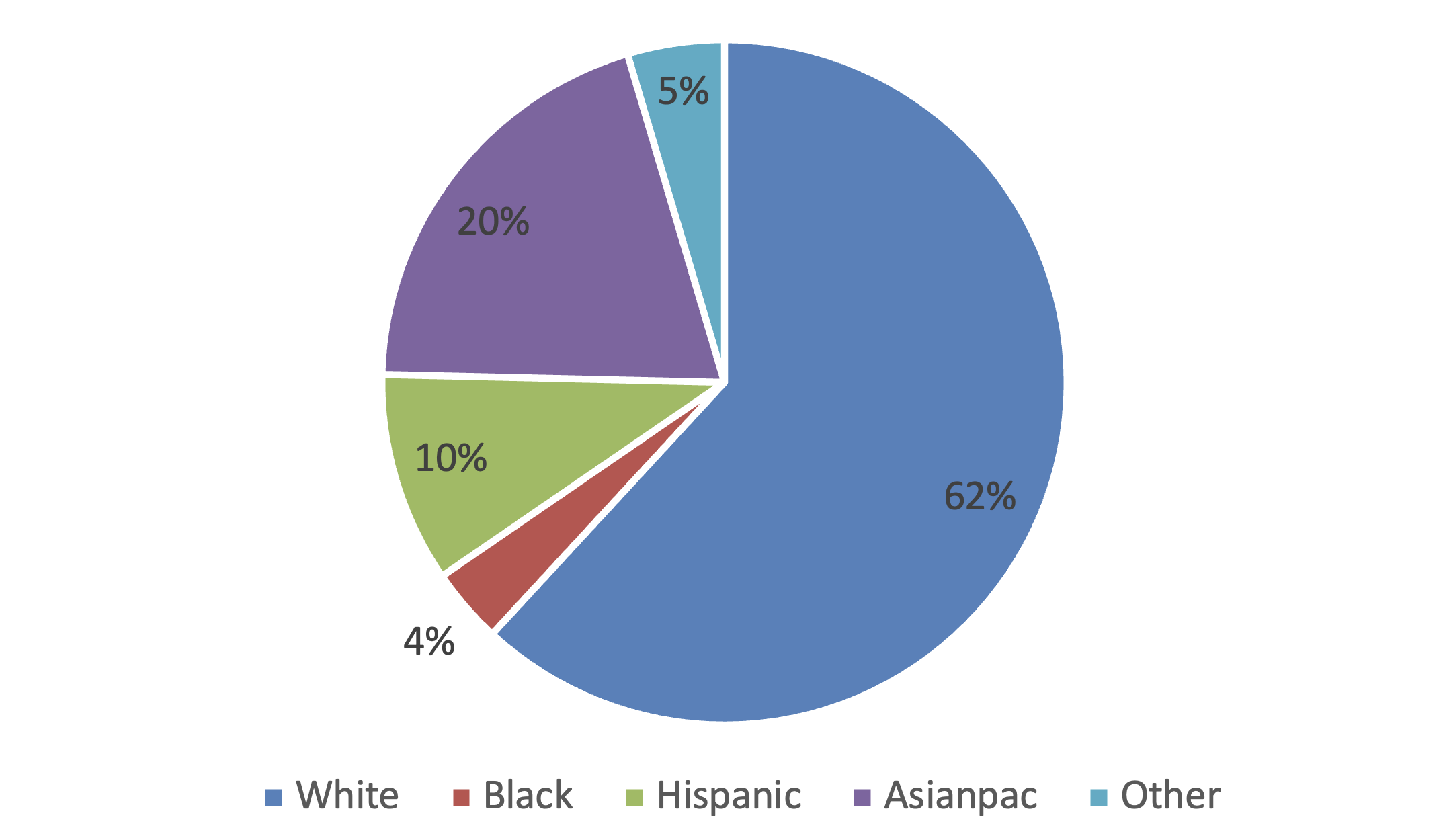
And here’s how that had changed by the spring of 2022:

Figure 2. Racial composition of eighth grade students at the 90th percentile or above in math, 2022
2

As anyone can plainly see, the proportion of high achievers who are White dropped significantly, from 84 to 62 percent. And yes, the proportion of high achievers who are Black doubled over that time—from a very low 2 percent to the still tragically low 4 percent. Most of the diversity gains came from Hispanic students (who went from 4 to 10 percent) and Asian students (from 9 to 20 percent).

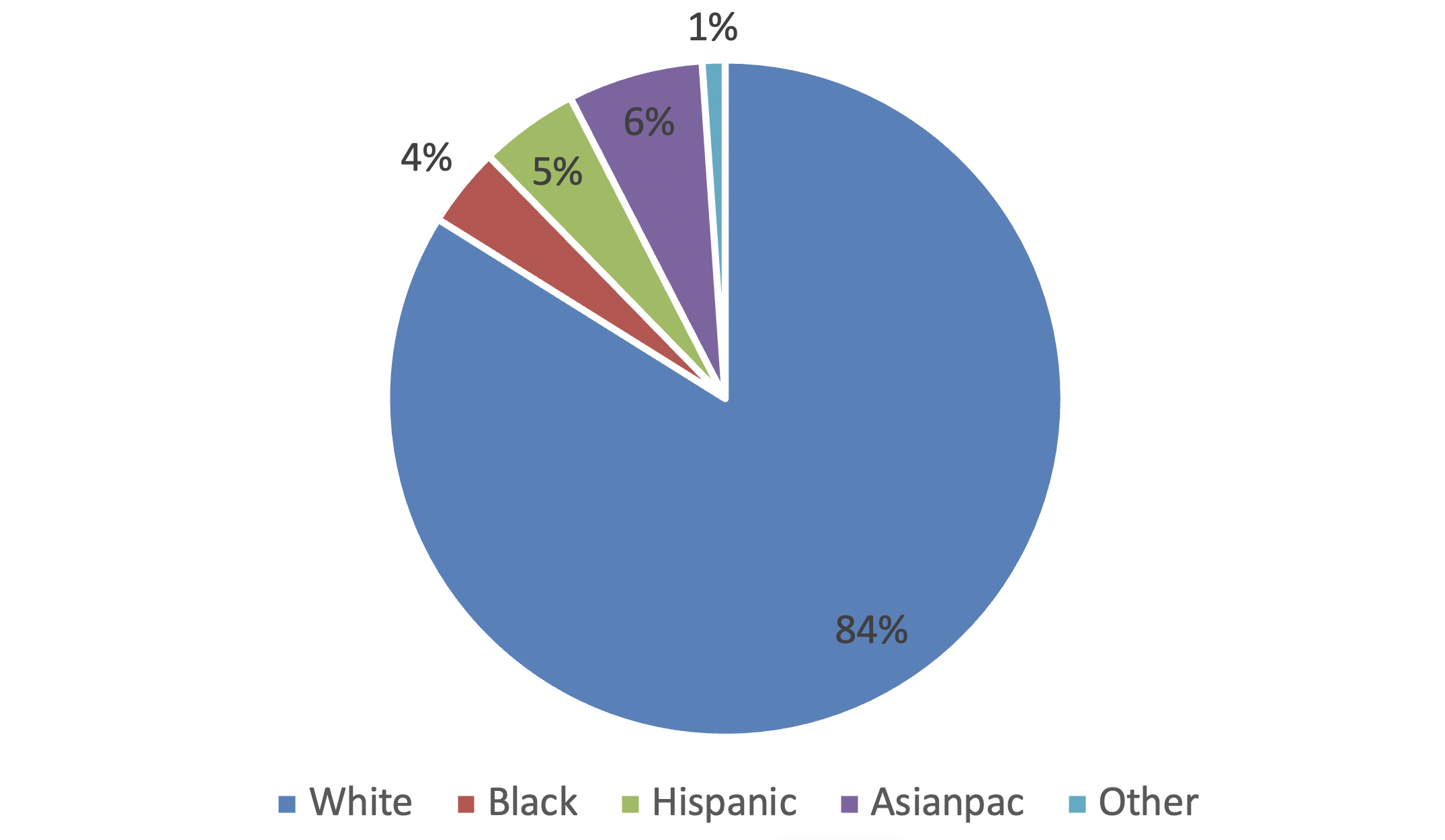
Now let’s see how it looks for reading, first in 2003:

Figure 3. Racial composition of eighth grade students at the 90th percentile or above in reading, 2003
3

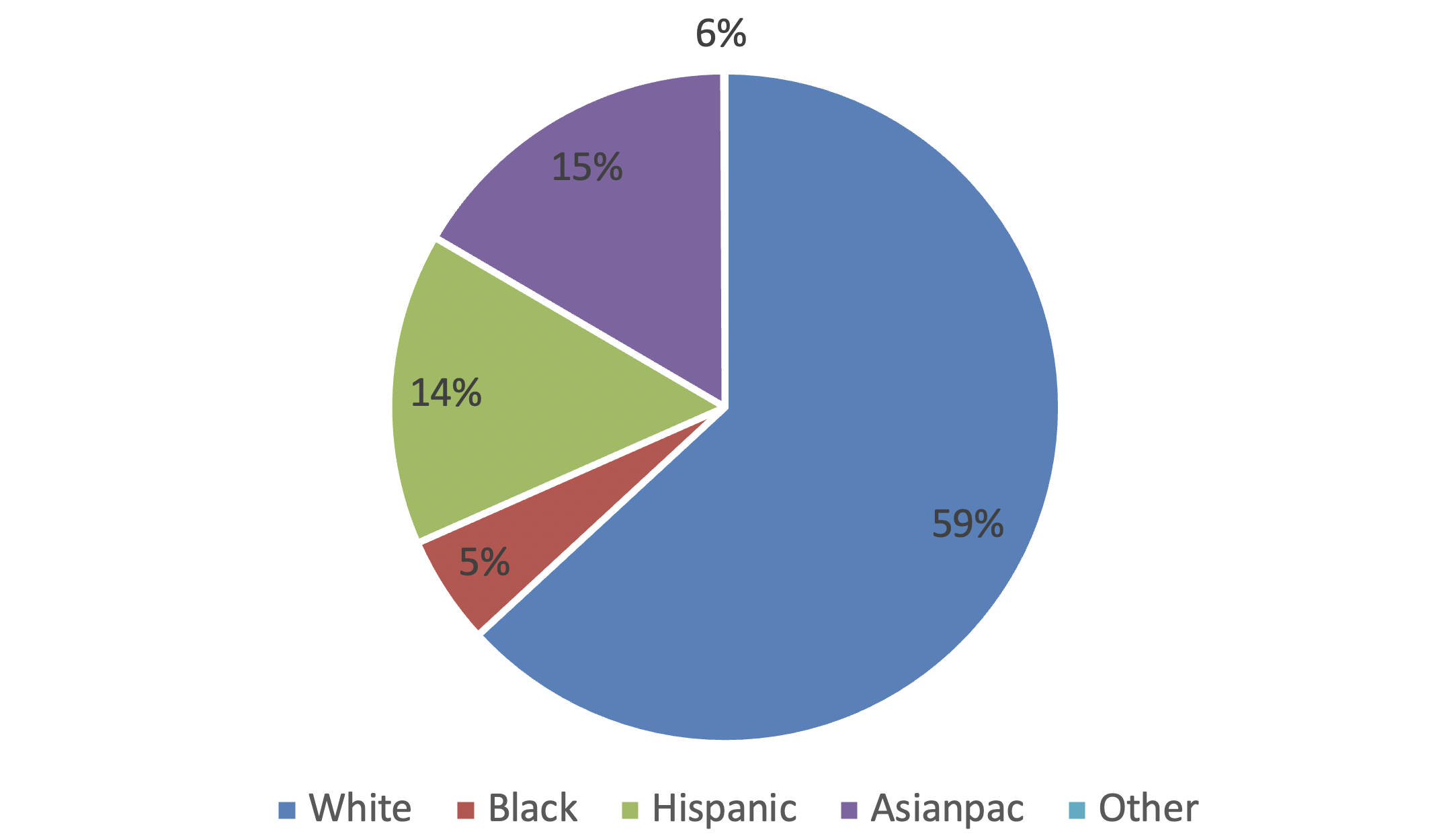
And now in 2022:

Figure 4. Racial composition of eighth grade students at the 90th percentile or above in reading, 2022
4

The pattern is largely the same: big declines in the proportion of White students, with large gains for Asian and Hispanic students—more the latter than the former when it comes to reading. The Black proportion is up slightly, to a very low 5 percent.

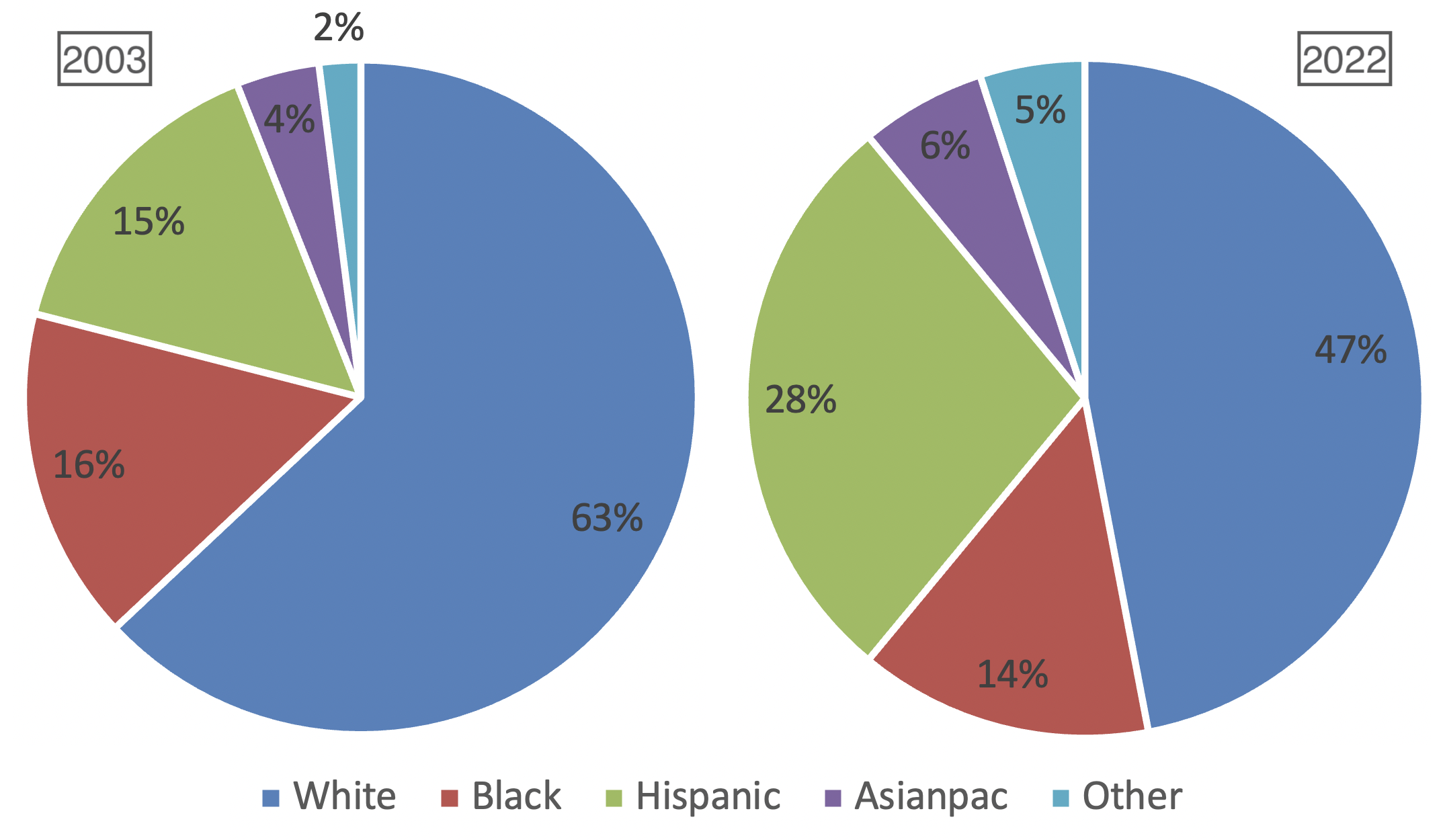
Those are significant changes over twenty years, but these pie charts don’t tell the full story. That’s because the demographics of the American student population writ large have also changed: White students now make up 47 percent of all eighth graders, down from 63 percent in 2003. Meanwhile, the Hispanic student population has grown from 15 percent of the total to 28 percent, and the Asian share has gone from 4 to 6 percent. The Black population share is down slightly, from 16 to 14 percent.

Figure 5. Racial composition of 8th grade student population, 2003 and 2022
5

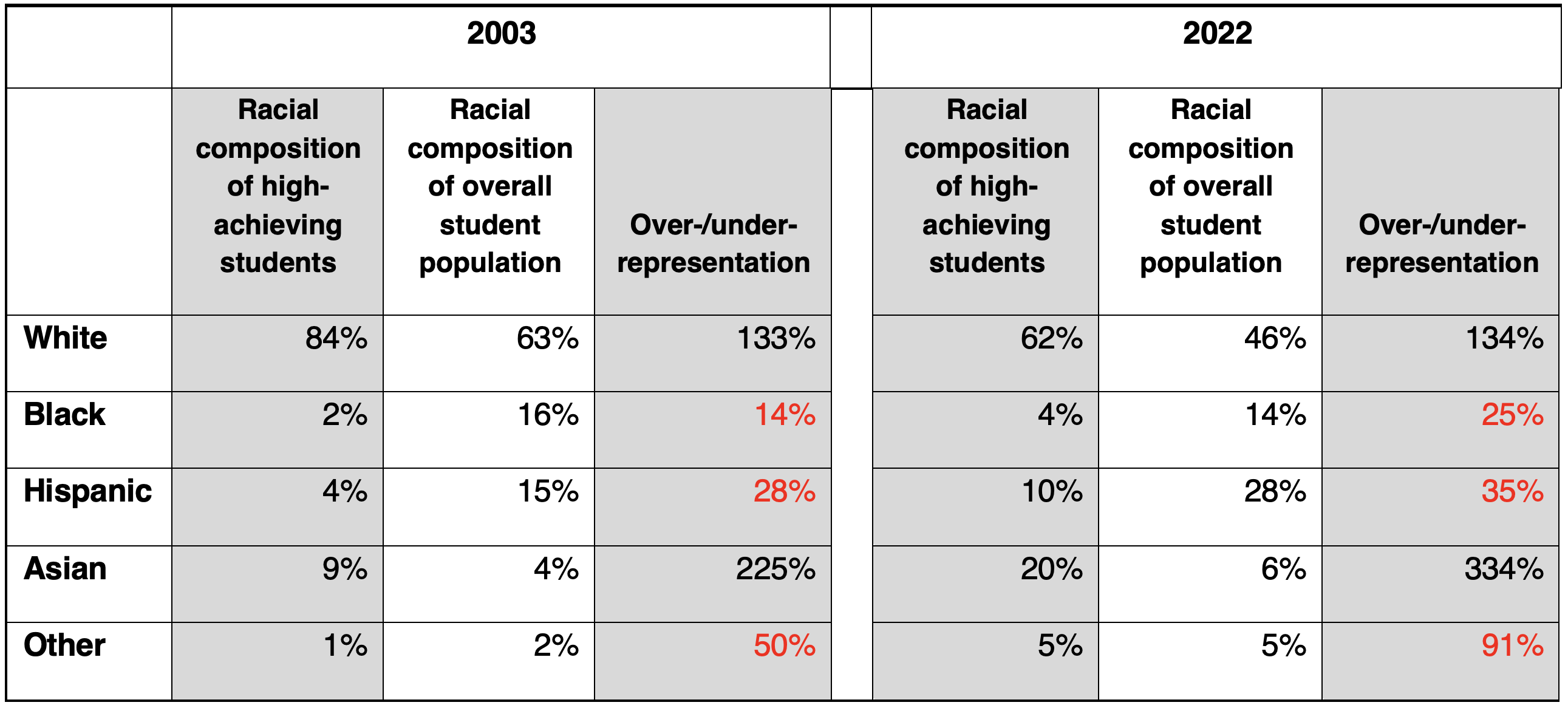
So the composition of high-achieving students is more diverse now than in 2003. But is it more representative of the student population, considering our changing demographics? Take a look at these data:

Table 1. Racial composition of students at the 90th percentile on NAEP math versus all students, 2003 and 2022
t1

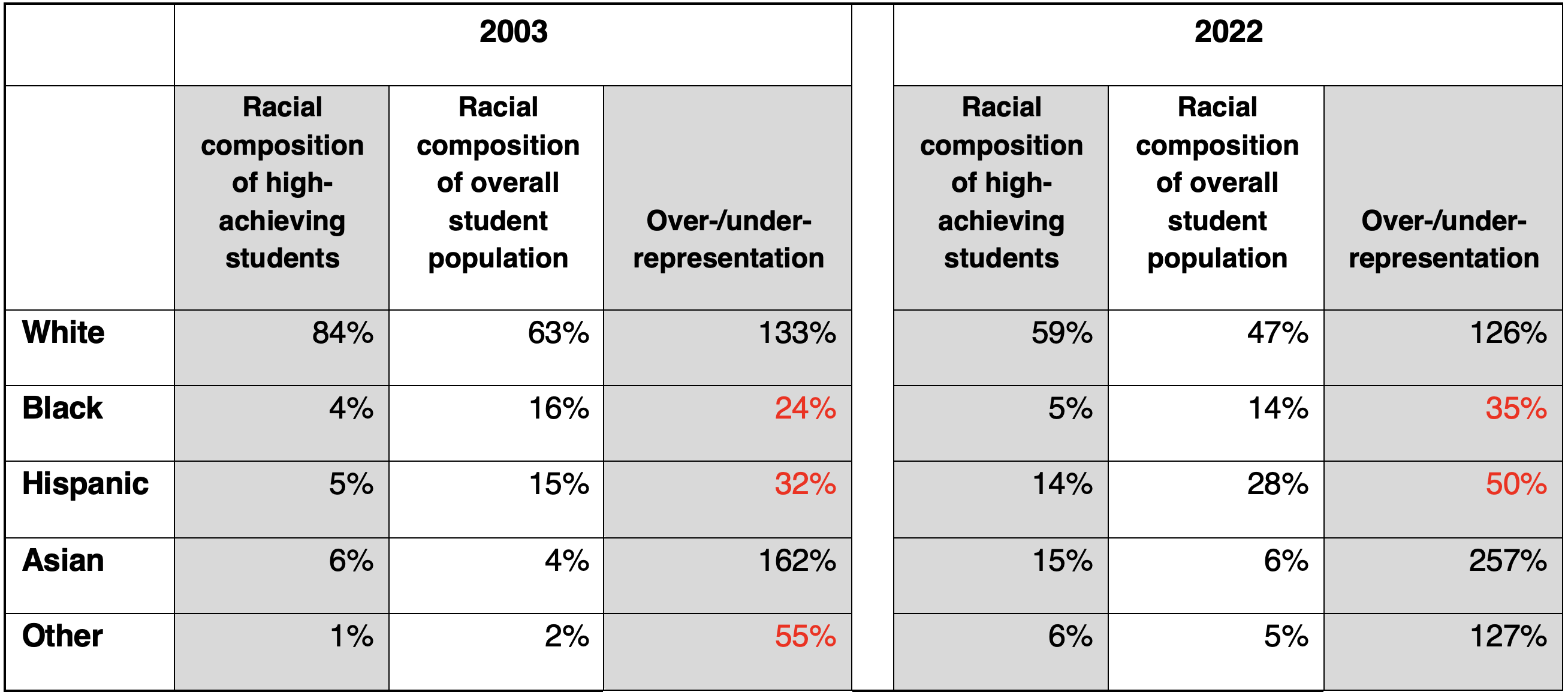
Values above 100 percent for “over-/under-representation” mean that a group is over-represented among high achievers, compared to their share of the total student population; anything under 100 percent means the group is under-represented.

What we see from these data, then, are that high-achieving math students in 2022 were not only more diverse than their counterparts in 2003, but also that under-represented groups were less under-represented. That’s the good news.

The bad news is that there’s still so far to go. Black high achievers now make up 4 percent of the total, up from 2 percent in 2003, even as their share of the total population dropped from 16 to 14 percent. That’s a huge amount of progress on a relative basis. Yet it’s still the case that there are barely one-quarter the number of Black high-achieving math students as there would be were their numbers proportional to their overall population. For Hispanic students, it’s just over one-third. This is better than in 2003, but it’s not much to celebrate.

Asian students, meanwhile, are even more over-represented than before. They used to be twice as likely to be in the high-achieving group as one would expect from their population share; now they are more than three times as likely. The fact that 20 percent of our high-achieving math students are Asian, then, reflects both the growing Asian population in America, and their improved performance over time.

The one constant has been White students: In 2003, they were about one-third more likely to be in the high-achieving student group than one would expect based on their population share, and that’s still the case today.

The trends in reading are broadly similar, with a bit more progress for Hispanic students, at the expense of White students:

Table 2. Racial composition of students at the 90th percentile of the reading NAEP versus all students, 2003 and 2022
t2

Analysis

So what can we take from all of these numbers?

First, let’s recognize that America’s high-achieving students are a more diverse group at the end of middle school now than they were just twenty years ago. Given that these are the students most likely to arrive four years later at our most selective universities, it’s no surprise that those campuses have become much more diverse, as well.

Yet most of this growing diversity has been driven by gains by Hispanic and Asian students. For Hispanic student, that largely tracks the growth of their population writ large. That’s part of the story for Asian students, too, but it’s also because of their improved performance. There’s been progress for Black students, but from such a low starting place that their numbers remain tragically low.

So was Justice O’Connor right that we are nearing the day when colorblind admissions would result in university classes just as racially diverse as America? Sadly, no. At least based on NAEP scores, such an approach would result in student bodies in which Asian students would be significantly over-represented, White students somewhat overrepresented, Hispanic students somewhat underrepresented, and Black students significantly underrepresented.

Which of course is why the Harvards of the world continue to come up with creative, if constitutionally dubious, ways to boost the chances of Black students and depress the chances of Asian students when applying for the golden ticket of admissions.

Meanwhile, the challenge for America’s K–12 system remains the same as it was twenty years ago: How to accelerate the progress of all students, including our high achievers, and especially our Black and Hispanic high achievers, so that Justice O’Connor’s expectation can finally be met.

Special thanks to Ebony Walton of the National Center for Education Statistics and Fordham’s Jeanette Luna for their assistance with the data presented here.

view

Public education is drifting from its founding ideals and public purpose

Robert Pondiscio
11.17.2022
Flypaper

Editor’s note: Last week, the Jack Miller Center convened a National Summit on Civic Education at Mount Vernon, the Virginia home of George Washington. Robert Pondiscio delivered the keynote address. This is adapted from his remarks.

It’s no longer news to observe that there’s a crisis of trust in K–12 education in this country. Nor do we need to belabor the causes of it: Covid shutdowns that went on far longer than necessary; remote learning that pried open the black box of the American classroom; fights over masking children; critical race theory, gender ideology, and social and emotional learning. That’s already a long list of flashpoints and grievances before we even get to the latest round of NAEP scores, which in most states saw decades of progress in reading and math vaporized at a stroke.  

All this comes at a time when there are more opportunities than ever for parents to vote with their feet and leave public school districts. According to data from my AEI colleague Nat Malkus, more than 1.2 million students have exited public school districts since the start of pandemic. I’m a school choice and charter school proponent, so perhaps all of this should delight me. It’s driving demand for choice and alternatives, including school models I admire.

But the vast majority of American children attend traditional public schools and probably always will. So I take no joy in their struggles. None of us should. And I think it’s worth asking what’s going on.

I’ll start with an attempt to diagnose the problem, and I’ll state it bluntly: Public education is drifting from its founding ideals and becoming increasingly estranged from its stakeholders and its public purpose. Our schools are supposed to be in the business of attaching our children to their country, their community, and civil society. But it sometimes seems they’re more interested in attacking them.

That’s a very strange business for public schools to be in. It’s like an organism devouring its host.

Benjamin Rush, one of our first great education theorists, observed that “our strongest prejudices in favor of our country are formed in the first one and twenty years of our lives.” In 1786, he wrote that a “general and uniform system of education...will render the mass of the people more homogeneous and thereby fit them more easily for uniform and peaceable government.”

If Rush were alive today and tweeted those words, he’d be cancelled for wanting to make Americans “more homogeneous.” But remember that the Founders warned us of the threat that factions posed to the infant republic. K–12 public education has drifted a long way from the ideals of its earliest theorists. So far, in fact, that we’ve now lost sight of the shore.

A few months ago, I wrote a cover story for Commentary magazine on “the unbearable bleakness of American schooling.” It pointed out that school culture and curriculum seem nearly to revel in the bad and the broken, suggesting to children that they have suffered the great misfortune to have been born into a country that is racist to its core, whose founding documents were lies when written, and where democracy is hanging by a thread. I dubbed this the “pedagogy of the depressed.” The worst part is that it’s thought to be a virtue among many professional educators. We view it as a mark of seriousness and sophistication. We think we’re simply being honest with children.

I don’t think it’s untoward or reactionary for parents and stakeholders to say, at some point, “Hold on. What is the permission structure that allows you to do this? To impose political or ideological views on my child? To make decisions unilaterally about what children in our country should know, or about the ideals, beliefs, and behaviors that are praised or condemned in schools that all of us support and pay for?”

When education drifts from its founding purpose of citizen-making, and cultivating “prejudices in favor of our country,” when it becomes a form of social justice activism, when it dwells exclusively in the bad and the broken, it tacitly encourages children to see their country as nothing more than a collection of problems to be solved, with none of the virtues and blessings of citizenship.

We want to educate our children to be problem-solvers, but that doesn’t mean schools should be problem-spotters or should fetishize America’s failures.

To be clear, I’m not suggesting that schools promote mindless nationalism or teach sanitized history. Fair-minded people can see that gratitude for what works and outrage at what’s not working are equally important to cultivate in a well-functioning society. But when only our shortcomings are emphasized, we risk creating in the minds of our children the impression that their country is reflexively antagonistic to their interests: What we have, what we have been given, and what some may seek to preserve is wrong, unjust, and must be dismantled, root and branch.

Again, what a strange business for public schools to engage in.

There is nothing wrong with thinking that a non-negotiable for public education must be to cultivate in our children a respect and even a reverence for the beliefs, the practices, the institutions, and yes, the virtues that made America the envy of the world.

The still relatively high but declining level of trust in schools and teachers suggests that there is a base to build upon. But it will require a shift in the culture of teaching, and a shift in the mindset of public education. Less activism, more humility. A reminder that teachers are not free agents, they’re public employees and influential state actors.

K–12 public school teachers must take to heart that we don’t have permission or legal authority to impose our views on a captive audience of our fellow citizens’ children. We can’t just shut the door and teach what we like.

But please, let’s not shy away from controversial topics in schools. Let’s lean into them. Not as activists and ideologues, but as serious, thoughtful professionals. I’ve argued elsewhere that, instead of CRT bans, schools, districts, and states should adopt a code of ethics that encourages teaching contentious issues while valorizing viewpoint diversity.

In sum, there’s an opportunity for public education to cultivate gratitude and optimism in our children, to invest them in their country, and to encourage them to take up the work of building a more perfect union.

But we’ve lost the plot.

Our founders saw the mission and purpose of public education much more clearly than we do today.

view

Parent groups win big despite Republican losses

Daniel Buck
11.17.2022
Flypaper

Considering President Joe Biden’s historically low approval ratings, many predicted a Republican wave in the midterms. Well, the wave turned out to be a gentle lapping at the toes. If anything, with Democrats keeping control of the Senate, they are enjoying their time in the sun on the beach, not even a high tide in sight.

That being said, there was a quiet winner in last week's elections: parents’ rights groups. In Charleston alone, voters elected seven new members, most of whom were backed by the parental activism organization Moms for Liberty. Across the country, they endorsed or financially supported 270 school board candidates, and over 50 percent of those candidates won—all newcomer candidates and many fighting incumbents. The Minnesota Parents Alliance won forty-nine races in the state. The 1776 Project Pac claims to have flipped 100 board seats.

Conversely, at the Manhattan Institute, Michael Hartney quantifies the real sway that unions have over school board elections. After crunching the numbers in California, New York, and Florida, he estimates that union-backed candidates have won seven out of ten races in those states in previous elections. Even in deep red districts, unions never drop below 60 percent. Considering the context then, Moms for Liberty can boast a huge success at a win rate of 50 percent. They may not have swept every school board seat, but they made them competitive.

And control of school boards is no insignificant matter. Education in America is notoriously local. Where governor’s mansions determine policies like school choice, funding, and basic standards, school boards determine just about everything else—from charter authorization to discipline policies, funding, staffing, and curricula.

This is where their true power lies. Moms for Liberty and other groups are too small a coalition to swing governorships or Senate seats. In these high-turnout elections, issues like the economy or abortion make most of the difference, while the parents coalition becomes just one more bloc among millions of voters. Their influence is diluted accordingly. However, they could make many school board seats competitive for years to come, and in doing so, provide a much-needed corrective to union dominance. Even the pressure of one or two seats in blue or purple districts could cause other candidates to tack towards the center and be more responsive to their constituents.

Normally, school board elections take place during off year election cycles; only thirteen states mandate on-cycle school board elections, while twelve actually require off-year, non-November elections—so few people bother to cast a ballot. However, according to Hartney’s analysis, teachers who lived where they worked voted in these elections at a rate two to seven times higher than other citizens. When I worked in public schools, for every election, no matter how small, a little union flier appeared on my desk in the morning reminding me when to vote and for whom to vote. When only a few votes are cast, getting teachers to the ballot box quickly turns into a plurality.

What’s more, Hartney points out that there’s an overrepresentation of former teachers, groomed by the union for politics, sitting on many of these boards. To be fair, any school board without a former educator or two among its members would certainly lack necessary insight and relevant direct experience. But there are plenty of reasons to have a representative sample. Parents, local business leaders, knowledgeable college professors, the average taxpayer—all of these can bring beneficial insight and different motivations to the table.

Not everyone is excited about the wins of candidates backed by Moms for Liberty and groups like it. At the New Yorker, Jessica Winter laments the wins of “education freedom”—with the scare quotes being, of course, hers. To Winter, such wins signal the success of Republican dark money and an unwarranted sense of crisis. Conservative school board activists capitalized on “lingering resentment” over lockdowns, a “manufactured culture war,” and pornography “supposedly proliferating in schools.”

Such pieces feature a painful lack of self-reflection. According to Gallup, confidence in public education as an institution is at an historic low. Rather than asking why trust is lagging in public education, however, Winter instead asserts that “a degree of trust” is simply “nonnegotiable.” Trust, she seems to argue, is to be demanded or assumed, not earned.

In reality, decisions by officials, elected and otherwise, have given the American public good reasons to question the credibility of their schools. There was early evidence that schools weren’t “super-spreaders” of Covid-19, but still administrators locked the doors to their buildings. There are plenty of examples of not just individuals, but also national English curricula, district-wide professional development, and even math standards all pushing divisive, progressive concepts in the classroom.

The wins of Mom for Liberty and other parent-activist organizations represent, not manufactured anger, but a real, warranted frustration with the state of schools. In place of responding to such frustrations, school boards and other elected officials spent ink casting them as villains, even domestic terrorists.

Edmund Burke wrote, “The effect of liberty to individuals is that they may do what they please; we ought to see what it will please them to do before we risk congratulations, which may be soon turned into complaints.” The same could be said for the electoral influence of groups like Moms for Liberty. With a national presence, their real power and influence is local. Now let’s see what they do with that power.

view
Long term effects of financial planning education SR image

How to turn children into financially-literate adults: Evidence from Brazil

Jeff Murray
11.15.2022
Ohio Gadfly Daily

In 2010, a group of researchers from the World Bank and the Central Bank of Brazil began to study the efficacy of a financial education program delivered to high schoolers in Brazil that aimed to help young people make good decisions around saving, borrowing, and credit usage. Their first report, in 2016, looked at short-term findings of the randomized control study and found decidedly mixed outcomes. A newly-published follow up looks at the students’ financial situations years later and finds that many of its young subjects have become more money wise in the longer run.

The experiment was conducted in 2010 and 2011 and included 25,000 students in 892 schools across six Brazilian states. Half the schools were randomly selected to receive teacher training and financial education textbooks. The treatment was integrated into the classroom curricula of math, science, history, and Portuguese during students’ last two years of high school. Control group schools did not receive the new training or materials, nor was any other formal financial education provided.

In their earlier analysis, just after high school graduation, researchers found that the program led to increased financial knowledge among treatment group students, as well as positive effects on attitudes toward savings, self-reported saving up for purchases, money management, and budgeting. On the other hand, treatment students reported a significantly greater use of expensive financial products such as credit cards, as well as greater likelihood of being behind on credit repayments than their control group peers. These differences were visible even before they had left high school. The research team speculated at the time that the curricular materials raised the profile of these risky products but may have erred by not actively discouraging their use.

The data in the new report come from administrative records on a subsample of nearly 16,000 individuals from the original experiment, covering nine years after their high school graduation. Long-run financial outcomes were tracked using data on bank account ownership (but not account balances), use of various credit products, as well as information on formal employment status and microenterprise ownership. Data span from students’ high school graduation in 2011 to February 2020, just before the Covid-19 pandemic hit Brazil. Slightly more than half of the subsample were in the original control group. The subsample contained significantly more females than did the full sample; otherwise the subsample’s treatment and control groups were statistically similar to the originals.

First the analysts looked at the same outcomes as in the previous study. The financial education program had no long-term effect on bank account ownership (although a commendable 85 percent of students in the full sample had bank accounts in 2020). Treatment students, however, used fewer expensive credit products in the long-term. They were 1.4 percentage points less likely to have credit card debt and 0.9 percentage points less likely to use overdrafts, compared to 23 percent of control students with credit card debt and 11 percent of control students with overdrafts at nine years post-graduation. The program also appeared to lead to lower the likelihood of having loans with repayment delays by about 0.9 percentage points, compared to 15 percent of control students with repayment delays.

There is no way to determine the mechanisms behind these long-term improvements using this methodology. But the researchers’ speculations seem reasonable: Maybe students “experimented” with expensive credit when young and then realized that this was not a sound financial decision, or perhaps they realized that expensive credit was untenable when larger, more expensive, “grown up” purchases were contemplated. The phrase “live and learn” comes to mind.

As to additional outcomes, treatment students were 3.69 percentage points more likely to own a formal microenterprise in 2020 than were control students and were 1.2 percentage points less likely to hold a job with a written contract, suggesting that the program encouraged a focus on owning their own business rather than being employees beholden to a boss or company. The researchers speculate that these effects stem from program modules on work and entrepreneurship whose impacts would only be seen later in students’ lives.

It’s certainly possible that the researchers are giving a bit more credit to a high school financial literacy program than they probably should. A lot happened in Brazil—and in the world economy—in those nine years, including a two-year-long recession. There is no way of knowing whether such upheavals impacted individuals differently, especially with so many students from the original study unaccounted for, nor what additional financial education they may have received in the interim, either formally or via the school of hard knocks. But perhaps that is the point here: Arming students with financial knowledge before they head out into the working world may help many of them navigate some of the difficult ups and downs of adulthood, no matter how treacherous those may be.

SOURCE: Miriam Bruhn, Gabriel Garber, Sérgio Mikio Koyama, and Bilal Zia, “The long-term impact of high school financial education,” World Bank Group (October 2022).

view
iStock/Getty Images Plus/cglade

Education Gadfly Show #846: What do the midterm elections mean for the parents’ rights movement?

11.15.2022
Podcast
 

On this week’s Education Gadfly Show podcast, Virginia Gentles, the director of the Education Freedom Center at the Independent Women’s Forum, joins Mike Petrilli and David Griffith to discuss the results of the 2022 midterm elections and what they mean for the parents’ rights movement. Then, on the Research Minute, Amber Northern reviews a study that finds that students from under-resourced schools perform worse on computer-based tests than on traditional paper ones.

Recommended content:

  • “School Board Candidates Who Pushed ‘Parental Rights’ See Mixed Results” —Wall Street Journal
  • “Still the Ones to Beat: Teachers’ Unions and School Board Elections” —Michael Hartney
  • “DeSantis, conservatives score more Florida school board wins” —Politico
  • The study that Amber reviewed on the Research Minute: John Gordanier et al., “Pencils Down? Computerized Testing and Student Achievement,” Education Finance and Policy (Oct 2022).

Feedback Welcome:

Have ideas for improving our podcast? Send them to our podcast producer Nathaniel Grossman at [email protected].

view

Cheers and Jeers: November 17, 2022

The Education Gadfly
11.17.2022
Flypaper

Cheers

  • Philanthropist MacKenzie Scott has gifted $16 million to Chicago’s Noble Schools, one of the original “no excuses” charter school networks. —Fox 32 Chicago
  • New York Governor Kathy Hochul should waste no time in lifting the state’s cap on charter schools, a position she supported during her campaign.  —New York Post
  • After completing a “listening tour” with community members, Cleveland Mayor Justin Bibb declares that schools must improve rapidly to help students. —Ideastream Public Media

Jeers

  • A new NWEA study shows that first and second grade achievement levels in math and reading are still below pre-pandemic levels, suggesting that it will take years for young students to catch up. —K-12 Dive
  • Columbus City Schools is still failing to provide busing for students who attend charter and district schools, and the lost learning time is adding up. —ABC 6 Columbus
view

What we're reading this week: November 17, 2022

The Education Gadfly
11.17.2022
Flypaper

What we’re reading

  • Virtual school enrollment continues a steady climb even as the pandemic fades. —The 74
  • There is little evidence that schools and families are making the necessary changes to tackle the learning loss detailed in the latest round of NAEP data. —Robin Lake and Paul Hill
  • While neither political party experienced a “wave” in the midterm elections, school choice scored big wins across the country. —Corey DeAngelis
Fordham Logo

© 2026 The Thomas B. Fordham Institute
Privacy Policy
Usage Agreement

National

P.O. Box 110
Burke, VA 22009

202.223.5452

[email protected]

Ohio

P.O. Box 82291
Columbus, OH 43202

614.223.1580

[email protected]

Sponsorship

130 West Second Street, Suite 410
Dayton, Ohio 45402

937.227.3368

[email protected]