Mobile Navigation

  • National
    • Policy
      • High Expectations
      • Quality Choices
      • Personalized Pathways
    • Research
    • Commentary
      • Gadfly Newsletter
      • Flypaper Blog
    • Events
    • Scholars Program
  • Ohio
    • Policy
      • Priorities
      • Media & Testimony
    • Research
    • Commentary
      • Ohio Education Gadfly Biweekly
      • Ohio Gadfly Daily
  • Charter Authorizing
    • Application
    • Sponsored Schools
    • Resources
  • About
    • Mission
    • Board
    • Staff
    • Career
Home
Home
Advancing Educational Excellence

Main Navigation

  • National
  • Ohio
  • Charter Authorizing
  • About

National Menu

  • Topics
    • Accountability & Testing
    • Advanced Education
    • Career & Technical Education
    • Charter Schools
    • Curriculum & Instruction
    • ESSA
    • Evidence-Based Learning
    • Facilities
    • Governance
    • Personalized Learning
    • Private School Choice
    • School Finance
    • Standards
    • Teachers & School Leaders
    • Think Again
  • Research
  • Commentary
    • Gadfly Newsletter
    • Flypaper Blog
    • Gadfly Podcast
  • Events
  • Scholars Program

The Education Gadfly Weekly

Sign Up to Receive Fordham Updates

We'll send you quality research, commentary, analysis, and news on the education issues you care about.
Thank you for signing up!
Please check your email to confirm the subscription.

The Education Gadfly Weekly: An octet of dualisms for the new year

Volume 23, Number 1
1.5.2023
1.5.2023

The Education Gadfly Weekly: An octet of dualisms for the new year

Volume 23, Number 1
view
High Expectations

An octet of dualisms for the new year

Consider eight pairs of education-related statements that Finn believes are both at least partly true, even though they seem to state opposing views or realities. The first: the pandemic was an unmitigated disaster for American education; and coming out of the pandemic, important elements of American education are savvier and more flexible than before.

Chester E. Finn, Jr. 1.5.2023
NationalFlypaper

An octet of dualisms for the new year

Chester E. Finn, Jr.
1.5.2023
Flypaper

Charter school teacher turnover and retention

Daniel Buck
1.5.2023
Flypaper

The typical gifted program is likely to become even less equitable

Scott J. Peters | Meredith Langi
1.5.2023
Flypaper

Education Gadfly Show #851: The case for teaching writing in the age of ChatGPT, with Checker Finn

1.4.2023
Podcast

Cheers and Jeers: January 5, 2023

The Education Gadfly
1.5.2023
Flypaper

What we're reading this week: January 5, 2023

The Education Gadfly
1.5.2023
Flypaper
view

Charter school teacher turnover and retention

Daniel Buck 1.5.2023
Flypaper
view

The typical gifted program is likely to become even less equitable

Scott J. Peters, Meredith Langi 1.5.2023
Flypaper
view
iStock/Getty Images Plus/paulaphoto

Education Gadfly Show #851: The case for teaching writing in the age of ChatGPT, with Checker Finn

David Griffith, Ph.D., Chester E. Finn, Jr., Amber M. Northern, Ph.D. 1.4.2023
Podcast
view

Cheers and Jeers: January 5, 2023

The Education Gadfly 1.5.2023
Flypaper
view

What we're reading this week: January 5, 2023

The Education Gadfly 1.5.2023
Flypaper
view

An octet of dualisms for the new year

Chester E. Finn, Jr.
1.5.2023
Flypaper

The Wall Street Journal’s regular Tuesday columnist, the wise, erudite (and British) Gerard Baker, kicked off 2023 by urging humility. Let us not resolve too much, let us abjure absolute certainty, and let us shun “the binary mind-set...

...that has seized our thinking about the kind of society and world we think we should live in. This is the mind-set that insists that every issue and question we confront poses an existential threat to our way of life if we don’t select the “right” choice. At this time of year especially, as we look back at the usual mix of things we got right and wrong, and forward to our hopes and plans, can we at least acknowledge the complexity of a world where our certainties proved so uncertain?

Humility is not perhaps the quality for which I’m best known. (You could double check with my family.) But I applaud Baker for reminding us that it’s wrong to be too certain that one is right and the other guy is dead wrong, that it’s possible for things to be partly true, for two seemingly opposed things to both be true and not entirely opposed, and that we’d be better people and live in a better society if we avoided either projecting absolute certainty about much of anything or demanding total acceptance of our most certain views by others.

Let me therefore launch the year with an octet of dualisms, eight pairs of statements that relate to education that I believe are both at least partly true, even though they seem to state opposing views (or realities).

1a: The pandemic was an unmitigated disaster for American education.

1b: Coming out of the pandemic, important elements of American education are savvier and more flexible than before.

The learning losses that our K–12 system now grapples with are grave, menacing—and as yet we’re not doing a great job of rectifying them. But we also watched thousands of schools adapt to the challenge, remain open while taking precautions, and continue to educate their pupils, often in innovative ways that blend technology with in-person instruction. We watched the swift invention of new forms of schooling, new choices, and the exercise of unprecedented engagement and interest by parents. We also saw political energies engaged that, while sometimes worrying, mostly feel like fresh breezes blowing through the stuffy corridors of districts and schools.

2a: The more school choice the better.

2b: A lot of schools of choice aren’t worth attending.

Kids need schools that work for them and alternatives to schools that don’t, and parents need the capacity to match their daughters and sons with the best possible schools. Despite impressive expansion of increasingly diverse school-choice opportunities in much of the country, millions of U.S. families still lack access to alternatives. So more school choice is needed. Yet too many schools—including “schools of choice,” whether district-operated, charter, or private—have displayed year after year of achievement and student-growth results so dismal that families should shun them. And too many of those schools mask their academic failures behind boasts and come-ons designed to attract kids and parents who aren’t good choosers.

3a: It’s time to focus more on what’s taught, less on the structures and governance of schooling

3b: Until we reform K–12’s archaic structures and rigidities, effective teaching and learning cannot happen.

Quality curriculum aligned with ambitious standards is fast emerging into the ed-reform sun, and that’s a good thing. Structures and policies alone don’t teach anybody anything. But—as painfully displayed in many places by districts’ child-averse reactions to the pandemic and inept, sluggish, and half-hearted efforts to overcome learning loss—the principal structures through which K–12 education is delivered in the U.S. are inflexible, authoritarian, and adult-centric. Local school districts overseen by locally elected school boards rarely put kids first, cannot flex when circumstances change, and are wedded to practices—Carnegie units, for example, year-long age-based grades, and six-hour days—that effectively block both teachers and students from the successful delivery of essential learning.

4a: Standards, testing, and accountability have run their course, done all they can, and done some harm along the way. Let’s move on.

4b: It’s time to double down on quality academic standards and results-based school accountability.

American education got some needed boosts from two-plus decades of the trinitarian reform strategy of standards, assessments, and results-based school accountability. Along the way, we learned some lessons about collateral damage: teaching to the tests, for example, narrowing the curriculum, mislabeling good schools, neglecting advanced learners, and more. We also saw more clearly how many of the things we want schools to do for kids—character building, persistence, tolerance, self-discipline, and more—cannot be gauged via standardized test scores. So, yes, we need a more diverse array of targets, metrics, criteria, and remedies. But there’s a baby in that bathwater that must not be discarded: the centrality of children mastering the core curriculum in ever more sophisticated ways so as to be well prepared for career, college, and citizenship. For that to happen, we must persist with ambitious academic standards, reliable means of gauging progress toward them, and rewards and interventions for schools depending on how well they move their pupils—all their pupils—toward mastery.

5a: We’ve oversold “college for all” and need alternate pathways for kids.

5b: No educator doesn’t want their kids to graduate from four-year colleges.

Too many young Americans see nothing in their K–12 schooling that isn’t pointed toward college, and a lamentable fraction of them end up in colleges they don’t necessarily see the point of attending and for which they’re ill-prepared to succeed. (Cue drop-outs and debt-burden.) We’ve overpromised and underdelivered when it comes to college-going, and millions of kids would benefit from high-quality alternatives such as apprenticeships and sophisticated CTE. Yet the U.S. education system has been hesitant and sluggish for at least three big reasons: it’s set in its ways and loath to take on the costs and disruptions of retooling the K–12 sequence in fundamental ways; it’s wary of “tracking” of any sort (though also thoroughly hypocritical on this point); and pretty much everyone in it is a four-year-college graduate (or more) who expects their own kids to do likewise. I’ve never seen a truly satisfactory answer to Howard Fuller’s penetrating query: Whose are the kids you think should not go to college?

6a: Teachers should be paid better.

6b: Until we right-size, upgrade, and redeploy the teaching force, teacher pay will remain mediocre.

School teachers are the largest single workforce in America, close to four million strong, more than any other occupation. And their numbers have grown far faster than the number of kids in their schools. (Today’s national teacher-student ratio is about half what it was when I attended elementary school.) Moreover, they’re employed in an industrial-style system, deployed and compensated without regard to expertise or performance, and locked into step-and-ladder salary structures. Yes, great teachers—the vast majority of teachers—should be paid more. But for this to happen in more than a marginal way, we’ll need a total overhaul of the K–12 HR system. Of course, there’s enormous resistance to any such thing—and very little reformist zeal to make it happen.

7a: Right and left are locked in an epic culture war over civics and history.

7b: There’s a lot of latent consensus waiting to be recognized and implemented.

A series of recent polls and surveys have shown widespread agreement across most of the U.S. public—parents included—regarding the essential content of civics and history education. It crosses party lines and goes well beyond “basic facts.” What’s more, any number of organizations have been working hard to develop better standards and curricula for these essential subjects. Most Americans want schools to teach “the whole story,” both triumphs and failures, and to engage kids with complex issues, not just stuff them with information. Yet professional culture warriors seem to take delight in faulting everybody else’s products—as well as their motives and perhaps their mothers-in-law—and in a politically divided country, each “side” suspects the other of being far more extreme than it actually is. One of the more sobering things I’ve read in ages is this from a recent report by “More in Common”:

One of our most notable findings is that both Democrats and Republicans alike grossly overestimate whether members of the opposing party hold extreme views.... Many Republicans may believe most Democrats want to teach American history as a history of shame, guilt and a repudiation of our founding figures—but we found that is not the case. Many Democrats may believe most Republicans want to teach American history in a way that glosses over the injustices of slavery and racism—but we found that is also inaccurate.

8a: SEL is a Trojan Horse for political indoctrination.

8b: For eons, schools have worked to teach valuable social and emotional skills to their pupils—and that should continue.

Every responsible educator knows, and has known forever, that kids don’t learn much when they’re upset, anxious, bullied, or traumatized, any more than when they’re cold or hungry. Every responsible educator also knows that good schools do their utmost to instill in their pupils self-control, sound values, tolerance, sportsmanship, and other vital social and emotional skills. In those important ways, SEL is old news, but because it’s not done well in every school or classroom, we benefit from renewed attention to it. Yet it’s slippery stuff that can easily distract schools from their core academic obligations and can slide into a negation of solid school discipline and good manners. As we found in a recent Fordham study, terminology alone can be worrying to parents, most of whom prefer a focus on specifics (e.g., teaching tolerance) rather than neologisms and abstractions.

—

You may not agree in all eight instances that both statements are least partly true, but I’ll wager that you think that about most of them. My thanks to Gerard Baker for a much-needed reminder that we’ll be better off if we acknowledge how seldom is there just one correct way of seeing things. It’s exhilarating to mount a soapbox and shout “I’m right and they’re wrong.” But so often that’s not true, it’s not fair, and it’s not helpful. Greetings, 2023.


view

Charter school teacher turnover and retention

Daniel Buck
1.5.2023
Flypaper

As one article at National Affairs put it, the cries about a nation-wide teacher shortage are “heavy on anecdote and speculation” but rather light on data. According to Derek Thompson at The Atlantic, there is no real teacher shortage. He argues that claims otherwise come from two misleading data points: unfilled positions newly created with pandemic funding or an increase in teachers considering leaving, but not following through. Some districts are struggling to fill all positions, yes, but these are localized problems and not a nationwide catastrophe.

That being said, there is an bona fide but often unaddressed teacher shortage: experienced teachers in charter schools. In the United States, a third of charter teachers have fewer than three years of teaching experience, compared to only a fifth of public school teachers. I’m in such a school and approaching thirty makes me a veritable octogenarian.

Comparative inexperience and youth in front of classrooms carries costs. More than any other school-related factor, a teacher’s efficacy matters most to student learning. And especially in the early years, nothing improves a teacher's efficacy quite like experience. Inexperienced teachers are often ineffective teachers. What’s more, as chronicled at Success Academy in Robert Pondiscio’s superb How the Other Half Learns, this high turnover rate leaves charter schools exhausting resources and administrative time training new hires and managing the shortcomings of inexperienced educators.

Nor is this problem confined to individual charter schools. Teach For America, a major supplier of instructional oomph for charter schools, only requires a two-year commitment, and thus is notorious for high turnover rates. One study that compared traditional teacher prep programs to alternate routes like Teach for America found that TFA would be more effective if it weren’t for “the negative effects of high exit rates.” Another recent study found that TFA teachers are demonstrably more effective five years in and this “performance advantage is large enough to offset turnover costs.” Even so, turnover remains a significant obstacle.

Two researchers, Jennie Weiner and A. Chris Torres, ran an interesting survey on the professional identity of charter school teachers. Their sample size was small, but the interviews were extensive, and so provides an interesting look into the psychology of these teachers and why they leave.

They found that many charter school teachers were drawn to the sector because teaching itself tends to lack cachet but charter schools are considered “elite positions.” The schools intentionally draw from driven, high-performing youth by appealing to their desire for intellectual challenge and prestige.

Despite their high ideals, unfortunately, burnout quickly took over. It’s comparatively easy to work sixty- to eighty-hour weeks while a single, childless adult. But many teachers in the survey wondered if “charter work was sustainable” after “typical adult milestones” like marriage or children. Pondiscio notes the comparative youth of teachers at Success Academy. There, even a few years of experience makes one a veteran.

These difficulties, however, are only amplifications of general trends in the larger education sector. In the National Affairs piece noted earlier, Andrew Biggs and Jason Richwine point out that the most common reason for a teacher leaving the profession is “personal life factors.” Common media preoccupations like salary account for less than 5 percent.

Even as I write about the need to retain teachers, I have to check myself. Perhaps there are some positive tradeoffs to this high turnover. As Catherine Worth has written in Fordham’s own pages, not all teachers are created equal, and where traditional public schools struggle to fire the duds, it’s possible that this rapid turnover in charters shakes off the least effective teachers. Also, if charter networks are achieving success by capitalizing on the excess energy and time of aspiring youth, who am I to question that model? Why not replicate success rather than criticize it?

That being said, there may be a happy medium—policies and environments that draw aspiring candidates and retain them long. With school choice growing in popularity nationwide and some states moving to fully fund charter schools—institutions that typically function on a lower per-pupil dollar amount—there may be resources to better balance these tradeoffs. For example, where pay doesn’t much affect teacher turnover more generally, charter teachers receive far less compensation on average, and I’ve watched colleagues switch to traditional public schools for this very reason as they age and acquire more financial responsibility. With additional funds, charters could adopt more aggressive pay scales, competitive wages, or hybrid leadership positions wherein the most effective educators split their time teaching and coaching new hires.

Similarly, if demands on time push many teachers out, with increased funding, schools could hire additional staff so that teachers have more prep time during the day—thereby spending less time outside of the building making and planning—or teaching assistants who can help with mundane work like copies or rote grading.

Finally, many teachers prefer the private and charter sector because of the relative peace and order in the buildings. It is a primary draw to their buildings, and so essential that they maintain it. Weiner and Torres’s survey tells of traditional public school teachers suffering from “chaotic, crazy, and overwhelming” environments where seemingly all teachers could do was spend energy “putting out fires.” Teachers in these traditional public schools were alone—no support with student discipline, early career coaching, or anything of the sort. Charter schools are known for their rigid discipline structures and instructional coaching. If they lose that—say, through progressive pressure into lenient discipline policies—they lose one of the major draws to the sector.

As a young teacher myself, weighing the demands of a no-excuses style school, I’ve always been happy with my pay. My frustration has come from managerial incompetence, lack of prep time, needless paperwork, bureaucratic hoops, and behavioral chaos. Teacher retention and support looks like more than a 2 percent pay bump every year and some cards on the holidays.

view

The typical gifted program is likely to become even less equitable

Scott J. Peters | Meredith Langi
1.5.2023
Flypaper

By now the unfinished learning that resulted from the Covid-19 pandemic is old news. Compared to Spring 2019 levels, our colleagues Karyn Lewis and Megan Kuhfeld found that, in Spring 2022, same-grade students are scoring about 3–4 percentile rank points lower in reading and 5–10 percentile rank points lower in math. NAEP 2022 showed similar findings. Unfortunately, students of color and those attending high-poverty schools were harmed even more by the pandemic. Black and Hispanic third graders fell 6 percentile points in reading and 10 and 9 percentile points in math. The overall achievement distribution in the United States has shifted downward with students of color shifting even more than average. 

As educators are now more aware of the scope and nature of unfinished learning, what’s also becoming apparent is the implications it has on many traditional policies and practices that were designed in a pre-pandemic world. A perfect example of such policies and practices are the identification and placement criteria for advanced learning opportunities, such as exam-based high schools, gifted and talented programs, or even individual courses like seventh-grade algebra. It might be intuitive to think that a drop in scores due to the pandemic will mean fewer students meeting traditional readiness benchmarks, and that’s likely true, but there are also important equity implications.

Many program placement or intervention criteria rely on predetermined cut scores or normative percentiles. Simply put, they identify students for placement if they score in the top or bottom X percent of a given normative sample or if they meet a given cut score (e.g., a MAP RIT score of 200). In states like Arizona, Oklahoma, Nevada, West Virginia, and Florida, students must meet certain national percentiles to be identified for gifted and talented programs. However, most if not all the normative samples to which students will be compared were collected before the pandemic. As a result, when schools give assessments during the 2022–23 school year, many of the test reports that schools and parents look at will include percentiles that contextualize scores based on pre-Covid performance.

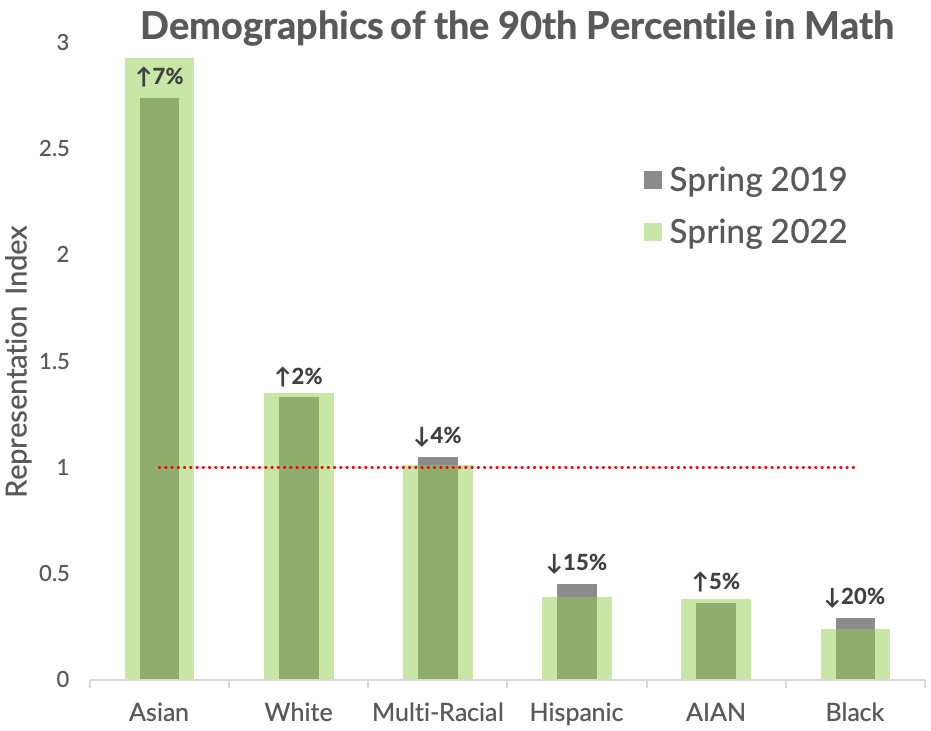
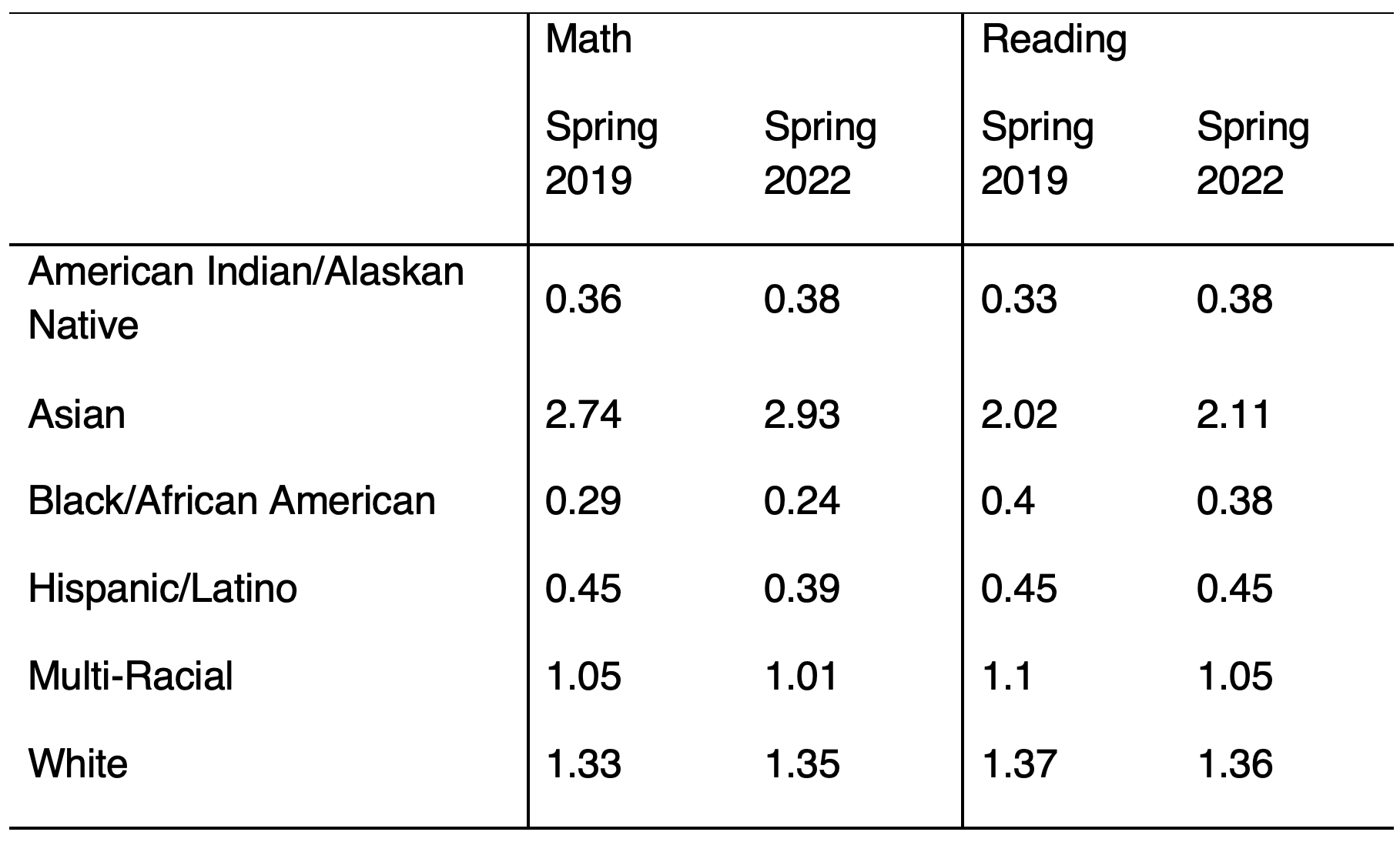
Given the decrease in overall student achievement, schools that make advanced learning program placement decisions in 2022–23 (and beyond) are likely to see smaller and less-equitable student populations compared to prior years. To test this hypothesis and quantify the change, we dove into third grade MAP data from spring 2019 and spring 2022. We wanted to know how the demographic profile of students meeting the 90th percentile threshold (as established in the NWEA norms) in spring 2019 compared to that of those who met the same threshold in spring 2022. To do so we relied on something called a representation index (RI), which is the proportion of students from a particular demographic group within the 90th percentile group divided by their proportion in the overall student population. For example, if White students were 50 percent of those who scored at or above the 90th percentile, but 40 percent of the overall student population, this would yield an RI of 1.25 (0.50/0.40) and signify proportional overrepresentation within the 90th percentile. Our analyses relied on data from roughly 1.5 million students who completed a MAP Growth test in spring 2019 or spring 2022. The math results are presented visually in Figure 1 with the specific RI values for math and reading at the end of the article in Table 1.

Figure 1. Change in the 90th percentile representation index in math by race/ethnicity, 2019 and 2022

f1

First, Figure 1 makes clear that even prior to the pandemic in 2019, there was already substantial inequity within the 90th percentile. For example, Table 1 shows Hispanic students were 45 percent as represented (RI = 0.45) as they were in the overall student population. Similarly, Asian students were 274 percent as represented as they were in the overall student population (RI = 2.74). Unfortunately, this only became worse after the pandemic. Figure 1 shows that, in spring 2022, the population of third grade students meeting the 90th percentile in math was less Black and Hispanic and more White and Asian than it was in Spring 2019. Black student representation decreased from a 2019 RI of 0.29 to a 2022 RI of 0.24—a drop of 20 percent. Hispanic students also become less represented—moving from an RI of 0.45 to 0.35 (a decrease of 15 percent). Meanwhile, White students (RI of 1.33 to 1.35) and Asian students (RI of 2.74 to 2.93) became even more overrepresented within the top 10 percent of math achievement. This trend was also present in reading (see Table 1) but was not as extreme as in math.

Importantly, just because fewer Black and Hispanic students scored at the 90th percentile does not mean they don’t need services. Talented students of color very much still exist, but because of the pandemic, the percentile their score represents is now lower. Consider a hypothetical student of color who would have scored at the 91st percentile, had Covid never happened, might now score at the 89th percentile. That’s a seemingly small change in the student’s achievement, but because they fell below a fixed threshold, they now don’t meet the criteria for a particular advanced learning opportunity and the small change becomes quite consequential, given many educational decisions are based on often-fixed, often-arbitrary percentile cut scores.

What does this mean for schools?

Around the country, K–12 gifted programs and exam-based high schools were already struggling with equity prior to the pandemic. A 2019 study found that students in the top 20 percent of socioeconomic status were identified as gifted at a rate of about 12 percent compared to just over 2 percent for their peers in the lowest 20 percent. Unfortunately, our analyses suggest that, when schools go to identify students for these opportunities in the 2022–23 school year, disproportional representation is likely to get worse. Although few advanced learning opportunities identify students solely based on a single data point (and we do not advise using MAP Growth scores alone to make such decisions), if our findings hold for other assessments and criteria, students of color will be identified for advanced learning opportunities at even lower rates than they were prior to the pandemic (and again, those were already very bad). Importantly, this is not something that is unique to any single test, nor does it represent a failure of any test. Instead, is it an artifact of a massive and unprecedented interruption in learning that was also experienced unequally by students from traditionally marginalized groups. Combined with the common practice of reliance on fixed and often inflexible cut scores for program admission, schools arrive at a perfect storm of inequity.

What should schools do?

One of the simplest ways schools could approach this challenge with an eye toward improving equity would to rely on district or school building norms to make such placement decisions using their most recent data. Conceptually, this means identifying students for advanced learning opportunities if they rank in the top X percent of students in their district or school as opposed to the top X percent of the nation. Doing so removes the influence of pre-Covid national norms from the equation, will make the proportion of students identified stable from year to year (and school to school), and will make the students identified more representative of the larger student population. School districts like New York City and Fairfax County (including Thomas Jefferson High School for Science and Technology), as well as the states of New Jersey and Illinois, have already implemented local normative criteria into their decision-making process prior to the pandemic. There are other conceptual and equity benefits to this practice, but their equity benefits alone make them worth considering.

Perhaps more importantly, schools should avoid the temptation to focus their Covid recovery efforts solely on minimal proficiency of grade-level standards. To be sure, struggling students require urgent intervention to recover from the pandemic. But ignoring the needs of advanced learners, particularly those of color or who are from low-income families, will only perpetuate pre-Covid inequalities in advanced learning opportunities. Instead, schools should see this as an opportunity to implement talent development activities that would mitigate these disparate rates of advanced achievement. Much attention is being paid to efforts to help students rebound from the pandemic. But if those efforts focus solely on rebounding to minimal proficiency, the worsening equity we describe above risks becoming a permanent fixture of American education.

Table 1. Representation indices for spring 2019 and spring 2022 by student subgroup

t1

Editor’s note: This was also published as a guest article in an edition of “Advance,” a newsletter from the Thomas B. Fordham Institute written by Brandon Wright, our Editorial Director, and published every other week. Its purpose is to monitor the progress of gifted education in America, including legal and legislative developments, policy and leadership changes, emerging research, grassroots efforts, and more. You can subscribe on the Fordham Institute website and the newsletter’s Substack.

view
iStock/Getty Images Plus/paulaphoto

Education Gadfly Show #851: The case for teaching writing in the age of ChatGPT, with Checker Finn

1.4.2023
Podcast
 

On this week’s Education Gadfly Show podcast, David Griffith talks with Checker Finn about why we should still teach writing in the age of ChatGPT, a new AI-powered bot that can mimic human prose. Then, on the Research Minute, Amber tells us about the challenges of implementing academic Covid recovery interventions.

Recommended content:

  • ChatGPT, the writing bot discussed in this episode
  • “Why learn to write?” —Checker Finn
  • “Artificial intelligence is not the end of high-school English” —Robert Pondiscio
  • “Did a fourth grader write this? or the new chatbot?” —New York Times
  • The study that Amber reviewed on the Research Minute: Maria V. Carbonari et al., The Challenges of Implementing Academic COVID Recovery Interventions: Evidence from the Road to Recovery Project, CALDER Working Paper (December 2022)

Feedback Welcome:

Have ideas for improving our podcast? Send them to our producer Nathaniel Grossman at [email protected].

view

Cheers and Jeers: January 5, 2023

The Education Gadfly
1.5.2023
Flypaper

Cheers

  • More young women are delaying motherhood until their 20s, which has helped to dramatically reduce America’s teen birth and child poverty rates in the past 30 years. —New York Times
  • Chapters of the NAACP are taking up the Science of Reading as a civil rights issue. —Hechinger Report
  • Roxbury Prep—a public charter school in Boston—is growing its own teachers with a 5–week summer fellowship for rising college seniors. —CommonWealth Magazine

Jeers

  • Indianapolis Public Schools is accused of denying a charter school network access to unused school buildings, a violation of state law. —Chalkbeat Indiana
  • School districts across the nation continue to grapple with student chronic absenteeism, more than a year after the return to in-person learning. —Wall Street Journal
view

What we're reading this week: January 5, 2023

The Education Gadfly
1.5.2023
Flypaper
  • ChatGPT—a bot capable of generating paragraphs of fluent writing—is causing headaches for teachers and professors on the lookout for plagiarism. —Washington Post
  • A study by a Stanford professor estimates that pandemic-era learning loss could cost students $70,000 in lifetime earnings. —Wall Street Journal
  • This game challenges you to guess whether an essay was written by ChatGPT or an actual child. —New York Times
Fordham Logo

© 2026 The Thomas B. Fordham Institute
Privacy Policy
Usage Agreement

National

P.O. Box 110
Burke, VA 22009

202.223.5452

[email protected]

Ohio

P.O. Box 82291
Columbus, OH 43202

614.223.1580

[email protected]

Sponsorship

130 West Second Street, Suite 410
Dayton, Ohio 45402

937.227.3368

[email protected]