Mobile Navigation

  • National
    • Policy
      • High Expectations
      • Quality Choices
      • Personalized Pathways
    • Research
    • Commentary
      • Gadfly Newsletter
      • Flypaper Blog
    • Events
    • Scholars Program
  • Ohio
    • Policy
      • Priorities
      • Media & Testimony
    • Research
    • Commentary
      • Ohio Education Gadfly Biweekly
      • Ohio Gadfly Daily
  • Charter Authorizing
    • Application
    • Sponsored Schools
    • Resources
  • About
    • Mission
    • Board
    • Staff
    • Career
Home
Home
Advancing Educational Excellence

Main Navigation

  • National
  • Ohio
  • Charter Authorizing
  • About

National Menu

  • Topics
    • Accountability & Testing
    • Advanced Education
    • Career & Technical Education
    • Charter Schools
    • Curriculum & Instruction
    • ESSA
    • Evidence-Based Learning
    • Facilities
    • Governance
    • Personalized Learning
    • Private School Choice
    • School Finance
    • Standards
    • Teachers & School Leaders
    • Think Again
  • Research
  • Commentary
    • Gadfly Newsletter
    • Flypaper Blog
    • Gadfly Podcast
  • Events
  • Scholars Program

The Education Gadfly Weekly

Sign Up to Receive Fordham Updates

We'll send you quality research, commentary, analysis, and news on the education issues you care about.
Thank you for signing up!
Please check your email to confirm the subscription.

The Education Gadfly Weekly: How not to read a book with students

Volume 23, Number 24
6.14.2023
6.14.2023

The Education Gadfly Weekly: How not to read a book with students

Volume 23, Number 24
view
High Expectations

How school systems can balance equity and excellence in their advanced education initiatives

One of the most important efforts in America today is making sure we have as large and diverse a group of academic high achievers as possible in order to meet tomorrow’s challenges. A new report released this week—Building a Wider, More Diverse Pipeline of Advanced Learners—offers three-dozen recommendations to education leaders and policymakers at all levels on how to accomplish this.

Michael J. Petrilli 6.14.2023
NationalFlypaper

How school systems can balance equity and excellence in their advanced education initiatives

Michael J. Petrilli
6.14.2023
Flypaper

CREDO got it wrong: Ohio’s charter sector is strong and getting better

Stéphane Lavertu
6.15.2023
Ohio Gadfly Daily

How not to read a book with students: A rebuttal to NCTE

Daniel Buck
6.15.2023
Flypaper

The policies, perceptions, and implications of open enrollment

Jessica Poiner
6.13.2023
Ohio Gadfly Daily

#874: How to build a continuum of advanced learning opportunities, with Nick Colangelo

6.14.2023
Podcast

Cheers and Jeers: June 15, 2023

The Education Gadfly
6.15.2023
Flypaper

What we're reading this week: June 15, 2023

The Education Gadfly
6.15.2023
Flypaper
view

CREDO got it wrong: Ohio’s charter sector is strong and getting better

Stéphane Lavertu 6.15.2023
Ohio Gadfly Daily
view

How not to read a book with students: A rebuttal to NCTE

Daniel Buck 6.15.2023
Flypaper
view
EdChoice OE analysis SR image

The policies, perceptions, and implications of open enrollment

Jessica Poiner 6.13.2023
Ohio Gadfly Daily
view

#874: How to build a continuum of advanced learning opportunities, with Nick Colangelo

Nicholas Colangelo, Michael J. Petrilli, Amber M. Northern, Ph.D., David Griffith, Ph.D. 6.14.2023
Podcast
view

Cheers and Jeers: June 15, 2023

The Education Gadfly 6.15.2023
Flypaper
view

What we're reading this week: June 15, 2023

The Education Gadfly 6.15.2023
Flypaper
view

How school systems can balance equity and excellence in their advanced education initiatives

Michael J. Petrilli
6.14.2023
Flypaper

The horrific murder of George Floyd and its aftermath led school districts nationwide to strengthen their racial-equity initiatives, which—in many places—included turning a skeptical eye on “gifted” education, honors courses, and selective high schools. Because those programs tend to serve a disproportionately low number of Black, Hispanic, and Native American students when compared with district-wide demographics, some advocates—and some elected officials—called for their elimination or complete overhaul.

That in turn led to a strong backlash in many quarters, including deep-blue communities such as New York, San Francisco, and the Washington, D.C., metropolitan area. In the City by the Bay, controversy over a policy to remove Algebra I from the district’s middle schools recently escalated into a lawsuit. In the Big Apple, Eric Adams won election as mayor on a plank that included a promise to rebuild the city’s advanced education programs. And just outside our nation’s capital, the decision to replace admissions tests with a merit lottery at the very selective Thomas Jefferson High School led a federal judge to rule that the new policies violated the Fourteenth Amendment to the U.S. Constitution’s guarantee of equal protection under the law. A U.S. Circuit Court panel has recently reversed this on appeal, however, and the Supreme Court may opt to have the final say.

Meanwhile, at the national level, the decisions in the Harvard and University of North Carolina affirmative action cases are expected from the Supreme Court any day now. The legal question is whether universities’ use of race-conscious admissions policies to diversify their student bodies violates the Fourteenth Amendment, as well as Title VI of the Civil Rights Act of 1964. The substantive question is how our diverse nation can ensure that its most prestigious postsecondary institutions are also diverse.

The National Working Group on Advanced Education was formed in Spring 2022 in response to all of this. Its twenty members, of which I am one, include researchers, practitioners, and advocates and represent diversity in terms of ideology, race, gender, and geography. Its purpose was to identify a set of recommendations for school districts, charter networks, and state leaders to use in better developing the talents of these high-ability students, with special attention devoted to students from racially underrepresented groups and low-income backgrounds.

A new report released this week—Building a Wider, More Diverse Pipeline of Advanced Learners—is a product of this work, and offers three-dozen recommendations to education leaders and policymakers at all levels.

We were not always of one mind on how best to further equity while sustaining and enhancing excellence. But where we all agree, and where we suspect most Americans also agree, is that the United States would be in a much better place if it had a robust and diverse pipeline of students prepared to do high-level academic work in high school and college. We believe that we must make sure that every child with the potential for high academic achievement is able to fulfill that potential, regardless of race or socioeconomic status.

Alas, that is not what we have today. The U.S. has been wasting a huge amount of human capital and squandering enormous amounts of human potential at the very moment we need more of it—and much of that wastage is among groups that have for far too long seen their opportunities limited and their potential squandered. We’re talking about bright students, advanced learners, striving pupils, and those with high but untapped potential—especially those who are Black, Hispanic, Native American, low income, or from otherwise marginalized backgrounds—whose educational needs aren’t being satisfactorily met by our schools. This needlessly limits what underrepresented students can learn and become, and causes the pipeline of high-achieving students to be narrower and less diverse than we need it to be if America is to be competitive, prosperous, secure, equitable, and democratic in these challenging times.

We know full well that closing America’s excellence gaps—the gaps between various racial and socioeconomic groups at the highest level of achievement—will not be easy. Like the more-often-discussed achievement gaps, excellence gaps are apparent the minute students enter kindergarten, arising from sharp disparities in children’s experiences from birth to age five. Yet they continues to widen as students progress through school.

Addressing these challenges is going to take work at every level, but most of the action is local. And leaders have a good chance of effecting real change if they keep three overriding principles in mind:

  • Build a continuum of advanced learning services, customized to individual students, rather than a binary “you’re in or you’re out” mindset. Just as students with disabilities need customized plans that are reevaluated periodically, so do students who can benefit from advanced learning opportunities. Skipping two grade levels might be right for one student; achievement grouping might be a better choice for another. As a student’s talents are developed, their need for more advanced programming may grow. The goal is to find the right fit for the needs of each child, continually evaluate what’s working and what’s not, and modify services according to students’ demonstrated need on an ongoing basis.

  • Embrace inclusion, remove barriers, and reject the scarcity mindset. If our goal is to build a wider, more diverse pipeline of high achievers, we need to be more welcoming to students on the bubble. While advanced learning opportunities imply some level of selectivity, look for reasons to include students in such learning opportunities, rather than excuses to keep them out. And do so at every grade level; never stop looking for students who could benefit from advanced learning. That, in turn, will require creating more seats—in “gifted and talented” programs, honors and advanced courses, selective high schools, and beyond. Instead of arguing over how to ration a scarce resource among the many who seek and could benefit from it, our goal is to make it more widely and equitably available.

  • Cultivate school-wide support for advanced learning opportunities for all students. Advanced education should not be thought of as a siloed, one-off activity administered to a select few; it should be woven throughout a school’s culture, professional development, curricular choices, and data analysis.

We know from experience and from research that schools could do many things to narrow excellence gaps, things that they’re not doing or not doing nearly enough of. We are leaving many effective tools in the toolbox. Here’s the good news: The Working Group’s experts believe that if districts and charter networks embrace the recommendations in our report and then implement them intentionally, rigorously, and consistently, we can expect to see a noticeable increase in the size and diversity of the pipeline of students ready for and succeeding with advanced content. This in turn should lead to the kind of advanced learning that results in greater economic security and personal fulfillment for the student, as well as economic prosperity and growth for the nation.

Ignoring the excellence gaps in our schools is not a path to activating all the talent our nation needs, but neither is eliminating advanced learning opportunities on grounds of equity. We must support students whose talents are easily recognizable and create environments where we can seek out those students whose talents are not yet tapped. Equity, done right, includes opening up advanced education to all students who could benefit from it. And excellence, done right, includes doing the hard work to help all students achieve at high levels—not just the students who come to school with great advantages.

You, dear reader, are part of an important movement, perhaps one of the greatest efforts in America today: the work to make sure we have as large and diverse a group of academic high achievers as possible in order to meet tomorrow’s challenges. Let’s not stop until it’s done.

This essay is adapted from Building a Wider, More Diverse Pipeline of Advanced Learners: The Final Report of the National Working Group on Advanced Education.

view

CREDO got it wrong: Ohio’s charter sector is strong and getting better

Stéphane Lavertu
6.15.2023
Ohio Gadfly Daily

NOTE: The Thomas B. Fordham Institute occasionally publishes guest commentaries on its blogs. The views expressed by guest authors do not necessarily reflect those of Fordham.

Charter schools are publicly funded but independently operated schools that serve students in grades K–12. Despite receiving far less funding than traditional public schools, they’ve significantly improved the educational options for Ohio families, many of whom lack the financial means to leave ineffective district schools. Indeed, on average, brick-and-mortar charters’ educational benefits are substantial—particularly for students from low-income households.

That’s not my opinion—it’s based on objective data analysis. Using rigorous statistical methods, my 2020 analysis of Ohio’s charter schools indicated that students attending brick-and-mortar charters between 2016 and 2019 were way better off than they would have been had they attended district schools. They learned more each year, were less likely to be absent, and were less likely to be suspended—all because they attended a charter school instead of a nearby district school. These effects were large, implying that students would receive the equivalent of an extra year’s worth of learning (180 days!) if they attended charter schools instead of their district schools from grade four to grade eight. The gains were largest for Ohio’s Black and Hispanic students.

Unfortunately, a false narrative about Ohio’s charter schools can emerge when one presents the data the wrong way. Recently, Education Week reported on a new study by CREDO, based on 2015–2019 data across thirty-one states, which found that charter schools across the nation generally outperformed traditional public schools. But the study also stated that Ohio charter students lost ground in math compared to otherwise similar students attending nearby district schools. Even worse, the article stated “Ohio charter schools saw the largest drop” in mathematics achievement (relative to nearby district schools) among the states in the study.  Subsequently, The Center Square, an Ohio statehouse news outlet, used those results to build a case against funding school choice in Ohio.

How on earth could CREDO come to that conclusion? After all, like my study, CREDO uses rigorous statistical methods that compare the learning rates of charter students to those of similar students in the same district (students with the same baseline achievement, same demographic characteristics, similar household income, and so on). We also use the same dataset. Did one of us make some sort of coding error when running our statistical models?

There are two reasons that CREDO’s report makes it look as if Ohio’s charters are doing poorly relative to charters in other states. First, while they include students attending brick-and-mortar charter schools in their analysis, they combine those brick-and-mortar charter students with students who learned remotely via online schools, as well as those who attended specialized schools (such as “dropout-recovery” schools for at-risk kids and schools that serve almost exclusively students with disabilities). Unfortunately, lumping all these schools together obscures the strong results of Ohio’s brick-and-mortar charter schools. Second, their estimates are based on averaging effects across five years (2015–2019) and do not capture the substantial improvement in Ohio’s charter sector during that time span—following Ohio’s major regulatory reforms that greatly increased the accountability for charter schools. I address each of these important problems in turn.

Online charters

The pandemic made clear to everyone—particularly parents and teachers—that online schooling is tough. Prior research has long shown that students tend to learn far less when schooling occurs online—particularly those who lack the proper supports at home. Parents often have very good reasons to enroll their kids in online schools. Perhaps their kids were bullied. Or perhaps the local district school is too far away or does not offer the curriculum they need. But the tradeoff is that most students learn much less online, particularly in mathematics. And because all online schools were technically “charter schools” during their period of study, CREDO’s analysis must compare the achievement of students in online charter schools to the achievement of students attending district schools in person. When doing so, they find that online charter students nationally lose an equivalent of fifty-eight days per year of learning in reading and 124 days in math. States with relatively large enrollments of online students would, therefore, appear worse when they are included in such an analysis.

And that’s exactly what CREDO found. For example, of the nine states they list as top performers for posting superior gains in math and reading, five don’t allow online charter schools (Massachusetts, New Jersey, New York, Rhode Island, and Tennessee). Of the two states where charters have negative impacts in math—Ohio and South Carolina—both have by far the highest share of online enrollments (more than double the average rate of online schooling across all states in CREDO’s sample). In addition to the 25 percent of Ohio charter students attending online schools and the approximately 60 percent attending brick-and-mortar schools providing a general education, Ohio’s remaining 15 percent of charter students in 2019 attended a school that caters primarily to students with special needs. Again, in CREDO’s study, these charter schools are compared to regular district schools, but it’s not quite clear whether that’s an appropriate comparison.

There is no doubt that comparing Ohio (with lots of online charter students) to, say, Massachusetts (with no online charter students) creates a false impression about the relative effectiveness of their charter sectors. And Dr. Raymond, CREDO’s director, knows it. The Education Week article states “Data from the online schools drag down the average performance for students in all charter schools, Raymond said.” So why combine students across sectors? Why not create a more apples-to-apples comparison across states? Why not compare Massachusetts brick-and-mortar schools to Ohio’s brick-and-mortar schools, for example? That would provide clearer insight into how the schools that most families consider an option for their children perform from state to state. As noted above, Ohio’s brick-and-mortar charters would likely stack up well against other locales.

Annual improvements

Even if you agree with CREDO that online and in-person schools should be combined,[1] CREDO’s analysis is still misleading. That is because CREDO’s analysis generates estimates based on data pooled across 2015–2019. Any improvements in a state’s charter sector that occurred during that span would be obscured—weighed down by the lower quality of the sector in early years.

That’s particularly problematic for Ohio. In 2015, the Ohio General Assembly enacted a rigorous set of reforms that greatly increased accountability for charter school authorizers (called “sponsors” in Ohio); included provisions that sought to improve online charter schools and the financial management of all charters; and required more transparency around the practices of charter operators—the organizations that many Ohio charter school boards contract with to run their schools.

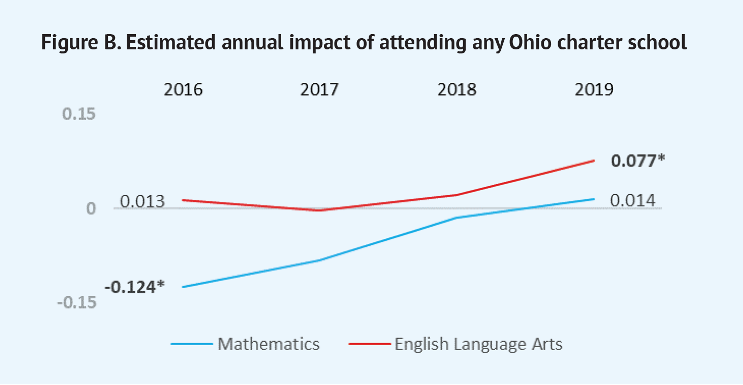
Ohio arguably went from having one of the least-regulated charter sectors in the nation to having a far more accountable sector. From 2015 to 2019, dozens of low-performing schools and operators were shut down, and the better ones remained, leading to a dramatically improved overall charter sector. The figure below—drawn from my 2020 report—documents this improvement in annual learning among all Ohio charter students (both brick-and-mortar and online schools).

1

The figure indicates that, in 2016, charter students learned far less math annually than similar students in their district schools (0.124 standard deviations less). That effect is as if students had received seventy-two fewer days of instruction annually than if they had attended their local district school. Averaging estimates across 2016–2019, the charter school disadvantage is equivalent to about thirty-two fewer days’ worth of learning in mathematics annually. That is just slightly different than the thirty-eight fewer days of annual learning that CREDO estimated across 2015–2019.

Yet we care much more about 2019 than 2015. In 2019—across all charter students (including the online and special education students)—students in Ohio’s charter schools had, on average, the equivalent of forty-five extra days’ worth of learning in English language arts (a 0.077 standard-deviation gain). And, though not statistically significant, it appears they also gained eight extra days’ worth of learning in mathematics. Those results are masked when the data are combined across multiple years.

There is much to admire about CREDO’s latest report. The statistical methods are rigorous; it provides a wealth of information (including estimates of the quality of specific charter management organizations and school networks); and the general take-home point, that charters across the nation are improving and that they provide an important alternative to traditional district schools, is welcome. I also don’t doubt that Dr. Raymond’s inclusion of both online and in-person students comes from a good place—a concern that we should ensure that charters serve all students well. But the lack of attention to Ohio’s context is careless and needlessly perpetuates a false narrative. Upon closer inspection, we see that Ohio’s brick-and-mortar charters are strong performers—and getting better.


[1] After all, the achievement of students in online schools, as well as the achievement of at-risk students, is just as important as the achievement of students attending brick-and-mortar charter schools in person. Improved test scores in math and English language arts are strong predictors of students’ future income and wellbeing, and they are predictors of economic growth—affecting us all.

view

How not to read a book with students: A rebuttal to NCTE

Daniel Buck
6.15.2023
Flypaper

An academic trifle to most, literary theory is a deceptively consequential issue in American education. In English classrooms, students are supposed to encounter great works of literature, sharpening and honing their own view of the world. And so it matters not just what books we choose to read with students, but how we read them.

The National Council of Teachers of English recently released a policy brief titled Culturally Responsive Approaches to the Teaching of Literature in Secondary English Classrooms. In it, they at once criticize traditional approaches to literary theory and espouse “critical theory,” a progressive, postmodern approach to reading. In each case, “regardless of the text,” the brief encourages teachers to “model and instruct students on how to read through a critical lens across a range of literary theories (e.g., postcolonial criticism, Black feminist criticism, Chicana feminist criticism).”

This approach is fundamentally flawed. Where it asks students to read through a “lens,” critical theory proves to be a muddied, distorted one. At best, it’s a literary parlor trick, encouraging books to chirp and squawk about themes their authors never intended. At worst, it’s a nefarious little way to slip political, even radical ideas into the English classroom, where they have no place.

Broadly speaking, there are three dominant literary theories. “Traditional theory”—under which falls New Criticism, formalism, and other subcategories—sees literature, even fiction, as definitive statements to be unearthed. A book means what it means. A more popular approach, and arguably the approach most common within the general population, is reader-response theory: A book means what it means to you; our own subjective perceptions matter most. Finally, critical theory treats a book more as a cultural artifact, reflective of the worldviews and “systems of oppression” in which it exists.

In short, traditional theory allows a book to speak to the reader, emphasizing the text itself. Reader-response prizes our own interpretations, emphasizing the person reading the book. Critical theory forces an interpretation onto any text, emphasizing a progressive view of the world.

Within the broader critical theory are various “lenses” through which readers can interrogate a book—feminist, Freudian, Marxist, critical race, anti-racist, post-colonial, and plenty more. In each case, what a text actually has to say matters less than what it reveals about oppression in society, be it racial, gendered, or even subconscious in origin.

Thus, were students to read Romeo and Juliet through a feminist lens, gone would be Shakespeare’s varied perspectives on love—Friar Laurence’s religious idealism, Romeo’s passion, or Mercutio’s flippancy—or the Bard’s pessimistic fatalism, as man is powerless before the whims of the Gods or strictures of society. Instead, this play becomes a story of gender oppression and class conflict. These are important discussions, surely, but the story then repeats itself with Hamlet, Sherlock Holmes, or any other work of literature.

T.S. Eliot, a seminal figure of New Criticism, believed that the ideal author removed himself and his emotions from his work to present to the reader ideas themselves. Books are more than a cultural artifact. They are almost arguments to be considered. Dostoyevsky forces readers to reckon with the haunting emptiness of a Godless world. Orwell presents the horrors of authoritarian governments and the covert ways in which they poison a society. Wordsworth lauds the salutary effects of nature and man’s corruption of man.

Conversely, critical theory acts like a photo filter, distorting and coloring every book until each text displays much the same message no matter the author’s original intent.

The NCTE statement rightly champions literature because it “presents students with various ethical systems, moral perspectives, and literal and figurative worlds that expand and deepen students’ awareness and imagination.” For healthy identity development, adolescents need to play around with ideas—beliefs about everything from gender to God, their own possible life trajectories, and more. Traditional theories accomplish these goals. Critical theory muffles the voice of the author, encourages deconstruction, and where it provides alternatives, it is almost cultish in its repetition of one message over and again. There is no consideration of “various ethical systems,” but a deconstruction of all and subsequent presentation of one progressive system.

The policy brief is light on concrete application and recommendations. It laments the “top-down” nature of traditional theory and gestures at the supposed ability of critical theory to disrupt and deconstruct various power relations. The brief lists a few example units built upon critical theories: comics-style essays for final projects, watching documentaries about current events, using Taylor Swift songs and Beauty and the Beast to “analyze toxic masculinity in The Great Gatsby.” Hardly a stirring call for a rigorous English classroom.

This is not to suggest that feminism, racism, colonialism, or other such themes have no place in the classroom. These are important discussions and debates that have shaped our country. But teachers and curriculum developers ought to select books and texts that have something definitive to say about them, such as “Letter from Birmingham Jail” or Beloved rather than forcing such messages from books selected at random. But if you’re reading Romeo and Juliet through a feminist lens, you’re doing it wrong.

view
EdChoice OE analysis SR image

The policies, perceptions, and implications of open enrollment

Jessica Poiner
6.13.2023
Ohio Gadfly Daily

This spring, the national education nonprofit EdChoice published a “capstone” report outlining a series of research projects it conducted alongside Hanover Research. The report focuses on open enrollment, a school choice model that allows students to attend public schools other than the one they’re assigned to by their district of residence. As implied by the “capstone” designation, the report offers a sweeping look at open enrollment across the nation, including literature reviews of participation and impacts, detailed case studies of four states (Arizona, Florida, Indiana, and Ohio), and several policy implications.

The report’s introduction offers some important context. It notes that, over the last few decades, public education has experienced a gradual shift away from assigned public schools and toward allowing parents to actively choose a school for their child. This shift has been hastened by “multiple forces,” including growing participation, public support, and innovation in school choice programs. The pandemic also played a part, as it left many parents dissatisfied with their assigned schools and searching for other options. Among the choice options available in most states are charters, magnet schools, virtual schools—and open enrollment.

There are two forms of open enrollment: intra-district, which allows students to transfer from one school to another within their resident district; and inter-district, which allows students to attend a school in a district other than the one in which they live. The first ever statewide open enrollment bill was passed in Minnesota in 1988, and forty-three states now have similar laws. A whopping 86 percent of the nation’s public school students now live in states with inter-district choice programs, and 41 percent live in states where offering open enrollment is mandatory (at least in some cases). Meanwhile, twenty-one states require districts to offer intra-district choice, and seven others have laws that allow districts to choose to participate. At the local level, an increasing number of large urban districts are eliminating attendance zones in favor of intra-district choice programs characterized by unified enrollment systems and a common application for families. And although nailing down participation numbers is tricky, the report suggests that the percentage of public school students participating in inter- or intra-district choice programs could be as high as 3.5 million students, or 7 percent—on par with the number in charter schools.

As for impacts, the report notes that different studies draw different conclusions. This is not surprising, given that policies are distinctive from state to state and district to district. Nevertheless, the report identifies several important conclusions. First, most parents cite school quality as their primary reason for choosing open enrollment, followed closely by school safety and environment, and then proximity to work, home, and daycare. Second, there is a tendency for students from poorly resourced, low-performing schools to transfer to well-resourced, high-performing schools. For example, a 2015 Michigan study found that historically disadvantaged students were most likely to request inter-district transfers, and an analysis from Wisconsin found that low-income districts experienced the highest rates of outmigration. Third, some studies identified evidence of higher academic achievement (Fordham’s 2017 study of Ohio’s program certainly did), while others found achievement to be unchanged or lower. Fourth, students and parents tend to express high rates of satisfaction with their new schools, though parents seem less than thrilled when it comes to transportation (more on this later). Finally, although some studies find that open enrollment policies can result in “greater stratification” by socioeconomic status and race, others find that open enrollment can actually increase diversity in receiving districts. (In Ohio, a 2021 Fordham study found that inter-district open enrollment had virtually no effect on segregation across districts or at the school level.)

The report also offers a more in-depth look at the inter-district open enrollment policies in four states—Arizona, Florida, Indiana, and Ohio. Although each case study is worth a read in its own right, here are a few overarching takeaways.

1.) Arizona and Florida have the least restrictive open enrollment policies. Both states require all public districts to adopt inter- and intra-district policies, which result in widespread school choice options for families. In Florida, districts and charter schools must develop and adopt an open enrollment plan, and they must also define their capacity and clearly post it on their websites.

2.) Indiana and Ohio have more restrictive open enrollment environments for students because districts may opt-out of inter-district open enrollment. Although districts in Indiana and Ohio get to choose whether to accept non-resident students, both states outline certain instances when a district is required to allow inter-district open enrollment. Indianapolis Public Schools, for example, is required to accept both inter- and intra-district transfers.

3.) Transportation is a huge barrier. In all four states, parents and guardians are largely responsible for getting their kids to their chosen school. Unsurprisingly, this can cause a lot of headaches for families.

4.) Although open enrollment can cause equity and access issues, states with voluntary inter-district policies struggle most. In Ohio, most of the affluent and suburban districts that surround the state’s eight major cities refuse to participate in open enrollment. As a result, “public perception generally perceives these suburban districts to be intentionally preventing students from nearby urban centers from enrolling” and therefore “barring access to high-quality education.” Meanwhile, in Indiana, districts were previously allowed to accept or deny students based on criteria like academic achievement, discipline records, and test scores. When a 2013 law prohibited them from continuing to do so, many districts opted to just stop accepting open enrollment transfers.

To accompany this literature review, Hanover conducted in-depth interviews with several district administrators. According to interviewees, open enrollment has positively impacted families and students alike. They reported feeling competitive pressure and often referenced the need to “retain market share” by attracting students from nearby counties. They also noted that many schools have created new or improved existing programs in an effort to retain students, and that districts are consistently using marketing and communication strategies to reach families outside their traditional boundaries. Every interviewee mentioned that open enrollment can make maintaining a “cohesive district system” difficult, not just because these policies can challenge community ties or change neighborhood school identities, but also because fluctuations in demand require constantly managing resources and capacity.

To close, the report covers several policy implications. At the state level, there are five. First, all inter- and intra-district choice programs should be mandatory for school districts. Second, state leaders should consider addressing transportation barriers within policy frameworks, perhaps by reimbursing parents for transporting their children or establishing conveniently located satellite bus stops. Third, open enrollment should be offered to all students, without them needing to meet certain criteria. Fourth, funding flexibility is crucial, as many state funding formulas aren’t designed to permit students to transfer between districts without creating financial disincentives. And finally, if state leaders opt to include capacity provisions, then parents must be able to easily find which schools have open seats. Arizona, Florida, and Oklahoma all require districts to post their open seats by school, grade level, and program, and to update those numbers periodically.

Implications were also included for districts (administrators must remember that transportation can be highly influential, and that school culture and academic programming matter to students), researchers (we need to better understand the potential connection between open enrollment and student achievement), and advocates (identifying and promoting solutions for transportation woes would be huge).

All things considered, it’s clear that open enrollment is a great option for millions of American families. Access to that option, however, largely depends on where a family lives and what school they want to send their child to. There are steps that policymakers, district leaders, and advocates can take to make open enrollment more accessible to more families. But report author Susan Pendergrass says it best: “Equality of opportunity comes not from trying to level the playing field between bureaucratic institutions, but from circumventing the institutions and empowering those whom they serve.”

Source: Susan Pendergrass, “Breaking Down Public School District Lines: Policies, Perceptions, and Implications of Inter-District Open Enrollment,” EdChoice (March 2023).


view

#874: How to build a continuum of advanced learning opportunities, with Nick Colangelo

6.14.2023
Podcast
 

On this week’s Education Gadfly Show podcast, Nick Colangelo of the University of Iowa joins Mike Petrilli and David Griffith to discuss the recommendations in the new report from the National Working Group on Advanced Education. Then, on the Research Minute, Amber discusses a California study that investigates how within-school differences in school quality contribute to educational achievement gaps.

Recommended content:

  • The National Working Group on Advanced Education’s new report: “Building a Wider, More Diverse Pipeline of Advanced Learners”
  • “The case for gifted education” —Brandon L. Wright
  • “Research Deep Dive: What we know about gifted education”—Michael J. Petrilli, Jonathan Plucker, and Amber M. Northern, Ph.D.
  • “Because equity” is not a good reason to lower standards” —Michael J. Petrilli
  • The study that Amber reviewed on the Research Minute: Matthew Naven, Within-School Heterogeneity in Quality: Do Schools Provide Equal Value Added to All Students?, Annenberg Institute at Brown University (May 2023)

Feedback Welcome:

Have ideas for improving our podcast? Send them to Jeanette Luna at [email protected].

view

Cheers and Jeers: June 15, 2023

The Education Gadfly
6.15.2023
Flypaper

Cheers

  • “Unbundling” isn’t just for parents. Education systems can do it too by rethinking and revising “the many roles, responsibilities, and tasks that schools have bundled together.” —Rick Hess
  • “Ellen Register teaches in Grady County [Georgia], on the Florida border, where teachers are in year two of Science of Reading training. She said she was shocked the material was new to her. ‘Because I have a master’s degree, I have a reading endorsement, and I didn't even know all of this.’” —NPR

Jeers

  • “Some families say that New York City schools are making unfounded reports to child protective services in retaliation against parents of disabled children who advocate for their children's educational needs.” —Reason
  • Schools are struggling not only with students’ chronic absenteeism, but teachers’, as well. —USA Today
view

What we're reading this week: June 15, 2023

The Education Gadfly
6.15.2023
Flypaper
  • Centrists can reboot education reform. —Liam Kerr
  • Passing legislation is only the start of the challenges to implementing universal ESAs successfully. —Education Next
  • Former school principal and state senator Mike Johnston wins Denver’s mayoral election. —Chalkbeat
  • Reforms at twenty-nine “high-priority, high-needs” Houston schools will include cameras in the classrooms and higher teacher pay. —Houston Public Media
  • In California, homeschooling rates remain 70 percent above pre-pandemic rates. —The Mercury News
Fordham Logo

© 2026 The Thomas B. Fordham Institute
Privacy Policy
Usage Agreement

National

P.O. Box 110
Burke, VA 22009

202.223.5452

[email protected]

Ohio

P.O. Box 82291
Columbus, OH 43202

614.223.1580

[email protected]

Sponsorship

130 West Second Street, Suite 410
Dayton, Ohio 45402

937.227.3368

[email protected]