Mobile Navigation

  • National
    • Policy
      • High Expectations
      • Quality Choices
      • Personalized Pathways
    • Research
    • Commentary
      • Gadfly Newsletter
      • Flypaper Blog
    • Events
    • Scholars Program
  • Ohio
    • Policy
      • Priorities
      • Media & Testimony
    • Research
    • Commentary
      • Ohio Education Gadfly Biweekly
      • Ohio Gadfly Daily
  • Charter Authorizing
    • Application
    • Sponsored Schools
    • Resources
  • About
    • Mission
    • Board
    • Staff
    • Career
Home
Home
Advancing Educational Excellence

Main Navigation

  • National
  • Ohio
  • Charter Authorizing
  • About

National Menu

  • Topics
    • Accountability & Testing
    • Advanced Education
    • Career & Technical Education
    • Charter Schools
    • Curriculum & Instruction
    • ESSA
    • Evidence-Based Learning
    • Facilities
    • Governance
    • Personalized Learning
    • Private School Choice
    • School Finance
    • Standards
    • Teachers & School Leaders
    • Think Again
  • Research
  • Commentary
    • Gadfly Newsletter
    • Flypaper Blog
    • Gadfly Podcast
  • Events
  • Scholars Program

The Education Gadfly Weekly

Sign Up to Receive Fordham Updates

We'll send you quality research, commentary, analysis, and news on the education issues you care about.
Thank you for signing up!
Please check your email to confirm the subscription.

The Education Gadfly Weekly: How to hire a school superintendent

Volume 26, Number 14
4.9.2026
4.9.2026

The Education Gadfly Weekly: How to hire a school superintendent

Volume 26, Number 14
view
Empty classroom desk
High Expectations

How to hire a school superintendent

Hiring a superintendent is the most important decision a school board makes. Superintendents are not just the district’s CEO. They are (or ought to be) the de facto chief academic officer, responsible for setting the instructional direction of the system.

Robert Pondiscio 4.9.2026
NationalFlypaper

How to hire a school superintendent

Robert Pondiscio
4.9.2026
Flypaper

The high school pathways that boost adult earnings

Aaron Churchill
4.9.2026
Flypaper

A school choice zealot’s case for neighborhood schools

Andy Smarick
4.9.2026
Flypaper

Another deep dive into estimates of economic returns to education

Jeff Murray
4.9.2026
Flypaper

AI in schools: Promise or pitfall? | Episode 1012 of The Education Gadfly Show

4.2.2026
Podcast
view
Path arrows

The high school pathways that boost adult earnings

Aaron Churchill 4.9.2026
Flypaper
view
Kids boarding a school bus

A school choice zealot’s case for neighborhood schools

Andy Smarick 4.9.2026
Flypaper
view
Chalkboard arrow

Another deep dive into estimates of economic returns to education

Jeff Murray 4.9.2026
Flypaper
view

AI in schools: Promise or pitfall? | Episode 1012 of The Education Gadfly Show

Jean-Claude Brizard, Michael J. Petrilli, David Griffith, Ph.D., Amber M. Northern, Ph.D. 4.2.2026
Podcast
view
Empty classroom desk

How to hire a school superintendent

Robert Pondiscio
4.9.2026
Flypaper

The school district in the upstate New York town where I live and pay taxes—and where I ran unsuccessfully for the local school board a few years ago—is beginning a search for a new superintendent. I’m not on the board, and the voters made clear they preferred it that way. But the changing of the guard has me thinking about what I would do if I were in the board members’ position.

Hiring a superintendent is the single most important decision a school board makes. The chief executive officer of a school district, the supe is responsible for overseeing operations, managing personnel and budgets, implementing board policies, and ensuring the effective administration of schools. He or she shapes not just policy but the daily experience of students and teachers for years to come. And given how frequently superintendents come and go—often before their ideas have time to take root (or get revealed as ineffective)—the real challenge is not simply choosing the right person, but creating the conditions for durable success.

In my recent writing on durable school success, I’ve argued that the rare school systems that improve and remain high-performing share a few common traits: coherence, focus, and the ability to resist the constant pressure of change for change’s sake. Thus, leadership churn is one of the greatest threats to durability. The onus is on school boards to ask not just, “Who should we hire?” but “How do we create conditions for the new superintendent to create or sustain success?”

A good place to start is by asking better questions.

Hire for the job you actually need done

Most superintendent searches begin with a generic profile: visionary leadership, strong communication skills, commitment to equity. A better approach is to begin with the district’s actual problems:

What are the three or four issues that must be solved in the next five years? What would success look like by the end of the new superintendent’s contract? Improving early literacy? Stabilizing staff turnover? Bringing coherence to curriculum and instruction? Superintendents should be hired to solve specific problems, not simply to “lead.”

Ask about execution, not vision

Education rewards charismatic figures who can talk compellingly about change. School districts need people who have actually delivered it. Ask candidates: What initiative did you lead that measurably improved student outcomes? What did you stop doing when it wasn’t working (and how did you know)?

The gap between announcing a reform and implementing it is vast, and the classroom is where ideas—good, bad, and mediocre—go to die. These questions force candidates to move beyond bromides and homilies and into the mechanics of implementation.

Rage against the initiative machine

One of the most common, yet least discussed, features of school systems is initiative churn. Programs appear, disappear, and reappear either rebranded or in slightly different forms. Teachers adapt to one set of expectations only to be told shortly thereafter that the district is moving in a new direction.

Ask candidates: What did you say “no” to in your last district? How do you prevent mission creep or initiative overload? Stability rarely comes from discovering the perfect new program; it comes from protecting the ones that already work.

Test their understanding of teaching

A simple but revealing question: What does a strong lesson look like? Follow-ups might include: What is the hardest part of teaching well today? What professional development have you led, seen, or approved that actually helps teachers improve?

A candidate who cannot answer these questions concretely is unlikely to improve classroom practice in the district.

Focus on the instructional core

Raising student achievement is not one priority among many. It is the work of a school system and defines a quality district. Everything else—operations, facilities, communications, politics—is in service of that goal or a distraction from it.

Superintendents are not just the district’s CEO. They are (or ought to be) the de facto chief academic officer, responsible for setting the instructional direction of the system: establishing priorities, selecting and implementing curriculum, ensuring coherence across schools and grade levels, and aligning resources—time, money, and people—around improving teaching and learning. That level of granularity might sound unnecessary, even naïve. It’s worth keeping in mind that, while our education debates are often framed around large urban districts, they are statistical outliers: The typical district is far smaller—one reason governance and leadership look or should look very different in most of the country. Even in small to medium-sized districts, the superintendent’s role is unavoidably political. But politics is not the purpose of the job. Improving teaching and learning is—and even in the largest systems, instructional savvy is indispensable to getting it done. So boards should press candidates directly:

  • What role should a superintendent play in selecting curriculum?
  • How do you ensure that adopted materials are actually used well in classrooms?
  • How do you balance teacher autonomy with the need for instructional coherence?
  • What evidence do you rely on when evaluating instructional practices?

And perhaps most revealing:

  • What would you do if you discovered that classroom instruction across your district was inconsistent or ineffective?

In a well-run district, everything points back to the classroom. And the superintendent is ultimately responsible for making sure it does. A candidate who sees curriculum as merely a procurement exercise or instruction as something best delegated to teachers is unlikely to move the needle on student outcomes. He or she understands that, while they do not teach children directly, they shape the conditions under which teaching happens.

In part, that means protecting teachers’ time. Dylan Wiliam often observes that when teachers are asked to identify something that they will stop doing or do less of to create time and space to improve their teaching, they fail miserably, concluding that everything they do contributes to student learning. “The essence of effective leadership is stopping people from doing good things to give them time to do even better things,” he wrote.

Probe governance and temperament

Even capable superintendents fail when the relationship with the school board breaks down. Boards should ask: How do you handle disagreement with a school board? How do you manage political pressure from the community?

The job is inherently public and often contentious. Temperament—calm under pressure, intellectual humility, and a willingness to play the long game—matters more than many boards realize.

Why this job?

Finally, I’d ask “Why do you want to lead this district?”

A serious candidate will demonstrate familiarity with the community and its challenges. As with any job, a weak candidate will offer a generic answer that could apply anywhere.

Hiring a superintendent is the most important decision a school board makes. But it is not a one-time event. It is the beginning of a relationship that will either enable or undermine long-term success.

The lesson of durable success is not that schools need better ideas. It’s that they need the discipline to stick with good ones long enough to matter.


view
Path arrows

The high school pathways that boost adult earnings

Aaron Churchill
4.9.2026
Flypaper

It’s not often that a conservative education secretary and a progressive teachers union boss see eye to eye. But such a convergence occurred last year, when Secretary Linda McMahon told a congressional committee that a “four-year college is not for everyone” and, a few months later, President Randi Weingarten of the American Federation of Teachers said almost the same thing in The New York Times. Rather than continuing to push a “college for all” approach, both voiced support for stronger career and technical education to help more young people transition from high school to the workforce.

With bipartisan support from many governors and legislators, career and technical education has also risen on state policy agendas. Leaders have promoted industry-recognized credentials as a tool to validate students’ technical skills and to aid transitions into the workforce. In Ohio, such credentials are used in three principal ways: (1) Students can use them to meet alternative high-school graduation requirements; (2) schools receive credit on the state report card when students earn them; and (3) schools receive extra state funding (currently up to $725 per credential) through the Innovative Workforce Incentive Program (IWIP).

For graduation and report-card purposes, Ohio has approved an expansive list of 693 credentials tied to jobs in 13 career clusters (e.g., agriculture, business, and healthcare). These credentials include anything from basic CPR and job-safety certificates to full occupational licenses. The state’s IWIP credentials are more selective—focusing on fields like IT and advanced manufacturing. Today, just 210 credentials qualify for these funds. Due to this trio of policies encouraging credentials, student participation and attainment have soared: 26 percent of Ohio’s class of 2024 earned credentials during high school, whereas just 2 percent of the class of 2014 did so.[1]

But how beneficial are such industry credentials for those obtaining them in high school? This is a critical question that state policymakers are wrestling with, though few studies have shed light on their value. A prior Fordham Institute report found that credential earning in Texas was associated with modest wage increases in the year immediately after high school; another study, from Florida, linked credentials to college attendance.

Fordham’s new study, College or Career Readiness? Postsecondary and Labor Market Outcomes for Ohio High School Students Earning Industry-Recognized Credentials, is the first from Ohio to examine industry credentials, and alongside a recently published report from Texas, is one of the first nationally to study how they relate to students’ longer-term outcomes. Author Jay Plasman of Ohio State University focuses on postsecondary education and labor market outcomes for students in the high school classes of 2016 to 2022, a span of time that covers cohorts affected by the state’s early rollout of credential policies.

Here are Dr. Plasman’s main findings:

1. Credentials typically provide students with an income boost right after high school, but wage returns weaken over time. In the year immediately after high school, students who earn an industry credential have an average annual income that is 21 percent higher than their non-credential-earning peers of similar demographic and academic backgrounds. However, the wage return on a credential falls to just 5 percent by the time (former) students reach their mid-twenties. That diminution may be partly due to students (without credentials) earning college degrees. It’s also possible that some credentials help young people get their foot in the employment door but don’t help them climb the ladder after that.

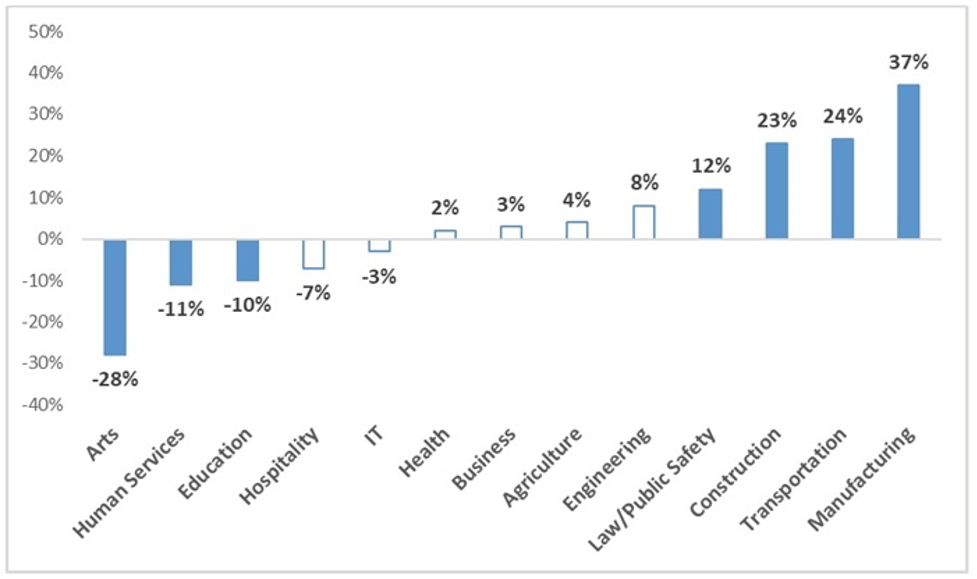
2. Some credentials hold value as students reach their mid-twenties—but others do not. As figure A shows, credentials in construction, transportation, and manufacturing are associated with stronger and more enduring wage returns. For instance, the average student attaining a manufacturing credential—e.g., a welding or mill-operating certificate—earned wages at age 25 that were 37 percent higher than a peer who did not attain a credential during high school. Credentials in other career clusters have less certain long-term economic value by the time students reach their mid-twenties.

Figure A: Credentials’ wage returns seven years after high school, by career cluster

1

Note: Solid bars indicate statistically significant wage gains or losses. Information about which specific credentials are tied to each career cluster is available here.

3. Young men benefit more from credentials. By their mid-twenties, male credential-earners have annual incomes 23 percent higher than students who have not earned credentials, while female credential-earners enjoy no wage advantage at all (their returns are actually negative). This reflects the fact that males attain far more of the high-value credentials in such industries as construction, manufacturing, and transportation.

4. Credentials are associated with higher wage returns when paired with career and technical education course completion. Students do not necessarily need to complete formal coursework to earn a credential; some credentials can be earned through self-paced learning modules and passing a skills assessment. But those students who combine structured coursework and an industry credential earn higher wages than those who only earn a credential: 18 percent more by their mid-twenties, versus 4 percent for students with only a credential.

5. Earning industry credentials is, on average, negatively associated with college attendance and degree completion. While this finding isn’t entirely surprising, it does contrast with prior studies suggesting that career and technical education might increase college-going. It’s not entirely clear what is behind the negative relationship. Although the analysis includes a rich set of control variables, the results may reflect unobserved characteristics (e.g., less motivation to pursue higher education) that contribute to credential earners’ lower college attendance rates. Credential earning could also be “nudging” students toward the workforce and away from college.[2] There may also be variation in post-secondary outcomes by the type of credential-earned, an issue not examined here but one that warrants further study.

What are the real-world implications of this analysis? Industry credentials should remain an integral part of a robust career-and-technical education system that also includes rigorous coursework and work-based learning. Yet not all credentials hold equal value. With that in mind, the study offers the following recommendations for state policymakers, both in Ohio and elsewhere.[3]

  • Be selective about which credentials are approved. Some industry credentials unlock value for students—and Ohio has done a respectable job of identifying those types for IWIP. But many others do not, including some that Ohio has approved for graduation. State leaders should be wary of approving low-value credentials, lest they inadvertently push students away from college or into jobs with little durable payoff.

  • Gauge credentials’ economic value based on longer-term outcomes. The study shows the importance of examining credentials over a longer timeframe. To wit, the cosmetology credential is associated with a modest income return immediately after high school, but its value disappears six years after high school. States should prioritize credentials that offer enduring value to students, not just a short-term boost.

  • Create high-value credential opportunities for disadvantaged students. The study indicates that economically disadvantaged pupils tend to earn lower-value credentials, a finding that mirrors data presented elsewhere showing that students in urban areas are racking up a great many questionable credentials en route to their high school graduation. In Ohio, we need more programs such as Toledo Public Schools’ new commercial driver’s license program and fewer programs that add little value to students’ career prospects.

  • Don’t substitute credentials for academic competence. For graduation purposes, Ohio permits students to substitute credentials for math and reading competency as measured by a state test. This is misguided policy, especially as the state has struggled to evaluate credentials and ensure quality control. Today, thousands of Ohio students exit high school with weak academic skills and credentials whose value will likely evaporate quickly. It’s important to encourage students to develop specialized technical skills and pursue individualized pathways, but not at the expense of basic English and math competency.

Young people should have opportunities to do something they love and to secure jobs that pay enough to support a family—and do all this without having to spend four years in college. That’s a tall order, but rigorous career and technical education can help many students get on the right path. Industry credentials can and should continue to play a key role in the future of career-tech in America. Let’s make sure that they are being used wisely and that they truly pay off for students who earn them.

view
Kids boarding a school bus

A school choice zealot’s case for neighborhood schools

Andy Smarick
4.9.2026
Flypaper

I’m a longtime zealot for school choice. I think students, families, schools, and communities benefit when we have a variety of education options and parents get to match their kids to learning environments.

But that doesn’t mean the longstanding America system of residentially assigned public schools has nothing going for it. In fact, I think choice advocates have hurt their own cause by failing to appreciate the virtues of neighborhood schools. Always, but especially in this era of alienation and polarization, we need to take advantage of the institutions that connect us to others—and traditional public schools are one of those institutions.

There are two types of “community,” and both are valuable.

School choice prioritizes the voluntary understanding of community. This has particular resonance in America because of our enormous diversity and our unusual capacity for forming groups without government direction. School choice is built on the conviction that families can have very different preferences and that those differences deserve respect. This is made possible by the fact that lots of community-based groups and educators want to create and run schools that reflect their own visions of the good life. If policy supports an expansive, diverse educational landscape, we enable more families to find the right fit, and we give power to kids, parents, educators, and local nonprofits.

The types of communities that emerge are the result of voluntary choices—people choose to start schools, people choose to teach in these schools, people choose to enroll their kids in these schools. This elevates the “pluribus” part of e pluribus unum—out of many, one. School choice recognizes that we are many.

Neighborhood public schools are built on a geographic understanding of community. People live in a place and are part of that society because of proximity. They shop at the same stores, eat at the same restaurants, walk in the same parks. And their kids go to the same schools. Because of this familiarity, they build bonds, sympathies, networks of mutual support, and shared experiences that are good for collective life.

Because geographic areas can be diverse in terms of background, income, and more, neighborhood schools help bridge our differences. We meet, work with, and learn with others. These schools are part of a democratically controlled system, meaning the geographic community—parents and nonparents alike—shares responsibility for its schools. The community builds solidarity through collective power and collective duty.

Neighborhood schools can pass along to the next generation a geography’s customs and sensibilities. These schools can be entwined—after years of collaboration—with the local library, local charities, local health clinics. They can have longstanding relationships with close-to-home employers and colleges. They are the place where people vote and watch basketball games. They are an actual, physical representation of an area’s investment in the future.

Of course, school boundaries can appear arbitrary. Sometimes they cut down the middle of a street or split a town in two. But that’s because central-office administrators need to think about bus routes and classroom capacity. Yes, the lines a superintendent’s team draws can serve the purposes of the bureaucracy better than the community’s families.

And yes, school boundaries have sometimes been drawn to divide people by race and class. That’s awful. And yes, the very nature of school boundaries and the residence-based assignments they support can force some families into schools that are ineffective or unsafe. That is unjust.

All of these things should be addressed by policymakers and administrators. They can undermine the health of an education system and the satisfaction of families.

But those things don’t erase the value of neighborhood schools. The virtues of geographic-based communities should not be ignored, even if we decide, in particular circumstances, the school-choice side of the scale is weightier.

Editor’s note: This first appeared as a comment in Mike Petrilli’s Substack, SCHOOLED.

view
Chalkboard arrow

Another deep dive into estimates of economic returns to education

Jeff Murray
4.9.2026
Flypaper

Hot on the heels of a recent report that postulated a lower-than-commonly-believed economic benefit of formal schooling comes a brand new analysis that offers more proof of high marginal returns to education. Who is winning the battle of the impact estimates?

The earlier report (which we will call Clark, the name of its lead author) was a meta-analysis of 79 previous studies that the authors concluded showed evidence of two types of publication bias. These combined to suppress findings of small or null impacts of an additional year of education on individuals’ future earnings, leading to an overestimation of positive benefits. If those biases were not in place, Clark says, typical income boosts would be in the range of 0 to 3 percent. At least two of the papers cited in Clark were co-authored by Harry Anthony Patrinos and George Psacharopoulos, researchers from the University of Arkansas and the London School of Economics, respectively. Now Patrinos and Psacharopoulos have published a brand-new report that once again supports the more-commonly-found positive impacts in the 8 to 10 percent range…and more besides.

Their new paper is also a meta-analysis, comprising 191 impact estimates from 145 studies across 54 countries, including 45 of the studies also analyzed in the Clark paper. Cognizant of the findings in Clark, Patrinos and Psacharopoulos look to overcome the publication bias questions by compiling the “most comprehensive” collection of studies that report both ordinary least squares (OLS) regressions and other credibly causal estimates of economic impact to allow for comparison—especially estimates using instrumental variables (or IV) regressions. They also document and discuss the changing geographic and temporal composition of the evidence base (that is, increasing evidence from low-income and low-educational-attainment contexts) and why that matters to outcomes. Their paper, they write, “does not provide new causal estimates of the return to schooling; instead, it analyzes how different identification strategies shape the magnitude and interpretation of reported returns, documenting systematic patterns across credible designs and clarifying their economic meaning.”

By comparing the impact findings in the two types of regressions, they observe three widely-documented empirical findings in their meta-analysis. First, estimated returns to schooling are consistently positive under both OLS and causal identification strategies. Second, IV-based estimates of impact exceed OLS estimates in the majority (78 percent) of cases reviewed. Third, the magnitude of the IV–OLS gap shows systematic variation driven by income levels. Specifically, the gap is substantially larger in lower- and middle-income economies than in high-income contexts. This pattern is not driven by a small number of outliers but reflects a broad regularity across studies, instruments, and study locations. Patrinos and Psacharopoulos interpret these findings as reflecting high marginal returns in low-educational-attainment environments and the fact that IV analysis identifies local average treatment effects of specific policy changes.

If true, these findings would serve to refute the idea that publication bias is driving up impact estimates, as the Clark paper argues. Instead, they indicate that causal estimates are specifically identifying very high returns to education for first-generation secondary or post-primary completion, which is more prevalent in lower- and middle-income economies. And while other returns may be lower—some even near zero despite being in similar low-income contexts, as Clark argues—the average income gains for an additional year of formal education would still settle out in the typical 8 to 10 percent range due to the very high impacts in those specific contexts.

Patrinos and Psacharopoulos conclude that their findings not only refute Clark, but actually make an even stronger case for the value of education for disadvantaged and lower-income populations. “Well-designed education policies,” they conclude, “that expand access to high-quality schooling remain a central instrument for promoting individual prosperity and supporting long-run economic development.” They recommend future research to quantify the relative contributions of specific contextual factors such as national income level and local test score variations and expanded investigations in using credible causal designs in low-income country settings where data are currently scarce.

SOURCE: Harry Anthony Patrinos, and George Psacharopoulos, “Causal returns to education,” International Journal of Educational Development (March 2026).

view

AI in schools: Promise or pitfall? | Episode 1012 of The Education Gadfly Show

4.2.2026
Podcast
 

Jean-Claude Brizard, president and CEO of Digital Promise, joins the Education Gadfly Show to discuss the promise—and the pitfalls—of artificial intelligence in education. Drawing on what he’s seen in classrooms abroad, Brizard makes the case that AI can elevate teaching and learning—if it’s used to strengthen pedagogy rather than replace it. But as schools experiment with new tools, how can they embrace innovation without undermining the foundational skills students still need?

Then on the Research Minute, Amber Northern looks at new evidence on alternative schools in Chicago—how they affect enrollment, graduation, and even arrests—and what they mean for students’ chances of going to college.

Recommended content:

  • AI in education requires national strategy —Jean-Claude Brizard for Fast Company
  • The human stakes of AI grading —Meredith Coffey, Ph.D., Thomas B. Fordham Institute
  • Should AI be used for teacher evaluation? —Kim Marshall, for the Thomas B. Fordham Institute
  • The Expansion of Alternative Schools: Impact of Schools Targeting Lower Performing Students —Farah Mallah, Nour Abdul-Razzak, and Monica Bhatt, EdWorking Papers (April 2026)

Feedback Welcome: Have ideas for improving our show? We would love to hear them. Send them to [email protected]

Note: The Education Gadfly Show will be on spring break next week. We’ll be back with a new episode the following week!

Fordham Logo

© 2026 The Thomas B. Fordham Institute
Privacy Policy
Usage Agreement

National

P.O. Box 110
Burke, VA 22009

202.223.5452

[email protected]

Ohio

P.O. Box 82291
Columbus, OH 43202

614.223.1580

[email protected]

Sponsorship

130 West Second Street, Suite 410
Dayton, Ohio 45402

937.227.3368

[email protected]