Mobile Navigation

  • National
    • Policy
      • High Expectations
      • Quality Choices
      • Personalized Pathways
    • Research
    • Commentary
      • Gadfly Newsletter
      • Flypaper Blog
    • Events
    • Scholars Program
  • Ohio
    • Policy
      • Priorities
      • Media & Testimony
    • Research
    • Commentary
      • Ohio Education Gadfly Biweekly
      • Ohio Gadfly Daily
  • Charter Authorizing
    • Application
    • Sponsored Schools
    • Resources
  • About
    • Mission
    • Board
    • Staff
    • Career
Home
Home
Advancing Educational Excellence

Main Navigation

  • National
  • Ohio
  • Charter Authorizing
  • About

National Menu

  • Topics
    • Accountability & Testing
    • Advanced Education
    • Career & Technical Education
    • Charter Schools
    • Curriculum & Instruction
    • ESSA
    • Evidence-Based Learning
    • Facilities
    • Governance
    • Personalized Learning
    • Private School Choice
    • School Finance
    • Standards
    • Teachers & School Leaders
    • Think Again
  • Research
  • Commentary
    • Gadfly Newsletter
    • Flypaper Blog
    • Gadfly Podcast
  • Events
  • Scholars Program

The Education Gadfly Weekly

Sign Up to Receive Fordham Updates

We'll send you quality research, commentary, analysis, and news on the education issues you care about.
Thank you for signing up!
Please check your email to confirm the subscription.

The Education Gadfly Weekly: Doing educational equity right: School discipline

Volume 24, Number 3
1.18.2024
1.18.2024

The Education Gadfly Weekly: Doing educational equity right: School discipline

Volume 24, Number 3
view
Teacher speaking to a student
High Expectations

Doing educational equity right: School discipline

If school funding is the issue around which it’s easiest to find common ground across left and right, school discipline might be the hardest. That shouldn’t be surprising, given how divisive our country’s debate has been on the related issue of criminal justice and law enforcement. But we can begin to bridge these ideological differences if we commit to “doing educational equity right.”

Michael J. Petrilli 1.18.2024
NationalFlypaper

Doing educational equity right: School discipline

Michael J. Petrilli
1.18.2024
Flypaper

Teachers are fed up with no-consequence discipline

Daniel Buck
1.18.2024
Flypaper

The rise and fall of Finland mania, part two: Why did scores plummet?

Tim Daly
1.18.2024
Flypaper

Do alternative pathways to teacher licensure depress teacher pay? Evidence from Texas

Amber M. Northern, Ph.D.
1.18.2024
Flypaper

Teacher pay increases and their impacts on salary level, hiring, and turnover

Jeff Murray
1.16.2024
Ohio Gadfly Daily

Cheers and Jeers: January 18, 2024

The Education Gadfly
1.18.2024
Flypaper

What we're reading this week: January 18, 2024

The Education Gadfly
1.18.2024
Flypaper
view

Teachers are fed up with no-consequence discipline

Daniel Buck 1.18.2024
Flypaper
view
flag

The rise and fall of Finland mania, part two: Why did scores plummet?

Tim Daly 1.18.2024
Flypaper
view

Do alternative pathways to teacher licensure depress teacher pay? Evidence from Texas

Amber M. Northern, Ph.D. 1.18.2024
Flypaper
view
Finance reforms and teacher salary revised SR image

Teacher pay increases and their impacts on salary level, hiring, and turnover

Jeff Murray 1.16.2024
Ohio Gadfly Daily

view

Cheers and Jeers: January 18, 2024

The Education Gadfly 1.18.2024
Flypaper
view

What we're reading this week: January 18, 2024

The Education Gadfly 1.18.2024
Flypaper
view
Teacher speaking to a student

Doing educational equity right: School discipline

Michael J. Petrilli
1.18.2024
Flypaper

This is the third in a series on doing educational equity right. See the introductory post, as well as ones on school finance, advanced education, school closures, homework, grading, effective teachers, and a concluding post on doing educational equity wrong.

If school funding is the issue around which it’s easiest to find common ground across left and right, school discipline might be the hardest.

That shouldn’t be surprising, given how divisive our country’s debate has been on the related issue of criminal justice and law enforcement. Whether it’s violent crime on the streets or mayhem in the hallways, conservatives are going to focus first and foremost on law and order, while liberals will be concerned primarily with fairness and equal treatment.

Nor do folks on right and left view racial disparities in arrests and incarceration—and suspensions and expulsions—the same way. For many on the left, such disparities are clear evidence of racial discrimination and injustice. Conservatives, however, view it as far more complicated, starting with the need to understand whether there are differences in actual behavior. If individuals from certain groups are more likely to commit murder, they will be more likely to be locked up for violent crime. If individuals from certain groups actually get into more school fights, they will more often be suspended or expelled—even if justice is meted out to individuals perfectly fairly and without bias .

So how can we try to bridge these vast ideological divides? Let’s go back to my three rules: 

  1. When aiming for equity, we should level up instead of leveling down.

  2. We should focus on closing gaps between affluent students and their disadvantaged peers, not between high-achieving students and their lower-achieving peers.

  3. We should focus equity initiatives primarily on class, not race.

The first rule is by far the most important, yet rarely gets discussed as part of the school discipline debate. And that’s because most of our arguments are about how adults should respond to student misbehavior. Should teachers send kids to the principal’s office? Should principals suspend kids, and for which kinds of infractions? Should school-board policy ever include expulsions, and what safeguards should be in place? How to make all of this less racially biased?

But those decisions are downstream from student behavior itself. And the first goal of any student discipline policy should be to help students behave better—to “level up.” In other words, we should reject the “soft bigotry of low expectations” when it comes to students’ comportment in classrooms, hallways, and the cafeteria, just as we reject it when it comes to our beliefs around what “certain kids” can learn.

We should avoid at all costs, then, any policies that indicate to kids that they can get away with bad behavior—cussing out their teachers; bullying their peers; interrupting instruction; much less engaging in violence. And we should focus instead on schoolwide approaches to helping students meet high behavioral standards.

To be clear, I don’t have in mind the old-school “no excuses” fetishes around matching socks, tucked-in shirts, and silent hallways, but standards of behavior that we’d expect to see in any well-run, joyful, learning-focused school.

That means modeling good behavior for students; holding them accountable for infractions; working proactively with families when there are bigger issues; and supporting teachers when they try to hold the line.

Now let’s bring in rule number two. In this context, it means paying just as much attention to well-behaving students as to their misbehaving peers. That’s one of the purposes of office referrals and suspensions—to “put out” the misbehaving kids so that their peers can return to learning (or, in the context of hallways and lunchrooms, to feeling safe). And that’s critical! We know from several high-quality studies that misbehaving students can wreak havoc on their peers—both in terms of making their behavior worse, and in driving down student achievement. Given that high-poverty schools struggle the most with disciplinary challenges, keeping disruptive students in classrooms only widens the achievement gap. Such policies also drive teachers crazy—and drive many of them out of the profession, or at least out of high-poverty schools.

Yet even discipline hawks—I admit to being one—must admit that suspending or expelling students from school is extremely problematic. A growing body of evidence demonstrates that these practices have troubling consequences for the students subjected to them, even after controlling for underlying factors that might have contributed to students’ misbehavior in the first place. And it doesn’t take a Ph.D. to understand why that might be. Many misbehaving kids are coming from broken homes and/or dangerous communities. Making them spend days or months on the streets, away from opportunities to learn, is hardly going to do them any favors.

What we need, then, are well-designed interventions for misbehaving students—especially chronic and violent offenders—that help them learn to improve their behavior, keep them learning academically, and protect their peers from further disruption along the way. That’s a tall order, but a number of schools and districts are experimenting with various approaches, from much-improved versions of in-school suspensions to “alternative placements”—other schools that kids attend for short to medium periods before returning to their home campuses.

None of that is easy, and like everything in education, this will only work if we get the details right. That means a lot of trial and error and continuous improvement. But do you know what will make that even harder? Viewing any effort to address student misbehavior as racially tainted.

Which brings us to rule three: focusing primarily on students’ socioeconomic status instead of race. Now, as I wrote in my introductory post, we can’t ignore race entirely. American education has a long and sordid history of discriminating against kids of color, especially Black children, including the use of suspensions and expulsions in racially biased ways. The Office for Civil Rights has a clear and compelling mandate to step in when schools or districts treat individual kids differently on the basis of their race (or other protected categories). Conservatives need to acknowledge as much.

But liberals need to be willing to embrace the complexity of this issue. Yes, Black students are suspended or expelled at disproportionate rates. But if we control for class, we see that most of those disparities disappear. That’s because kids growing up in poverty are much more likely to experience all manner of challenges that make it more likely for them to misbehave in school—and that’s true whether we’re talking about White, Black, or Brown students. Kids without a father in the home are more likely to get in trouble at school. Kids from dangerous neighborhoods are more likely to get in trouble at school. Kids dealing with lead poisoning are more likely to get in trouble at school. Kids who are victims of abuse or neglect are more likely to get in trouble at school.

In every case, these situations are tragic—as is the fact that Black students in America are three times as likely as their White peers to live in poverty, and six times as likely to live in deep poverty. Thus, it’s just a matter of basic math that Black students on average will be more likely to misbehave in school than their peers—not because they are Black, but because they are suffering the ill effects of poverty.

But guess what: The (few) studies that have been able to control for underlying student behavior find that the racial gaps in punishment shrink to almost nothing. Not zero—indicating that some racial bias remains and must be addressed. But it’s very much on the margins, not the center of the story.

To conclude, here’s how we might find common ground around this most vexing issue:

  1. Put real effort and resources into helping students meet high behavioral expectations.

  2. Develop alternatives to out-of-school suspensions and expulsions that address the needs of chronically or violently misbehaving students, while protecting the sanctity of the classroom for their teachers and peers.

  3. When working to root out racial bias in exclusionary discipline, control for differences in student misbehavior, or, if that proves impossible, at least control for students’ socioeconomic status.

The way to “make school discipline more equitable” isn’t by letting kids get away with misbehavior, but by helping all kids, from every group, learn to behave well. We might never fully achieve that lofty objective, but we’ll be a better country if we try.

view

Teachers are fed up with no-consequence discipline

Daniel Buck
1.18.2024
Flypaper

I used to judge teachers who quit midyear. How could they abandon their students? Didn’t they sign a contract? Could they just really not cut it? Well, now I get it. Midyear quitting may be unseemly, but it’s understandable. When teachers must abide relentless chaos or fear outright brutality, I get it.

In an online thread, thousands of teachers tell stories about the new normal of students throwing supplies, cussing out teachers, and showing complete apathy toward academic work. PBS ran a more thoroughly journalistic story in which teachers raised the same concerns: “Hitting, biting, spitting, throwing furniture” are common in too many classrooms nowadays.

Whatever metric you use, statistics bear out the anecdotes that emerge both from reporting and from online vent sessions: post-pandemic student behavior remains chaotic. In schools across the country, there was a 9 percent increase in weapon confiscation last year. Violence spiked in districts from North Carolina to Denver. In a 2023 survey of superintendents, concerns about behavior topped academic loses as a major concern: 58 percent cited academics as worse since the pandemic, while 81 percent noted behavior.

And teachers are fed up with this reality on the ground. Two representative surveys capture this dissatisfaction. The first, from the National Alliance for Public Charter Schools, finds that the greatest concern among teachers right now is behavior. The second, from the Rand Corporation, places behavior as the number two stressor in teacher’s lives, behind only concern for the academic growth of students. Both place teacher pay, the dissatisfaction about which we hear most, far lower.

But surveys miss what this really means in practice.

They don’t capture the stress and adrenaline shock after breaking up a fight. They don’t capture the change in thinking from “these students are disrespectful” to “I don’t deserve their respect”—a shift as subtle as it is emotionally crushing. Nor does it capture teachers’ all-consuming anxiety—fear, even—at the uncertainty of what will happen that day, playing out worst case scenarios like a suspense thriller in their mind.

Teachers are expressing this dissatisfaction. In Akron, Ohio, for example, the union threatened to walk out after a proposed district policy that would redefine “assault” as only incidences that resulted in injury. In Charlottesville, teachers staged an unofficial walkout, calling in sick on a Friday in November and forcing a shut-down the following Monday and Tuesday because of ubiquitous classroom violence. In Portland, a group of principles penned an open letter pleading for help with record-setting incidents of classroom disruptions and physical altercations.

As with any policy issue, the solutions to this behavioral uptick are complex and mostly unsatisfying. How do you improve poverty? Well, it’s economics, tax-policy, healthcare, safety nets, public philosophy and Zeitgeist shifting, philanthropy, institution building, and more.

The causes of today’s spike in misbehavior are multiple: pandemic-era disruptions in schooling and the subsequent unlearning of behavioral norms and habits, learning loss that fosters academic difficulties and so misbehavior, screen addictions, trends in permissive parenting, broader trends of societal disorder, lenient discipline fads in schools, and on and on. As such, the solutions to our behavior crisis involve dozens of levers in public policy and education reform.

With that in mind, below I hazard six behavior-specific recommendations:

1. Keep the federal government out of it.

Even before the pandemic turned the behavior crisis to eleven, the Obama administration arguably set the course for leniency with its 2014 Dear Colleague Letter, threatening legal action against school districts that showed disparities in rates of punishment, thereby forcing schools towards leniency. Policy at such a high level cannot possibly fit facts on the ground. In a district where I worked, a handful of students racked up the lion’s share of disciplinary action. Recent research finds that it’s also just a handful of novice, ineffective teachers who write the majority of office referrals. These outliers skew data and so handcuff administrators from effectively disciplining students. And any federal policy that incentivized strictness would likely cause the debate to swing equally too far in the opposite direction. Most teachers prefer stricter discipline, and so keeping decisions local would likely bring the pendulum swing to a happier middle.

2. Sweat the small stuff.

Too many administrators ignore the minutiae of behavior codes, such as the need for a uniform policy. Why enforce attendance or discipline a child for talking out of turn when there’s a fight in the cafeteria? “We’ve got bigger fish to fry!” But if school staff do not hold the line on small fights, bigger fish come along. Highly successful charter schools adopt a “broken windows” approach to school order—even paying staff whose job it is to replace every burnt out lightbulb, wipe up every scuff on the floor, and reorder any school display. Sweating the small stuff communicates to students that school buildings are not places that tolerate disorder, and that instead they expect excellence from everyone who walks through their doors.

3. Lean on school boards.

School boards can compel buildings to review student conduct codes to tighten up what behavior warrants what response. I’ve written and reviewed a few discipline codes myself. They are the tools that empower or handcuff an administrator’s ability to back up their teachers. If a code of conduct doesn’t allow a detention or suspension for chronic minor disruptions, for example, a building administrator is powerless to help a teacher. What’s more, school boards can include language, such as that recommended in a model policy by the Wisconsin Institute for Law and Liberty that actively requires administrators to impose consequences: “If a teacher removes a student from class due to behavior outlined in this policy, before a return to class, the building principal or other administrative personnel will administer appropriate corrective action.” If the parents-rights movement leaned into school discipline, they might find more electoral success than messaging about explicit books.

4. Conduct a campaign of behavioral transparency.

Historically, attempts to tighten down on student discipline have met with hostile press cycles. When North Carolina required schools to reassess their discipline codes, local media framed it as a vote against “policies to soften racial disparities.” In a report for AEI, Max Eden recommends that districts open up anonymous surveys and conduct annual behavioral audits to see what is really going on. Districts that have done this receive teacher responses such as “we were told referrals would not require suspensions ‘unless there was blood.’” These would provide much needed rhetorical cover for any enterprising education reformer.

5. To teachers, do what you can.

Let me take off my policy wonk hat for a moment and speak to my fellow educators. I’ve worked in chaotic schools. I’ve seen bathrooms with sinks ripped off the walls and other scenes that aren’t fit to describe in pages such as these. I’ve walked down school hallways that reek of marijuana, where the most common sounds are students cursing and teachers shouting. In these scenarios, I had my students working silently, reading, and learning. One year, my students had the highest reading gains at my school. My administration thought I had some special “relationship-building” magic. I didn’t. I simply sat down one day and listed every consequence that I myself could impose where my administration demurred: pulling kids myself from lunch, recess, or gym to impose my own detention, grades for behavior, and whole class consequences, such as extra homework. I tallied over 150 calls home one year (both positive and negative). Like limping with a broken foot, some of these are not “best practices,” but are necessary when administrators cannot or will not maintain order.

6. To unions, take action.

As a conservative, I can’t believe I’m saying this, but local unions may be one of the few places of leverage that we have. At the national level, the major unions have bought into soft-on-consequences discipline, but, as in Charlottesville and Akron, local unions could force change where all other incentives foster inertia. National advocates are too often removed from boots-on-the-ground teachers, but local reps can see what their teachers really need most, and so are more likely to pick up this fight.

—

I’m a stalwart proponent of instructional, reading, and curricular reforms. These are the policies that will win real academic improvements for American children. But no amount of phonics instruction or civics education will mean much if students can’t even hear their teacher. Getting behavior right comes first.

view
flag

The rise and fall of Finland mania, part two: Why did scores plummet?

Tim Daly
1.18.2024
Flypaper

Editor’s note: This was first published on the author’s Substack, The Education Daly.

In part one, which you should probably read before continuing further, we learned that a streak of outstanding results on international assessments in the early 2000s made Finland the world’s envy. Waves of besotted visitors soaked up Finnish wisdom.

Then it got weird. So now we’ll retrace the decline of the world’s most celebrated school system and sort through explanations and lessons.

—

Just as Finland achieved hegemony, its performance slid. The first murmurs were heard after the 2012 PISA administration, when Finland found itself outside the top ten countries in math for the first time. They grew louder after the 2015 exam, which showed declines in all three tested subjects.

Then came the pandemic. Students around the globe suffered unprecedented setbacks after missing critical in-school instruction and coping with disruptions to learning habits. By the 2022 PISA administration, the results of which were just announced in late 2023, Finland’s incredible slide in student performance had become undeniable.

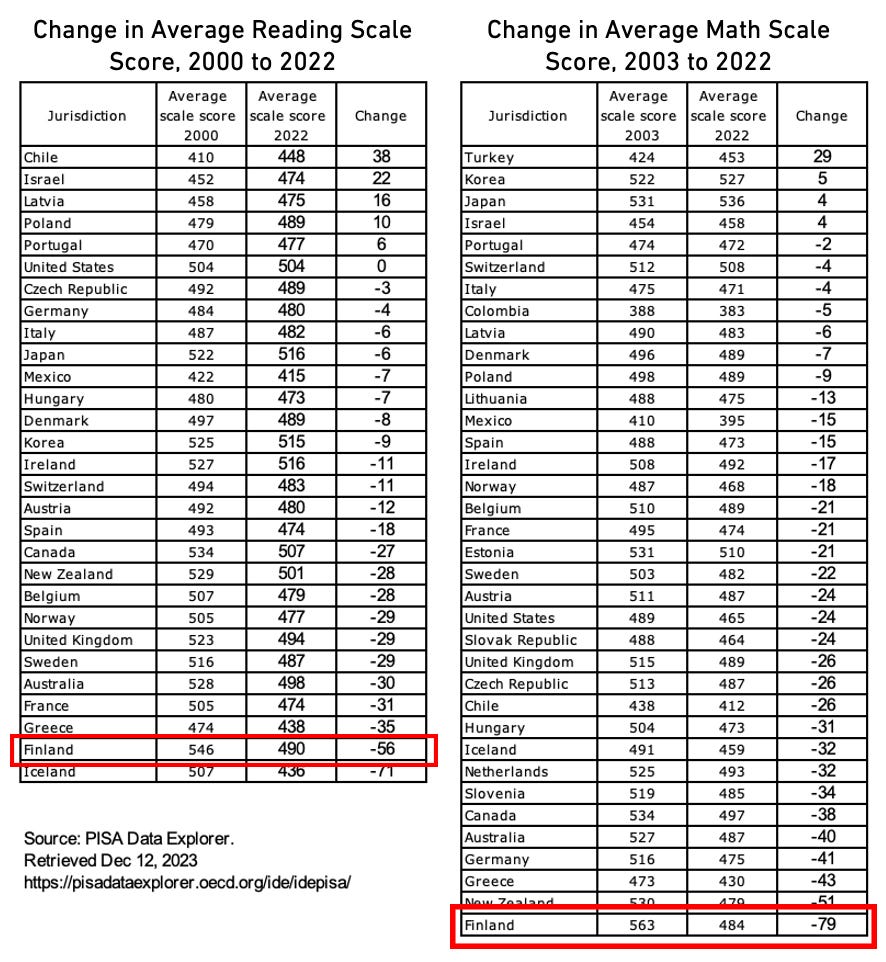
The tables below rank countries by their change in scale score on the PISA reading and math tests since they were first administered (2000 for reading, 2003 for math).[i]
td1

In reading, Finland’s drop of 56 points over approximately two decades is exceeded only by Iceland’s. Poland, as a counter example, improved 10 points over the same time period, and is now performing on par with Finland despite trailing it by a massive amount in the initial PISA administrations.

However, it’s math where the bottom truly fell out. Finland’s average scale score went down by an incredible 79 points between 2003 and 2022—lapping the other laggards by miles.

As of 2022, Finland was no longer ranked number one in math among PISA participants. It was twentieth. And in reading, while Finland still placed a respectable fourteenth, it found itself trailing...wait for it...the United States.

You read that correctly. Over the course of twenty years, the poster child for what not to do had somehow overtaken (in reading) the country heralded as doing everything right.

In math, Finland still outperforms the U.S., but the gap between the two countries has shrunk by 75 percent. This is especially shocking given that the past decade has not been a good one for American performance in that subject.

You are probably wondering how the Finns took the news. Answer: hard.

According to the Helsinki Times, the Ministry of Education and Culture described the latest results as “extremely concerning.” The Minister for Education noted that results have “continued on a downward trend” and “eroded substantially.” Officials were particularly alarmed that the percentage of students with substandard math skills ballooned over time from 7 to 25.

In the candid, humble assessments from Finnish officials across the board, the days of junkets and embassy seminars seem worlds away.[ii] On Behind the Music, this is when the band splits up and everyone goes broke paying for their divorces.

Why did Finland plummet?

There are a few common explanations for Finland’s unprecedented change in PISA performance.

Explanation 1: Finland’s initial success was a fluke. Perhaps the vagaries administering an international assessment led to undetected biases in the early-2000s Finnish student sample, leading to an overly positive result. After all, only a small fraction of a nation’s students take PISA. Finland’s blockbuster rankings came when the test was new. Maybe there were bugs to work out. Through no fault of Finland’s, what if noise in the scoring functioned uniquely in its favor at first? One could imagine that Finland’s students did not change markedly in their performance, even if its rankings did.

How strong is this explanation? Not too persuasive. First of all, Finland wasn’t a one-hit wonder. It did exceptionally well in multiple years of PISA across multiple subjects: math, science, reading. No evidence has emerged in the past two decades that there was something odd about any of those results, let alone all of them. Also, Finnish officials have said that lower PISA results confirmed findings from national assessments and research that were “well known” by 2016, rendering PISA “not big news.” So the trend line seems to track.

However, PISA isn’t the only international assessment. Finland’s results on the Trends in International Math and Science Study (TIMMS), given to fourth and eighth graders, have generally not been as good as its PISA results. Way back in 2013, Tom Loveless at Brookings was raising questions about Finland based on its less-than-elite TIMMS scores. So it’s fair to say there were a few cautionary signs that Finland’s performance could have been overrated.

Explanation 2: Finland’s initial success was real—but it was followed by a period of remarkable decline. The tests captured the picture accurately. For a relatively brief time, Finnish students who entered elementary school in the 1990s were the best performing in the world. But their peers who followed them just a few years later weren’t nearly so successful. If Finland’s education system was once uniquely elegant in its design and execution, this was probably no longer the case by the time pilgrims arrived en masse. Rather, visitors were taking lessons from schools that were an echo of an earlier prime.

How strong is this explanation? More plausible than explanation 1. Just as Finland’s early PISA results are very persuasive, its decline is also consistent across subjects and test years. The long-term drop raises the question of whether initial Finnish success may have reflected a lag effect of how its schools were organized and operated in the 1970s, 80s, and 90s, when Finland centralized teacher training at major universities and employed national inspectorates to maintain school quality. They had their own NCLB moment. Over time, more authority was devolved locally, nominally to trust educators, but also driven by budget pressure. It’s difficult to know whether the early 2000s high scores were due in part to those discarded strategies.[iii]

Explanation 3: Finland’s performance drop was due to increased immigration and larger demographic shifts rather than weaker instruction. While Finland had previously been notable for its ethnic and religious homogeneity, global migration patterns led to more diversity. Recent arrivals presented more acute challenges that could not be ameliorated by Finland’s social safety net.

How strong is this explanation? Pretty unlikely. While immigration certainly increased, just 7 percent of Finnish students were immigrants in 2022, a far cry from 24 percent in the United States. Finland’s initial success was characterized by transcending global trends, with unusually small gaps between higher- and lower-performing students and demographics playing a smaller role in predicting outcomes. Over time, Finland has become more like the pack. Gaps have widened. Demographics are now more predictive. Finland’s ranking isn’t being weighed down by certain subgroups. It is simply down across the board.

What lessons should we take away?

1. It’s fun to recall that education was once a top-tier domestic policy issue. It drew governors to major summits and commanded consistent attention above the fold and on editorial pages of national papers. This hasn’t been true for a long time. Bipartisanship disintegrated by the end of Obama’s first term. The Trump administration had a narrow agenda around school choice. It’s difficult to tell if the Biden administration has any K–12 agenda whatsoever. Nobody’s junketing. Even a flawed search for new ideas is better than staring at the wall, watching paint dry.

2. Excellence is difficult to sustain. It’s fragile. Ask Bill Belichick and the New England Patriots. Actually, the Patriots’ NFL domination lasted much longer than Finland’s education reign. We have seen some of the same issues among U.S. states, with one-time leaders losing ground to hard-chargers (hello, Mississippi!) that have continued to improve their schools while peers have become complacent.

3. We should take reasonable cautions when making international comparisons. Let’s state the obvious: There is very little reason to believe that copying the structures or policies of the Finnish education system would have made American schools better. By the time Finland had become the object of obsession, it was declining. We were obsessing over the late era of something once great that no longer warranted imitation, like the episodes of The Andy Griffith Show once they switched to color. This does not mean that we can’t learn from other countries. We absolutely can. But there’s no excuse for the lack of common-sense scrutiny that characterized Finland mania.

4. Hype bubbles are real—and too common. Finland’s boosters, there and in the U.S., were completely sincere in their conviction that they were selling the real deal. They believed that Finland was the best school system in the world and that this was because of its distinct features. But Lucy Calkins is sincere that her reading program is effective despite decades of research showing that it shortchanges students with too little attention to phonics and a bizarre fidelity to word-guessing as a strategy. The hype surrounding her reading curriculum—and the educators who have attested to its success despite rigorous evidence to the contrary—has more than a few parallels to Finland. The Calkins program felt right to many. Finland felt right, too. It’s the job of education leaders to make good decisions by seeing through what feels right and adopting things with real evidence behind them that can be executed consistently in local contexts. Finland never met that standard. I can hear some of my readers saying “Wait! What about all the hype bubbles that school reformers pushed in the past few decades?” And you are dead right. There was hype about standards, charter schools, vouchers, community schools, extended da and year calendars, teacher evaluation, testing, technology, etc. All of it deserves more examination. Which brings me to my last point.

5. We need better post-mortems. I don’t know where all the Finland boosters went. They sort of disappeared. Or rather, they stopped writing about and discussing Finland when it tanked. Like it never happened. Like it was never promoted as the solution to all that ails us. Seemingly, everyone had an answer as to why Finland was a top performer and nobody had one for why it plummeted. I would genuinely like to hear more from the folks who visited Finland and engaged with its school up close during the mania. How does it look different in hindsight, if at all? Which lessons still seem applicable and which ones don’t? Where did Finland go wrong? Why didn’t we ask more questions? Where’s that book of Finnish lessons? If we don’t excavate this stuff, we will just circle around the same fads every few generations, making the same mistakes and ending up where we started.

—

Later this year, I’ll try to take my own medicine and post-mortem some topics that were near and dear to my heart. Maybe I was the breathless superfan.


[i] Countries are only included here if they participated in testing for both years covered by the tables. For reading, this means 2000 and 2022. For math, 2003 and 2023. If you are looking for a country that took PISA in 2023 and do not see them, it’s probably because they did not take it in the earlier year. You can access the full results here: https://www.oecd.org/publication/pisa-2022-results/.

[ii] Incredibly, there are still multiple websites selling education junkets to Finland. And no, you are not getting a discount just because they are no longer atop the rankings. Occasionally you may run across a contemporary account of a visit, like this cringe-worthy 2023 piece from a group of USC professors who only glancing acknowledge that Finland’s performance has “slipped some” since the salad days of 2003.

[iii] Amanda Ripley includes a brief overview of Finland’s policies in chapter 5 of her very good 2013 book, The Smartest Kids in the World. I strongly recommend reading it in light of Finland’s subsequent trajectory.


view

Do alternative pathways to teacher licensure depress teacher pay? Evidence from Texas

Amber M. Northern, Ph.D.
1.18.2024
Flypaper

Alternative licensure pathways—which equip prospective new educators for the classroom in ways other than traditional, university-based teacher preparation programs—aim to expand and diversify the ranks of K–12 teachers. These once unconventional programs, better known as alternative certification (“alt cert”) programs, have previously been shown to increase diversity in the field and usher more males into teaching, but research is limited on their relationship to teacher pay.

A recent descriptive study published in AERA Open looks at data from Texas to investigate further. It’s a narrow study—it looks only at correlations between the change in alternative certification policy and both the proportion of new entrants into the field and potential reductions in elementary teachers’ starting salaries—but it nonetheless adds to our understanding of these now-popular programs.

In 2001, the Lone Star State enacted guidance provided by the Texas Higher Education Coordinating Board. It essentially allowed alt cert—which already existed but was not widespread at the time—to reduce its program length, including no longer mandating a student teaching experience. In this study, analysts look at the year preceding the policy change and fourteen years afterwards in about 1,200 districts.

They use a regression model that examines changes at the district level from one year to the next over time, while controlling for district-level differences, such as the percentage of new teachers who are novices, number of students, per-pupil expenditures, teacher turnover rates, racial composition of teachers and students, percentage of special education students and low-income students, and so on. They also look at differences between the highest and lowest quartiles of rates at which districts were hiring alt cert teachers, with “high alt” districts defined as hiring 50 percent or more of alternatively certified elementary-level teachers each year and “low alt” districts as hiring less than 20 percent of them.

The analysis shows that the average district hired about twenty novice teachers each year, and the average district hired 32 percent of its novices from an alt cert program. Within five years of the policy change, more than half of the state’s new teachers were alternatively licensed. Districts hiring the most alt cert teachers were more diverse and larger and they generally experienced more turnover.

The average district pay for new elementary teachers declined between 2 and 13 percent within fifteen years of the policy change. But the number of alt cert teachers in a district impacted salary trajectories. In the year prior to the policy, the average district offered higher pay, which fell over time. But districts that hired few alt cert teachers initially offered lower wages and increased pay over time; those that hired a lot of them offered higher wages initially but decreased their pay as more and more alt cert teachers were hired. For example, in 2005, high-alt districts paid new teachers 9 percent less than in 2000, while low-alt districts paid them 4 percent less.

The ultimate takeaway may be a lesson in economics 101. That is, an increased supply of a good or service will generally result in a lower cost to purchase that good or service. But the analysis also uses a tight definition of pay, excluding additional benefits such as health insurance and retirement options, which can greatly enhance overall teacher compensation. Nor is there any discussion of teacher effectiveness/quality or of the specific types of teachers hired via alternative certification, which could influence total pay and benefits. Potential pay differences among alt cert programs are also obscured, as online, community college, district-run, or university-based programs are all analyzed together (mostly because of how they are coded). And finally, the Great Recession, which hit districts’ bottom lines hard and reduced both teacher employment and pay with equal force, cannot be ruled out as a factor limiting teacher pay in that part of the study period.

So, all in all, this blunt look at alt cert and teacher compensation could use additional investigation—especially because one is not well understood by the field and the other not well understood by the public.

SOURCE: Sarah Guthery and Lauren Bailes, “Unintended Consequences of Expanding Teacher Preparation Pathways: Does Alternative Licensure Attenuate New Teacher Pay?” American Education Research Association (March 2023).

view
Finance reforms and teacher salary revised SR image

Teacher pay increases and their impacts on salary level, hiring, and turnover

Jeff Murray
1.16.2024
Ohio Gadfly Daily

What is the impact of teacher salary increases on recruitment and retention? A new report gives us an interesting on-the-ground look using data from Washington State.

As the result of a state Supreme Court verdict in 2012, huge changes were ordered to the way education is funded in the Evergreen State. That funding—an additional $7 billion allocated over four years—began flowing in earnest in 2017. Most of the money was earmarked for teacher salaries, and that’s where the vast majority of it went. Local teachers unions across the state negotiated huge raises for their members, moving the average inflation-adjusted teacher salary from twenty-first highest in the nation to eighth highest. By 2019–2020, the state was sixth highest.

This significant expansion of state funding for teacher salaries over time allowed a group of researchers, led by Min Sun of the University of Washington, to estimate the relationship between teacher salaries and labor markets. They use a combination of sources to build their models: administrative files, state-level data, legislative reports, and statistics from the American Community Survey (ACS)—including data on teachers’ years of experience, job assignments, salaries, benefits, and full-time-equivalent (FTE) status—between the 2013–14 and 2019–20 school years. The start of the 2018–2019 school year marks the divide between pre- and post-treatment.

As expected, the majority of districts experienced increases in teacher salary post-treatment. These increases generally ranged between 1 and 25 percent, though a handful of districts went as big as 50 percent thanks to the influx of state cash. On average, base teacher salaries statewide increased by roughly $18,000 per year—from just under $60,000 to nearly $80,000 annually. Despite efforts to avoid districts substituting state funds for local funds—including a cap on local levy dollars—districts who relied less on state funding to start with still boosted salaries the most. Thus, pre-treatment disparities between high-paying and low-paying districts remained about the same pre- and post-treatment. Interestingly, there was no clear pattern in the quantitative data as to how any district would allocate the raises. Some of them frontloaded, giving larger increases to novice teachers, while others went the opposite direction to give more money to their veterans. Overall, however, the longer a teacher’s tenure, the larger their salary increase.

Pay bumps appeared to significantly reduce teacher turnover in all districts—between 3 and 5 percentage points—in the first year after treatment. Effects were especially strong for teachers with eight years of service or above. Hiring patterns showed largely null effects, except for a small but statistically-significant increase of .08 percentage points in hiring of so-called “junior teachers” (those with 4 to 7 years of experience) for every $1,000 increase in base salary post-treatment.

That is as far as the quantitative analysis goes. But the analysts also provide qualitative data via case studies. Interviews with a cross section of district staffers and teachers union representatives in five districts are used to tease out the mechanisms by which the funding changes translated into the varying outcomes seen in the data. Interviewees from both groups said that teachers unions at the state and local levels coordinated quickly and collectively to communicate a unified goal of raising teacher salaries as their top or sole priority following the court’s decision. Some district leaders expressed interest in using a portion of the new discretionary state funds in other areas, such as curriculum purchases and professional development, but union negotiators quickly set their sights on the full amount of the increase. As such, districts ended up putting the vast majority of their new revenue into salaries. Local union negotiators reported being well-informed by state union reps about how much was coming, and thus how much of a raise their districts could afford. Additionally, the longevity of tenure on both sides of the negotiating table seemed to matter. More veteran teachers on the union side equaled a higher salary boost overall (and, probably not coincidentally, a boost that was more likely to be backloaded in favor of veterans). More veteran administrators on the district side equaled a lower salary boost overall. This is anecdotal evidence from a small subset of districts, and so is not generalizable beyond their borders, but it would help explain the seemingly “patternless” quantitative findings.

Overall, this research indicates that state efforts to boost teacher salaries can impact who stays in the classroom and for how long, but also that specific local factors can distort any straightforward relationship between salary and the labor market. As schools and districts across the country address teacher pipeline issues, this analysis may give some context to salary-based recruitment and retention efforts.

SOURCE: Min Sun et al., “The Effects and Local Implementation of School Finance Reforms on Teacher Salary, Hiring, and Turnover,” Educational Evaluation and Policy Analysis (December 2023).

view

Cheers and Jeers: January 18, 2024

The Education Gadfly
1.18.2024
Flypaper

Cheers

  • New curricula are focused on building student knowledge to improve literacy. —Education Week
  • Louisiana Governor Jeff Landry removed an alternative graduation route for students who fail the states graduation exam. —Louisiana Illuminator
  • Standardized tests remain an important tool for measurement and accountability, so we must improve, not abolish, them. —Jessica Grose, New York Times

Jeers

  •  Young students entered kindergarten with lower reading and math scores than before the pandemic. —Wall Street Journal
view

What we're reading this week: January 18, 2024

The Education Gadfly
1.18.2024
Flypaper
  • As remote work normalizes and crime spikes, working professionals are fleeing the city, and it’s causing headaches for politicians. —Megan McArdle, Washington Post
  • Critics of school choice want more scrutiny over where funds go, how parents use vouchers, and how students fare in participating schools. —Education Week
  • American revitalization doesn’t require the rethinking of classical liberalism but a rebolstering of republicanism. —Andy Smarick, National Affairs
Fordham Logo

© 2026 The Thomas B. Fordham Institute
Privacy Policy
Usage Agreement

National

P.O. Box 110
Burke, VA 22009

202.223.5452

[email protected]

Ohio

P.O. Box 82291
Columbus, OH 43202

614.223.1580

[email protected]

Sponsorship

130 West Second Street, Suite 410
Dayton, Ohio 45402

937.227.3368

[email protected]