
Much of the education world is obsessed these days (and rightly so) with preparing students for the world of work. That is certainly the case within the subculture of career and technical education, but a growing number of policymakers and advocates are expressing an interest in making sure that all students, even those heading straight to college after high school, develop the real-world “durable skills” that their future employers will demand.
The impulse is great. But as with so many other skills that we hope our young people will develop, we quickly assume that what’s needed is some new school-based program or course or curriculum. What if, instead, the way to teach work skills is to encourage teenagers to, you know, work?
There’s a growing interest in work-based learning, such as apprenticeships and internships during high schoolers’ junior and senior years. But there’s also a recognition that placing lots of students in such opportunities is nigh impossible, given transportation and liability challenges, not to mention that a lot of workplaces don’t know what to do with sixteen- and seventeen-year-olds.
But other workplaces absolutely do. In particularly, the kinds of businesses that have long hired teenagers for after-school, weekend, and summer work. Helping students access jobs at fast-food restaurants, swimming pools, smoothie shops, summer camps, and other entry-level employers would be a much more productive effort for education systems than helping them develop workplace skills while sitting in classrooms. That’s akin to trying to build soccer skills by having kids watch Premier League games rather than just letting them play.
Thankfully, some schools are ahead of this curve. So reports Education Week’s Elizabeth Heubeck, who found several high schools that are helping kids land jobs by hosting summer job fairs and/or partnering with non-profit employment agencies.
But we need a lot more of that. Especially since, counterintuitively, America’s most affluent kids are more likely to work during the summer. (See figure 1.) A 2024 Labor Department study found that:
The likelihood of a young person being employed during the summer months is strongly associated with their family’s income. A young person from a family with a higher income is more likely to be employed during the summer months than a young person from a family earning less. For example, nearly half (46 percent) of youth from families earning between $100,000 and $149,999 per year were employed, whereas about only a quarter of young people (27 percent) from families earning less than $30,000 had summer employment.
Figure 1. Percent of youth employed by family income, June to August 2023
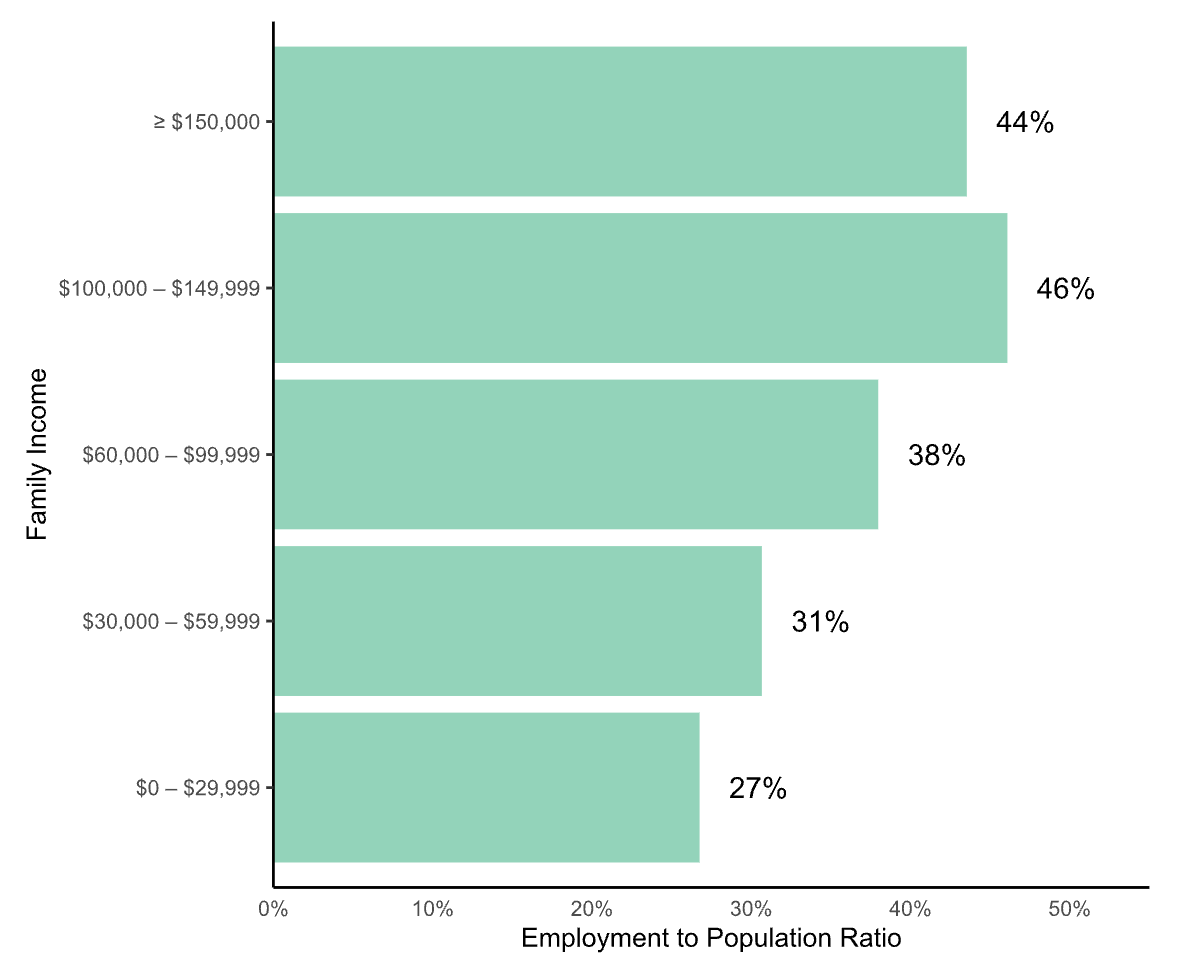
Source: U.S. Department of Labor and its analysis of CPS Basic Monthly Samples (June–August 2023) accessed via IPUMS.
Kids growing up in high poverty neighborhoods without many nearby workplaces, plus fierce competition for the limited jobs available, have a much tougher time finding work. That’s why some cities have created summer jobs programs to overcome these challenges—programs that show real educational benefits for participants.
But schools and municipalities could do so much more. One possibility is to let teenagers work during part of the school day—say, every morning or afternoon—“for credit.” Even a so-called “low-skill” job builds a track record, confidence, and some valuable skills. Combine that with mentorship and academic courses and we might have junior- and senior-year experiences that are much more engaging, relevant, and fruitful than the ones that many kids sleep walk-through now.
In the meantime, educators in schools nationwide, and especially CTE programs, should ask themselves a simple question: Could we be doing more to help our students find summer work?