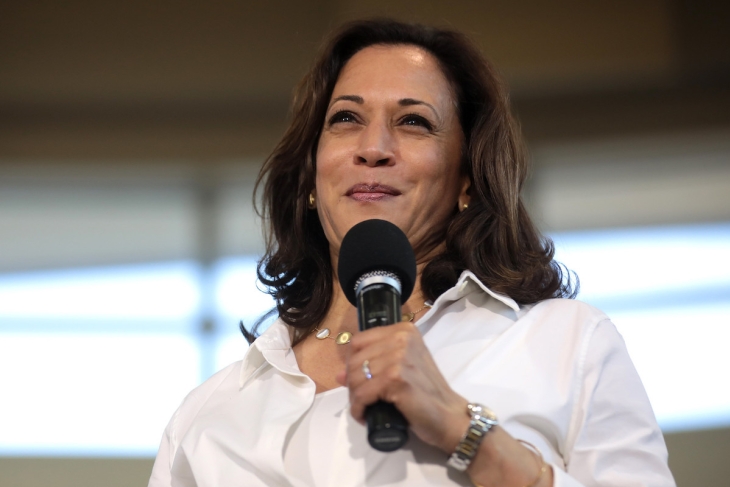
Kamala Harris’s presidential acceptance speech at the Democratic National Convention promised Americans “an opportunity economy where everyone has the chance to compete and the chance to succeed.” But working-class Americans are glum about their economic position today and what this promise means for them. For example, two out of three say the working class is worse off today than it was forty years ago, while only one out of five say the working class is better off.
That information comes from YouGov surveys of working-class voters—those without college degrees—conducted for the Progressive Policy Institute’s (PPI) Project on Center Left Renewal. They include a focus on seven Presidential or Senate battleground states: Arizona, Georgia, Michigan, Montana, New Hampshire, Nevada, and Pennsylvania.
Working-class voters are divided on which political party will advance their interests. Asked who will “put the interests of working-class people first,” 38 percent said Democrats and 37 percent said Republicans. When asked which party would be best at “creating economic opportunities for working Americans,” 38 percent said Republicans and 33 percent said Democrats. Nearly one out of five said neither party.
Moreover, less than half of working-class voters said the federal government is responsive to their needs, compared to seven out of ten who said the government is responsive to the needs of the college-educated. No doubt this response reflects the fact that 62 percent of U.S. adults have no bachelor’s degree, rising to 72 percent for Black adults and 79 percent for Hispanic adults.
Harris must persuade working-class voters that her proposal for an opportunity economy responds to their concerns.
Opportunity pluralism
PPI’s Campaign for Working Americans suggests a key part of the opportunity economy is a career pathways system for young people and working adults without degrees. This system offers them more education and training options than current K–12 school-to-college-to-job pathway or workforce training programs. This career pathways approach can be called opportunity pluralism and has five elements.
1. Expand apprenticeship programs. Apprenticeships are jobs where individuals earn a paycheck and learn an occupation. Today, there are around 600,000 US registered apprenticeships, mostly in building trades and heavy industry. Countries like Great Britain, Germany, and Australia have many times more in countless occupations. Around 74 percent of working Americans believe that apprenticeships will help them acquire skills and advance in today’s economy. This earn-and-learn model can grow by changing the way federal apprenticeships are registered, increasing financial support for them, and tying support to pay for performance, which means apprentices get credentials and good jobs.
2. Recruit more organizations to offer work-based learning. An all-hands-on-deck partnership approach can create a larger system of career pathways programs. It should include coordinating or intermediary organizations like K–12 schools, community and four-year colleges, workforce boards, unions, industry and employer associations, and other nonprofit and for-profit ventures. In addition to apprenticeships, other work-based learning approaches like internships and cooperative programs should expand.
3. Allow the Pell Grant to support education and workforce development. Current federal (and state) policies favor subsidies to those who get a degree. For example, in 2018 the federal government spent around $149 billion on higher education versus $58 billion for workforce education and training. When the latter figure deducts Pell Grants and veteran’s programs, spending drops to around $16 billion for seventeen federal workforce-related programs. Pell Grants should include support for quality short-term workforce programs not now eligible for support.
4. Base hiring on skills not degrees. Many employers use the four-year degree as a quick way to judge a person’s job readiness, creating a bottleneck or paper ceiling that limits opportunities for those without degrees. Opportunity@Work research shows that not having a degree does not mean individuals are low-skilled. Rather, about half of the workforce—70 million individuals—are STARs or Skilled Through Alternative Routes like military service, training programs, or on-the-job experience. This is leading employers and government at all levels to drop degree requirements for jobs that do not need them and use skill-based hiring for these jobs. Reforming hiring practices will promote upward mobility in an opportunity economy.
5. Support a new high school movement. K–12 schools’ focus on the college-for-all model means many young people cannot access quality career counseling and education, including career and technical education or CTE. Roughly 1 out of 4 public high schools do not offer CTE. Only around one out of ifve high schoolers complete at least three CTE courses. High schoolers should have access to CTE, including work-based learning. The current inspiration for doing this is found in the early twentieth century when America faced new workforce challenges. A grassroots high school movement emerged and led to what Harvard economists Claudia Goldin and Lawrence Katz call America’s “spectacular educational transformation.” Today’s new movement can create “faster and cheaper” pathways to jobs.
Knowledge and networks
An important part of an opportunity economy is what Harvard economist David Deming calls the economics of skill development, especially the relationship between acquiring knowledge and developing social networks. He finds that the importance of cognitive skills has declined as a predictor of wage success.
On the other hand, the importance of relationships, networking, and social skills has increased, especially skills like communication, cooperation, collaboration, social intelligence, and conflict resolution. After age thirty-five, wage growth is greater in jobs requiring social skills.
This means that the building blocks of an opportunity economy are knowledge, skills, relationships, and networks, summarized in a simple equation: Knowledge + Networks = Opportunity. As the adage goes: It is not only what you know but whom you know.
The opportunity economy for working-class Americans is built on acquiring knowledge and networks and is an example of opportunity pluralism—ensuring that working-class families have multiple education and training pathways to prepare them for good jobs, satisfying careers, and flourishing lives.
If Harris offers working-class voters a positive opportunity pluralism agenda she can reap the rewards.
Editor’s note: This article was originally published by RealClearEducation and made available via RealClearWire.