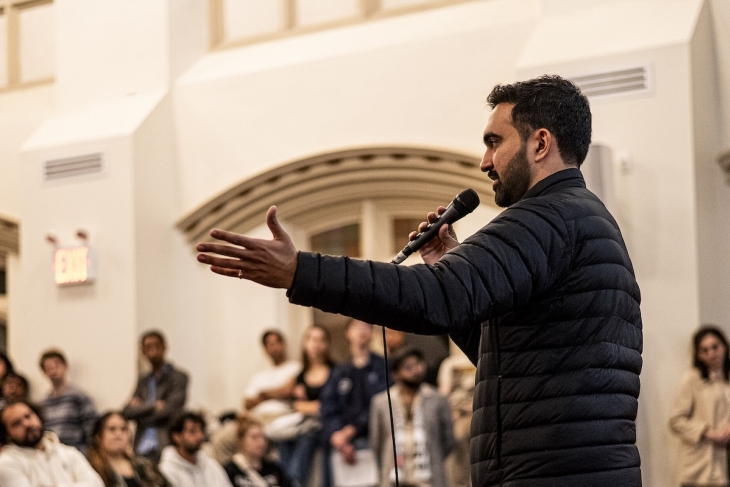
Zohran Mamdani, the Democratic Party’s nominee for mayor of New York City, has announced his intention to end kindergarten entry into the city’s Gifted & Talented (G&T) programming by September 2027.
According to his campaign spokesperson Dora Pekec, “Zohran knows that five-year-olds should not be subjected to a singular assessment that unfairly separates them right at the beginning of their public school education. His agenda for our schools will ensure that every New York City public school student receives a high-quality early education that enables them to be challenged and fulfilled.”
(For the record, Mamdani attended a private, progressive elementary school. Clearly, his parents did not believe that NYC public schools would offer their child “a high-quality early education” that would leave him “challenged and fulfilled.”)
As for Mamdani’s “agenda for our schools,” according to his own website, it consists of:
Zohran will ensure our public schools are fully funded with equally distributed resources, strong after-school programs, mental health counselors and nurses, compliant and effective class sizes, and integrated student bodies.... Zohran supports an end to mayoral control.
“An end to mayoral control” means Mamdani will have limited say in whether G&T programs are cut citywide. From this, the main conclusion we can draw is that he has no plan whatsoever for NYC’s public schools, gifted or otherwise.
Instead of doing any thinking of his own, Mamdani defaulted to the positions of 2019’s School Diversity Advisory Group, organized under his predecessor and role model, Bill de Blasio. Except even they weren’t definite on what they were recommending beyond replacing dedicated G&T classes with an enrichment-for-all model. As I wrote at the time:
The report itself doesn’t offer a clear answer, but experts and those involved in writing it said it might involve something called “schoolwide enrichment models”—an approach that tasks school staffers with identifying students’ interests and then developing mini-courses, more detailed units of study, and electives for older students centered on those topics.... For younger children, that could mean setting up small groups of students who are pulled out of their classrooms to learn the basics of photography. In middle and high school, staff can give students questionnaires about their interests and use that information to set up electives that could include topics ranging from robotics to journalism...
How does being able to take photos, direct videos, and make robots keep boredom at bay during traditional subjects for kids who are reading chapter books in kindergarten and experimenting with math algorithms in second grade? Because the report isn’t suggesting replacing traditional subjects with the above, is it? It’s proposing them in addition to. That’s what “enrichment” means.
Here we come to the crux of the problem: How does stuffing every public school to the gills with “enrichment” serve kids who are capable of performing at a higher level academically than what’s offered in a basic general education classroom?
And no, I don’t just mean “gifted” children. I mean all children. As I wrote for Advance in 2024:
The most important reason why all students deserve a “gifted” education is that what NYC calls G&T would be considered standard in Europe and Asia for students two grades younger. There is nothing happening in a NYC “gifted” classroom that could not be mastered by any child with a good teacher.
Need proof that even NYC teachers, who, we’re told, are much better at assessing a kid’s progress than any silly standardized test, believe their students are capable of doing higher level work? When asked to recommend students for “gifted” programming, 85 percent received the thumbs up!
Yet instead of talking about raising the performance bar or enhancing curriculum or training teachers to instruct at a higher level, we are talking about offering more fun electives! The rationale for this proposed change, like the rationale for all educational edicts in NYC, is that it will benefit low-income and minority children.
Except that it won’t. We know it won’t. It will, instead, hurt precisely those it’s supposed to help. Need more proof? In 2022, I wrote:
In an attempt to shrink the achievement gap, New York, along with many other American cities, moved to get rid of tracking—the practice of sorting students by ability into homogeneous classrooms... The view prevailed that getting rid of accelerated and honors programs in kindergarten through eighth grade would lead to higher—or, at least, equal—achievement for all in high school.
What happened in actuality was the opposite: In wealthy districts, when programs for high achievers were cut, parents moved out of the city, transferred their children to private schools, or hired tutors from outside the classroom. In poorer, often also nonwhite, districts, high-achieving students were left with no such options. No more honors programs meant a curriculum well below what some students were capable of. It meant fewer complex texts to analyze and no algebra in middle school. Mastery of both is vital to success on the high school admissions test—but students were no longer being taught what they needed to know to pass it....
The ultimate consequence of losing these programs was espoused by city public advocate Jumaane Williams, himself a Brooklyn Tech grad.... As Williams wrote in the Daily News, “The most clear failure has been establishing an accessible pipeline. In the past, gifted-and-talented programs in middle schools have been a reliable pathway.”
Under Mayor Bill de Blasio, even more G&T programs were eliminated in the interest of equality—another name for the detracking movement. In the same vein, middle schools that previously could select students for their advanced programs based on grades and test scores dropped the practice altogether. In both cases, that spelled the end of placing some students on an accelerated academic track.
And now, de Blasio’s likely successor proposes continuing with his failed policies. This would be a good place to bring up that old chestnut about insanity defined as doing the same thing over and over and expecting different results.
But even that would be repetitive. No matter how many times we say it, we already know what the results will be.