American children are suffering from unprecedented learning loss, and many are not even bothering to show up to school. Given these dire circumstances, one might assume that America’s teachers unions would have a singular focus on supporting teachers in their mission to get kids caught back up. So what were the issues discussed, debated, and voted on at the most recent meetings of the American Federation of Teachers and the National Education Association? The Israeli-Palestinian conflict. Abortion rights. Disinvesting from fossil fuels. And what did United Teachers Los Angeles, which represents more than 30,000 K–12 teachers, demand before returning to the classroom in 2020? Defunding the police, single-payer healthcare, providing housing as a human right, and dismantling systemic racism.
This far-ranging political activism deviates from unions’ primary mission to support and advocate for the professional lives of teachers—to the detriment of both their members and our children. This is because the time, effort, and expense needed to fight these political battles cannot also be used to support teachers in educating students. When unions combat climate change, they ignore the chronic absenteeism that has plagued schools since the pandemic began. When they attempt to resolve the Israeli-Palestine conflict, they lose sight of the scope of learning loss that needs to be overcome before students are college and career ready. Any organization—even one as large and well-funded as the NEA or the AFT—has a limit to what it can effectively do. Spread too thin, it will do many things poorly. It’s a zero-sum game, and every bit of energy that’s dedicated to these extracurricular projects is taken away from the primary mission of supporting teachers in their day-to-day professions.
There are other costs, too. Families are now voting with their feet and abandoning the public school system to seek better circumstances in private schools. Home schooling is on the rise. In a seismic shift unthinkable just a few years ago, recent polls suggest that the public trusts Republicans on education issues more than Democrats—the party most closely aligned with teachers unions. Perhaps it’s not a coincidence that teacher burnout and shortages are increasing at the same time as this educational mission creep.
And though teachers unions have taken a hard, progressive line on the hot-button issues of the day, it’s not clear that doing so represents the feelings of all teachers. According to a survey conducted by the Heritage Foundation, 37 percent of teachers self-identified as politically liberal, just slightly more that the percentage that identified as conservative or moderate (32 percent each). So while teachers lean a bit more to the left than the general population, they’re hardly a band of Jacobins. One teacher I spoke with—who also serves as the vice president of his local union—bemoaned how “far left” his national union had drifted. He’s “very passionate about advocating for teacher pay, benefits, respect,” but wants teachers unions to “stay in our lane.” He feels teachers unions’ time “would be spent on more important things” without the focus on political issues.
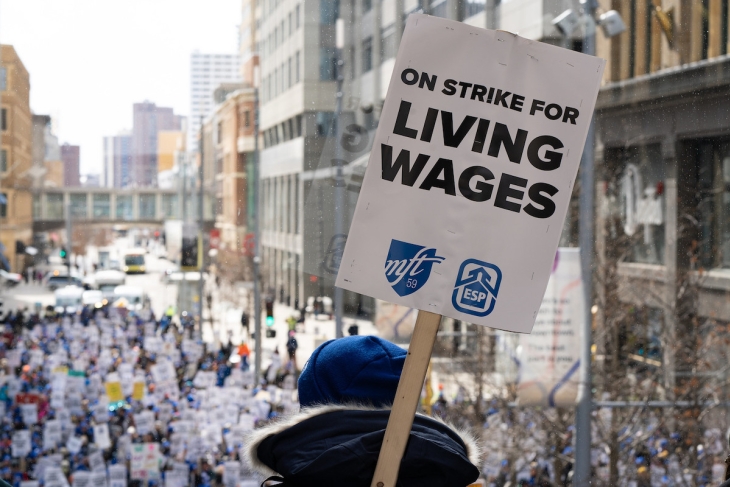
Those more important things? They are traditional union prerogatives like increasing pay and improving working conditions for teachers. Historically, unions have been effective at both. A strike in 2012 gained Chicago teachers a 16 percent pay raise over four years, for example. In Oklahoma, the teachers union fought for and won an average salary increase of $6,000. West Virginia’s teachers secured a raise five times as large as the one originally offered by the state’s governor. These are just a small sample of the significant victories that directly benefit the working experience of teachers, Republican and Democrat alike.
Unions may also be harming themselves by losing sight of their mission. An analysis by The 74’s Mike Antonucci found that virtually every teachers union in the country had a decline in membership during the 2020–21 school year. As of yet, this hasn’t hurt the unions’ bottom lines (the 510 employees of the NEA earn an average annual salary of $134,000, but this number might be skewed by president Becky Pringle’s salary of $426,000), and was almost surely caused by Covid-related closures and employment issues, not the mission creep. But the pandemic-induced reductions in membership make the unions more vulnerable to any further drops caused by their non-classroom-related advocacy. A long-term decline in dues paying members will eventually lead to a financial downtrend that will make organizing and lobbying more difficult.
The national teachers unions would do well to worry. Instead of creeping into other causes, they should reaffirm their commitments to their primary missions. Learning loss is a national emergency, and educators are on the frontlines of a generational struggle. Children deserve the complete dedication of their teachers, and those teachers deserve the committed support of their unions.