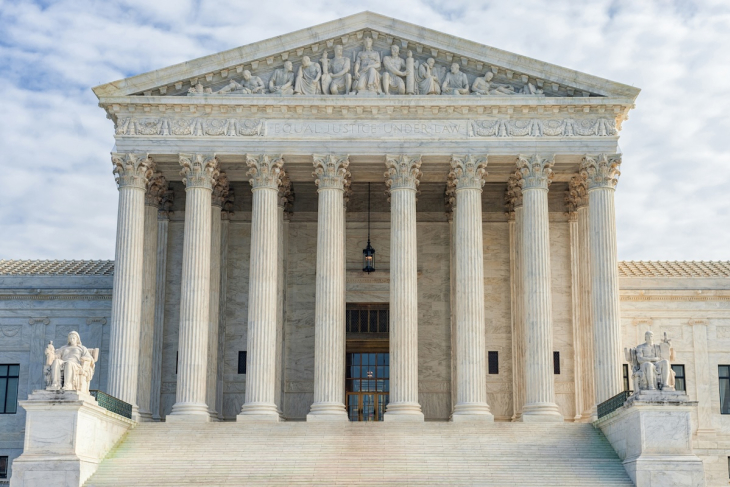
The question of whether, when, and how public funding may flow to religious schools has been contested for more than 150 years, animated by the tension between the First Amendment’s Establishment Clause, which bars the state from sponsoring religion, and its Free Exercise Clause, which restricts the burdens that can be placed on religion.
Over the past 25 years, the Supreme Court has resolved that tension in stages: first holding that the Constitution does not forbid public dollars from reaching religious schools through parents’ free choices (Zelman v. Simmons-Harris, 2002); then that states cannot deny religious schools a benefit freely available to their secular counterparts (Trinity Lutheran v. Comer, 2017; Espinoza v. Montana, 2020); and, finally, that states cannot evade that rule by drawing a line between a school’s religious status and its religious use of funds by saying, in effect, “we will fund a religious school, but not if it does religious things with the money” (Carson v. Makin, 2022).
Now the Court has agreed to hear yet another case in this realm, St. Mary Catholic Parish v. Roy, which raises a different and perhaps more vexing question: What happens when the free exercise of religion collides with a state’s anti-discrimination laws? How the Court answers could determine whether states may attach conditions to public benefits that religious institutions cannot, in conscience, accept.
St. Mary centers on a conflict over Colorado’s universal preschool program, which promises every family in the state a free year of early education at the provider of their choice. To participate, a preschool must sign an agreement pledging not to base its enrollment decisions on a list of characteristics that includes sexual orientation and gender identity. Two parish preschools in the Archdiocese of Denver—St. Mary’s in Littleton and St. Bernadette’s in Lakewood—say that signing such a pledge would require them to adopt policies that contradict Church teaching on marriage and the human person. The case was joined by Dan and Lisa Sheley, parents whose children attend St. Mary’s, who argue they are shut out of the universal program their own taxes help fund.
The Tenth Circuit sided with Colorado, reasoning that the state’s nondiscrimination requirement is neutral, generally applicable, and not motivated by hostility toward religion. Which is to say, the appellate court ruled against the schools and the Sheleys.
The Supreme Court agreed to review that holding, but on deliberately narrow grounds. Specifically, the justices declined the preschools’ invitation to reconsider Employment Division v. Smith, the 1990 decision that governs when religious objectors must obey neutral laws. That means this case will focus narrowly on two questions. First, whether Colorado’s requirement is truly “neutral and generally applicable,” a question complicated by the fact that Colorado already allows some providers selective exemptions from its enrollment rules. Second, whether the “status/use” logic of Trinity Lutheran and Carson applies here. In Trinity Lutheran, the Court held that a state could not exclude an institution from a generally available public benefit because of its religious status—that is, simply because it was religious. Carson went a step further, holding that a state cannot exclude a school based on religious use—that is, because it would use the benefit to teach the faith. The question now is whether a state can attach conditions to participation in a public program that would force religious schools to choose between their beliefs and their participation.
That first question hinges on an inconvenient fact: As things currently stand, Colorado does not actually require every provider to enroll every child. Participating preschools may reserve seats for certain children for a variety of state-approved reasons. Preference can be given to students with disabilities, for instance, or to children of the school’s employees. What’s more, the state runs a case-by-case process for approving a school’s customized enrollment preferences and has granted 17 so far, including preferences for fully vaccinated children and even for children with dual-language needs willing to eat a vegetarian diet. The parishes argue that a state making room for vegetarian diets, but not religious mission, is not applying its rule neutrally.
The conflict here is real, with potentially far-reaching implications for private school choice programs. The earlier precedents focused on programs that excluded religious institutions by design. Colorado’s program is open to religious and nonreligious schools alike, and the law in question was written to prevent discrimination and protect families—including LGBTQ families, whose fear of being turned away at a schoolhouse door is not hypothetical. The state has a sincere and legitimate interest in protecting families against discrimination, just as the parishes have a sincere and legitimate interest in maintaining and operating according to their beliefs.
Whichever way the Court rules, the implications will run far beyond the Archdiocese of Denver’s 36 Catholic preschools.
If Colorado prevails, other states may have a roadmap for excluding religious schools from state-funded programs without ever saying so. That is to say, a state program only needs to attach a condition to participation in a publicly funded program that religious providers cannot, in conscience, accept.
If the preschools prevail, on the other hand, the Court will have extended the logic of Carson to its natural conclusion: What a state cannot do through exclusion, it cannot do through conditions. But a ruling for the preschools means that some families will encounter, in a program their taxes support, schools whose conditions of enrollment they regard as a closed door—a cost that deserves to be acknowledged.
Regardless of the outcome, states will remain free not to fund private schools. What the Justices will decide is whether the requirement that states must extend private school funding to religious schools can be undone in the fine print. Or, said more simply, whether a guarantee the Constitution will not let states deny openly can instead be denied by condition.