Motivating students to pursue their educational passions and grow into the learners they are all inherently able to be is both a simple and complex equation. At its core, it’s about access, inspiration, articulating how educational concepts are relevant to their lives, and tapping into the well of curiosity that exists deep inside each child. One answer, to use a term familiar to many of us, is enrichment.
Removing students from their “normal” learning world and placing them into an environment with new texture and life—assuming there is a standards-aligned, rigorous and passionate approach to teaching—can truly open their eyes to new possibilities and views. If we strategically expose children to new experiences and environments, we can change their trajectories and interest levels significantly.
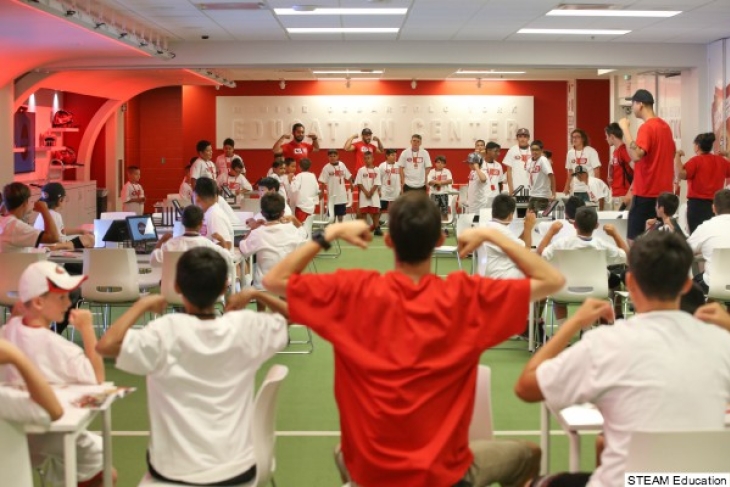
For the STEAM education program that we run at the San Francisco 49ers, our path to enrichment is paved using football and Levi’s Stadium to demystify and “cool-up” subjects like environmental sustainability, structural engineering, and physics. We leverage the power of the game, our players, and the most tech-savvy sports venue in the world to get kids to open up to the ideas that the subjects for which they may believe they have no aptitude or interest are actually tangible, approachable, and easy to see in real life. We light a fire that says to them “the things that I like are made possible by the things I study.”
Other informal learning environments that embrace and create enrichment may include a watershed along the San Joaquin River where a study of local flora and fauna can articulate what a life as an environmental scientist can look like; a wind tunnel where students get a better grasp of the way that mathematics informs development of aerodynamic planes and space vehicles; and a community garden where students learn how responsible water use, the power of the sun, and a passion for others can improve the health of that community. The opportunity to leverage informal learning environments is limitless. There are so many amazing entities out there ready to expose students across the country to applied practice of concepts in a way that makes students jump up and say “YES, I see why this matters now!”
Our constant challenge as educators is to figure out how to push the right buttons to help trigger the passions that drive our students. Make no mistake, every student cares about something. However, the overwhelming majority—especially those in underserved or economically disadvantaged circumstances—have not (yet) had the exposure they need to figure out what, exactly, they care about and how their educational pursuits can be a bridge to a life in that world.
It’s our job to find a way, and informal learning experiences should be a part of the equation. Research field trip opportunities in your area. Speak to local businesses and ask them to participate in class with activities, lessons, and mentorships. Expand thinking about curriculum development and deployment to include true project-based learning that exposes students to new processes, products, and definitions of teamwork and collaboration. GET YOUR KIDS OUTSIDE. It is truly amazing what you can accomplish if the ONLY thing you do is uproot your class and introduce content aligned with a new environment.
As NAGC president-elect Sally Krisel said in a thought-provoking blog, students “must be given exposure to various talent domains through enrichment programs that unearth talent and potential, and ignite passion for future possibilities.”
The views expressed herein represent the opinions of the author and not necessarily the Thomas B. Fordham Institute.