Editor’s note: This essay is an entry in Fordham’s 2021 Wonkathon, which asked contributors to address a fundamental and challenging question: “How can schools best address students’ mental health needs coming out of the Covid-19 pandemic without shortchanging academic instruction?” Click here to learn more.
“In case of emergency, put on your oxygen mask first before assisting your child,” flight attendants instruct. The logic? Because adults won’t be able to help their children if they pass out first.
From a policy perspective, this notion applies to schools as we transition out of the pandemic: To best address students’ mental health needs, as well as strengthen their academic instruction, we must begin by addressing educators’ mental health needs. School leaders, teachers, and other educators can then teach these tools to their students.
We must of course help students that are struggling, both emotionally and academically. But as the adults who work with them feel overwhelmed, anxious, distracted, and depressed from the lasting effects of Covid-19, effective teaching and learning won’t happen, no matter how many student SEL supports, curricular reforms, or new educational activities schools create. Academic preparedness requires both intellectual and emotional readiness! You simply cannot establish a culture of either mental wellness or quality academics if the educators are gasping for air—or as a recent NY Times article noted, heading for the exits.
At Shine Your Light, the nonprofit I founded and lead, my staff and I have spent the past three decades coaching, training, and facilitating forums for educational leaders, teachers, parents, and students to learn easy, accessible, immediately effective intuitive wellness techniques to be in an optimal intellectual and emotional state of readiness to teach and learn. As a career educator myself, serving as a teacher and principal in inner-city Boston and a national charter school movement pioneer, I know firsthand what educators face every day.
The powerful benefits of our tools and skills include:
- Easing overwhelm, anxiety, depression, and stress
- Sharpening concentration, engagement, and focus to effectively teach and learn in difficult, changing circumstances
- Successfully navigating and moving beyond burnout
- Overcoming social and emotional isolation
- Developing discernment and trust, including self-trust, in uncertain times
Most mental health programs in schools teach only basic “mindfulness” training. Shine Your Light’s unique Mental Wellness for Academic Readiness program offers three increasingly transformational levels of intuitive skills and tools, starting with basic mindfulness techniques, then immediately diving deeper to shift the underlying core issues to quickly transform to a calmer, clearer, happier place—both in an academic setting and in one’s overall life.
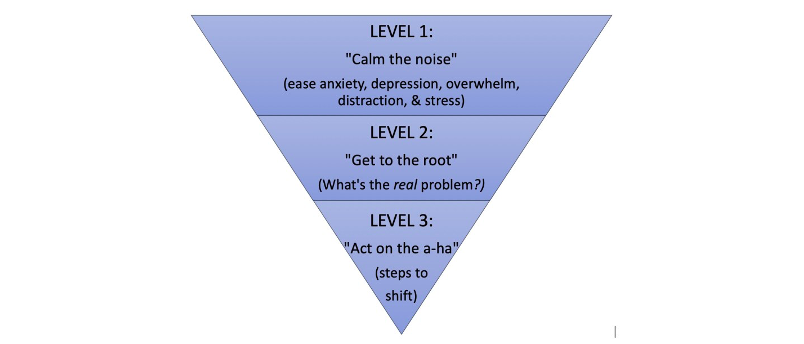
Sample Level 1 skills:
- Grounding and centering techniques to calm anxiety, overwhelm, depression, and stress
- Tools to sharpen focus, clarity, and concentration to better teach and learn
- Staying in your best, highest self, even when others around you are not
- Bubbling up: Stand in your power during challenging situations and relationships
- Recognizing and removing energy vampires
- Medicine Walks: Connecting with the outdoors to regain the big picture
- Navigating the three stages of burnout
- How to make quick, clear decisions by trusting your gut
- Know whom to trust and whom to avoid
Sample Level 2 and 3 skills:
- What’s the real problem, and what’s the solution?
- “The Toddler Why” (getting to the root of procrastination and other times you’re stuck)
- One Essential: Prioritizing amidst a constant, overwhelming to-do list
- Compassionate conflict resolution: “What would Love do (for you and the other person)?”
- Wellness weigh-in: Self-care for your head, heart, body, and spirit
- Listening to your body’s deeper messages
- Healing shadow side traits, childhood wounds, and unhelpful family patterns
- Practical, doable next steps to immediately shift to a better place
Our three-level menu of both direct services and train-the-trainer models offer every school the opportunity to craft a custom program for their community’s needs.
Here are some spotlights from our most recent work:
- In San Francisco, the Covid-19 Coordinator of a prominent high school is getting to the root of his anxiety and feeling overwhelmed in his high-stress role through SYL’s one-on-one intuitive leadership coaching and “Trust Your Gut” master classes.
- In Newark, New Jersey, a team of teachers worked with an SYL trainer to learn immediately calming anti-overwhelm techniques to quell their daily stress and manage long-term burnout.
- In Oakland, California, a group of parents openly vented in a safe, supportive forum with each other and an SYL coach their frustrations and challenges of schooling their kids at home.
- In Camden, New Jersey, a school leader and her teachers did a whole-staff training, using intuitive wellness tools to feel more appreciated as they’ve struggled to do their best in changing learning conditions and allowing themselves to start having fun again.
Masks on. Let’s fly!