Nikole Hannah-Jones set the education world on fire with her essay last month reflecting on the school choices she made for her daughter. I’ve already written about how she missed some warning signs about her daughter’s struggles in math, but today I want to dig in on another part of the story.
Namely, I want to pick apart a set of claims made by Hannah-Jones and This American Life producer Chana Joffe-Walt. Several times in her interview with Hannah-Jones, Joffe-Walt makes a reference to how unequal and segregated American public schools are. At one point she says:
And so little has changed. Public schools are [as] unequal and segregated as they were 10 years ago, 30 years ago, 60 years ago.
Um, 60 years ago was 1966.
School spending has gone up substantially over time and has become more equitable.
A lot has changed in terms of integration as well. In 1966, the Civil Rights Act had been signed just two years earlier, and the Fair Housing Act was still two years away. Across the South, the federal government was only beginning to dismantle a system of legally enforced school segregation.
By the late 1960s and early 1970s, millions of children were attending schools that would have been legally segregated only a few years earlier. Integration efforts continued in earnest throughout the 1970s and 1980s.
It’s hard to square that history with the idea that “so little has changed.” Schools are significantly more equitable and less segregated than they were 60 years ago.
But perhaps you think I’m just picking up on a slip of the tongue. What about the first part of Joffe-Walt’s claim, that schools are more segregated than they were 10 or 30 years ago? Maybe you’ve heard that story that America (briefly) integrated its schools and then allowed them to “resegregate” over time?
That narrative is misleading, in part because it relies on a measure of integration that doesn't account for America's changing demographics. In a 2016 paper for Education Next, University of Chicago economist Steven Rivkin looked at how integration had changed over the previous 50 years.
He looked at two different measures of integration. The first he called the “exposure” index, as measured by the average percentage of Black children’s schoolmates who are White. The second he called the “dissimilarity” index, and it measures how unevenly Black and White students are distributed across schools, accounting for the overall racial composition of the student population.
The figure below shows the results, and the two measures tell different stories. Because society as a whole has become more diverse over time and the share of students who are White has fallen, the exposure index has moved along with policy efforts. It rose amidst desegregation efforts and subsequently fell when those efforts stopped. That's one reason people have concluded that American schools have been resegregating.
But now look at the dissimilarity index. This measure asks whether racial groups are distributed unevenly relative to the underlying population. At the district level, the results are slightly positive as residential segregation has fallen somewhat over time. But at the school level, the trend has seen steady improvement over time.
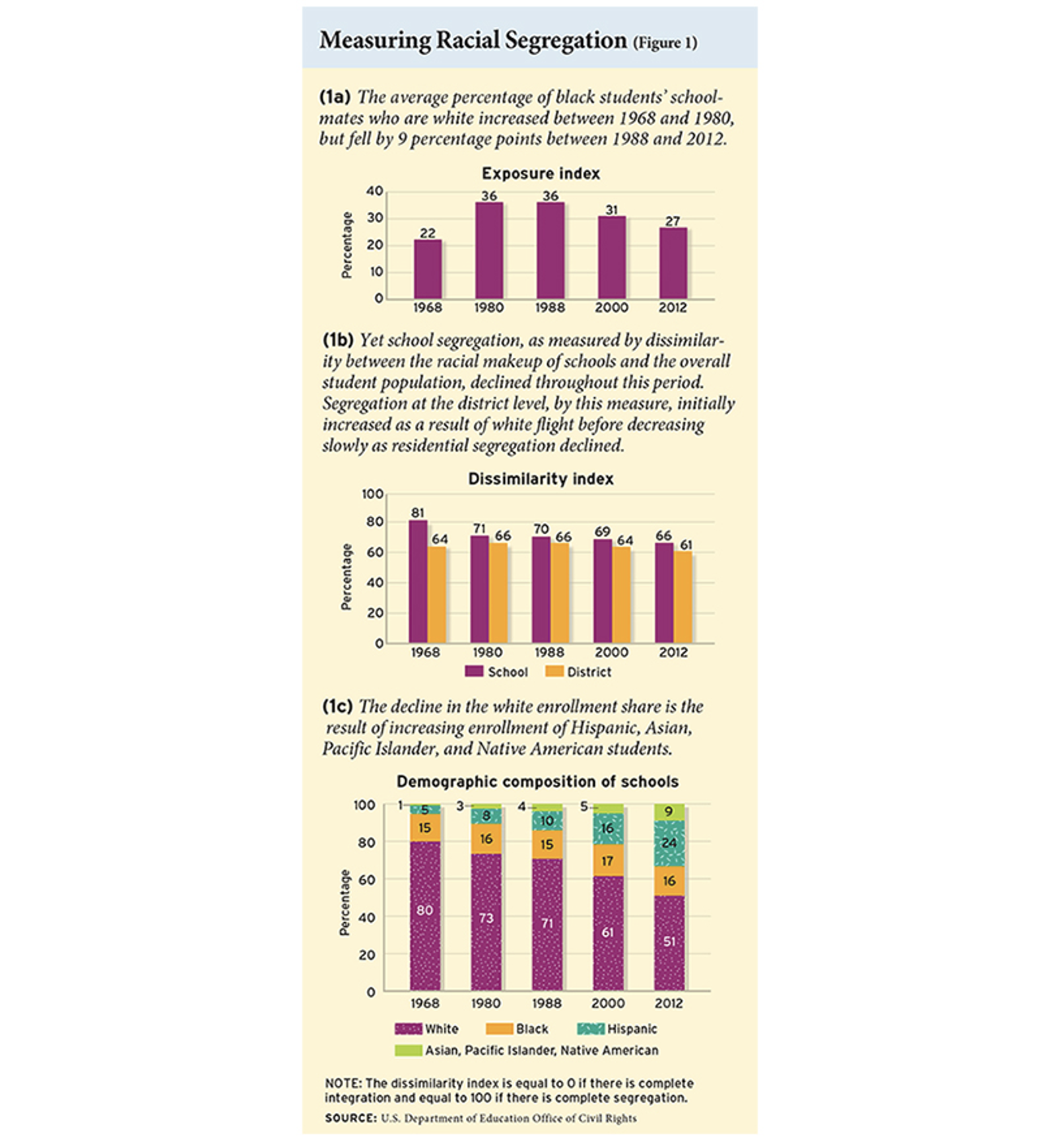
Figure via Steven Rivkin’s 2016 article for Education Next titled “Desegregation Since the Coleman Report.”
Rivkin concluded from this evidence that “By this measure, schools are closer to complete integration than ever before, and thus racial composition would have to change less now than when the [Coleman] report was released.”
More recent research has developed other ways to account for demographic changes. Stanford’s Educational Opportunity Project created a measure called “normalized exposure,” which accounts for changes in the racial composition of the underlying student population. The national results still don’t look like a return to the past. White-Black segregation increased about 4 percent from 1991 to 2000 and was essentially flat from 2000 to 2020. White-Hispanic segregation actually declined by about 10 percent over the full period.
Separately, they also created a measure of “racial economic segregation” and showed that it decreased significantly from 1998 through at least 2020. As you can see in the chart below, the largest contributing factor is between-district inequality.
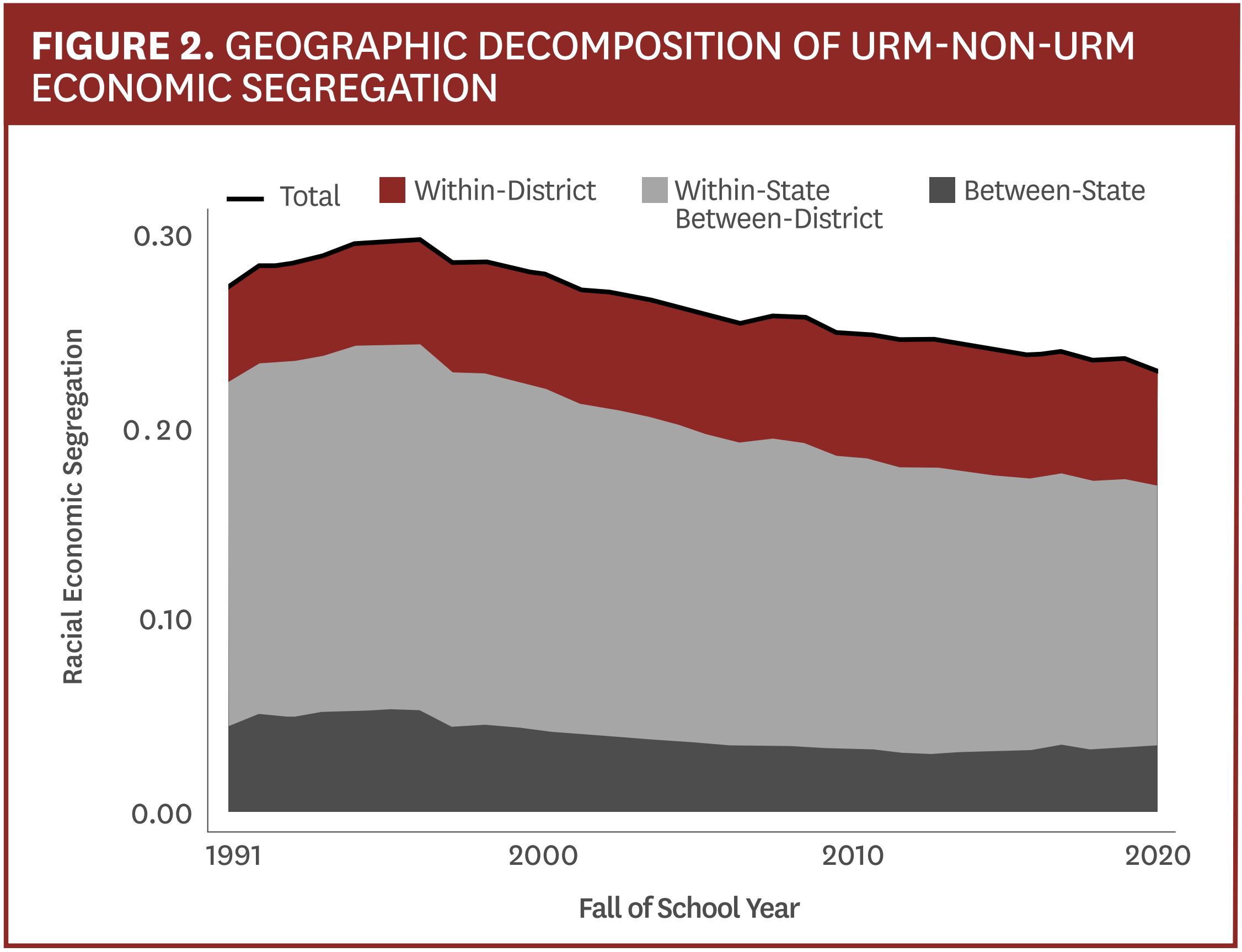
There are important exceptions to the national trends. The Stanford team also found that segregation has increased within many large school districts, particularly as earlier desegregation policies were abandoned. And we can all point to plenty of neighborhoods where schools remain highly segregated today.
But the longer history, and the source of any remaining inequities, should inform how we think about solutions going forward.
What role do schools play in segregation or integration?
For Hannah-Jones and Joffe-Walt, integration has long been central to the discussion about educational inequality. Their reporting has emphasized the advantages that flow to schools serving more affluent families and the disadvantages facing schools serving predominantly Black, Hispanic, and low-income students.
However, integration and school quality are two different goals, and that distinction matters for understanding Hannah-Jones's experience.
For integration, we have to consider the geography of school segregation. A 2023 study by economist Tomás Monarrez compared actual school enrollment patterns with what would happen if every child attended their nearest school. He found that actual school boundaries, on average, made schools slightly more integrated than residential patterns alone would predict.
In other words, if integration is the primary goal, the best solutions are policies that operate across district boundaries, such as open enrollment, regional magnet schools, charter schools, and zoning policies that make more communities accessible to more families.
Hannah-Jones herself experienced one such approach. As a Black girl growing up in Iowa, she participated in a voluntary desegregation program that bused her across town to one of the whitest and wealthiest schools in Waterloo. These types of programs can boost academic outcomes. Economist Rucker Johnson, for example, has found that Black children who attended schools under court-ordered desegregation plans went on to complete more schooling, earn more money, and experience better health as adults. Johnson also found that the benefits were especially pronounced when desegregation was accompanied by improvements in school resources, including higher spending and smaller classes.
For her part, Hannah-Jones has described her own experience with desegregation as academically transformative but socially difficult. She didn’t want her daughter to experience the same racial isolation, so she chose a predominantly Black and Hispanic school in Brooklyn. While there, her daughter encountered ungraded math assignments, classroom disruptions, and inadequate instruction.
Those sorts of academic issues tend to get lost when we treat integration as the central solution to educational inequality. America has made enormous progress on integration since the 1960s, and there are good reasons to keep working toward it. But children can’t wait for their schools to become more integrated before they get a good education. They need challenging coursework, capable teachers, and adults who notice when they’re falling behind—regardless of who their classmates happen to be.
Editor’s note: This was first published on the author’s Substack, Aldeman on Education.