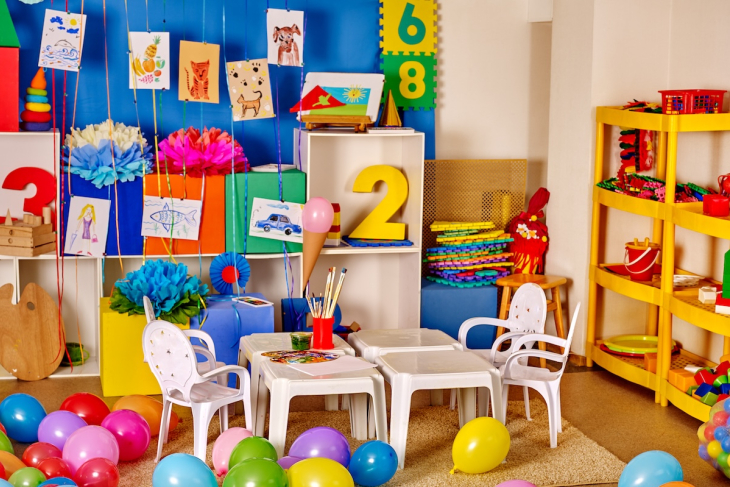
We’ve all visited those classrooms. They look like 30-gallon bags full of confetti, crepe paper, and Elmer’s glue exploded in the center. The bulletin boards are a mess of student work and neon posters, arts and crafts projects dangle from the ceiling, and groups of desks are buried in tassels and decorations.
Must a classroom be a confusing and unrelenting assault on the senses?
I admit that such an opening salvo leaves me vulnerable to accusations of wanton curmudgeonliness. Classrooms should certainly be welcoming, engaging places, and in light of rancid debates over curriculum, accountability, the role of the federal government, chronic absenteeism, declining test scores, and whatever complaint is currently raising the hackles of culture warriors left and right, why bemoan a construction-paper-happy classroom?
I understand that classroom organization and design isn’t the most important factor in school-level effects. Yet it matters. Improving test scores is an all-of-the-above affair. No hail-Mary solution will close achievement gaps and achieve universally high test scores. Rather, education reform requires an assemblage of blocks, tackles, end runs, and short passes. Teachers need guidance here, too.
I recall the prep days before my first year teaching, standing in an empty room, wondering about the minutiae of classroom design: Student desks in groups, rows, or pairs? Where do I put my own desk? How about the bookshelf? What should I put on the walls? Can I get a kidney table?
Research into such questions is sparse but informative. One study found that children were more distracted, off task, and demonstrated smaller learning gains when “walls were highly decorated than when the decorations were removed.” The results held when researchers observed students in actual classrooms, not just laboratories. Another study found students less able to complete cognitively demanding tasks in “high load visual environments.”
Too much distraction creates cognitive overload. Adults can relate. Driving on unfamiliar city streets, bustling through a busy airport with kids, or trying to read in chaotic places—each scenario presents so many stimuli to our senses that we struggle to focus. Likewise, “visual noise” in a classroom distracts students from the content of the lesson, making it more difficult to focus on what matters.
Research has also looked into the effects of seating arrangements. One older study found that when classrooms shifted from tables to rows, on-task behavior doubled, disruption decreased, and teachers provided more positive comments. A more recent review examined eight studies and concluded that “students display higher levels of appropriate behaviour during individual tasks when they are seated in rows, with disruptive students benefiting the most.”
And while this concern isn’t apt to show up in research, I wonder about the ROI of time invested. I watched colleagues labor over meticulously designed bulletin boards and highly decorated classrooms, staying late into the night. When curricular units changed, they repeated the ritual to overhaul their decorations. Wouldn’t their time be better used reflecting on and revising lesson plans, contacting homes, providing feedback, or simply leaving at a reasonable hour to spend time with their own families?
The final end of any classroom is academic instruction and learning. Thus, all decisions must be made to that end. Materials need to be easily accessible. Teachers must be able to move about freely without obstruction. And student attention should be directed towards the front where instruction occurs—not to their friends or a collage of posters and crepe paper.
Underneath the pull toward an over-decorated classroom is a prioritizing of engagement, activity, or even fun, not learning. This same tendency then manifests in classroom activities that prioritize glitter, glue, and razzmatazz over academic work. A teacher asks, “How can I engage my students today?” instead of “What are they going to learn and how can I best facilitate that?”
In the incessant push for engagement in schools, there needs to be a counterweight towards serious academic work. Mike Schmoker said it well:
Lessons need not be particularly elaborate or complex. Teachers can build them around versatile (but underappreciated) routine academic activities such as close reading, note-taking, discussions, and writing prompts about content.... Done right, these activities never become dull. Curriculum built around this core simplifies lesson planning and powerfully promotes students’ intellectual and expressive capacities.
Ideally, a classroom is orderly and free of needless distractions. Just as the famous admonition to writers from Strunk and White to “omit needless words” doesn’t mean one must always be brief or curt, just get rid of the excess, a well-ordered classroom isn’t barren and lifeless. Hang a framed painting from history, an author’s portrait, or the Declaration of Independence. Showcase the best student work on a bulletin board. Create word walls or useful anchor charts.
Obviously, I don’t expect replacing a “Dream Big, Be Kind, You Matter” pastel post with a framed portrait of Lincoln will cause fourth grade reading score on NAEP suddenly to rise. But it will signal to students that in this particular classroom, at least, the work of learning history, science, literature, and the arts is treated as a serious endeavor.