Mobile Navigation

  • National
    • Policy
      • High Expectations
      • Quality Choices
      • Personalized Pathways
    • Research
    • Commentary
      • Gadfly Newsletter
      • Flypaper Blog
    • Events
    • Scholars Program
  • Ohio
    • Policy
      • Priorities
      • Media & Testimony
    • Research
    • Commentary
      • Ohio Education Gadfly Biweekly
      • Ohio Gadfly Daily
  • Charter Authorizing
    • Application
    • Sponsored Schools
    • Resources
  • About
    • Mission
    • Board
    • Staff
    • Career
Home
Home
Advancing Educational Excellence

Main Navigation

  • National
  • Ohio
  • Charter Authorizing
  • About

Ohio Menu

  • Topics
    • Accountability & Testing
    • Advanced Education
    • Career & Technical Education
    • Charter Schools
    • Curriculum & Instruction
    • ESSA
    • Evidence-Based Learning
    • Governance
    • Personalized Learning
    • Private School Choice
    • School Finance
    • Standards
    • Teachers & School Leaders
  • Research
  • Policy
  • Commentary
    • Ohio Gadfly Newsletter
    • Ohio Gadfly Blog
    • Events

The Education Gadfly Weekly

Sign Up to Receive Fordham Updates

We'll send you quality research, commentary, analysis, and news on the education issues you care about.
Thank you for signing up!
Please check your email to confirm the subscription.

Ohio Gadfly—The 2025 edition of Ohio Education By the Numbers

Volume 19, Number 5
3.4.2025
3.4.2025

Ohio Gadfly—The 2025 edition of Ohio Education By the Numbers

Volume 19, Number 5
view
School Funding

Ohio Education By the Numbers—2025 Edition

The brand new and fully updated eighth edition of our Ohio education guidebook is out now. It offers policymakers, journalists, and civic and business leaders easy-to-use statistics—sans commentary—about Ohio’s K-12 schools and the students they serve.

Aaron Churchill 3.4.2025
OhioReport

Ohio Education By the Numbers—2025 Edition

3.4.2025
Report

DeWine’s state budget overhauls Ohio’s absence intervention framework

Jessica Poiner
3.3.2025
Ohio Gadfly Daily

Governor DeWine keeps the momentum going for Ohio charter schools

Aaron Churchill
3.3.2025
Ohio Gadfly Daily

Four ways the proposed state budget prioritizes literacy and numeracy

Jessica Poiner
2.25.2025
Ohio Gadfly Daily

Examining a new method of estimating homeschool participation

Jeff Murray
2.27.2025
Flypaper

The state of pandemic learning loss recovery

Jeff Murray
2.20.2025
Flypaper

A visit to Cristo Rey Columbus High School

Beth Lawson
2.20.2025
Ohio Gadfly Daily
view
Chronic absenteeism in the budget blog image

DeWine’s state budget overhauls Ohio’s absence intervention framework

Jessica Poiner 3.3.2025
Ohio Gadfly Daily
view
DeWine budget charters blog image

Governor DeWine keeps the momentum going for Ohio charter schools

Aaron Churchill 3.3.2025
Ohio Gadfly Daily
view
Literacy and numeracy in the budget blog image

Four ways the proposed state budget prioritizes literacy and numeracy

Jessica Poiner 2.25.2025
Ohio Gadfly Daily
view
Homeschooling

Examining a new method of estimating homeschool participation

Jeff Murray 2.27.2025
Flypaper
view
School building

The state of pandemic learning loss recovery

Jeff Murray 2.20.2025
Flypaper
view
SCO Cristo Rey piece main image

A visit to Cristo Rey Columbus High School

Beth Lawson 2.20.2025
Ohio Gadfly Daily
view

Ohio Education By the Numbers—2025 Edition

3.4.2025
Report

Welcome to the brand new, eighth edition of the Thomas B. Fordham Institute’s Ohio Education by the Numbers. This guidebook offers policymakers, journalists, and civic and business leaders easy-to-use statistics—sans commentary—about Ohio’s K-12 schools and the students they serve. This edition includes the most recent data available through January 2025, which is primarily data from the 2023-24 school year.

The following tables and charts describe education in Ohio at a high level—they are not an evaluation of state policies or school practices. Nevertheless, a basic understanding of historical trends, as well as the current status of K-12 education, can help us make more informed decisions about how best to serve students.

Whether you’re a lawmaker, reporter, community or business leader, or a parent or grandparent, this booklet is designed for you. As a readily accessible resource, we hope you’ll find it to be a go-to guide as you discuss education in your community.

You can download a PDF version of the booklet from the button at the right of this page, and you can view these data online at our companion webpage, www.OhioByTheNumbers.com.

As always, we welcome feedback for future editions.

view
Chronic absenteeism in the budget blog image

DeWine’s state budget overhauls Ohio’s absence intervention framework

Jessica Poiner
3.3.2025
Ohio Gadfly Daily

Nearly a decade ago, Ohio lawmakers passed House Bill 410 and overhauled state requirements for schools regarding student absences. The bill’s primary aim was to stop schools from “passing on” truancy problems to the courts, and to require them to work with families to address root causes of absenteeism. The hope was that, by requiring schools to use a state-established intervention framework, attendance numbers would improve. 

Then the pandemic hit, and chronic absenteeism—defined as missing at least 10 percent of instructional time for any reason—skyrocketed. In 2018–19, the statewide chronic absenteeism rate was just under 17 percent. By 2021–22, that number had jumped to 30 percent. During the most recent school year, a whopping 25 percent of students were chronically absent. In some districts, the rate is higher than 50 percent.

Something needs to change. And based on his state budget proposal, Governor DeWine agrees. He included several recommendations from a 2023 report published by the Ohio Attendance Taskforce. The report, which outlined feedback from school administrators regarding current law, found that, although HB 410’s increased focus on data was positive, the law went too far by setting a “prescriptive, legalistic, and reactive response to students missing school.” DeWine’s budget would address this by repealing requirements for districts and other public schools to assign habitually truant students[1] to absence intervention teams and adopt prescribed absence intervention plans for them. Instead, intervention efforts would be determined by schools.

Given how high absenteeism rates are around the state, it might seem like a step backward to repeal state-level requirements and turn over intervention to local officials. But it’s important to recognize that the state’s top-down framework was in place all throughout the pandemic and has remained in place over the last few years. While it’s likely that nothing could’ve prevented the spike in absences during an unprecedented health crisis that included inconsistent building closures, schools have been back to business as usual for at least two full school years. If a rigid, one-size-fits-all framework mandated by the state was the best way to decrease absenteeism, then surely the statewide rate would’ve dropped more than just a measly 1 percentage point between 2022–23 and 2023–24. But it didn’t.

The attendance taskforce was established for a reason. And the changes in the budget should help accomplish the taskforce’s recommended shift from compliance-driven activities to prevention and early intervention. Budget analysis observes that, according to the Department of Education and Workforce (DEW), districts and schools have reported dedicating “a significant amount of staff hours and resources” to implement current requirements. The taskforce report found the same, noting that, because the law prescribes what and how to communicate with families, it’s “preventing districts from efficiently using more effective methods they’ve identified.”

In other words, the current system is more of an administrative burden than an effective intervention framework. It’s costing schools time and money and preventing them from trying other things, all while absenteeism rates remain sky-high. By repealing these requirements, the budget would allow schools to recoup hours and resources that they can then invest in prevention and early intervention efforts.

But that doesn’t mean absence tracking and intervention will be a free-for-all. State report cards will continue to track chronic absenteeism rates. And the budget also requires districts and schools to adopt a (revised) policy to address student absences by August 1, 2026. These policies, which must be developed in consultation with juvenile courts, as well as parents and guardians, must do all of the following.

  1. Acknowledge that student absences for any reason, whether excused or unexcused, take away from instructional time and have an adverse effect on student learning. This requirement is crucial given recent efforts to water down attendance expectations and make it easier for students to miss school. 

  2. Identify strategies to prevent students from becoming chronically absent. DEW already offers plenty of resources, so districts won’t need to reinvent the wheel. But they will have to select strategies that their schools can (or should) implement.

  3. Include procedures for notifying parents and guardians when a student has been absent for a number of hours determined by the board. This number cannot exceed 5 percent of the minimum number of required hours in a school year. Although it might seem like a no-brainer for schools to notify parents of attendance issues, there are places where it won’t happen without a state-level requirement.

  4. Establish a tiered system that provides more intensive interventions and supports for students with greater numbers of absences. This system must include resources to help students and families address the root causes of absences. Districts and schools are permitted to consult or partner with public and nonprofit agencies to provide assistance.

  5. Provide for one or more absence intervention teams. Although the student assignment requirement is gone, intervention teams remain. They will work with students (and families) at risk of becoming chronically absent to improve attendance.

  6. Prohibit schools from suspending, expelling, or otherwise preventing a student from attending school based on their absences. This was a key feature of HB 410, and it makes sense to maintain it—responding to chronic absenteeism by forcing students to miss even more school is not effective.

The upshot? While districts and schools will have a lot more freedom and flexibility to respond to chronic absenteeism, the state-level expectation to track absences and address them hasn’t changed. Given all the research indicating that chronic absenteeism negatively impacts academic and social-emotional development, that’s good news—especially when one-fourth of Ohio’s students are chronically absent.


[1] State law defines a habitual truant as a student who is absent without legitimate excuse for thirty or more consecutive hours, forty-two or more hours in one school month, or seventy-two or more hours in one school year.

view
DeWine budget charters blog image

Governor DeWine keeps the momentum going for Ohio charter schools

Aaron Churchill
3.3.2025
Ohio Gadfly Daily

During his terms in office, Governor Mike DeWine has been a strong supporter of public charter schools. His signature policy initiative in this area is the high-quality charter funding program that he shepherded through the legislature in 2019. The program has provided much-needed aid to charters, which have long faced significant funding shortfalls. A recent Fordham study found that qualifying schools have used these funds effectively—including increased teacher pay—and have yielded achievement gains for students.

Earlier this month, the governor unveiled his budget proposals for the next biennium. Included among them are several notable—and praiseworthy—charter school provisions that, if enacted, would continue to move the sector in the right direction. Let’s take a look at what three of his charter proposals would do.

1. Protect critical charter funding initiatives for the long-term

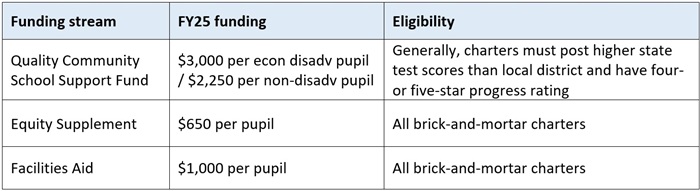
Over the past decade, state lawmakers have created three programs that help to narrow (though not quite erase) the charter funding gap. As table 1 indicates, they include the high-quality funds, as well as a charter equity supplement and per-pupil facilities allowance. Taken together, the high-quality funding and equity supplement narrow the operational funding gap for high-quality charters to about 10 percent below local district funding—a large improvement against the roughly 30 percent shortfall they have historically faced. Meanwhile, the facilities aid ensures that about half of charters’ building-related expenses are covered.

Table 1: State programs that narrow charter (community school) funding gaps[1]

DeWine budget charters blog figure 1
Notes: Ohio’s eight independent STEM schools, which are funded similarly to charters, are eligible for QCSSF and facilities aid. Online charters are ineligible for the equity supplement and receive $25 per pupil in facilities aid; no online charters have met the criteria for QCSSF dollars.

Governor DeWine’s budget leaves all three programs intact and commendably raises the facilities amount to $1,500 per pupil. But it also takes one more important step forward that will help increase the likelihood that these programs continue long after the governor has left office. He proposes, for the first time, to etch these programs into statute,[2] a move that signals they are integral elements of the state’s funding system for charter schools. As such, it would be more politically challenging for future lawmakers to cut funding for these programs. As the budget bill heads to the legislature, lawmakers should approve the new statutory language. They should also further solidify the high-quality and facilities funds by incorporating those dollars into the state’s general K–12 education appropriation.[3]

2. Boost state support for charter facilities

Charters have long struggled to secure adequate facilities, as they’re ineligible for Ohio’s main school construction program and lack access to the local taxes that support districts’ capital projects. The only significant source of facility support for charters is the state’s per-pupil facility aid, which was first created during the Kasich administration. To its credit, the legislature has ramped up this funding in recent years. And as noted above, the governor has proposed another boost in his budget proposal.

House and Senate lawmakers should enthusiastically approve the per-pupil facility increase. They should also embrace proposed changes to the state’s unused facilities law that would increase charters’ access to vacant or underutilized district buildings. For years, Ohio has had a right-of-first-refusal law that requires districts to offer an “unused” building—either vacant or half-empty—to charters for lease or purchase. The policy makes perfect sense. These are purpose-built facilities that taxpayers have already paid for, and if provided to charters, they would continue to serve communities and students, rather than becoming blight or repurposed for other uses.

Unfortunately, school districts have not always dutifully offered these properties to charters, and the governor’s budget wisely strengthens this section of law to ensure they do so. His proposal includes a clearer and more objective definition of an “unused” facility, ensures that unused buildings are offered to charters at more affordable prices, opens opportunities for high-quality charters anywhere in the state to bid on facilities, and adds transparency requirements that help ensure compliance with these provisions. In sum, the proposed rewrite will help more charters meet their facility needs through increased access to unused district buildings.

3. Improve accountability for dropout recovery schools

Of Ohio’s roughly 320 charter schools, eighty-four are formally designated by the state as “dropout recovery” schools. To receive that designation, current law requires a “majority” of students to be enrolled in a dropout prevention and recovery program operated by the school. Acknowledging that most students attending such schools are academically behind, the state has implemented an alternative—and much softer—accountability system for dropout recovery charters.

However, the “majority” threshold (just 50.1 percent) for designation and alternative accountability allows dropout recovery schools to avoid the higher expectations that we should have for their general-education students. For instance, Ohio gives dropout recovery schools credit when students graduate well past the traditional four-year window after ninth grade.[4] That makes some sense for an adolescent who dropped out for a couple years, but that type of leniency is inappropriate for a general-education student who should be expected to graduate in four years. Also problematic is that a few dropout recovery schools currently serve elementary students. Their results simply go unaccounted for in the dropout recovery accountability system, which focuses on high school–based measures.

To its credit, the budget bill tightens the definition of a dropout recovery school. Under the proposed legislation, a dropout recovery charter must enroll only students ages fourteen to twenty-one who are at least one grade level behind their age cohort when they initially enroll.[5] In practice, this would mean that such schools are actually “specialized” dropout recovery high schools, and are more justly subject to alternative accountability standards. The bill provides a two-year transition period for current dropout recovery schools to allow them to create a “spin-off” school that serves students not covered in the age-range requirements, and to assist general-education students in finding another school. 

* * *

To his credit, Governor DeWine has once again gotten charter policy off to a strong start in this year’s budget cycle. House and Senate lawmakers should enthusiastically approve the proposals discussed above. Yet they can move the ball even further downfield. As we at Fordham have recommended, they should further support charter facility needs by creating credit enhancement and revolving loan programs that reduce the costs of financing capital projects. They should also provide a lift to charters that do not qualify for the high-quality dollars—schools that still suffer from wide funding gaps—by boosting the charter equity supplement to $1,000 per pupil. In the days ahead, lawmakers should continue to make charters—a high-quality option for a growing number of Ohio families and students—a priority in the state budget.


[1] The governor’s budget proposal would provide STEMs with the equity supplement.

[2] In past budgets, these programs have been funded through temporary (i.e., “uncodified”) appropriations language of the budget bills.

[3] The high-quality funds and facilities aid are funded via standalone, line-item appropriations that could be vetoed by a future governor. The equity supplement is not funded via standalone appropriation.

[4] Dropout-recovery schools’ graduation rating is based on a combination of four-, five-, six-, seven-, and eight-year graduation rates. Other public schools’ (district and charter) graduation ratings are based on four- and five-year graduation rates.

[5] The bill also says a dropout recovery school may enroll students who “experience crises that significantly interfere with their academic progress such that they are prevented from continuing their traditional educational programs.”

view
Literacy and numeracy in the budget blog image

Four ways the proposed state budget prioritizes literacy and numeracy

Jessica Poiner
2.25.2025
Ohio Gadfly Daily

In 2023, Governor DeWine made a statewide initiative grounded in the science of reading, an evidence-based instructional approach that focuses on phonics and knowledge-building, the centerpiece of his education budget. As part of the initiative, public schools were required to adopt curricula and materials that appear on a state-approved list of high-quality options. Teachers were required to undergo professional development. Funding was set aside for reading coaches in the state’s most challenged schools. And the Ohio Department of Higher Education was tasked with auditing teacher preparation programs to ensure proper training in the science of reading.

Implementation of these efforts got off to a good start in 2024. But Ohio still has a long way to go to reach the finish line. Results from the 2024 administration of the National Assessment of Educational Progress (NAEP)—which was administered prior to schools implementing the science of reading—show that Ohio’s reading proficiency rates have declined in both fourth and eighth grade. Just 32 percent of fourth graders achieved proficiency. Math scores were slightly better, but still pretty bad—less than a third of eighth graders were proficient. Results on state exams in both subjects are similarly lackluster.

The upshot? If policymakers are serious about improving student achievement, then the 2025 budget needs to double down on the literacy efforts that began in 2023 and add numeracy to the mix. Fortunately, Governor DeWine’s initial budget proposal does both. Here are four provisions the governor proposed that could push Ohio further down the achievement path.

1. Expanding access to advanced math

Earlier this year, my colleague Aaron Churchill made a persuasive argument for expanding access to advanced math courses. In particular, he argued in favor of automatically enrolling high-achieving seventh graders in Algebra I during eighth grade. All across Ohio, there are already eighth graders who take Algebra I. But it’s only a fraction of the students who have demonstrated their ability to succeed in that course based on their performance on state math exams. An automatic enrollment policy would ensure that all high achievers are on a rigorous academic pathway that can help them enroll in selective colleges or pursue STEM careers.

The governor's budget proposal takes a more expansive approach by extending advanced math opportunities to all high achievers, not just those headed toward Algebra I. If passed, it would require districts to provide every student who achieves at the advanced level—the highest mark on state math exams—with learning opportunities that “provide academic content or rigor that exceeds the standard curriculum for a student’s grade level.” That includes enrolling students in an advanced math course during the following school year.

There are two exceptions worth noting. First, districts must notify the parents and guardians of students who qualify for advanced opportunities and courses. Upon notification, parents may opt their child out. Although it seems unlikely that many would do so, including an opt-out provision is wise. Second, districts are only required to offer advanced learning opportunities and courses if those options already exist for the grade level the student will enter the following school year. In other words, districts wouldn’t be obligated to create new opportunities or courses—they’re merely required to ensure that advanced students are enrolled in any courses or opportunities that do exist. That’s a mistake. The purpose of an automatic enrollment policy is to ensure that every student who is ready for advanced math has access to it. Excusing districts from meeting the needs of their advanced students runs counter to that purpose.

2. Universal screening tools for reading and math

Diagnostic assessments are crucial tools for schools, as they identify children who are off-track and make early intervention possible. A foundational piece of Ohio’s Third Grade Reading Guarantee is a requirement for schools to administer a reading diagnostic assessment to all students in grades K–3. The Department of Education and Workforce (DEW) has developed a diagnostic exam for this purpose. But districts aren’t currently required to use it. They are permitted to choose a different diagnostic from a state-approved list instead, even though data suggest that that some of these assessments may not be predictive of children’s reading proficiency. Meanwhile, although current law calls on DEW to adopt diagnostic assessments for math, the requirement is only for grades one and two. And districts aren’t required to administer those exams, either.

Together, these flexibilities mean that hundreds, maybe even thousands of students who are struggling in math, reading, or both aren’t being properly identified and might not be receiving the intensive support they need. DeWine’s budget seeks to address this issue by requiring DEW to adopt a diagnostic assessment aligned with Ohio’s academic standards in both reading and math for each grade K–3. The assessment for reading must be aligned to the science of reading. And schools will be required to administer DEW’s diagnostics beginning in the 2026–27 school year. That means math diagnostics will no longer be optional, nor will districts be able to choose a different assessment. This universal expectation is crucial, as it will ensure that struggling students are properly identified and that all schools will be operating from the same identification playbook.

3. Continuing the focus on professional development

Providing teachers and administrators with professional development in evidence-based reading instruction is a key feature of Ohio’s statewide early literacy effort. DeWine’s latest state budget proposal continues the focus on training in two ways. First, it maintains funding to support literacy coaches in schools with the lowest reading proficiency. And second, it adds some new requirements to ensure ongoing development.

Specifically, the budget calls on DEW to do two things: 1) maintain a training course for licensed educators that serves as an introduction to the science of reading (likely the one it’s currently offering to fulfill requirements enacted in the last budget), and 2) develop a competency-based training course for licensed educators that will update and reinforce their knowledge and skills in the science of reading. Anyone hired as a teacher or administrator in a public school prior to July 2025 must complete the competency-based training course by June 2030 and every five years thereafter. Those hired by public schools after July 2025 must complete the initial training course within one year of being hired[1] and the competency-based course every five years thereafter. Completing these trainings will count toward professional development requirements for educator license renewal. 

4. Leveraging state dollars for disadvantaged students to provide reading intervention

Context on two Ohio-specific policies is required to understand this proposal. First is Reading Achievement Plans (RAP). As part of Ohio’s Third Grade Reading Guarantee, districts and charter schools with poor literacy results are required to submit RAPs to the state. As the name suggests, an RAP is a district plan for raising student achievement in reading. These plans must include analyses of student data, measurable performance goals, and improvement strategies. Second is disadvantaged pupil impact aid (DPIA). DPIA is a funding stream that allocates extra state aid toward meeting the needs of low-income students. These dollars are intended to cover the cost of supplemental services like high-dosage tutoring, extended learning time, and other interventions for the state’s neediest students. In 2024, Ohio allocated $563 million toward DPIA.

Under the proposed budget, districts and schools that submitted RAPs during the prior fiscal year would be required to spend at least 50 percent of their DPIA funding in the current fiscal year on two things: 1) reading improvement and intervention aligned with the science of reading and evidence-based strategies and/or 2) professional development in the science of reading and evidence-based strategies for K–3 teachers. Districts and schools must specify in their improvement plans how they will use DPIA funds to comply with this requirement. Meanwhile, all other districts, charters, or STEM schools—those that aren’t under an RAP—will be required to spend at least 25 percent of their DPIA funds on these reading-specific efforts.

By leveraging DPIA to address reading outcomes, the DeWine administration is zeroing in on one of Ohio’s most significant problems: the sizable achievement gap between low-income students and their more affluent peers. Recent NAEP results show that the achievement of Ohio’s economically disadvantaged students has worsened over the past decade, and that the biggest drop has been in fourth grade reading. State exam results also show a sizable gap between economically disadvantaged students and their non-disadvantaged peers. Requiring schools to use funds that are targeted at low-income students on reading improvement efforts could give these students a much-needed literacy boost.

***

Governor DeWine deserves kudos for his continued commitment to early literacy and for tackling numeracy. But there’s always room for improvement, and there are several ways that lawmakers in the House and Senate could strengthen the governor’s proposals over the next few months. Stay tuned for a future piece that outlines our recommendations.


[1]   New hires aren’t required to complete the initial training course if the district superintendent or head administrator can verify that, within five years prior to the date of hire, they already completed that training or a similar training or that they completed appropriate coursework as part of their preparation program.

view
Homeschooling

Examining a new method of estimating homeschool participation

Jeff Murray
2.27.2025
Flypaper

A valuable recent edition of the Journal of School Choice focused entirely on research around homeschooling, aiming to add useful data and rigorous analysis to this little-studied education sector. The work published in that edition gives us a new appreciation for homeschooling but also illustrates how much we still need to learn. It is as much about refining the research process as it teasing out the findings. We at Fordham have already reviewed two of the reports in that issue, and here is another report, in which analysts test some interesting strategies to identify data on homeschooling from surveys asking parents about other aspects of their children’s education.

Missouri does not live up to its famous nickname in at least one regard: The Show Me State is one of twenty-nine states that do not require homeschooling to be reported by parents to any agency. Amy Shelton and Collin Hitt, two Saint Louis University researchers, recently tested three approaches to estimating homeschool enrollment in Missouri using publicly available datasets.

Their first approach uses data from the Census Bureau’s American Community Survey (ACS) from 2008 to 2023. ACS samples households continuously throughout the country and uses those responses to estimate the demographics and socioeconomic conditions of the entire population, broken down at the state and community levels. Among the education-related questions, ACS asks respondents to indicate school type and grade (if applicable) for each person in the household, and reports the results in three bands—ages 5–9, 10–14, and 15–17.

Shelton and Hitt compare the population of school-age children in Missouri to the totals in the three age bands reported by ACS to arrive at an annual estimate of the number and percentage of school-age children enrolled in each type of school. This approach is a start, but it is far from definitive for two reasons. First, because the ACS education categories are “public school,” “private school, homeschool,” and “has not attended in the last three months.” It is entirely plausible that homeschool families might choose either “has not attended” or “homeschool” as an option for their children on this survey, obscuring the true numbers of homeschoolers in both categories. Second, compulsory education in Missouri begins at age seven, leaving a swath of five- and six-year-olds who could be artificially inflating the “has not attended” numbers.

The analysts’ second approach compares the ACS data to two other sources, looking to eliminate as many verified private and public school students from the ACS categories as possible. Private school enrollment data come from the Private School Universe Survey (PSS) administered every other year to private-school leaders across the country by the National Center for Education Statistics (NCES), and public school numbers come from the Missouri Department of Elementary and Secondary Education.

The analysts clean both sets of data to match ACS as closely as possible, including estimating numbers for the out-years when PSS was not administered. Both are analyzed looking for trends—decreases and increases in students in public and private schools, but decreases in particular—that could equate to changes in enrollment within the three ACS school type categories. Shelton and Hitt zero in on an observed decrease of 16,000 students attending public schools between the 2019–20 and 2021–22 school years—that is, through the first years of the coronavirus pandemic, when enrollment patterns shifted nationwide. Private school enrollment in Missouri increased by approximately 1,800 students in the same time period, but that only accounts for 11 percent of the net public-school decrease. This suggests that the majority of the increase also observed in ACS’s “private school, homeschool” category over that time is due to increased homeschooling participation in Missouri. However, despite heroic attempts to align the three datasets, both the lowest (ages 5–9) and the highest (15–17) age bands likely suffer from noisy data based on Missouri’s specific K–12 framework, as noted above.

The third analytical approach utilizes data from the Census Bureau’s Household Pulse Survey (HPS), which began in April 2020 to examine trends in the experiences of American families during the pandemic and beyond. The first waves of the HPS asked respondents if, at any time during February 2020, any children in the household were enrolled in a public or private school or educated in a homeschool setting in kindergarten through twelfth grade. Subsequent surveys asked the same question regarding the 2020–21, 2021–22, 2022–23, and 2023–24 school years. Importantly, public and private school enrollment are grouped as one response category on the HPS, while homeschool is offered as second, standalone category of school enrollment—that is, formal schooling versus homeschooling.

They pool these results along with Missouri-specific household surveys conducted by St. Louis University’s PRiME Center research hub in 2021 and again in 2024, concluding that approximately 7.26 percent of Missouri’s school-age children were homeschooled in fall 2021, including 6.92 percent of children in grades 4–8 (once again, the most accurate age/grade bands due to data misalignment). Those numbers increased to 10.49 percent of all Missouri school-age children and 9.9 percent of fourth through eighth graders when parents were polled in 2024.

Putting all of this together, Shelton and Hitt conclude that, in 2024, approximately 61,000 Missouri children ages 5–17 were homeschooled, a substantial increase from 37,000 children in 2020. Put into perspective: That is roughly equal to the public school enrollments in St. Louis City and Kansas City combined. It also confirms for them, as accurately as existing data will allow, that the anecdotal pandemic-era boost in homeschooling indeed occurred in Missouri and persisted beyond the restoration of “schooling as usual” in the state.

The authors recommend that state leaders interested in supporting families take note of these findings and craft policies according to the true state of play in education, which appears to be different than most policymakers and pundits believe it is. Additionally, Shelton and Hitt urge researchers in other states to replicate their work. ACS, NCES, and HPS data are available for every state, and the statewide polling that the PRiME Center conducted—which put all of the other Missouri datasets into focus—can be done simply and inexpensively in other states. It’s a huge step forward for homeschooling research.

SOURCE: Amy Shelton and Collin Hitt, “Taking Attendance: Estimating Homeschooling Populations in States without Official Homeschool Data – a Pilot Analysis in Missouri,” Journal of School Choice (December 2024).

view
School building

The state of pandemic learning loss recovery

Jeff Murray
2.20.2025
Flypaper

The third iteration of the Education Recovery Scorecard, compiled by Harvard’s Center for Education Policy Research, was released hot on the heels of 2024 NAEP test scores and is an invaluable supplement to that dismal data. The Scorecard is specifically looking for evidence of recovery from pandemic learning loss at the district level and—unfortunately—does not find much.

To get a picture of how schools are or are not bouncing back, the Center uses score results from NAEP math and reading exams, plus state assessments administered to roughly 35 million fourth- and eighth-grade students across forty-three states in 2019, 2022, and 2024. The analysts then connect these data to findings from their previous report on federal pandemic relief funding and national data on chronic student absenteeism (gathered by AEI’s Nat Malkus) to see how each has impacted those recovery goals.

The 74’s Kevin Mahnken sums up the scorecard’s findings most starkly: “More than five years after the first appearance of Covid-19 on American shores, 94 percent of elementary and middle schoolers live in districts that still have not returned to pre-pandemic levels in math and reading.” Overall, students have fallen further behind than where they were in 2022 and the average student today is still six months behind in both core subject compared with children in the same grades in 2019.

These negative findings are more pronounced in districts serving higher proportions of lower-income and racial/ethnic minority students. In math, for example, the disparity in scores between students in affluent and low-income districts has grown by 11 percent since the start of the pandemic, and the disparity in scores between students in predominantly non-minority versus minority districts has grown by 15 percent. Even within districts, the average racial/ethnic disparities in math scores have grown by 7 to 12 percent since 2019. That is, even the small pockets of positive growth observed are in higher-income and majority-white districts. The same gaps have grown in reading, as well, but not by quite as much.

As to funding, each dollar of federal relief was shown to improve student achievement by about as much as a general revenue increase—approximately 0.008 of a standard deviation per $1,000 spent. And while that is precious little bang for the buck, the analysts are sure that outcomes would have been far worse without it. It is also clear that what districts bought with the money mattered even more than the amount. In California, where the most-detailed expenditure data were available, student achievement grew more in districts that spent their funds on academic interventions, such as tutoring or summer school, versus districts that spent on more general items like staffing or facilities.

Chronic absenteeism, predictably, exerted a drag on student achievement, although the correlation was less direct. While AEI’s data show the chronic absenteeism rate has declined from its peak in 2022, it remains 8 percentage points higher than immediately before the pandemic. The rise in absenteeism was widespread, occurring in both high- and low-income districts. However, the increases were larger in low-income, high-poverty districts and in districts which had high absenteeism rates before the pandemic.

Fortunately, it’s not all gloom and doom. The data show that there are over 100 school districts that have fully recovered from pandemic learning loss. The analysts took an in-depth look at several of them, including Ector County, Texas (where leaders used $7 million to reward outstanding teachers for becoming “master teachers” and showing improvements in student learning), and Natchitoches Parish School District in Louisiana (where leaders replaced ineffective curricula with a science of reading-based program and retooled their instruction weekly based on student testing data). None of this means that these districts are necessarily doing everything right, of course, but getting back to square one is a prerequisite for any further improvement. Those that have done so should be examined and lauded.

The scorecard report concludes by highlighting four priority items that could help more districts, schools, and students recover from Covid learning loss. These are (1) continuing to fund—by any means necessary—proven, high-quality academic catch up efforts that now-exhausted federal funding kickstarted; (2) making a full-court press to reduce chronic absenteeism, specifically by enlisting local leaders, employers, and community members in the effort; (3) consistently and clearly informing parents about their child’s progress (or lack thereof) toward on-grade-level achievement and offering easy access to any available remediation programming; and (4) expanding reforms that are working, like the science of reading and high-quality curricula, to other states who have yet to join the party.

Millions of American students have graduated or otherwise left school since the coronavirus pandemic closed their school buildings five years ago. That damage is no longer the province of K–12 education to remediate. But millions more are still here, and their sisters and brothers are coming up behind. We owe them nothing less than to learn from past mistakes, end the harm, and commit every resource to actively repairing their educational paths and launching them to further and better academic achievement.

SOURCE: Daniel C. Dewey et al., “Education Recovery Scorecard: Pivoting from Pandemic Recovery to Long-Term Reform,” Center for Education Policy Research (February 2025).

view
SCO Cristo Rey piece main image

A visit to Cristo Rey Columbus High School

Beth Lawson
2.20.2025
Ohio Gadfly Daily

NOTE: This piece was originally published as part of School Choice Ohio’s Success Stories in Education blog series.

Since joining the SCO team in 2022, I had been hearing about the Cristo Rey network of schools, specifically the three schools in Ohio; Columbus, Cincinnati, and Cleveland. Their approach to the education and training of their students was very intriguing and I was hoping for an opportunity to visit one of the Cristo Rey schools in our state.

Last week, members of the SCO team got an invitation to visit Cristo Rey Columbus High School. Our visit exceeded any expectations or understanding that I had about the school, its founding story, the school’s corporate partnerships and the opportunities it provides for each one of its students.

SCO Cristo Rey piece image 1
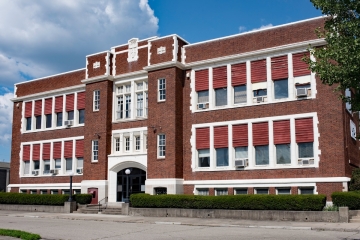
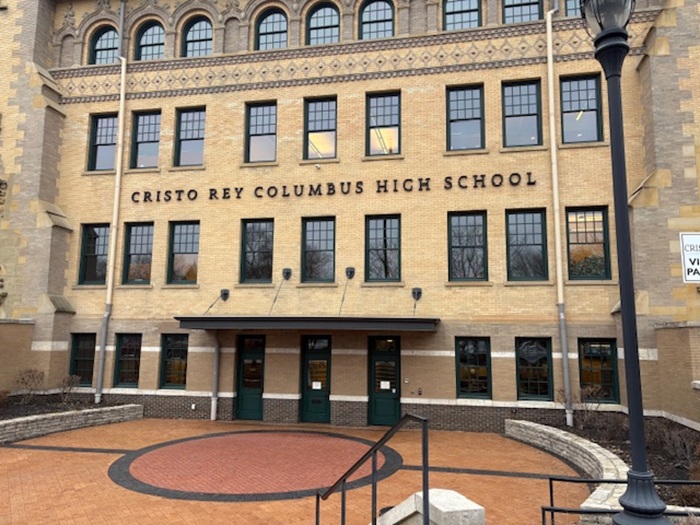
Cristo Rey Columbus is situated in downtown Columbus, Ohio. Quite frankly, the building is beautiful and impressive from the moment you pull into the parking lot. The school was built in 1899 to serve as the home of the Ohio Institution for the Deaf which moved to another location in 1953. The building was slated for demolition after falling into disrepair over the years, but a group of motivated people saw a vision to found Cristo Rey Columbus.  Through the efforts of what can only be described as a village, the property went through major restoration and renovation before opening its doors in 2014. The site is now listed on the National Register of Historic Places and the Columbus Register of Historic Properties.

An Innovative Approach to Education

One of the most remarkable things about an education at Cristo Rey is the community partnerships that have been formed that directly benefit CRCHS students. One of the school’s first partnerships was with the library that sits next door to the school building. The Columbus Metropolitan Library serves both as the school library and as a community partner that employs Cristo Rey students each school year through the school’s Professional Work Study Program (PWSP).

SCO Cristo Rey piece image 2
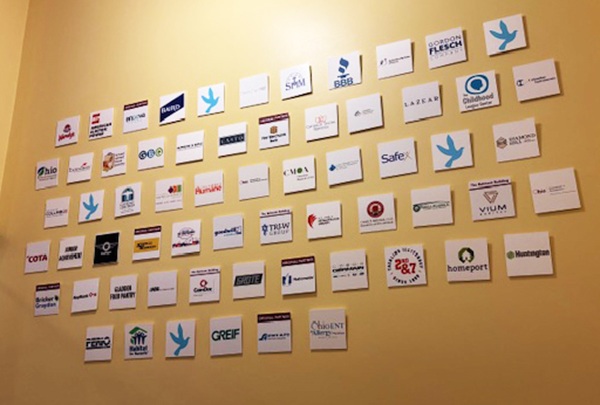
Cristo Rey Columbus High School proudly displays its Professional Work Study Program partners in the main lobby.

The Professional Work Study Program is foundational to the education and student life at Cristo Rey. This unique and intentional approach sets the Cristo Rey model apart as an exceptional educational option for students. The PWSP not only enhances each student’s high school experience and training but also assists corporate partners in filling entry level positions. Corporate partners help make their students’ education affordable while also pouring into the lives of the students working at their offices or facilities.

Each student gains professional work experience that prepares them for life beyond school. Every Cristo Rey Columbus student works with and for a corporate partner during the school year. Incoming students participate in the Summer Business Training program which is designed to prepare and enable each student to make the most of the PWSP opportunity Cristo Rey affords them. Work opportunities are in a variety of fields such as medical, legal, government and business offices. Students are provided with supervision and mentorship throughout their 4 years at Cristo Rey.

It is important to note that two-thirds of the student body lives in a household whose income is below 175 percent of the Federal Poverty Level. ALL students of Cristo Rey live in a household whose income may not exceed 250 percent of the Federal Poverty Level. Educational costs are funded through EdChoice Scholarships, the Work Study Program, fundraising, and family contributions which average $900 per year. The ongoing education for students would not be possible without much-needed additional funding from private and corporate donor partnerships. It was surprising to learn that the school provides transportation for every student to and from their work study employer. Those transportation costs alone are almost $100,000 per year…and can you imagine coordinating those logistics?

SCO Cristo Rey piece image 3
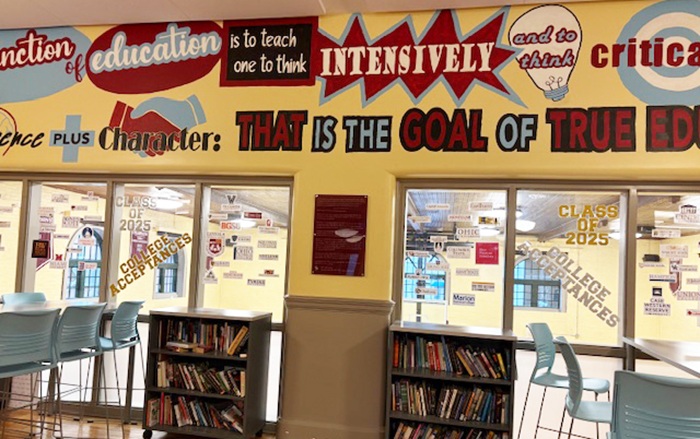
While the work study platform provides a lot of benefits for both the students and corporate partners, the atmosphere at Cristo Rey sets the tone for student success. The positive messaging, from verbal to visual, serves to celebrate student achievement and inspire each student for their future.

Proof of Concept:  The Amazing Students of Cristo Rey

Cristo Rey Columbus serves a student body of about 400 students.  It was not surprising to learn that each year, over 400 students apply for 100-120 spots in the upcoming freshman class. In the admissions process, faculty look for students who are committed to academic, spiritual, emotional, and professional growth.

The student body is diverse, giving students an opportunity to learn from other students who represent 43 different countries within the student body.   The Student Council designed a wall display that celebrates all the different countries of origin within the school’s student population.

SCO Cristo Rey piece image 4
Student Council wall display celebrates the countries of origin represented in Cristo Rey’s diverse student body.

Student outcomes prove the education model at Cristo Rey through the 100 percent graduation rate and the 100 percent college acceptance rate of their students. During our visit, we had an opportunity to meet with two of the exceptional students at Cristo Rey Columbus.

Marie is a sophomore at Cristo Rey. As the youngest of five, she is a very poised and impressive young lady who is taking full advantage of all that Cristo Rey has to offer. In her first (freshman) semester she worked at the Better Business Bureau, followed by a semester at City Hall. This year, she is working at Ohio ENTs and that has influenced her desire to become a neurologist. Marie was very honest with us in stating that sometimes the workload is a lot. To make sure that she remains focused on her studies she withdrew from extra-curriculars at least for now.

It was very interesting to hear the perspective of Amani, a senior who is nearing the end of her journey at Cristo Rey Columbus.  Throughout her 4 years, Amani has participated in sports, while working with corporate partners such as the Ohio Department of Health, the YMCA, and T. Marzetti Company.  She will be pursuing a degree in the math or science fields and has already been accepted to Miami and Hampton Universities. When a senior is accepted to college, each accepted student’s locker is decorated to celebrate their admission to college.

The Staff

After meeting these two remarkable young ladies, school leaders shared about the accomplishments, progress, and successes both students have made in their time at Cristo Rey. It was especially compelling to see how proud they are of their students. It was a clear reflection of the mission and purpose each staff member feels toward their students. Every staff member that we met was excited to share not only specific illustrations, but also the reasoning behind every aspect of education and student life at Cristo Rey.

It Takes a Village

The unique and transformational approach to education at Cristo Rey directly correlates to its success as demonstrated by student outcomes. From the vision to found Cristo Rey Columbus to the work study program and educational opportunities, the business, educational and organizational partnerships formed to benefit students are what has made Cristo Rey Columbus High School an outstanding educational option for students.

For more information about Cristo Rey Columbus High School visit their website at https://www.crchsworks.org/.

Beth Lawson is Director of Media and Communication for School Choice Ohio.

Fordham Logo

© 2026 The Thomas B. Fordham Institute
Privacy Policy
Usage Agreement

National

P.O. Box 110
Burke, VA 22009

202.223.5452

[email protected]

Ohio

P.O. Box 82291
Columbus, OH 43202

614.223.1580

[email protected]

Sponsorship

130 West Second Street, Suite 410
Dayton, Ohio 45402

937.227.3368

[email protected]