Mobile Navigation

  • National
    • Policy
      • High Expectations
      • Quality Choices
      • Personalized Pathways
    • Research
    • Commentary
      • Gadfly Newsletter
      • Flypaper Blog
    • Events
    • Scholars Program
  • Ohio
    • Policy
      • Priorities
      • Media & Testimony
    • Research
    • Commentary
      • Ohio Education Gadfly Biweekly
      • Ohio Gadfly Daily
  • Charter Authorizing
    • Application
    • Sponsored Schools
    • Resources
  • About
    • Mission
    • Board
    • Staff
    • Career
Home
Home
Advancing Educational Excellence

Main Navigation

  • National
  • Ohio
  • Charter Authorizing
  • About

National Menu

  • Topics
    • Accountability & Testing
    • Advanced Education
    • Career & Technical Education
    • Charter Schools
    • Curriculum & Instruction
    • ESSA
    • Evidence-Based Learning
    • Facilities
    • Governance
    • Personalized Learning
    • Private School Choice
    • School Finance
    • Standards
    • Teachers & School Leaders
    • Think Again
  • Research
  • Commentary
    • Gadfly Newsletter
    • Flypaper Blog
    • Gadfly Podcast
  • Events
  • Scholars Program

Teachers & School Leaders

Displaying 1441-1450 of 1450 results
Report
2.14.2008
Governance, Teachers & School Leaders

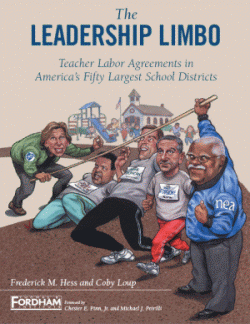
The Leadership Limbo

Coby Loup

In the era of No Child Left Behind, principals are increasingly held accountable for student performance. But are teacher labor agreements giving them enough flexibility to manage effectively? The Leadership Limbo: Teacher Labor Agreements in America's Fifty Largest School Districts, answers this question and others.
Report
9.18.2007
Governance, Teachers & School Leaders

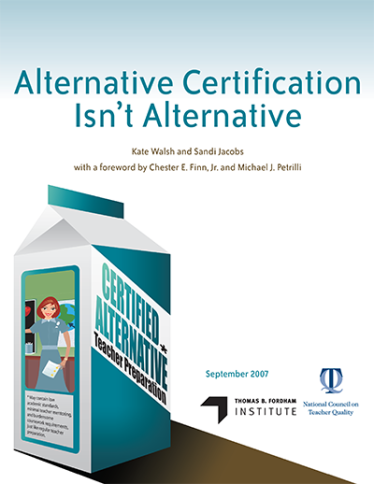
Alternative Certification Isn't Alternative

Kate Walsh, Sandi Jacobs

At first glance, the explosive growth of 'alternative' teacher certification--which is supposed to allow able individuals to teach in public schools without first passing through a college of education--appears to be one of the great success stories of modern education reform. But, as this report reveals, alternative certification programs have so far failed to provide a real alternative to traditional education schools. In fact, they represent a significant setback for education reform advocates.

Report
3.16.2006
Teachers & School Leaders

Fwd: Teacher Education: Coming Up Empty

Kate Walsh

The nation's leading teacher educators made a startling admission last year in their tome, Studying Teacher Education, by conceding there's little evidence that what happens in ed schools helps in the K-12 classroom. Kate Walsh explores why teacher educators are ignoring the achievement gap and, thus, consigning their field to irrelevance.

Report
9.8.2005
Accountability & Testing, Teachers & School Leaders

Personality Test: The dispositional dispute in teacher preparation today, and what to do about it

William Damon

The standards of the National Council for Accreditation of Teacher Excellence (NCATE) are of critical import for America's future teaching corps and will wield disproportionate influence for decades to come. Over the past fifteen years, 25 states have outsourced the approval of teacher preparation programs to NCATE by adopting or adapting its standards as their own; the other 25 have various 'partnerships' with the organization. Which makes it all the more disturbing that central to these standards is the call for teachers to possess certain 'dispositions' such as particular attitudes toward 'social justice.' As Professor William Damon of Stanford University explains in Fordham's latest Fwd: Arresting Insights in Education, NCATE's framing of the 'dispositions' issue has given education schools 'unbounded power over what candidates may think and do.' This is leading to (understandable) charges of ideological arm-twisting and Orwellian mind-control.

Report
9.7.2004
Charter Schools, Private School Choice, Teachers & School Leaders

Fwd: Where Do Public School Teachers Send Their Kids to School?

Brian Diepold, Denis P. Doyle, David A. DeSchryver

Does it matter where public-school teachers send their own children to school? If so, how and why? What can we learn from them?

Report
8.1.2001
Charter Schools, Teachers & School Leaders

Personnel Policy in Charter Schools

Dale Ballou, Michael Podgursky

When schools are held accountable for results and freed from red tape governing personnel decisions, they take advantage of their freedom by adopting innovative strategies for hiring and rewarding teachers, according to this new report by economists Michael Podgursky and Dale Ballou. This study is based on a survey administered to a random sample of 132 public charter schools that have been operating for at least three years.

Report
1.1.2001
Governance, Teachers & School Leaders

Professionalism and the Public Good: A Brief History of Teacher Certification

Jeffrey Mirel, David L. Angus

Why does our system of teacher certification emphasize training in pedagogy rather than subject-matter knowledge? The answer can be found in this report, which traces the emergence of state control over teacher certification. The focus is on efforts by the teacher education establishment to gain monopoly control over the licensing of teachers.

Report
1.1.2000
Standards, Teachers & School Leaders

Growing Better Teachers in the Garden State

Leo Klagholz

This report explains how New Jersey has implemented high standards for teachers without causing a teacher shortage by creating an alternative certification program.

Report
11.1.1999
Teachers & School Leaders

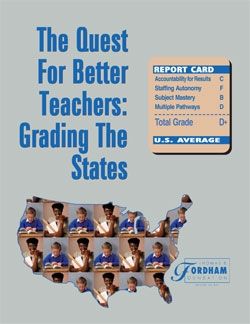
The Quest For Better Teachers: Grading The States

Michael J. Petrilli, Chester E. Finn, Jr., Marci Kanstoroom, Ph.D.

Most states are beginning to get serious about boosting the quality of their teaching force. Unfortunately, most of the steps they are taking point in the wrong direction. This 'report card' contains plenty of evidence of that fact-together with some happy exceptions and hopeful signs.

Report
4.20.1999
Governance, Teachers & School Leaders

The Teachers We Need and How to Get More of Them

A policy statement endorsed by governors, chief state school officers, state board members, prominent education thinkers and analysts, and veteran practitioners, which sets forth principles and policies to guide states as they prepare to hire a teaching force for the 21st century.

Pagination

  • First page « First
  • Previous page ‹ Previous
  • Page 41
  • Page 42
  • Page 43
  • Page 44
  • Page 45
  • Page 46
  • Page 47
  • Page 48
  • Current page 49

Type

  • Commentary (1363)
  • Event (3)
  • Podcast (34)
  • Report (37)

Topics

  • Accountability & Testing (503)
  • Advanced Education (266)
  • Career & Technical Education (84)
  • Charter Schools (1115)
  • Curriculum & Instruction (1589)
  • ESSA (129)
  • Evidence-Based Learning (833)
  • Facilities (25)
  • Governance (1409)
  • Personalized Learning (51)
  • Private School Choice (139)
  • School Finance (167)
  • Standards (190)
  • (-) Teachers & School Leaders (1450)

Date

  • 2026 (143)
  • 2025 (188)
  • 2024 (159)
  • 2023 (156)
  • 2022 (206)
  • 2021 (269)
  • 2020 (203)
  • 2019 (86)
  • 2018 (8)
  • 2017 (9)
  • 2016 (3)
  • 2014 (3)
  • 2013 (3)
  • 2012 (4)
  • 2008 (1)
  • 2007 (1)
  • 2006 (1)
  • 2005 (1)
  • 2004 (1)
  • 2001 (2)
  • 2000 (1)
  • 1999 (2)
Fordham Logo

© 2026 The Thomas B. Fordham Institute
Privacy Policy
Usage Agreement

National

P.O. Box 110
Burke, VA 22009

202.223.5452

[email protected]

Ohio

P.O. Box 82291
Columbus, OH 43202

614.223.1580

[email protected]

Sponsorship

130 West Second Street, Suite 410
Dayton, Ohio 45402

937.227.3368

[email protected]