
Commentary
Unsolved problems – and signs of hope – as 2012 dawns
The challenges and opportunities of the year ahead.
The challenges and opportunities of the year ahead.
Setting the record straight on Diane Ravitch.
Guest blogger Paul Teske reflects on the future of digital learning and Paul T. Hill's "School Finance in the Digital Learning Era."
School reformers are a dime a dozen these days, with education policy a suddenly sexy field and more than a few people willing to challenge the status quo.
“Consequential accountability,” à la No Child Left Behind and the high-stakes state testing systems that preceded it, corresponded with a significant one-time boost in student achievement, particularly in primary and middle school math.
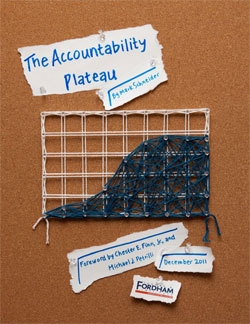
After more than ten years under NCLB, that law’s legacy continues to be fiercely contested. This analysis of NAEP scores—focusing on Texas and on the entire nation—by former NCES commissioner Mark Schneider finds that solid gains in math achievement coincided with the advent of "consequential accountability," first in the trailblazing Lone Star State and a few other pioneer states, then across the land with the implementation of NCLB. But Schneider warns that the recent plateau in Texas math scores may foreshadow a coming stagnation in the country’s performance. Has the testing-and-accountability movement as we know it run out of steam? How else might we rekindle our nation’s education progress?
Dismayed that they’ve all lost their fearless leaders at the same time, Ed Sector, the Center on Education Policy, and the New America Foundation have joined forces to identify a new Czar of Left-Leaning Ed Policy in Washington.
This week, Mike and Rick discuss Denver, school choice, and tattoos. Research Minute takes a week off, and Education News of the Weird is retired for Rate That Reform! Click here to listen through our website and peruse past editions.
Statewide textbook adoption distorts the market, entices extremist groups to hijack the curriculum, enriches the textbook cartel, and papers the land with mediocre instructional materials that cannot fulfill their important education mission.
This week, Mike and the National Council on Teacher Quality's Sandi Jacobs discuss whether liberals should support Reading First, the worst teachers deserve $10,000 to quit, and the best teachers deserve $125,000 to teach. Jeff Kuhner is outraged about lawyers, unions, theft, and Elliot Spitzer, and Education News of the Weird is, psst...yo...got any Milk Duds?
The newest issue of Education Next is out and, as usual, it contains some top-notch stuff. (We're especially partial to the national standards material.) Check it out here!
In recent months, policymakers and policy wonks alike have been singing the praises of value-added analysis, which focuses on the achievement gains that a school or teacher elicits rather than just looking at how high the students score, since high or low scores of students in a school may reflect the socioeconomic makeup of the student body (and other "input" variables) rather than the quality
Or at least the Office of Management and Budget’s education branch does. They’re looking for a program examiner, who would analyze on-going policies and programs, especially legislative proposals, for conformance with Presidential policies, and review and prepare budgetary documents and other materials for Presidential programs related to education.
Justin Torres raises some interesting points in his review of Arthur Levine's new report on education leadership programs (see "Levine versus the ed schools"). In particular, I think the idea of folding education leadership programs into M.B.A. programs is very timely.
This week, Mike and Rick talk about developing talent; Winerip's illogic; and separating students by race, gender, etc. Tom Loveless stops by to talk about his new Brown Center report (reviewed below), and Education News of the Weird hits the campaign trail. Click here to listen through our website and peruse past editions.
This week, Mike and Rick discuss New York City's Leadership Academy principals' lackluster results, charter school transparency in Pennsylvania, and whether we should try to encourage lower levels of truancy.
The Senate Public Charter Schools Caucus, announced last week by Senators Lamar Alexander and Mary Landrieu, will provide a vehicle for informing members of Congress, their staffs, and the public about the role and potential of the nation's charter schools.
This week, Mike and Rick discuss possible stimulus-stimulated reforms, whether grades should include more than just content mastery, and if we should letting students who pass their classes and the state test out of school early. Then Amber tells us about a (snooze-inducing) new ETS report on the achievement gap and Rate that Reform encounters Big Brother, school edition.
School Choice Ohio, an organization that seeks to expand and protect educational choice options, seeks an executive director who will be responsible for the organization's overall operations.
As always, the National Education Association convention, recently concluded in Los Angeles, was quite a circus.
This week, Andy and Stafford discuss Denver’s plan to make charter schools abide by school assignment boundaries, Maine’s teacher licensure confidentiality law, and what happens when increasing the charter cap in Tennessee doesn’t yield any more charters.
The verdict is in--this is the big one! Where, may you ask, must you be "seen" in your latest Jimmy Choos--err respectable think tanker loafers?
This week, Mike and Rick talk about how to pay educators, test four-year-olds, and train middle school teachers. Education Week's Mark Walsh stops by to discuss Bong Hits 4 Jesus, and Education News of the Weird is melting, melting! Click here to listen through our website and view past editions.
This week, Mike and Rick talk NCLB, NYC, and WASL. Jeff Kuhner is taking some time off to cool down, and Education News of the Weird is about bad lunches and the Good Book. Click here to listen through our website and peruse past editions.
This week, Mike and Rick talk incentive pay in Dallas, Head Start, and the power of unions. Fordham's Jeff Kuhner talks about the 2008 presidential contest, but Education News of the Weird was tied up at the time. Click here to listen through our website and peruse past editions.
This week, Mike and Rick talk about why America doesn't need more college grads, why choice isn't enough, and why cracking down on corruption is sometimes good and sometimes bad. Education News of the Weird legislates morality--at least for calendars. Click here to listen through our website and peruse past editions.
Please join Common Core in welcoming Diane Ravitch (Research Professor of Education, New York University), E.D. Hirsch, Jr.
As the race for governor in Ohio heats up, so too has the interest in candidate Ken Blackwell's "65 Cent Solution," which would require every Ohio school district to spend at least 65 cents of each education dollar on "classroom instruction." The proposal clearly has political appeal.
Take away all the jargon, emotion, envy, confusion, and embarrassment and much of the No Child Left Behind debate comes down to this: Which schools are good, which are bad, and does NCLB do a decent job of telling the difference?
Every once and a while, Gadfly sticks in a VHS (we’re old fashioned) and relaxes with a cold cup of flower nectar; then he shares his thoughts with you. Remember our review last summer of “The Cartel,” that exposé of the New Jersey education system?