Mobile Navigation

  • National
    • Policy
      • High Expectations
      • Quality Choices
      • Personalized Pathways
    • Research
    • Commentary
      • Gadfly Newsletter
      • Flypaper Blog
    • Events
    • Scholars Program
  • Ohio
    • Policy
      • Priorities
      • Media & Testimony
    • Research
    • Commentary
      • Ohio Education Gadfly Biweekly
      • Ohio Gadfly Daily
  • Charter Authorizing
    • Application
    • Sponsored Schools
    • Resources
  • About
    • Mission
    • Board
    • Staff
    • Career
Home
Home
Advancing Educational Excellence

Main Navigation

  • National
  • Ohio
  • Charter Authorizing
  • About

National Menu

  • Topics
    • Accountability & Testing
    • Advanced Education
    • Career & Technical Education
    • Charter Schools
    • Curriculum & Instruction
    • ESSA
    • Evidence-Based Learning
    • Facilities
    • Governance
    • Personalized Learning
    • Private School Choice
    • School Finance
    • Standards
    • Teachers & School Leaders
    • Think Again
  • Research
  • Commentary
    • Gadfly Newsletter
    • Flypaper Blog
    • Gadfly Podcast
  • Events
  • Scholars Program

Topics

Displaying 61-90 of 448 results
Commentary
11.2.2005

Apples and oranges

Abigail and Stephen Thernstom can only wonder: "Is the ghost of George Wallace running New York City's public schools?" Jonathan Kozol seems to think so. He writes in his new book, The Shame of the Nation, that in New York and other big cities one "cannot discern the slightest hint that any vestige of the legal victory embodied in Brown v.

Commentary
11.2.2005

Spin zone

People for the American Way president Ralph Neas writes in USA Today that the Senate's Katrina package (which includes a provision that will provide vouchers to help support private-school families) is an opportunity for right-wingers "to implement an ideological agenda that has little to do with the hurricane itself." Pot calling the kettle black, eh?

Commentary
11.2.2005

Saving Money and Improving Education: How School Choice Can Help States Reduce Education Costs

Eric Osberg

David SalisburyCato InstituteOctober 4, 2005

Commentary
11.2.2005

Top of the Class: How Asian Parents Raise High Achievers - and How You Can Too

Dr. Soo Kim Abboud and Jane KimBerkley Publishing Group2005

Commentary
11.2.2005

Similar Students, Different Results: Why Do Some Schools Do Better?

Martin A. Davis, Jr.

EdSourceOctober 2005

Commentary
11.2.2005

Don't blame NCLB

Congratulations on getting your theory that No Child Left Behind is causing states to lower their accountability standards into the news cycle (see here).

Commentary
11.2.2005

In IB we trust?

At first glance, the International Baccalaureate (IB) diploma program appears to be an education reformer's ideal. It boasts a demanding curriculum. It concentrates on core subject areas (experimental science, math, languages, etc.), and it integrates them with a Theory of Knowledge class that shows how the subjects are interrelated.

Commentary
11.2.2005

Common cents

It's not news when interest groups ask legislatures for more money, but it's certainly worth noting when they ask legislatures to spend money more wisely. Up-and-coming school reform group First Class Education is doing just that. Funded by Patrick Byrne of Overstock.com fame, the organization advocates for targeting spending on actual classroom instruction.

Commentary
11.2.2005

Grading spaces

School construction is no longer about bricks, mortar, and a couple of workers with lunch pails. Today, aesthetics matter. At least, that's the opinion of a pair of school architects from Illinois who contend that their newly developed list of eight design strategies can lead to higher achievement in middle schools.

Commentary
11.1.2005

Now Buzzing the Buckeye State

Chester E. Finn, Jr.

Welcome to the inaugural issue of The Ohio Gadfly, a bi-weekly source for news, analysis, and insight into the education reform effort in Ohio. This e-newsletter is written, edited, and produced right here in the Buckeye State by staff of the Thomas B. Fordham Institute in Dayton. Since 1998, Fordham has been out front on school reform issues in our home community and across the state.

Commentary
11.1.2005

Why did it take so long?

In the short two years an Indianapolis charter school was open, it mismanaged funds and didn't prove academically viable. The result? Despite a public outcry to keep the school open, officials wasted no time in shuttering its doors. Contrast that with the long overdue closing of The International Preparatory School (TIPS) in Cleveland.

Commentary
11.1.2005

Why do parents in Columbus choose charter schools?

Allison Porch

What is it about charter schools that's tantalizing enough to lure families away from district schools? Is it Disney vacations? Free TiVo? According to the Kids Ohio survey, it's something less glitzy—plain business sense. Charter schools listen to their clients (parents and teachers) and offer the products (schools) that meet their varying needs accordingly.

Commentary
11.1.2005

School attendance shenanigans

They say that what's good for the goose is good for the gander, but in the world of public education, that axiom is not always followed. Take, for example, Cleveland Public Schools' recent attendance policy controversy. For the 2004-05 school year, CPS reported an astonishingly low number of excused absences (just 620, while Columbus reported over 300,000 for the same time frame).

Commentary
11.1.2005

Lone Ranger

Terry Ryan, Allison Porch

It's The Good, the Bad, and the Ugly time at the charter schools corral. And David Brennan, famed industrialist and creator of the White Hat school management company, stars in all three roles. To charter supporters he's the hero, to the teachers unions he's the villain, and as for the ugly, well, keep reading.

Commentary
10.26.2005

The two faces of No Child Left Behind

Chester E. Finn, Jr., Madeleine Will, Michael J. Petrilli

If there's one memorable takeaway from last week's release of the 2005 National Assessment of Educational Progress (NAEP) results in reading and math, it's a timeless one: incentives work. They alter behavior in education and government, just as they do in capitalism. Unfortunately, they don't always alter behavior for the better.

Commentary
10.26.2005

Up or down at Edison?

I'm a regular reader of the Education Gadfly and Checker's columns and would like to clarify a statement made three weeks ago concerning Edison Schools.  In your editorial announcing Dick Carpenter's

Commentary
10.26.2005

Un-exceptionalism

Education's labor market is finally starting to exhibit the flexibility - and churn - common in other sectors of our economy. Population booms in Las Vegas and retirement trends in Chicago have prompted officials to recruit a different breed of teacher.

Commentary
10.26.2005

Witches, and vampires, and ghouls - Oh my!

Although Halloween is still a few days away, the witching hour arrived early in some American classrooms.

Commentary
10.26.2005

Seattle's worst

The Gates foundation has learned some lessons - and Seattle's public schools are poorer for the experience. In 2000, the foundation made a series of high-profile, five-year, multi-million-dollar gifts to districts deemed capable of bringing about significant change in their schools. Seattle received $26 million at the time, but it most likely won't be receiving any more.

Commentary
10.26.2005

Row about streams

Ben Bernanke (President Bush's pick to lead the Federal Reserve) wasn't the only economist receiving front-page, above-the-fold treatment in the Wall Street Journal this week.

Commentary
10.26.2005

Free to Learn: Lessons from Model Charter Schools

Martin A. Davis, Jr.

Lance T. Izumi and Xiaochin Claire YanPacific Research Institute

Commentary
10.26.2005

State Involvement in School Restructuring Under No Child Left Behind in the 2004-2005 School Year

Michael J. Petrilli

Rebecca Wolf DiBiaseEducation Commission of the StatesSeptember 2005

Commentary
10.26.2005

Let me make one thing perfectly clear

Question: If you're the superintendent of a district labeled "in need of improvement" under NCLB, are you allowed to offer federally funded tutoring directly to students? Answer: No—unless, of course, your name is Arne Duncan and you run the Chicago Public Schools. Then the answer is yes.

Commentary
10.26.2005

Single-Sex Versus Coeducational Schooling: A Systematic Review

U.S. Department of Education, Policy and Program Studies Service2005

Report
10.24.2005
Curriculum & Instruction, Standards

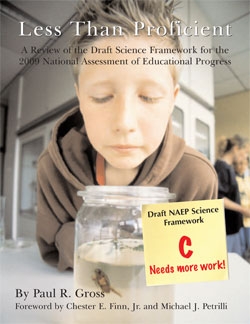
Less Than Proficient

Michael J. Petrilli, Chester E. Finn, Jr., Paul Gross

Almost every week a new report or commission decries the decline of America's preeminence in science, and calls for the nation's education system to raise standards in order for our economy to remain competitive with the rest of the world. Within this context, the National Assessment Governing Board is preparing to launch a new science assessment for 2009. Curriculum developers and textbook writers are likely to follow its lead. Fordham couldn't help but wonder: is the draft science Framework up to the challenge? Using much the same criteria applied in the Foundation's state science standards reviews (due out this December), our reviewers answered: no. As author (and esteemed biologist) Paul R. Gross wrote, The Framework is an interesting start, but there is much work to be done if it is to achieve its potential usefulness.

Commentary
10.19.2005

What 'cha reading?

Mark Bauerlein

[Editor's Note: The following editorial draws on the 2004 long-term trend NAEP results. These should not be confused with the 2005 "main NAEP" reading results discussed in our October 19 press release, Gains on State Reading Test Evaporate on 2005 NAEP.]

Commentary
10.19.2005

Entrance requirements - not just for college anymore

To Idaho, now, where the state Board of Education wants to implement high school entrance requirements. If enacted, all eighth-grade students would need to earn a cumulative C average in four subjects and pass pre-algebra before moving on. Those who do not will - presumably - be retained for another year. That's the catch, though.

Commentary
10.19.2005

A new wave of home schooling

The number of home schoolers is on the rise, thanks to the combined impacts of hurricanes Katrina and Rita. Displaced residents, many grown tired of placing their children in new surroundings, have decided to take on the education burden themselves. In Plaquemines Parish, Louisiana's southern-most, school officials estimate that some 800 families are taking the do-it-yourself route.

Commentary
10.19.2005

Stemming the tide

District schools in Columbus, Ohio, are finally exploring ways to bring students back into the fold. Why now? Because the exodus of students to charter schools is hitting the district in its pocketbook. Last spring, the district set its budget for 2005-2006 based on an estimate of 6,200 students taking the charter option. But so far this year, it's looking more like 7,100 students.

Commentary
10.19.2005

Sex, drugs, and Mickey Mouse

"Seniors of Kellenberg Memorial High School - You've just had your prom cancelled. What are you going to do now?" Why, go to Disney World, of course. It seems the $20,000 rental house in the Hamptons and liquor-loaded chauffeured limousines became simply too much for the principal of Long Island's tony Catholic high school to accept. So he called the whole shebang off.

Pagination

  • First page « First
  • Previous page ‹ Previous
  • Page 1
  • Page 2
  • Current page 3
  • Page 4
  • Page 5
  • Page 6
  • Page 7
  • Page 8
  • Page 9
  • Next page Next ›
  • Last page Last »

Type

  • Commentary (439)
  • Report (9)

Topics

  • Accountability & Testing (2)
  • Charter Schools (1)
  • Curriculum & Instruction (2)
  • Governance (1)
  • Private School Choice (1)
  • School Finance (1)
  • Standards (6)
  • Teachers & School Leaders (1)

Date

  • (-) 2005 (0)
  • September 2005 (41)
  • October 2005 (40)
  • November 2005 (49)
  • May 2005 (32)
  • March 2005 (31)
  • June 2005 (42)
  • July 2005 (50)
  • January 2005 (45)
  • February 2005 (41)
  • December 2005 (31)
  • August 2005 (29)
  • April 2005 (42)
Fordham Logo

© 2026 The Thomas B. Fordham Institute
Privacy Policy
Usage Agreement

National

P.O. Box 110
Burke, VA 22009

202.223.5452

[email protected]

Ohio

P.O. Box 82291
Columbus, OH 43202

614.223.1580

[email protected]

Sponsorship

130 West Second Street, Suite 410
Dayton, Ohio 45402

937.227.3368

[email protected]