Commentary
An Evaluation of Florida's Program to End Social Promotion
Jay Greene & Marcus Winters, The Manhattan InstituteDecember 2004
Jay Greene & Marcus Winters, The Manhattan InstituteDecember 2004
Institute of Education, University of LondonDecember 2004
Perhaps it's just a straw in the wind. Possibly it was even a mistake, a misstatement awaiting retraction. There's ample reason to describe NEA president Reg Weaver as a follower, not a leader, a perpetuator of the status quo rather than an innovator.
While No Child Left Behind requires states to issue school report cards, ostensibly to let parents know how their child's school is doing, we should observe our neighbors across the pond. "School league tables" were introduced a decade ago in Britain to offer an easy way to compare the academic achievement of different schools.
Gadfly does not try to note every expression of pedagogical silliness out there - otherwise, he'd do nothing else! But once in while you have to stop and smell the skunk cabbage. This week, Alison Gopnik, a professor of psychology and author of a book on learning styles, had a column in the New York Times so absurd as to be noteworthy. Dr.
United States Government Accountability OfficeDecember 2004
Tom Luce and Lee Thompson, Ascent Education Press2005
Are today's twentysomethings spoiled, coddled brats who sponge off their parents and wander aimlessly through an entertainment-addled existence? Or do they face unusual challenges that make it difficult to follow the time-honored high school-college-adulthood script? Both assertions were on view this week.
Income inequality in the U.S., the Economist warns, "is growing to levels not seen since the Gilded Age, around the 1880s.
You may be confused by the dueling charter school studies that have appeared in recent months. If so, two new articles try to beam a light through that tangled forest.
Ellen Forte Fast and William J. Erpenbach, Council of Chief State School Officers2004
The Education TrustJanuary 2005
The recommendations of a national panel looking at fixes to the ailing Israeli K-12 education system has the entire country up in arms.
Two decades after the U.S. was deemed "a nation at risk," academic standards for our primary and secondary schools are more important than ever - and their quality matters enormously.
California Governor Arnold Schwarzenegger, in his State of the State address, has declared his intention to promote merit-based pay for Golden State teachers.
Why it seems like only yesterday. . . . Oops, sorry, this is not to be a sappy reminiscence by an aging fogey. (Well, aging, maybe.) But in greeting 2005, I want to explain some momentous changes these past four decades, for American education and for me.
It's a new year and new fights loom in state legislatures. In Utah, buoyed by a study suggesting that it might save $1.2 billion in K-12 costs by allowing students to enroll in private schools, proponents plan to push a tuition tax credit plan. But they've got the state's biggest newspaper, the Salt Lake Tribune, against them, as well as the teacher unions.
College and university campuses across the country claim to be bastions of diversity, where students of every sort come together to learn, socialize and solve the great issues of the day.
We've heard plenty about the outsourcing of American jobs to "Asian Tiger" economies and about the swell of graduate students from other countries (India especially) coming to the U.S. to take high-tech and research positions.
Public AgendaNovember 16, 2004
Two decades after being diagnosed as "a nation at risk," academic standards for U.S. primary and secondary schools are more important than ever-and the quality of those standards matters enormously.
As Checker Finn noted last month, "the NEXT BIG THING in education reform is a serious focus on high school." (Click here for more.) Among the bipartisan chorus calling for high school reform are a few who ascribe America's staggering college drop-out problem to inadequacies in the high schools.
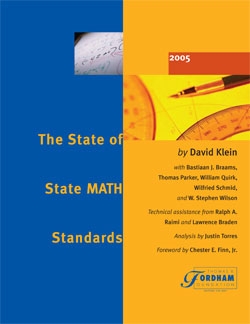
States still have far to go in setting rigorous, high quality expectations for K-12 math instruction. Although a majority have replaced or revised their math standards since 2000, many have failed to make substantial improvements. The review was led by David Klein, Professor of Mathematics at California State University-Northridge, and evaluates the content, writing quality, and clarity of K-12 math standards in each state. Klein and his team attribute many of the shortcomings to overuse and wrong applications of manipulatives and calculators; wrong-headed guidance from the National Council of Teachers of Mathematics; and lack of true mathematics competence among those writing the standards.
Do states' current English/language arts and reading standards expect what they should? Are they demanding enough? Clear enough? Are states using them to guide not only the curriculum and assessment system for students but also their teacher-training programs? Sandra Stotsky, research scholar at Northeastern University and former senior associate commissioner in the Massachusetts Department of Education, finds that most states have revised or replaced their standards since 2000 and made some improvements, especially to K-8 standards. However, major shortcomings remain in other areas including high school literature requirements.