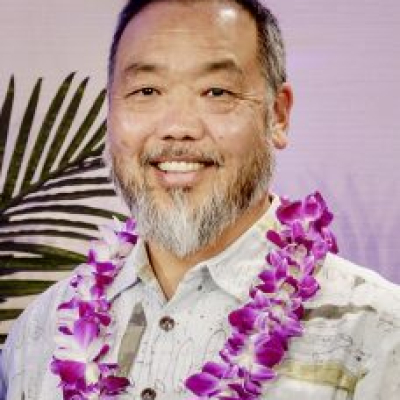
Aloha from Maui! This week, Mike Petrilli brings The Education Gadfly Show to a live audience for the first time in the podcast’s twenty-plus year history. Mike sits down with Dr. Ed Noh, executive director of the Hawaii State Public Charter School Commission, to explore what makes the state’s charter schools so unique. From schools dedicated to preserving Hawaiian language and culture to unionized teachers and principals, Hawaii’s charter sector doesn’t quite fit the typical charter school mold.
Then, on the Research Minute, Amber Northern examines a new NBER study on the federal Reading First program from the No Child Left Behind era and its impact on student achievement.
Recommended content:
- 2025 Annual Report — Hawaii State Public Charter School Commission
- Hawaii’s Teacher Union Strength Profile — Thomas B. Fordham Institute
- A Crowded Table: Teacher Union Strength in 2026 — Melissa Arnold Lyon, Sandy Frost Waldron, and Rebecca Jacobsen, Thomas B. Fordham Institute
- Decoding Success: Phonics-based Instruction and Student Achievement — Alex Hollingsworth, Alberto Ortega, and Nikolaos Zirogiannis, National Bureau of Economic Research
Feedback Welcome: Have ideas for improving our show? We would love to hear them. Send them to [email protected]
This transcript was generated with the assistance of AI and lightly edited for clarity and readability.
Transcript
Introduction
Mike Petrilli [00:00]
Welcome to The Education Gadfly Show.
I'm your host, Mike Petrilli of the Thomas B. Fordham Institute.
This week's is a special Aloha edition. That's right.
We're coming to you from Hawaii, where I sat down with Ed Noh to discuss the state's charter school sector and what a fascinating sector it is.
What with its unionized charter schools, lots of campuses focused on Hawaiian culture and language, and solid results.
Then on the Research Minute, Amber Northern examines a new NBER study on the federal Reading First program from the No Child Left Behind era and its impact on student achievement.
All that and more this week on The Education Gadfly Show.
Ed Reform Update: Hawaii's charter school sector
Mike Petrilli [00:57]
Hello, this is your host, Mike Petrilli of the Thomas B. Fordham Institute, here at The Education Gadfly Show and online at FordhamInstitute.org.
Now, please welcome today's special guest, Ed Noh.
Ed, welcome to the show.
Ed Noh
Wow.
Mike Petrilli
Well, those of you listening or watching at home may notice something different here.
That is a live studio audience. It is true.
Thank you.
Our first ever in over 20 years of doing The Education Gadfly Show.
We are here at the 50CAN Summit in Maui, in Hawaii, where we have been learning about Hawaii education reform.
We're going to do that today on the show.
Ed, I should introduce him as the Executive Director of the Hawaii Public Charter School Commission.
So let's talk about Hawaii charter schools on Ed Reform Update.
All right.
Well, it is great to have you here, Ed, and appreciate you coming on the show.
You know, I think when people out around the country, when you think of charter school, I suspect a lot of people in their head, they probably picture some big city, maybe one of the big networks, KIPP or Success Academy, you know, maybe what we used to call no-excuses charter schools.
That might be in what people's mind.
And then you think, oh no, there's all these charter schools in Hawaii, and their minds probably get blown.
Help us understand, if we are going to take a tour of charter schools in your state, what are we seeing?
Tell us what they're like.
Ed Noh [02:32]
Yeah, well, I'm going to borrow a quote from a dear friend who did pass, and he was one of the charter founders for the state of Hawaii, Steve Hirakami.
And he would often say, if you visited one charter school in Hawaii, then you visited one charter school in Hawaii.
Right?
And by design.
Our vision at the commission is that each community is empowered to create schools of excellence.
And that's what really defines our charter schools.
They're really embedded within the communities in which they serve.
And of course, we do have some schools across the islands.
Hawaii Technology Academy, for example, they're based out of Oahu, but they have really grown.
They're one of the largest charter schools in our portfolio and second-largest public school in the state of Hawaii.
So obviously they've kind of created a demand around their model of learning and teaching.
And so, again, you have schools from all over.
We have five islands that have charter schools.
Our largest concentration is on Oahu.
That's 18 schools, 14 on the Big Island, six, in fact, on the island of Kauai, and then one here in Maui.
Actually, again, I'll bring up HTA because they do have two that are right here in Maui as well, and one in Molokai.
Mike Petrilli
All right.
And so it is hard to generalize about what they look like.
I understand there are a lot that focus on Hawaiian culture.
So tell us a little bit about those schools.
Ed Noh
Yeah, well, you've visited here.
You've seen what this beautiful land, the ʻāina, can offer.
We had a beautiful introduction at the opening of our conference of understanding the importance of place and space.
And I believe every charter school moves into that area and uses the resources around.
So when people ask, well, what is a Hawaii-focused charter school?
They say, well, it's a school that uses, again, and understands and respects the resources.
It understands and respects the community, the elders that have cared for that community.
But then if we really look at some of the schools that actually, they teach with a Hawaiian medium, that's from bell to bell.
They are reviving and restoring properly the Hawaiian language.
And it's really a beautiful, like, when you look at the arc of these Hawaiian-focused or Hawaiian-language charter schools that have a preschool component to their K-12 model.
And so you can imagine 13-plus years of students really being loved on and poured on through Hawaiian language and culture and values.
And it's created a really special kind of tapestry of charter schools within our portfolio and unique to Hawaii.
Mike Petrilli
And it sounds like, it just feels like it would be hard to have the same kind of dynamic we see in some places where there are these charter school opponents and their opponents.
I mean, how can you be against a school like the one you just described?
I mean, are they more welcomed as part of the broader tapestry of public education?
Ed Noh
Yeah, well, Hawaii was one of the top 10, or the first 10 states, I should say, that actually adopted charter law.
So '91 was Minnesota, and in '94 we were one of the first 10 states.
So it really shows that Hawaii legislators and community really had this forward-thinking idea.
So I would say 30 years into the movement, we're a force that actually can't really be ignored now.
When I first entered into my charter school here in Hawaii, we were at 31 schools, and today we're at 40.
And we're actually the only sector within education, whether it's the traditional public and/or the independent schools, that's actually had growth in our enrollment for the last five years.
So I think that's something that speaks really into the model in which the charter schools are offering.
And I would say the support has also been really rewarding because those schools work very hard to tell their story.
Mike Petrilli
Is it creating new tensions?
So one of the things that we've been learning about is, you know, we see this all over the country, enrollment declines, the baby bust.
Ed Noh
Sure.
Mike Petrilli
Really, though, you can see more extreme here in Hawaii.
Ed Noh
Sure.
Mike Petrilli
People especially moving away for opportunity.
It's hard.
There's not as many economic opportunities for young people here.
And so a lot of times people leave, especially college educated.
It sounds like they may not come back.
So in a lot of places, when you have declining student enrollment and then that ends up leading to schools needing to be closed, this does not make it easy for people who are advocating to have these new charter schools.
Ed Noh
Yes.
I actually had a conversation with one of our legislators, and it was at the Capitol during session early into my tenure here.
It's my third year now as executive director.
And she pulled me aside and said, Ed, we've got to do something about your charter schools stealing our kids.
And I said, oh, okay, respectfully, can we talk about maybe it's the fact that our schools are offering a program, a choice, they're offering a mission and a vision that parents can really rally around?
And again, I think in the face of declining enrollment in all places, because maybe the traditional model is not working, maybe the independent schools are out of reach and/or it's definitely a choice.
Again, I go back to our schools embedded into their communities.
Our families want their students to be around their peers in their communities and thriving there.
So I said, in all respect, I think we're offering choice.
Mike Petrilli
Right.
You know, on a lot of people's minds is this recent election, this big blue wave.
And a lot of us suddenly realize, wow, okay, some states have been very Republican, now divided; states have been divided, now Democratic trifectas.
And the charter movement in particular waking up to some new challenges in some places where the unions have a very strong anti-charter-school position.
I understand it's very different here in Hawaii because the charter schools are unionized.
Tell us how that works.
Ed Noh [08:48]
Yes, we're very unique.
And to put one extra layer of complexity, our charter schools are not an LEA.
They're actually a state agency.
So when they get authorized through our commission, when we are the sole authorizer, then they become a state agent.
And that, with it, of course, there's a lot of benefits, retirement and other factors that come into their, you know, as a state employee.
It also means that our teachers are part of a bargaining unit.
It means all the staff, the education assistants, are part of a bargaining unit.
Our administrators would be part of one as well.
And I think with that, there's a lot of opportunities.
But definitely when I speak to counterparts across the nation, it's the fact that they want to do school differently, yet you have these constraints around the bargaining units.
Sometimes that could be a challenge.
But I will say, we have worked well with our unions.
Our charter schools are allowed to have supplemental contracts to the master contract.
And so we've had schools, again, really pushing the envelope around innovation.
And so I think those are models to build on.
Mike Petrilli
Yeah, no, that's fascinating.
Say more about that.
A lot of charter people would say, oh my God, I mean, that autonomy is such a key part of charter schooling.
Almost everywhere that includes not having unions be part of the picture, though I think, what, 10 percent of the schools maybe have a teachers union.
So, yeah, okay, I mean, what do those carve-outs look like?
Ed Noh
Sure.
And now I will say, you know, we all want what's in the best interest of the student.
And so when those two parties can come together and negotiate this contract, I'll give you an example of one where they wanted to provide more wraparound services.
They wanted to extend the school day.
Well, that's also going to take an increase in pay, so it could be a win-win on both sides.
Can a school offer more services throughout the day, extend the day, and then also benefit the teachers?
Because we know how, you know, the hardship that we hear from stories all the time around teachers and salaries, especially living in Hawaii.
So when those two interests can come together, then they can form an agreement that will be part of their master contract.
So again, there's ways to do it.
I think when the bargaining units come together, they're protecting the interests of their employees, and we understand that.
But we also have to say, well, what's in the best interest?
And they have been able to get to some of these different agreements.
Mike Petrilli
Oh, that's great.
All right, well, last question.
Where do you see this going?
What do you picture for the future of Hawaii charter schools?
Ed Noh
All right, so I've been waiting for this question the whole time.
Mike Petrilli
Oh, okay.
I should've got right to it.
Okay.
Ed Noh
One of the unique things about our charter situation, the charter bargain, right, that we have here.
Yes, we've got great support from our legislators.
We have great support from our communities.
What we don't have is facilities funding.
So while our per pupil has gone up, and that's great, and everyone, we get really excited, but when the school is 30, 40, you know, maybe even north of that, is going towards facilities, you have to stop and think, what else could these resources be used for for students?
And so I have such respect for our charter school leaders and founders who have really built something from, yes, nothing.
But they have also, there's a trade-off.
Right?
So my big question is, like, what more could be done?
Because we've obviously shown, we have some proof points of growth, we have the support from our communities.
I feel like this is just the next step of the evolution of charter schools in Hawaii.
And it has to be done at the legislative level because when they first passed that law back in '94, it was very clear that it will be minus facilities funding.
And when you speak to the original framers of that, they said, well, that was what it took to get us to this point.
And now, again, I think there is a great interest.
We have legislators that have been in key positions.
And we have different models around public-private partnerships that we can build this.
We have schools that have successfully built creative, innovative spaces.
So we have, again, proof points.
And so I want to build on that.
And that's where I believe our next step is.
But doing this all on 60 or 70 cents on the dollar, you could do so much more if you're able to get to parity.
Mike Petrilli
All right.
Well, hey, everybody.
Ed Noh, again, Executive Director, Hawaii Public Charter School Commission.
Ed, thanks so much for coming on the show.
Now it's time for everyone's favorite, Amber's Research Minute.
Research Minute: Revisiting Reading First
Mike Petrilli [13:34]
Amber, welcome back to the show.
Amber Northern
Hi, Mike.
Mike Petrilli
And David, welcome to you as well.
David Griffith
Thank you.
Good to be here.
Mike Petrilli
Yes, it's true.
I was in Hawaii.
Aloha.
I hope everybody just enjoyed that recording from our first-ever live studio audience.
That was super fun to do it there.
Not just because it was Hawaii, though that was awfully nice.
But the 50CAN Summit, great, great meeting.
Tons of energy and just a great conversation we just had about Hawaii charter schools, which are really fascinating.
But I missed a big trip, Amber, that you got to go to Ocean City, Maryland.
Amber Northern
I did.
Are you really going to compare Ocean City, Maryland, to Maui?
Anyhow, it was nice.
Yes, Mike, I talked to the Maryland Assessment Group on your behalf while you were in Hawaii.
Mike Petrilli
Yeah.
Amber Northern
Hopefully I filled your shoes, or at least half filled them, but it was great.
It was a really awesome conference.
I was so impressed by the Maryland state and local officials who were there and all the teachers and educators who really want to get this change to the assessment system right.
They don't want to lose the rigor that they had once upon a time under PARCC.
And so, yeah, I tried to explain different ways that they could keep the rigor, and hopefully they'll do that.
Mike Petrilli
You know, I do appreciate you doing that for me, Amber.
You know, I did have a conflict, and I guess I could have asked you to go to Hawaii in my stead.
All right.
Not what I did.
David Griffith
Good one.
Mike Petrilli
I think most of our listeners probably just assume you're in Hawaii, right?
Amber Northern
All the time.
Mike Petrilli
All the time.
Yeah.
Yeah, yeah.
That is not the case.
And by the way, Amber, you've already been to Hawaii.
Amber Northern
I have, I have.
But it's the kind of place where you want to go back, Mike.
It's not like one and I never want to come back here.
It's paradise.
And you're like, okay, when can I come back?
Mike Petrilli
It is lovely, and it is paradise.
But as we talked about, they have their challenges, and they're big.
I mean, as you can imagine, cost of living is just through the roof.
So hard for people working in the tourist industry and the other service-sector jobs to be able to afford to live anywhere near their work.
And a lot of young people.
I mean, I think I heard something like 40 percent of the young Hawaiians will go to the mainland after college because there's just not that much opportunity there.
And so that's another big, big challenge.
You know, the charter schools, though, are thriving.
But, you know, as we just heard, unionized charter schools, unionized teachers, unionized principals.
Amber Northern
Yes.
Mike Petrilli
It's different out there.
Amber Northern
They were our strongest state.
Of course, you remember that our first time around doing state-of-the-state strength of unions.
They were number one.
Mike Petrilli
What place they were in this time around?
Amber Northern
Still top five, I think it was.
Mike Petrilli
Yeah, yeah.
We talked about that.
All right.
Well, we might need to do this live podcast recording again because it was really fun, and not just in Hawaii.
Amber Northern
Well, I will say that means I've only got three states to go till I hit 50.
So if you would like a live podcast recording in South Dakota, North Dakota, or Montana, you just let me know.
Mike Petrilli
Okay, wow.
That's what's left?
Amber Northern
That's what's left.
Mike Petrilli
That's what's left.
Wow.
Amber Northern
And I can hit those in one trip.
So I just, you know...
Mike Petrilli
You could.
You could.
All right.
What you got for us on the research?
Amber Northern [17:07]
Oh, man, we are going back to Reading First.
I was like, oh my gosh, when I saw this study because, I don't know, before I came to Fordham 18 years ago, I was evaluating Reading First at Westat.
And so I was kind of like, wow, this is interesting.
New NBER paper revisits Reading First.
Those of us who might not remember, it was a billion-dollar-a-year program.
It pushed phonics-based instruction down into K-3, and now we're asking again whether it worked because, you will recall, it was defunded in 2008 because the federal evaluation found that it wasn't working.
But those of us who were on the ground in the field know it wasn't working because everybody was doing it, and there was a huge spillover effect.
Yada, yada.
Because everybody, I think, actually saw the writing on the wall and that this made a lot of sense.
But I digress.
Since then, we've had 40 states or more mandate phonics-based early literacy instruction, similar to what Reading First did.
Texas received $100 million a year in late 2003 for phonics-based curricula, reading materials, coaching, PD, the whole nine yards.
Reading First had this wraparound effect.
So now this paper is going to go back.
It's going to use two designs built on the state's eligibility rules back then.
So a district qualified if its 2002 third-grade reading failure rate was at or above the state average of 13.6 percent.
And they also had to meet a poverty or low-performance criterion.
So this is an intent-to-treat difference-in-differences design.
We're comparing districts who are predicted to be eligible.
So they're using this frozen 2002 data, going back in time, looking at the ineligible districts before and after 2004.
They're looking at year-by-year comparisons to check that these two groups weren't already diverging because we've got to worry about pre-trends.
And then they're also looking at this sort of within-five-points-of-the-cutoff standard where the eligible and the ineligible districts look most alike.
So they are kind of looking at this a few different ways.
And then they're also trying to ask whether more money helped.
So they're applying the state's funding formula to 2002 data to predict how much each district should have received.
Then they're using these predicted amounts, not the actual spending, to estimate the effect of cumulative spending.
And this matters because obviously districts that receive more money could be very different, are different, in need and poverty.
So they're trying not to compare them directly because that would mix up whether or not the money came from, you know, the actual money or the money that they actually received.
Anyway, it's complicated.
Then they actually follow students from third grade into college and the labor market.
And then they go back.
I mean, this study, incredible.
Then they go back and digitize the third-grade reading exams from back in the day.
And they classify all those questions by word count and decodability.
And then they, and then I'm not even finished.
Then they compare unrestricted tax election revenue to test whether the phonics requirements, not just the extra money, drove the gains.
Hence why I emailed you guys and said, can I have a little bit more time with this study?
Because it was really complicated.
Anyway, I'm just going to assume you got all that.
Finding one: They basically say Reading First worked.
The gain stuck.
They look at third-grade reading.
It rose by 0.11 standard deviations, which is about four to five percentile points.
The pre-trends check worked out.
The effects lasted through eighth grade, shrinking over time, but still significant.
And then the chance of scoring, I guess, as you went along, fell about three points.
But these effects that we saw were largest in higher-poverty areas, Hispanic and Title I schools.
And then they looked at the eligible students, and they found that they were more likely to graduate on time, to enroll in college by the age of 19, to finish a four-year degree, and earn $509 more by the age of 25.
And I'm like, okay, that's a lot.
But the outcomes did move together.
You know, you saw the later reading scores, the on-time graduation, the college enrollment, the four-year completion all moved together.
So that seemed to make it a little more plausible to me that this actually occurred.
Number two: It was decoding, not test prep, but they say spilled into math.
So the treated students did better on the longer questions, the broad comprehension-type questions, and the easier-to-decode word questions.
They did not do as well on the vocabulary items.
So it's interesting.
And then they say that the strings-attached money beat the unrestricted money.
So recall that the district spent the money mostly on salaries.
We knew that from the larger Reading First.
They spent about, I think it said, $72 per K-3 student.
They spent the money on supplies.
And this tax election revenue thing they looked at went to salaries.
And they basically found that the, what was it, 0.12 standard deviation for Reading First was basically, was what it ended up being once they kind of netted everything out.
And then the last thing they said was the cost.
They did a back-of-the-envelope cost thing.
And they said the cost was $70 to $185 per student per year per 0.1 standard deviation.
And then they compare all these other things.
And they say that that's a fraction of the $3,846 that other studies have said per year per pupil have required for a similar comparable gain.
And then what else we got?
Oh, and then they try to explain why the 2008 federal evaluation was a bust.
And they kind of came up with half the third graders that it tested in 2007 had not been fully treated.
So maybe this was, we're all, you know, kind of closed the book on this thing before it's really been followed through.
And then the last thing I'll say is a couple limitations.
The treatment had the curriculum, the materials, the coaching, the PD, the money.
So we really don't know which part mattered the most.
They're not able to look at it that way.
They also talked about the NCLB, and Texas had this sort of promoting of a retention rule, you know, the third-grade retention, and that can't be ruled out as possibly a factor.
And of course, I'm still worrying about spillover because they weren't really able to tell you what these comparison groups were doing.
So, but all that said, it was quite the study.
Obviously working paper, so lots of pieces of this I'm sure reviewers will dig into.
But it's good news for Reading First advocates who were sorry to see it go back in the day.
Mike Petrilli
Yes.
And there were about three of us, as I recall.
And so we will take our victory lap.
No, that's not true.
There were a ton of teachers out there who would come, including to these annual Reading First conferences, and they loved it.
It's the same thing we hear from Emily Hanford's story from these more recent waves of reforms.
Teachers want kids to be successful.
And when they're given these tools and this knowledge to help kids learn to read, I mean, they start crying.
They're like, oh my God, this is amazing.
I can't believe these other kids I served in years past that I wasn't able to reach because I wasn't using the right approach.
It's really powerful.
So glad to see finally Reading First vindicated.
This should be Emily Hanford.
Amber Northern
That's right.
Mike Petrilli
For Sold a Story season three.
Amber Northern
Three.
That's right.
David Griffith
There's an interesting Direct Instruction tie-in, including in the so-called scandal that brought it down.
The scandal being that the federal government, federal officials in the Bush administration, my friends, refused to fund states that were still using whole language.
Amber Northern
That's correct.
Mike Petrilli
And that became a Washington scandal.
I guess, David, I'm curious.
I mean, when you hear all of this, what does it mean for the current wave of reforms?
I mean, what should states, districts, schools out there that are doing now this new version of Reading First, so to speak, take from this?
David Griffith [26:09]
Well, I think the first lesson is stay the course, right?
Like, we're actually right about this one.
We have made many missteps over the years, using the royal we, but, you know, social policy is really hard.
Education policy is hard.
And this is one thing that seems to work, you know, regardless of how people look at it from left to right.
Yeah, I mean, I guess I am heartened.
You know, correct me if I'm wrong.
Is it fair to say that content knowledge was not a major piece of this?
Was it largely a decoding-focused thing?
Amber Northern
Absolutely.
In a way that, frankly, the National Reading Panel in 1999 had very little to say about content knowledge.
David Griffith
Yeah.
Yeah, I mean, I think that there's been this ongoing debate about whether we're making a mistake by not putting enough emphasis on the other half of this, on content knowledge.
I don't know.
It's a moot point at this point because it feels like we are putting emphasis on content knowledge now.
I don't know.
Maybe it's okay.
My takeaway from this and from other research is that even just this half of it is worth a lot.
You know, there are, for lack of a better word, spillovers, right?
Just from being able to decode.
And this has always been sort of my intuition, but I do think it's tricky, right?
Because you hear people who say, well, you know, that's nice that the kid knows their letters, that they know the sounds, right?
But, you know, if you're not building their passive vocabulary up, right, there's going to be ceiling effects on these sorts of skills, right?
And I think there's obviously something to that.
Right.
But at the same time, I think that it is just a fact that the sooner kids are decoding, the more they're reading, the more they will read, the sooner they can understand the math problem that their teacher puts in front of them on the worksheet.
Like, that can only help.
Right?
And so I, I don't know.
I...
I don't think we should overcomplicate it.
Right?
And I also think personally that this sort of can't happen soon enough.
Right?
Because the sooner kids can do this, the sooner everything else sort of comes to life for them.
And so I'm very skeptical of narratives that say, well, that's too fast or, you know, that's not age-appropriate.
Right?
There are a lot of other things that sort of hinge on this and are waiting for this to happen in order to sort of unlock that door to the rest of school.
Mike Petrilli
Well, the only thing I would say, that's all well said, David.
And of course, it's both/and, not either/or.
It's the money, right?
I mean, Reading First was first and foremost about the money, a billion dollars a year with a grant program.
You know, like most federal programs, right?
That's the hook, is providing extra money.
And yet, look, there are states out there that are passing Science of Reading laws and not putting any money into it.
I believe that's the case in Massachusetts.
I should be careful because I think I heard.
But I don't know in California if there's a lot of money.
I mean, it's interesting that it's in some cases the blue states.
I thought blue states liked spending money, but they maybe don't like spending money just on this.
But oh my gosh, I mean, you know, we just did this big study on Alabama we've talked about here.
And, you know, they hired 750 reading coaches at the state level in a small state.
That, with real money, professional learning, real money.
I mean, you got this, if you're going to train up the teachers and give them the support they need and make sure that you stay the course, as David said.
Right?
And yet, I don't know, there's still some states trying to do this on the cheap, it seems like.
David Griffith
Yeah, it's really hard to strike the right tone when it comes to money.
Right, Amber?
Like, I mean, because I can hear, you know, I can just...
Amber Northern
Let me and David tell Mike how he needs to not just throw money at the problem.
David Griffith
Well, and you do, but also, like, I don't know.
I mean, it's no good if nothing happens, right?
I don't know.
Sometimes you just need to make the thing happen, right?
And this is the Science of Reading and it actually works.
So let's throw money at things that we actually know work and not at other stuff that we don't have science behind.
Amber Northern
Yes.
Yes.
Mike Petrilli
No, I mean, that is the takeaway, right?
It sounds sort of silly, but if we put money behind things that work, the money will go further, right?
Amber Northern
Yeah.
Yes.
I mean, I guess I'm just curious, like, what do you guys think?
Like, how many more times do we have to do this?
Are we close to doing it for the last time?
Like, I mean, seriously, though, right?
Mike Petrilli
There's no question that there's been progress.
Look, I think the fact that it is not a federal push this time helps, you know, because when Reading First, when it first went away, it all kind of collapsed last time.
It's going to be, you know, if there is some kind of backlash, if there is, and there may be, right, you know, it may be more stable because of our federalist system.
You know, it's now in 40-plus states.
And so, I mean, we'll see.
I think, you know, maybe the risk this time is not so much it collapsing as much as it just fading away.
People get bored or they move on to other things.
And look, if our ed schools continue to not do the job of training the next generation of teachers appropriately, and I don't have a lot of faith that they will, this never ends.
I mean, we have to keep training new teachers in how to do this stuff.
Amber Northern
Well, yeah.
But your point about the money is important, right?
Because, Mike, they're not dependent on a federal grant because what happens sometimes when the federal grant goes away, the thing goes away.
Right?
You know, so, like, it's not like, oh, unless you keep giving us the money, we can't keep doing this.
I mean, states, to your point, I mean, states obviously need to support this too.
But I think it's actually a win not to have the states dependent on the federal government for Science of Reading instruction.
So anyhow.
Mike Petrilli
Yeah.
All right.
We will leave it there.
We are grateful for that.
And that's a good way to segue to saying I hope everyone out there has a happy Thanksgiving.
And I hope you do too, Amber.
Amber Northern
Yes.
Yes.
Thank you, Mike.
Mike Petrilli
All right.
Well, that is all the time we've got for this week.
So until next week.
David Griffith
I'm David Griffith.
Mike Petrilli
And I'm Mike Petrilli of the Thomas B. Fordham Institute, signing off.