
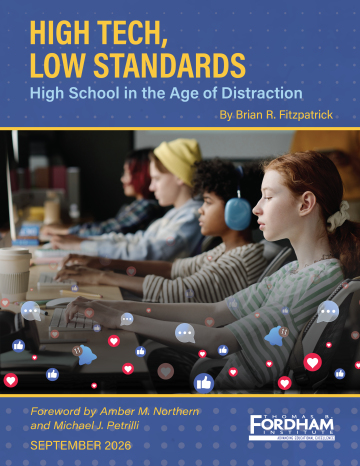
High Tech, Low Standards: High School in the Age of Distraction
A new national survey finds that school-issued devices, AI misuse, and grade inflation are undermining learning and leaving many students feeling unprepared for the future.
Stretching the School Dollar: How Schools and Districts Can Save Money While Serving Students Best
In this volume, a diverse group of experts—scholars, educators, journalists, and entrepreneurs—offer wisdom and advice on how schools and districts can cut costs, eliminate inefficient spending, and better manage their funds in order to free up resources to drive school reform.
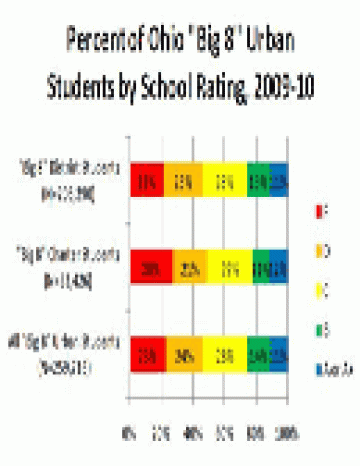
2009-10 Ohio Report Card Analysis
Each year the Thomas B. Fordham Institute conducts an analysis of urban school performance in Ohio. We found that in 2009-10, 26 percent of public school students (district and charter) in Ohio's Big 8 urban communities attended a school rated A or B by the state, 28 percent attend a C-rated school, and 47 percent attended a school rated D or F.
America's Best (and Worst) Cities for School Reform: Attracting Entrepreneurs and Change Agents
This study tackles a key question: Which of thirty major U.S. cities have cultivated a healthy environment for school reform to flourish (and which have not)? Nine reform-friendly locales surged to the front. Read on to learn more.
The State of State Standards—and the Common Core—in 2010
This study weighed existing state education standards against the Common Core education standards. The findings? The Common Core standards were clearer and more rigorous than English language arts standards in 37 states and math standards in 39 states.
Common Education Standards: Tackling the Long-Term Questions
How should the "common core" state standards be governed? Who will "own" these standards (and related assessments) 20 years from now? To stir smart thinking about important aspects of these issues, the Fordham Institute invited knowledgeable experts to write background papers.
Review of the Draft K-12 Common Core Standards
The Fordham Institute's expert reviewers have analyzed the draft Common Core K-12 education standards (made public on March 10) according to rigorous criteria. Their analyses lead to a grade of A- for the draft mathematics standards and B for those in English language arts. Read on to find out more.
Tracking and Detracking: High Achievers in Massachusetts Middle Schools
Brookings scholar Tom Loveless examines tracking and detracking in Massachusetts middle schools, focusing on changes that have occurred and the implications for high-achieving students. Among the findings: detracked schools have fewer advanced students in math than tracked schools and detracking is more popular in schools serving disadvantaged populations.
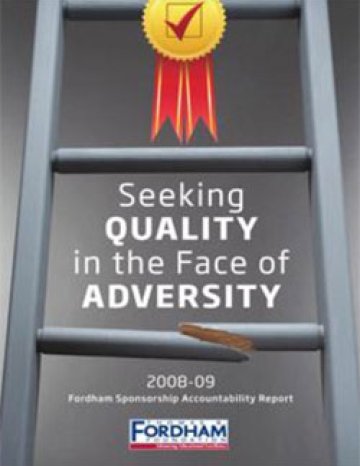
Seeking Quality in the Face of Adversity: 2008-09 Fordham Sponsorship Accountability Report
As a charter school sponsor (authorizer), Fordham submits an accountability report to the Ohio Department of Education at the end of November each year. The report includes profiles of each Fordham-sponsored school, as well as graphics comparing the achievement data of our schools, their home districts, and statewide averages. You'll also find pertinent information on Ohio charter school spending over the last decade, and in the introduction, a timely analysis of the political and legislative environment impacting Ohio charters in 2008-09 that explains why the title, "Seeking Quality in the Face of Adversity," is befitting.
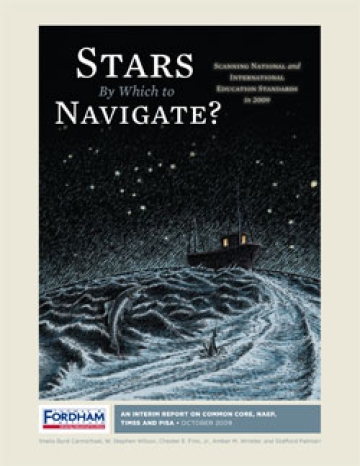
Stars by Which to Navigate? Scanning National and International Education Standards in 2009
Expert reviewers appraise the Common Core drafts -- which outline college and career readiness standards in reading, writing, speaking and listening, and in math -- and also evaluate the reading/writing and math frameworks that undergird the National Assessment of Educational Progress (NAEP), the Trends in International Mathematics and Science Study (TIMSS) and the Programme for International Student Achievement (PISA). How strong are these well-known models?
From Schoolhouse to Courthouse
From Schoolhouse to Courthouse: The Judiciary's Role in American Education examines the role of the courts in modern American K-12 education. From race to speech, from religion to school funding, few aspects of education policy have escaped the courtroom. In this book, experts describe just what the impact of judicial involvement has been. Published jointly by Fordham and Brookings Institution Press.
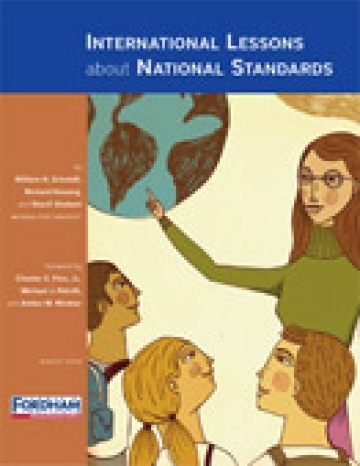
International Lessons about National Standards
Whether the United States should embrace national standards and tests is perhaps today's hottest education issue. For guidance in addressing it, this report looks beyond our borders. How have other countries navigated these turbid waters? What can we learn from them? Expert analysts examined national standards and testing in Brazil, Canada, China, France, Germany, India, the Netherlands, Russia, Singapore and South Korea.
The Great Graduation-Rate Debate
This paper aims to promote a clearer understanding of the graduation-rate debate by distilling the policy developments and controversy surrounding the measurement of these rate. Why are there so many different ways to calculate graduation rates? How do these different rates account for the multiple pathways to graduation? What are the data sources used in the various dropout-rate calculations, and what are their pros and cons?