Mobile Navigation

  • National
    • Policy
      • High Expectations
      • Quality Choices
      • Personalized Pathways
    • Research
    • Commentary
      • Gadfly Newsletter
      • Flypaper Blog
    • Events
    • Scholars Program
  • Ohio
    • Policy
      • Priorities
      • Media & Testimony
    • Research
    • Commentary
      • Ohio Education Gadfly Biweekly
      • Ohio Gadfly Daily
  • Charter Authorizing
    • Application
    • Sponsored Schools
    • Resources
  • About
    • Mission
    • Board
    • Staff
    • Career
Home
Home
Advancing Educational Excellence

Main Navigation

  • National
  • Ohio
  • Charter Authorizing
  • About

National Menu

  • Topics
    • Accountability & Testing
    • Advanced Education
    • Career & Technical Education
    • Charter Schools
    • Curriculum & Instruction
    • ESSA
    • Evidence-Based Learning
    • Facilities
    • Governance
    • Personalized Learning
    • Private School Choice
    • School Finance
    • Standards
    • Teachers & School Leaders
    • Think Again
  • Research
  • Commentary
    • Gadfly Newsletter
    • Flypaper Blog
    • Gadfly Podcast
  • Events
  • Scholars Program

The Education Gadfly Weekly

Sign Up to Receive Fordham Updates

We'll send you quality research, commentary, analysis, and news on the education issues you care about.
Thank you for signing up!
Please check your email to confirm the subscription.

The wise wonks’ hierarchy of charter school quality

Volume 14, Number 25
3.13.2013
3.13.2013

The wise wonks’ hierarchy of charter school quality

Volume 14, Number 25
view
Quality Choices

Searching for Excellence: A Five-City, Cross-State Comparison of Charter School Quality

Conducted jointly by the Thomas B. Fordham Institute and Public Impact, the new research study Searching for Excellence: A Five-City, Cross-State Comparison of Charter School Quality sheds light on charter performance — in Albany, Chicago, Cleveland, Denver, and Indianapolis. These cities were highlighted because they have relatively large numbers of charter schools and charter school students. These are cities where charters have been part of the educational landscape for a decade or more. Read this exciting report today!

3.13.2013
NationalReport

Searching for Excellence: A Five-City, Cross-State Comparison of Charter School Quality

3.13.2013
Report

The wise wonks’ hierarchy of charter school quality

Michael J. Petrilli
6.18.2014
Flypaper

A Common Core accountability moratorium?

Chester E. Finn, Jr.
6.18.2014
Flypaper

What’s your next move?

The Education Gadfly
6.18.2014
Blog

In which Michelle admonishes Governor Jindal

6.18.2014
Resource

2014 Teacher Prep Review: A Review of the Nation’s Teacher Preparation Programs

Amber M. Northern, Ph.D.
6.18.2014
Blog

Estimating the Effects of No Child Left Behind on Teachers’ Work Environments and Job Attitudes

Aaron Churchill
6.18.2014
Blog
view

The wise wonks’ hierarchy of charter school quality

Michael J. Petrilli 6.18.2014
Flypaper
view

A Common Core accountability moratorium?

Chester E. Finn, Jr. 6.18.2014
Flypaper
view

What’s your next move?

The Education Gadfly 6.18.2014
Blog

In which Michelle admonishes Governor Jindal

Amber M. Northern, Ph.D., Pamela Tatz 6.18.2014
Resource

view

2014 Teacher Prep Review: A Review of the Nation’s Teacher Preparation Programs

Amber M. Northern, Ph.D. 6.18.2014
Blog
view

Estimating the Effects of No Child Left Behind on Teachers’ Work Environments and Job Attitudes

Aaron Churchill 6.18.2014
Blog
view

Searching for Excellence: A Five-City, Cross-State Comparison of Charter School Quality

3.13.2013
Report

In just two decades, charter schools have grown from a boutique school reform strategy to an alternative public school system serving a significant percentage of the nation’s K-12 students. In 1996, just 19 states had charter legislation in place, and there were only about 250 charters serving some 20,000 pupils. Fast forward to 2013: 41 states and the District of Columbia now have charter laws on the books, and there are more than 2 million students enrolled in 5,600 charter schools.

Many students attending charters are in high-need, high-poverty neighborhoods; in Cleveland for example—in Fordham’s home state Ohio—nearly 15,000 students (25 percent of Cleveland’s public school students) attended a charter school during the 2011-12 school year. This begs the question: how are these schools doing in comparison to their district peers and in comparison to their wealthier peers across the state? And how might we structure closure and new school policies to increase the number of high-flying charters while reducing the number of academic laggards?

Conducted jointly by the Thomas B. Fordham Institute and Public Impact, the new research study Searching for Excellence: A Five-City, Cross-State Comparison of Charter School Quality sheds light on charter performance — in Albany, Chicago, Cleveland, Denver, and Indianapolis. These cities were highlighted because they have relatively large numbers of charter schools and charter school students. These are cities where charters have been part of the educational landscape for a decade or more.

Searching for Excellence analyzes the 2010-11 standardized test results for 108 elementary and middle schools in these five cities. Charter school quality is assessed by comparing charter school test results to those of the home school district and to all public schools statewide. Results are reported for both individual charters and as a citywide cohort.

Download the report today!  

view

The wise wonks’ hierarchy of charter school quality

Michael J. Petrilli
6.18.2014
Flypaper

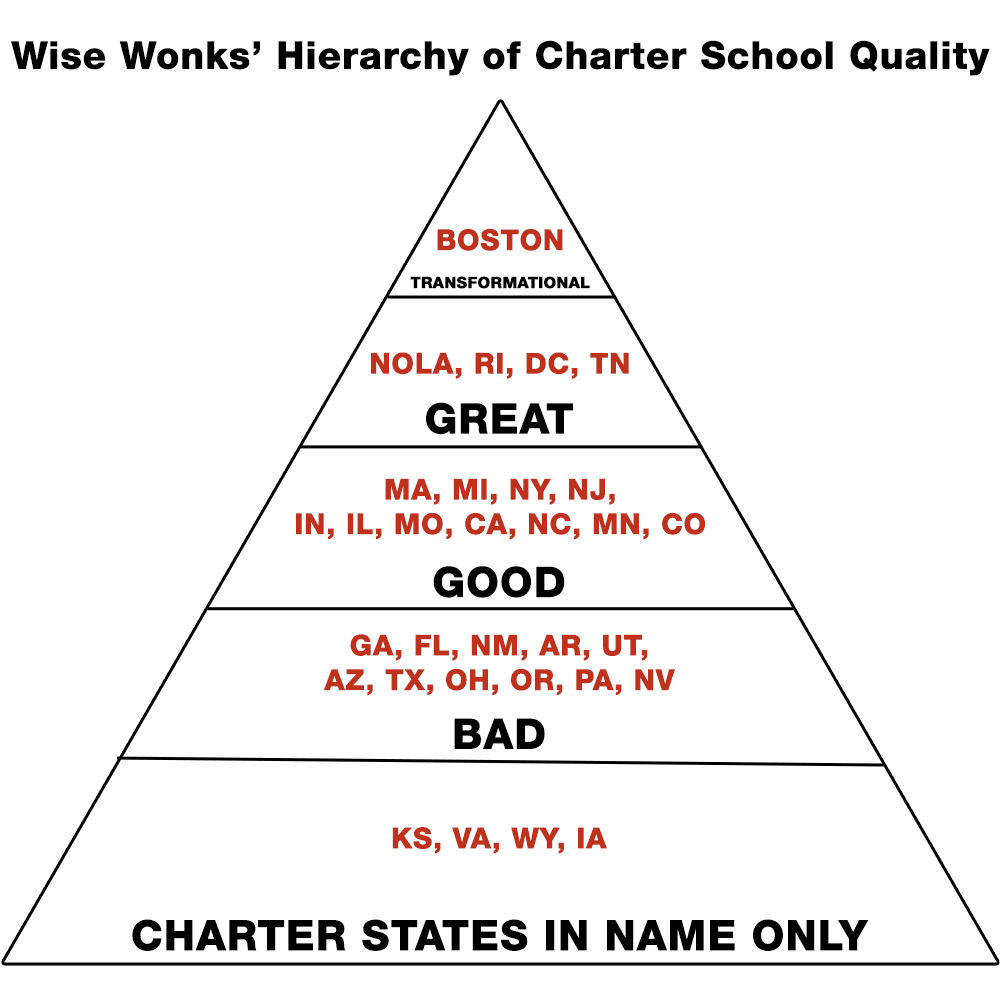
Over the past three weeks, Fordham’s Flypaper blog hosted the charter school wonk-a-thon, an exercise in punditry and policy analysis that exceeded all expectations. (Congrats to our winning wonk,Joe Siedlecki of the Michael and Susan Dell Foundation.) Let me ambitiously attempt to synthesize the major arguments into a unified theory: the Wise Wonks’ Hierarchy of Charter School Quality.

At the bottom of our pyramid are Charter States in Name Only. These are the ones with nominal charter laws but very few actual charter schools. That’s because they only allow entities to authorize charter schools that don’t like charters (i.e., traditional school districts) and/or because they provide paltry funding and/or because they don’t offer schools the autonomy that would make starting a charter worth the effort.

One level up, we find Bad Charter Sectors. These are the states at the bottom of the heap when it comes to test-score gains as measured by CREDO* and other sophisticated analyses. (No, test scores and score gains aren’t everything, but let’s assume for now that these indicators relate to the other stuff we also care about, such as long-term student success.) Their charters mostly falter because of some combination of low-quality authorizers (unselective when handing out charters, unwilling to shut down low performers) and mediocre funding. (In a few cases, such as Arizona, there were major problems in the past but the sector is working on digging itself out of a hole.)

Next we see Good Charter Sectors. Going from “bad to good” was a major focus of the wonk-a-thon, and most of our pundits posited that strong policies were essential. But which policies? Unpack the analyses and it boils down to two issues (again): strong authorizing and sufficient funding. As per the former, it’s essential for states to allow entities other than districts to authorize schools and to create high expectations for organizations that play that role. As for the latter, states must find ways to get charter schools to a decent level of per-pupil funding, plus facilities funding, if not in comparison to traditional public schools then at least in terms of real dollars. It’s hard to find many “good” charter sectors making do with less than, say, $7,500 in per-pupil revenue. Even considering variations in costs of living, $10,000 is probably a better baseline, and closer to $15,000 is necessary if states or cities want to attract out-of-state networks.

Here we must introduce a wrinkle, thanks to our wonks. Many suggested workarounds where sound policies are not in place. Take California, in particular: most of its authorizers are mediocre or worse and its per-pupil funding is in the tank, but because the California Charter Schools Association plays a very effective self-policing role, the Golden State’s charters perform better than expected. And because California’s philanthropists have stepped up to the plate, its charters aren’t as underfunded as state dollars alone would imply. Several other states are fortunate to have conscientious authorizers that make up for their mediocre charter policies.

Continuing up the pyramid, next we find Great Charter Sectors. The “good-to-great” question was also wrestled by our muscular analysts. The consensus appears to be that these higher levels of performance have less to do with policy than with everything else: the “ecosystem” of reform in a given place (usually a city) and its network of “human-capital providers,” expert charter-management organizations, leadership-development programs, school-incubator efforts, local funders and civic leaders, etc.—in other words, what conservatives like to call “civil society”: the space between the government and the individual (in this case, between government and individual schools). Once a certain degree of policy adequacy is in place (reasonably smart laws around autonomy and authorizing, decent-enough funding), the difference between good sectors and great sectors boils down to the “ecosystem” built by the local reform community. That strikes me as a correct, and hopeful, conclusion because most of this work is within “our” (reformers’) control. (It also means that we can’t regulate our way to excellence.)

At the pinnacle of the pyramid are Transformative Charter Sectors. These are the places where charters are significantly and consistently shifting outcomes for children in terms of academic achievement, college readiness, and, one hopes, upward mobility. Here, per Michael Goldstein, stands Boston, our City on a Hill. And as Goldstein argues, it has everything the other great charter cities have, plus a preponderance of fantastic “no-excuses” charter schools—because, at the end of the day, it’s all about the schools.

So there you have it: the Wise Wonks’ Hierarchy of Charter School Quality. At this stage, it’s just a theory and can surely be refined, as can be the placement of states and cities within it. Did I overlook an important element that assists jurisdictions in jumping from bad to good, good to great, or great to transformational? For instance, none of our wonks focused overly much on school closure as a strategy toward greatness; most seem to see it as a way to raise the floor. Is that the right way to think about it? Is that how it’s working in New Orleans, where it’s become a part of standard operating procedure? Am I naïve to place such importance on funding? Are the incubators and local “growth funds” and “human-capital pipelines” as important at the top of the hierarchy as we think?

The wonk-a-thon is over, but let the wonkery continue.

* These test score gains are average impacts for the five school years between 2006–07 and 2010–11 (except for a handful of states with missing data for some years). It's possible that some states' charter sectors saw more rapid growth in the more recent school years, but that information is not (yet) publicly available.

view

A Common Core accountability moratorium?

Chester E. Finn, Jr.
6.18.2014
Flypaper

Here follow the opinions of four experts on whether states should consider “pressing the pause button” for a couple of years before taking Common Core–aligned assessment results into account in high-stakes decisions on teacher evaluation, school accountability, and student promotion.

Let’s give students and teachers time

Vicki Phillips

As the school year comes to a close and we have a chance to reflect on the successes and challenges of the past nine months, I wanted to write to you about our work together to make sure the Common Core State Standards help teachers prepare their students for success. It’s been inspiring this past year to hear from teachers and educators in many states and school districts who are excited about the standards and the new lessons and materials they’ve been able to develop. Some are already seeing clear advances from their students.

An assistant superintendent in a Kentucky school district wrote to tell me that “reading and writing scores have increased across the board in our middle and high school....We see results not only in classroom visits, but on our state assessment, which is based on the common core.”

It is especially thrilling to hear about these students’ gains because we know they’re performing against rigorous standards. They’re taught to analyze and apply information, not just gather it and remember it. They’re encouraged to ask questions, solve problems, and think for themselves; they are becoming strong learners who can succeed in college or career; and they are gaining the skills they need to be good citizens in a democratic society.

Every student needs and deserves the same gains the students are getting in that school district. And they need it now. Every year is precious. The common core is an urgent cause.

But even the best new ideas aren’t self-fulfilling; they have to be put into practice wisely. That’s especially true when it comes to using assessment scores as a factor in student or teacher evaluations.

The Gates Foundation is an ardent supporter of fair teacher feedback and evaluation systems that include measures of student gains. We don’t believe student assessments should ever be the sole measure of teaching performance, but evidence of a teacher’s impact on student learning should be part of a balanced evaluation that helps all teachers learn and improve.

At the same time, no evaluation system will work unless teachers believe it is fair and reliable, and it’s very hard to be fair in a time of transition. The standards need time to work. Teachers need time to develop lessons, receive more training, get used to the new tests, and offer their feedback. Applying assessment scores to evaluations before these pieces are developed would be like measuring the speed of a runner based on her time—without knowing how far she ran, what obstacles were in the way, or whether the stopwatch worked!

Over the past seven years, we’ve had the privilege of working with extraordinary educators doing pioneering work to advance our common goals-improving student achievement with a focus on those students most in need. As I’ve talked with our partners over this past year, I have heard over and over again their wholehearted support for the Common Core and their very real anxiety about the challenges that come with change. The teachers’ anxiety is understandable: a rushed effort to apply the assessments could punish teachers as they’re trying new things, and any hiccups in the assessments could be seen as flaws in the standards.

That’s why the Gates Foundation agrees with those who’ve decided that assessment results should not be taken into account in high-stakes decisions on teacher evaluation or student promotion for the next two years, during this transition.

A number of states, including Kentucky, Maryland, Colorado, and Louisiana, have provided additional time for teachers to create their own lessons and curriculum, get new professional support, and become familiar with the assessments before they’re used as a measure of teacher performance. Each of these states is taking a different approach, but they all are listening to teachers and they are all taking steps to align their approach with what teachers need to make the standards succeed.

Common Core–aligned assessments play a crucial role in delivering on the standards’ promise. They measure students’ abilities in critical thinking and problem solving. They will give teachers, parents and students the information they need to improve learning. They’re an indispensable part of the Common Core, and they’re undergoing a careful practice run right now.

It’s valuable for students to actually take the Common Core–aligned tests without consequences during this period, so that teachers can get familiar with the tests, have a chance to offer their feedback, and get a feel for the students’ successes and challenges. It is an important part of the process of arriving at fair and reliable tests.

Including the assessment results in teacher evaluations even though they won’t count for two years also has benefits: First, the teachers can begin to use the assessments to inform their practice. And second, teachers can see how their performance looks using these measures and make sure it lines up with other measures of teaching practice. This is crucial in building teacher trust in the assessments.

In our view, allowing two years in which assessments will be administered and scored but not yet taken into account strikes the best balance between a commitment to teacher evaluations that measure student learning and a commitment to ensure that teachers will not be harmed as they complete the transition to the Common Core.

Under this approach, teachers get the time, tools and support they need to teach the new standards, and students have a chance to get used to the new tests. This can ensure that students receive the high-quality instruction that will get them ready for life—and can track their growth as they go. That would fulfill the goals of the Common Core: to promote the opportunity that is the purpose of our public schools. At a time when economic inequality is rising and social mobility is falling, the Common Core is the best way to keep faith with the American Dream.

Let’s take the time needed to get it right.

Vicki Phillips is the director of Education, College Ready at the Bill and Melinda Gates Foundation. This article was originally published as a “Letter to Our Partners.”

***

We must uphold our commitment to our students

Hanna Skandera

State education chiefs throughout the country, including the members of Chiefs for Change, have taken a thoughtful and comprehensive approach to managing the transition to more rigorous academic standards and assessments. States have negotiated transition plans in good faith with their partners. They have chosen different timelines with regard to using new assessment data to make decisions about teacher support and employment, student promotion or graduation, and school accountability. A one-size-fits-all approach to this work is imprudent and disregards the hard work that has already been done.

Let’s not forget that states started adopting the Common Core State Standards in 2010. By now, in many states, teachers have been trained, lesson plans have been developed, students are being taught under the new standards, and a practice run of the new Common Core–aligned tests has been successfully completed.

Standards alone will not improve student learning. They must be combined with great teaching and high-quality assessments to measure whether those standards were learned. State education leaders have been preparing for the full implementation with detailed plans to ensure fair, valid and reliable accountability systems are in place. We owe it to our teachers and students to give them the feedback that they deserve in a timely manner and to use that information to make improvements.

We must allow states to work with their partners to determine what is best for them, taking into account their own unique state circumstances and with the ultimate goal of producing better educational outcomes for all children. We must uphold our commitment to our students by ensuring the standards are measured and results are used to build a world-class education system that prepares each and every student for college and career in the twenty-first century.

Hanna Skandera is chair of Chiefs for Change and secretary of the New Mexico Public Education Department. The article above originally appeared as a press release issued by Chiefs for Change.

***

Between a rock and a hard place

Chester E. Finn, Jr.

I’m torn by the recent statements about a Common Core accountability “moratorium” issued by Vicki Phillips and Hanna Skandera. Call me a wimp, caught between two powerful women whom I like and respect, but honestly, they’re both right, albeit in different ways.

Attaching consequences to student achievement is always touchy, tricky, and technically complex, whether we’re talking about promoting and graduating kids, evaluating and rewarding (and retaining/dismissing) those who teach them, or giving grades (and interventions) to entire schools and districts. The data may be shaky, the analyses precarious, and the consequences almost inevitably unfair to some.

Change the standards, the curriculum and instruction, the tests and cut scores, and all such actions become even more challenging. And it’s no secret that educators are less happy being “held to account” for pupil results in the midst of all this change than they were under the old standards and tests (though many were plenty cranky on this topic before the standards changed!). They legitimately point out that in many states the new assessments aren’t even visible yet and in many districts the new textbooks aren’t even available.

And yet. We have plenty of stark evidence that real change in student, teacher, and school performance doesn’t come from standards or tests alone. Sure, the data feeding back into the system are apt to produce slow improvement as more educators become more adept at applying that information to their classroom practice and building leadership. But consequences are what really get people’s attention and prod them to make real-time changes that they might not otherwise be willing to make: The kid working on homework instead of playing an electronic game, studying for the end-of-course exam rather than partying, going to summer school rather than being held back. The school that is awakened and moved to action by its “D” grade—and loss of pupils—leading to structural and staffing changes that were otherwise just too painful. The entire state seeing its performance rise—this accounts for the “Massachusetts Miracle,” insists former commissioner Dave Driscoll—once everyone realized that students really, truly had to pass those tests in order to graduate.

Yes, it’s behaviorist, and few educators lean in that direction. But it’s real.

That doesn’t make it easier or fairer to attach consequences to new standards, tests, and classroom practices. But if the head of a state education system believes that her (or his) state is prepared (or obligated) to stick to its guns and benefit its pupils by persevering with wrenching changes that make some adults uncomfortable, that’s the state’s prerogative. That’s why we elect leaders: to make tough decisions. And there’s a pretty good chance that it’ll turn out to benefit the kids.

The Chiefs for Change are less patient than Ms. Phillips. That doesn’t make her wrong. And states that lack the readiness—or gumption—to proceed swiftly to adjust their accountability to the new standards probably should hit the pause button she is recommending. But places that are ready should move forward, not dither. Nobody’s child has the luxury of a two-year moratorium on his own school experience—or the life that follows.

This article originally appeared as a blog post on Flypaper.

***

Accountability drives results

Patricia Levesque

With students now out for the summer and states, local school districts and schools now preparing for the coming academic year, many in the education reform community are focusing on the rigorous new tests that will be in place next spring.

In many states across the nation, these new assessments will measure students’ mastery of the skills and knowledge outlined in the Common Core State Standards. We believe that if properly implemented, these high-quality math and English language arts standards will raise the academic bar in American classrooms, ensuring children are ready for life after high school, whether that involves enrolling in college or pursuing a career.

But it’s important everyone understand the limits of standards. By themselves they do not make kids smarter. Nor do they make teachers better, or require that school districts be more flexible, responsive and efficient.

In fact, Eric Hanushek, one of the nation’s most respected education researchers, fears that Common Core may distract us from pursuing basic school reforms that have been proven to accomplish those goals. “As history clearly indicates,” he says, “simply calling for students to know more is not the same as ensuring they will learn more.”

Consider California. It had perhaps the best language arts and math standards in the nation, regarded as equal to or even superior to those in Common Core. If standards reflected achievement, California students would be consistent leaders in the National Assessment of Educational Progress (NAEP) test results.

Instead, California is a consistent under-performer.

Florida, on the other hand, has become a national leader in NAEP learning gains. In comparison to California, Florida has adopted a wide slate of education reforms, including an aggressive K–3 literacy policy, an A–F scale for grading schools, rewards for success and sanctions for failure, tenure reforms, digital learning opportunities, and a host of choice options, including charter schools and scholarship programs for low-income students or those with learning disabilities.

School improvement requires multiple approaches, centered on accountability for adults and school choice for parents. Simply put, the system responds differently when student achievement is regarded as mandatory rather than optional, and when parents have alternatives to failing neighborhood schools.

California lacks such reforms, in effect turning its standards into a wish list.

We just saw this in the historic Vergara v. California ruling. The state grants teachers tenure far too soon, in only eighteen months, and maintains ironclad job protections regardless of job performance. Incompetent teachers stay on the job, with evidence revealing that they are most likely to wind up in low-income schools.

We can’t measure the specific impact of this, but can point out a glaring statistic. In the 2013 NAEP results, low-income fourth graders in California ranked near the bottom nationally in reading. They are almost two grade levels behind their peers in Florida (218–200 NAEP points). The difference is that Florida has a third-grade retention policy for functionally illiterate children, which is backed by intensive remediation. The state’s A–F school grading formula also takes into account gains made by the lowest performing quartile of students.

Accountability drives results.

This is what is concerning about calls from the teachers’ unions and even the Bill & Melinda Gates Foundation, one of our donors, for across-the-board moratoriums on accountability. The stated intent is to smooth the transition into the Common Core standards. But states that have implemented sound accountability policies do not need moratoriums. They are ready to move forward and maximize the potential of the new standards.

In my experience, pressing pause means stopping forward momentum. And when that happens, things can go backwards.  There can be changes in leadership and political will. States that press pause likely will find it difficult to restart accountability policies.

Given the longstanding antipathy that unions have had toward accountability, it’s hard to imagine them suddenly embracing the concept a few years from now simply because they ostensibly support higher standards.

Standards cannot be used as a strategy to loosen accountability. If testing data reveal that children aren’t learning, or that certain teachers are not effective, how can we simply put that information on hold? Given what we learned in Vergara v. California, the losers in this equation will be our most disadvantaged students.

One of the most compelling arguments for higher standards is the belief that if we hold all children to high expectations, we can close the achievement gap. But moratoriums on accountability could well have the opposite effect.

Lastly, let’s be clear about accountability. We do not believe high-stakes decisions should be made about children or teachers based on one test given one day. There should be multiple measures to assess students and teachers, and multiple opportunities to achieve success.

Adopting high standards is easy. Backing them up with the reforms required to ensure they will be met is not. It requires taking on powerful special interests. It often entails telling people what they don’t want to hear about the quality of their schools and the academic achievement of their children.

The solution for states is simple. Be thoughtful, but move forward. Make children the focus of your education systems. Make their ability to read and write, to multiply fractions, and solve for X the sole criteria for judging success. And if you do, then the Common Core standards and rigorous new assessments adopted by states will be a success.

Patricia Levesque is the chief executive officer of the Foundation for Excellence in Education. This article originally appeared as an open letter issued by the Foundation for Excellence in Education.


view

What’s your next move?

The Education Gadfly
6.18.2014
Blog

Success Academy, the high-performing charter network run by tough-as-nails Eva Moskowitz, is looking to expand—and has put Mayor Bill de Blasio in a tough spot. He has long opposed the policy of allowing charter schools to share space with traditional public schools, enacted by his predecessor. However, a state law passed in April requires that he do just that—or give the schools money to find their own space. And as the New York Times notes, “The last time he denied space to Success Academy schools, it led to the law that now handcuffs him.”

Governor Bobby Jindal has issued executive orders that, he says, will remove Louisiana from the Common Core and PARCC. “Not so fast,” say State Education Superintendent John White and others who point out that Jindal doesn’t have that power, especially on the standards. “This is all political theater,” said Mike to Politico. “Gov. Jindal will score points with the tea party, but his actions seem likely to be stymied in court.” Or so we hope.

This week, a New York Times piece, featuring both an article and an accompanying short video, highlighted New York’s transition to the Common Core. Kids are struggling to adjust to thinking critically and writing evidence-based rather than personal essays, and teachers are struggling to teach the new standards with new materials—while the low test scores in the first Common Core–aligned tests dinged their confidence. However, as the teacher featured in the Times’s video points out, this is just the second year of implementation and “we cannot expect [the Common Core to be] this magic pill.”

In which Michelle admonishes Governor Jindal

6.18.2014
Resource

Michelle and Brickman discuss pausing accountability while states transition to the Common Core, the perils of playing politics with Eva Moskowitz, and Governor Bobby Jindal’s Common Core bluster. Amber schools us on teacher prep.

Amber's Research Minute

2014 Teacher Prep Review: A Review of the Nation’s Teacher Preparation Programs by Julie Greenberg, Kate Walsh, and Arthur McKee, (Washington, D.C.: National Council on Teacher Quality, June 2014).

view

2014 Teacher Prep Review: A Review of the Nation’s Teacher Preparation Programs

Amber M. Northern, Ph.D.
6.18.2014
Blog

The results of the second edition of NCTQ’s evaluation of teacher-preparation programs aren’t that much more optimistic than last year’s much publicized and contentious findings. This years’ study examined the same programs, for the most part, but expanded the scope of the work by analyzing them more comprehensively. In total, over 1600 elementary and secondary programs were evaluated on all “key” standards, which include selectivity and admissions practices; subject-area preparation; student teaching; and classroom management. Out of this universe, only twenty-six elementary and eighty-one secondary programs made the list of top ranked programs, which is roughly 6 percent. Overall, elementary programs are weaker than secondary ones: 67 percent of the former landed in the lowest tier of scores. Further, coursework in just 17 percent of programs prepares elementary and special-education teachers in all five fundamentals of scientifically based reading instruction. The analysis also included an evaluation of alternate route programs, which now account for the education of one in five teachers in America. They don’t appear to be doing much better than traditional programs. Of the eighty-five programs reviewed, just one—Teach For America, Massachusetts—received top marks.

SOURCE: Julie Greenberg, Kate Walsh, and Arthur McKee, 2014 Teacher Prep Review: A Review of the Nation’s Teacher Preparation Programs (Washington, D.C.: National Council on Teacher Quality, June 2014).

view

Estimating the Effects of No Child Left Behind on Teachers’ Work Environments and Job Attitudes

Aaron Churchill
6.18.2014
Blog

Mainstream media and advocacy groups often portray teachers as an embattled, even embittered, ensemble. Tougher policies are sometimes accused of contributing to their stress. But has accountability actually led to deteriorating work conditions and lower morale among teachers? This new study shatters that popular conception. A team of researchers discovered that teachers have been reporting increasingly positive attitudes about their job since the enactment of No Child Left Behind (NCLB) in 2001. The study examined the responses of nearly 140,000 public school teachers from four rounds of the Schools and Staffing Survey (SASS): two waves occurred prior to NCLB, and two occurred after the law took effect (most recently in 2008). Happily, the researchers found that, post-NCLB, teachers are more likely to perceive support from their colleagues, administrators, and parents than prior to the law. The study also found that teachers report a greater sense of “classroom control” (e.g., autonomy over curricula, textbooks, discipline, etc.), greater job satisfaction, and a stronger commitment to the profession. In addition, the researchers attempt to tease out the causal effects of NCLB on teachers’ attitudes. (One cannot necessarily attribute the positive trends to NCLB per se.) To do this, they compared teachers’ responses in states with accountability regimes prior to NCLB to teachers in states that implemented systems as a result of NCLB. The researchers discovered that the onset of accountability positively impacted teachers’ feelings of classroom control and administrator support. The researchers, however, did not discern a similar effect on job satisfaction or commitment, though there were no significant negative effects either. The most recent survey from Met Life portrays a less-satisfied teaching profession, but this study refutes the notion that increased accountability measures—at least those contained in NCLB—suck the joy out of teaching. Debbie Downers beware!

SOURCE: Jason Grissom, Sean Nicholson-Crotty, and James Harrington, “Estimating the Effects of No Child Left Behind on Teachers’ Work Environments and Job Attitudes,” Educational Evaluation and Policy Analysis (2014): 1–20.

Fordham Logo

© 2026 The Thomas B. Fordham Institute
Privacy Policy
Usage Agreement

National

P.O. Box 110
Burke, VA 22009

202.223.5452

[email protected]

Ohio

P.O. Box 82291
Columbus, OH 43202

614.223.1580

[email protected]

Sponsorship

130 West Second Street, Suite 410
Dayton, Ohio 45402

937.227.3368

[email protected]