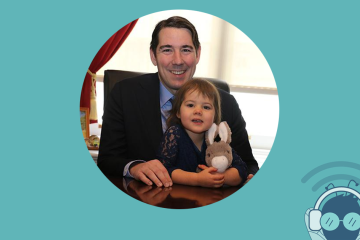
Congressman Josh Harder joins Mike Petrilli and David Griffith to discuss his push to revive the National Reading Panel and advance the READ Act. They consider whether a new panel could update the evidence base on reading instruction, how federal funding might encourage stronger implementation of science-of-reading reforms, and whether literacy could help rebuild a bipartisan federal role in education policy without repeating the mistakes of past reforms.
Then, on the Research Minute, Amber Northern reviews a new study on how adding AP courses may affect school enrollment, socioeconomic integration, and academic tracking.
Recommended content:
Feedback Welcome: Have ideas for improving our show? We would love to hear them. Send them to [email protected]
Transcript
This transcript was generated with the assistance of AI and lightly edited for clarity and readability.
Introduction
Mike Petrilli [00:00]
Welcome to The Education Gadfly Show.
I’m your host, Mike Petrilli of the Thomas B. Fordham Institute.
This week, we’re joined by Congressman Josh Harder to discuss his push to revive the National Reading Panel and advance the READ Act. Can Washington help spread the science of reading without repeating the mistakes of past federal reforms?
Then on the Research Minute, Amber Northern reviews a new study on how adding Advanced Placement courses may affect school enrollment, socioeconomic integration, and academic tracking.
All that and more this week on The Education Gadfly Show.
Clip [00:36]
This is The Education Gadfly Show.
Well, first of all, I haven’t had the chance to talk yet, Mike. You don’t know what I think.
What does Gadfly say?
Mike Petrilli [00:46]
Hello, this is your host, Mike Petrilli of the Thomas B. Fordham Institute, here at The Education Gadfly Show and online at FordhamInstitute.org.
Now, please join me in welcoming our very special guest for this week, Congressman Josh Harder. Congressman Harder, welcome to the show.
Josh Harder
Thanks for having me. Big fan and longtime listener and watcher.
Mike Petrilli
Well, it is great to have you with us.
Congressman Harder is a Democrat representing California’s Ninth Congressional District. Congressman, where is that in California, given that you’ve got, I think, something like fifty-odd congressional districts?
Josh Harder
Yeah, for now. It’s in beautiful, sunny Stockton, California, land of all the best wine and almonds you’re ever going to find.
Mike Petrilli
Love it. Very good. All right. Well, welcome.
Joining us as always, my co-host, who’s also from wine country, David Griffith.
David Griffith
Yeah, it’s a different kind of whining, Mike. But yeah, it’s great to be here.
Mike Petrilli
No, no. Oregon has wonderful wines. Actually, I shouldn’t dismiss them.
David Griffith
Exactly.
Mike Petrilli
Well, Congressman, I think this is the first time that we have had a sitting member of Congress on the show, which is crazy to think about. We’ve been doing this for over twenty years and a thousand episodes.
I think that is correct. Maybe we’ll have to have The Education Gadfly Show historians go back and double check that. But we’re super excited, and especially to note that in both the House and Senate, at least at the committee level, there has actually been some legislating happening recently, which is nice to see.
I remember Matt Yglesias talking about the secret Congress, the Congress that actually rolls up its sleeves and gets things done, maybe without making too much noise about it. And so this could be an example of that.
We want to talk about literacy, particularly bringing back the National Reading Panel, as well as the READ Act. Let’s do that on Ed Reform Update.
Ed Reform Update: Bringing back the National Reading Panel
Mike Petrilli [02:52]
All right. So, Congressman Harder, you were able to get into an appropriations bill recently some language about bringing back the National Reading Panel after more than twenty-five years. Can you tell us about that?
Josh Harder
Yeah. I think it was certainly my biggest joy in my life to teach my two daughters to read. We have a four-year-old and a two-year-old, and it was just incredibly exciting to see them start on that journey, go from not being able to sound out words to becoming confident readers.
But literacy is still a real struggle for millions of American school kids. We last had the National Reading Panel in the late 1990s, and it kick-started the entire science of reading movement. And I think that has done a tremendous amount of good, putting into practice with great effect in states like Mississippi and Louisiana and these other southern surge states.
And so hopefully bringing this back is going to jumpstart our federal response to this literacy crisis and make sure that everybody has the best tools and solutions possible.
Mike Petrilli
First of all, let’s note that you buried the lede. Your two-year-old can read already? That’s incredible.
Josh Harder
We’ve got the book Teach Your Child to Read in 100 Easy Lessons, and we’re very dutifully following it. I’m a big disciple, so we’re at the early stages, but so far, so good.
Mike Petrilli
Amazing. We’ll have you back on to talk about gifted education another time.
But all right. Look, like many policy wonks, I think back fondly to the National Reading Panel. I certainly agree with you that it was critically important in jumpstarting what became Reading First, which was part of No Child Left Behind, as well as a lot of state efforts. I think particularly a direct line to what happened in Florida, as well as, you said, Mississippi, back then.
But let me push on it a little bit. There were also unintended consequences, as is always the case. For example, that National Reading Panel did not say much about the importance of knowledge building. This was something that even back then, E.D. Hirsch had been writing about and arguing about for quite some time, and marshalling a lot of evidence that reading comprehension, once you do learn the foundational skills, is largely about learning history and science and other kinds of content and vocabulary.
But that was not a part of the National Reading Panel report. And you could argue maybe that’s why it took us so long to finally get to the point, really just very recently, that we start to see more people talking about the importance of that.
So I guess the question is, what if a new National Reading Panel gets it wrong? Isn’t there some risk of mischief here? What if the balanced literacy people somehow get control? What do you think about that?
Josh Harder [05:58]
I think that’s exactly why we need a refresh, because there were gaps in the original reading panel. There’s a lot more evidence now. I don’t think balanced literacy has nearly the foothold in the academic education movement. And so I don’t think it’s going to be sabotaged by some other group.
I hope what we’re able to do with this is focus not just on what’s changed when we’re talking about the science of reading, but more importantly, what has actually changed on implementation. The biggest problem that we have on reading right now, which I think you and others have written about, is that almost every state has passed a science of reading bill, but very few states are actually seeing sustained gains in student outcomes.
And so that gap is really important. How do we learn from the states that are doing it best? And how do we teach some of the states that have put lipstick on this pig and changed some of the statewide curriculum, but haven’t actually implemented that school by school and really pushed in teacher preparation to do things differently?
That’s something that a reading panel can really do well, not just saying what has actually succeeded in terms of the neurobiology of kids and how we teach folks to read at a really conceptual level, but how do we actually make sure that we’re putting this into every classroom in the country?
The READ Act and the federal role in literacy
Mike Petrilli [07:20]
Okay, well, that’s a good segue into another related development, which is that a bill called the READ Act has now passed both the House and Senate Education Committees, slightly different versions, I believe. So there’ll need to be some work to get them congruent, and then, of course, to take it to the floor of both bodies.
And again, though, I have concerns about unintended consequences. This law would basically incentivize and fund states to pass these kinds of science of reading laws. I think the money would be prioritized for states with the lowest student achievement in reading.
But as you said, we know that implementation matters. And I worry that what it would take for the federal government to actually get states and districts to implement the science of reading appropriately would get us caught up again in a big debate about federal control of curriculum, politicizing an issue.
I mean, this seems to be going pretty well. Aren’t you worried that Uncle Sam is going to mess it up?
Josh Harder
Well, I don’t think it has been going particularly well. I think my goal is nothing less than to resurrect the federal education reform movement. It did an awful lot of good. It was deeply bipartisan for many decades.
We’ve seen an awful lot of backsliding for almost twenty years on federal education policy, culminating in ESSA, which watered down No Child Left Behind. And so how do we actually bring back that bipartisan consensus?
I think one of the best ways to do it is to find states that really have succeeded. I think the reason why we have moved so far backwards on education reform is because, one, a lot of these ideas became very polarizing and very partisan. And also policymakers lost hope. They didn’t think anything they were doing was actually working. They felt like there were no silver bullets to fix education. And so they decided they weren’t going to do anything.
And so I think why I want to start with literacy is because it’s something that is deeply bipartisan. Everybody agrees on the importance of it. And two, we’ve had some real success stories in a handful of southern surge states and Mississippi.
And so the most important question is, how do we make sure that that exists, not just in a handful of states, but all across the union? And so the READ Act is trying to really make that national.
I hear you that there is a national issue. There have been some important gains, but it hasn’t been happening fast enough. And so what this is trying to do is take this grant program. We have $200 million that goes toward comprehensive literacy grants. We’re trying to get more money into this and trying to make sure that that is more focused on implementation.
So all the states that say they care about the science of reading, but aren’t really doing anything about it, actually have a financial incentive to implement this into various classrooms.
So that’s the same goal we have with the reading panel. It’s different ways of getting to the same outcome. But if we’re successful here, we’ll make not just improvements in literacy, but I hope we will bring back the idea that education is important and it’s possible to change these outcomes for students across the country.
Mike Petrilli [10:40]
Yeah, look, that all makes sense. I just have these memories of Reading First from twenty years ago where one of my good friends was in charge of that program.
And look, he made this Washington mistake of actually saying no to states when they tried to get money that didn’t follow the guidelines. They basically said, “Oh, yeah, yeah, yeah, we’re doing science of reading,” or whatever we called it back then. But in fact, they were doing balanced literacy. He said no, became a big controversy, ends up getting fired, the program gets killed.
I mean, this is the thing, right? If you actually want to get beyond, as you say, lipstick on a pig, you actually want to make sure somebody’s going to have to say, no, we’re serious. You have to actually implement this thing. You have to actually, for example, tell your ed schools to stop with the nonsense and start teaching.
And it’s hard.
Josh Harder
Let me draw a distinction here that I think the last generation of education reform fights were a lot about charter schools and a lot about accountability. The next generation of fights, I think, are not going to be top down.
What parents want more than anything else is to make sure that their kids can actually read. And I think we’ve seen across the country enormous differences between schools that are doing real implementation well and schools that aren’t, and states that haven’t really gotten the picture.
The federal role in that is how do we catalyze success and how do we give more money to the places that are actually trying to do best-in-class, evidence-based implementation? And I think if we do that, then you’re not going to see this top-down dictate. You’re actually going to see a more bottom-up approach, but catalyzed by that federal financial support.
Building consensus around reading instruction
Mike Petrilli [12:42]
I mean, David, this is probably all music to your ears, I imagine. Other than saying amen, anything you want to say?
David Griffith
Well, first of all, I haven’t had the chance to talk yet, Mike. You don’t know what I think.
Mike Petrilli
We’ve been doing this show for years. Of course I know what you think.
David Griffith
You’re the one who wants to bring back NCLB.
Listen, I am generally supportive of this because I think in general that when we’re pushing at a national level or a state level, it makes sense to do that when we’re sure of the answer. And this is an area where I feel like we’re pretty sure.
I’ve never met someone who was literate who didn’t get phonics instruction. It has that sort of bipartisan appeal that you get when everybody has a personal connection to it. They can remember having phonics instruction, right?
So I am fairly sanguine, actually, about the potential for a backlash from either side, particularly because the folks who typically react to the federal government doing something have been taking the lead on this, right? These southern states, they’re mostly red states. It’d be weird for them to suddenly turn around and go in the opposite direction just because Democrats started saying yes.
So I think this makes sense. I think it makes sense for us to try to build a national consensus around what strong reading instruction looks like.
It is tricky. I think the part that you said that spoke to me most, Mike, was: how do we confirm implementation? Because it’s so squishy. In my view, it’s not just about people kind of saying the right words but doing something else. It’s also a generally complicated subject, and you get implementation that’s sort of okay, but when you push on it, you’re not sure they really get it, or they’re misunderstanding this or that.
I have been amazed at how difficult it is sometimes to articulate what I mean by a particular tenet of reading instruction. It’s prone to misunderstanding.
And so I think that’s where we have to be realistic. It is going to be challenging to get quality at the kind of scale we’re talking about. But I don’t see any downside personally to trying to refresh the National Reading Panel, for example, and try to get an updated understanding of what exactly strong reading instruction looks like. I think that’s appropriate.
Mike Petrilli [15:14]
Yeah. So Congressman Harder, the National Reading Panel part is actually now law, right? So what do you see happening on that front? Has there been any movement?
Josh Harder
Well, we still have to pass the budget, so it’s not quite law yet, but it’s moving.
What you’re going to see afterwards is a convening of experts. You’re going to see identifying hopefully the smartest minds on literacy, a real set of standards, not just from academia, but also from teaching and classrooms, which is something that was missing the last time we did the National Reading Panel.
And really focused on what’s changed over the last twenty-six years and then how to make sure that it doesn’t just stay in the ivory tower, but is implemented in the classroom as well.
Mike Petrilli
All right. Well, we will watch to see if that piece gets across the finish line as well as the READ Act.
Hey, really appreciate you coming on the show, Representative Harder.
Josh Harder
Yeah. Thanks so much for all the work you do.
Mike Petrilli
All right. Now it’s time for everyone’s favorite, Amber’s Research Minute.
Research Minute: Do AP courses increase socioeconomic integration?
Mike Petrilli [16:15]
Amber, welcome back to the show.
Amber Northern
Thank you, Mike.
Mike Petrilli
Yeah, it’s been a little while. I know we’ve had Brian fill in recently.
Amber Northern
You’ve been, you know, gallivanting about.
Mike Petrilli
Yes, I have.
Amber Northern
Did some beach gallivanting and then tried to make it to a conference, but didn’t make it. But anyhow, yes, it’s always helpful to have a competent substitute on the Research Minute. So kudos to Brian.
Mike Petrilli
Brian’s doing great. And you know who else did great? Representative Harder, who we just had on.
David, I’m like, did you build that guy in a lab? He seems like right up your alley.
David Griffith
Yeah, yeah. And for some reason, he loves your blog, right?
Mike Petrilli
Yeah.
David Griffith
I thought he showed knowledge of the issues. We’re not going to agree on everything, but we can disagree knowledgeably. And so I think that’s what we want of our representatives, right?
Mike Petrilli
Yeah. No, I was very impressed. And yes, he, off the air, said nice things about my Substack, Schooled, that he reads it and likes that I round up what people across the spectrum are saying.
Look, it’s always interesting to me. He’s from California. And I get it. If you’re from a blue state where it is just really hard to get Democratic lawmakers and governors to kind of do good things on ed reform, having the federal government tell them to do those things is not the craziest strategy.
Even though, as I’ve made very clear, I’m worried about it going sideways and the game of telephone that happens when we go from the federal level to the state level to the local level. It’s a problem. But if every state had the politics that we see in red states, where it is more feasible to get a lot of things done, maybe we wouldn’t need the federal government. So there you have it.
David Griffith
They’re really listening to me about IES right now. So what can I say?
Amber Northern
Gosh, yeah.
Mike Petrilli
Sorry about that, Amber. Keep trying.
Amber Northern
That’s good.
Mike Petrilli
All right. Well, that’s a good segue into the Research Minute. What do you have for us this week?
Amber Northern [18:24]
We have a new EdWorkingPaper from Farah Mallah, a new name for me. She’s out of Stanford. It’s asking what I think is a really good question, which is: Does adding AP courses to a high school actually increase lower-income students’ exposure to higher-income peers, which some folks think may be important, or does it just sort kids into separate tracks?
So they use longitudinal administrative data from Texas, one of our states that likes researchers, from 2004 through 2022. She’s exploiting variation in the timing of when schools first introduce an AP course in a given subject to estimate causal effects using a difference-in-differences design.
I won’t go into a lot of this, but that design came under some scrutiny recently. And so she does do some fixes, where it basically means she’s comparing schools only to those that had not yet added the same AP course, so that she’s not clumping all the schools together in one broad comparison category, which can be problematic. So she does pay attention to that.
The key outcome is the share of lower-income students’ classmates who are higher income, and again, measured across all courses taken in a subject area. And she finds no evidence of pre-trends in the share of higher-income students prior to that AP course addition, which is good. And she rules out that these effects may be driven by simultaneous changes in teacher experience or school size. So those are important things to be looking out for.
All that said, the key finding: Rather than increasing stratification, adding an AP course increased lower-income students’ share of higher-income classmates by about 1.3 percentage points, which is roughly 12 percent over the baseline, which is about one third of the exposure gain you’d get from randomly reassigning students across schools in the same district. So that gives you some order of how this looks pragmatically on the ground.
Then they say, okay, how did we increase the share of higher-income classmates to these lower-income students? And they found two ways. One, the share of higher-income students in the school rose by up to 1.6 percentage points. And then they found that within-school sorting by income also increased. So basically this rising shift of more higher-income kids was higher on net than the sorting effect. So they ended up again on net with this 1.3 percentage points, or 12 percent over baseline, of more higher-income classmates above and beyond the sorting mechanism.
And then they found that efforts were concentrated in science, foreign language, and fine arts, but not in math. And they basically explained that math has barriers to lower-income enrollment in AP, obviously some prerequisites and that sort of thing.
And then they tried to find out, okay, what’s driving the shift in the composition of the student body? And they found that adding AP in one school looks to draw higher-income students away from other public schools in the same district. So they found that the share of higher-income students in other district schools dropped by about a percentage point.
And there was also evidence that the AP course additions modestly increased the district-level share of higher-income students overall. And they thought that perhaps they’re retaining families who might otherwise leave for private schools.
But all that said, notice I keep saying higher income because it didn’t translate into exposure to higher-achieving classmates. So again, they basically are finding that the AP integration effect is primarily by income and not prior achievement.
And then they say, okay, we don’t look at whether this AP additional course improves students’ performance, but we do look at whether the prior achievement is drawing different types of students.
So aside, we don’t know whether this policy hurt low-performing students academically. They didn’t look at that. But they did find that it was higher-income, higher-achieving students increased slightly, as I already said, but so did the higher-income students without the prior achievement, which I already said.
So basically it all kind of hangs together in terms of this finding that it was appealing not only to families who were higher achieving, but also to higher-income families more broadly.
Finally, just to wrap up, basically they say equity is sort of in the eye of the beholder. It’s sort of complicated. And if you try to remove AP courses to reduce the sort of within-school tracking that many folks do not like, obviously, then you can unintentionally accelerate this between-school sorting by income as higher-income families, as they’ve found, often exit for private schools or other districts.
But if you add AP courses, it may also be the case that you signal that there are these stronger academic opportunities to families, and at least there’s socioeconomic integration, at least at the school level. So that’s what I got.
Mike Petrilli [24:28]
Interesting. Yeah. Look, this is something I feel like Rick Kahlenberg would like. He has been a big advocate for socioeconomic integration for a long time and somebody on the left who’s been willing to say that you’re not going to get there if you’re not willing to have some degree of tracking and ability grouping within the schools. As if you have a more socioeconomically diverse group of kids, it’s probably going to be a more academically diverse group of kids. Certainly the wealthier, higher-achieving families are going to demand that their kids get challenges.
So yeah, it sounds like it can all turn out okay.
I have to say, though, some of these numbers sounded awfully small to me. So I guess you have all this huge amount of data from Texas, so you can find significant results even with these small little changes. Is the message that there wasn’t a lot of socioeconomic sorting or integration anyway, and so this is all kind of around the margins?
Amber Northern
Yeah. Well, that’s why I said 12 percent over baseline, so that kind of gives you a little bit. And then I put this in here, too, because I thought it was instructive. It basically equates to one third of the exposure gain you get from randomly reassigning students across schools in the same district. So, yeah.
Mike Petrilli
Which maybe to me means that these districts are probably not very integrated, right?
Amber Northern
Yeah.
Mike Petrilli
In Texas, districts tend to be segregated by income.
Amber Northern
Yeah, that’s what I took from it, Mike.
David Griffith
I feel like I need to spend some more time in Texas to really have a sense of it. I also say, generally speaking, when a study finds small effects, I’m like, hey, those might be real.
Yeah. I think it’s a really important study, actually, and I think this is a really important issue. The effects are modest, right?
But I think if you care about socioeconomic integration, and I do, it is worth reflecting deeply on this. Because if we refuse to make distinctions, educationally defensible distinctions, like distinctions between kids who have very different levels of prior preparation, we are basically forcing parents to use proxies for those things, right? Race, income, et cetera. And that is unambiguously worse, by the same lights that you were using to evaluate policy.
That’s actually making things worse, in my opinion. And it’s also basically forcing them, because of the way our education system works, to do it between schools, which I would argue is probably worse than doing it within schools, just for lots of reasons, like the level of teacher turnover that you get if every classroom is poor.
I think there is a strong case for essentially what this study is saying, which is that we should make sensible, educationally defensible distinctions between kids with different levels of ability or preparation, or whatever you want to call it, and basically give parents a reason to do what we’re all sort of hoping they’ll do, which is keep their kids in the system. Otherwise, of course, they’re going to exit the system.
I don’t know. I’m not going to get any pushback from this crowd. But I really think that the smart person of Richard Kahlenberg’s, he should speak for himself, but if you care about these issues, I think it is worth reflecting on these findings and on the dynamics that are at play here.
Because when you really think about it, there is a strong case for insisting that whatever sorting is going to happen happens on the basis of things that it should happen on, educationally meaningful things.
Amber Northern
Yeah. And sort of this notion of everything in moderation. If you take a position that you’re going to have to kind of hard line on equity on everything, you can unintentionally take actions that are going to push the wealthy families out, which is actually not good for equity.
So, which is not to say that you should always give in to whatever the wealthy parents want, because that’s not good. I mean, I see that here in Montgomery County, Maryland, where I do worry about, on some issues, that the rich parents are getting what they want, and it’s not necessarily good for the poor kids.
So you’ve got to find that balance. The impulse to say, hey, we shouldn’t just let the rich parents get what they want all the time, as normal politics would allow because they’ve got the political power, that impulse is right, but it can be taken to an extreme.
David Griffith
Yeah. I just think it’s important to think systemically about this, right? Sorting can happen within schools, between the classrooms. It can happen between schools within the same districts. And it can happen between districts. And so if you end it in one place, you’re going to wind up seeing more of it at a different level.
And so I just think that we need to take the most constructive approach possible to this challenge. And it’s not, I think, saying everybody needs to take Algebra at exactly the same time. That’s not constructive. That guarantees a reaction.
Amber Northern
I mean, it’s an access question, right? A long, long time ago, we found that lower-income schools often didn’t have the AP courses that the higher-income schools did. And so we obviously want those opportunities to be available as well. And of course, we want kids to be prepared.
But yeah, this is an access issue, and it’s the right way, I think, to address it, as you’ve been saying, David.
Mike Petrilli
Well, thank you, Amber, for bringing that to us. I agree with David. That was a really important one, and so I’m glad to see it.
But that is all the time we’ve got for this week. So until next week,
David Griffith
I’m David Griffith.
Mike Petrilli
And I’m Mike Petrilli of the Thomas B. Fordham Institute, signing off.
Announcer
The Education Gadfly Show is a production of the Thomas B. Fordham Institute, located in Washington, D.C. For more information, visit us online at FordhamInstitute.org.