Mobile Navigation

  • National
    • Policy
      • High Expectations
      • Quality Choices
      • Personalized Pathways
    • Research
    • Commentary
      • Gadfly Newsletter
      • Flypaper Blog
    • Events
    • Scholars Program
  • Ohio
    • Policy
      • Priorities
      • Media & Testimony
    • Research
    • Commentary
      • Ohio Education Gadfly Biweekly
      • Ohio Gadfly Daily
  • Charter Authorizing
    • Application
    • Sponsored Schools
    • Resources
  • About
    • Mission
    • Board
    • Staff
    • Career
Home
Home
Advancing Educational Excellence

Main Navigation

  • National
  • Ohio
  • Charter Authorizing
  • About

National Menu

  • Topics
    • Accountability & Testing
    • Advanced Education
    • Career & Technical Education
    • Charter Schools
    • Curriculum & Instruction
    • ESSA
    • Evidence-Based Learning
    • Facilities
    • Governance
    • Personalized Learning
    • Private School Choice
    • School Finance
    • Standards
    • Teachers & School Leaders
    • Think Again
  • Research
  • Commentary
    • Gadfly Newsletter
    • Flypaper Blog
    • Gadfly Podcast
  • Events
  • Scholars Program

The Education Gadfly Weekly

Sign Up to Receive Fordham Updates

We'll send you quality research, commentary, analysis, and news on the education issues you care about.
Thank you for signing up!
Please check your email to confirm the subscription.

The Education Gadfly Weekly: Schools are neglecting advanced learners before high school

Volume 24, Number 18
5.2.2024
5.2.2024

The Education Gadfly Weekly: Schools are neglecting advanced learners before high school

Volume 24, Number 18
view
Bored student in classroom
High Expectations

Schools are largely neglecting advanced learners before high school

Fordham is among a wee group of reformers that’s paid attention to advanced education over the last twenty-five years. This disregard has resulted, among other problems, in a lack of informative research for the field. Our latest report addresses one of many unknowns: whether districts across the nation have adopted policies and programs to identify, support, and cultivate the talents of all students capable of tackling advanced-level work.

Amber M. Northern, Ph.D., Michael J. Petrilli 5.2.2024
NationalFlypaper

Schools are largely neglecting advanced learners before high school

Amber M. Northern, Ph.D. | Michael J. Petrilli
5.2.2024
Flypaper

A new lost generation: Disengaged, aimless, and adrift

Robert Pondiscio
5.2.2024
Flypaper

LIFO policies harm teacher diversity, teacher quality, and student learning

Heather Peske
5.2.2024
Flypaper

How some schools are changing staffing styles due to shortages

Jeff Murray
5.2.2024
Flypaper

Cheers and Jeers: May 2, 2024

The Education Gadfly
5.2.2024
Flypaper

What we're reading this week: May 2, 2024

The Education Gadfly
5.2.2024
Flypaper
view
Sad lost teenager

A new lost generation: Disengaged, aimless, and adrift

Robert Pondiscio 5.2.2024
Flypaper
view
Teacher leaving and locking classroom

LIFO policies harm teacher diversity, teacher quality, and student learning

Heather Peske 5.2.2024
Flypaper
view
School administrators and teachers meeting

How some schools are changing staffing styles due to shortages

Jeff Murray 5.2.2024
Flypaper

view
Fordham Gadfly image

Cheers and Jeers: May 2, 2024

The Education Gadfly 5.2.2024
Flypaper
view
Fordham Gadfly image

What we're reading this week: May 2, 2024

The Education Gadfly 5.2.2024
Flypaper
view
Bored student in classroom

Schools are largely neglecting advanced learners before high school

Amber M. Northern, Ph.D. | Michael J. Petrilli
5.2.2024
Flypaper

1998 was a rambunctious year, as both Google and iMac arrived, Bill and Monica made headlines, and Seinfeld ended with a widely-panned finale. It was also the year that we at Fordham published our very first report on advanced education (née “gifted & talented”). It dealt with tracking and ability grouping and was authored by the estimable Tom Loveless.

Since then, we’ve published fourteen other reports or books on how to improve education for America’s high achievers. Suffice to say, we’ve been among a wee group of reformers interested in that topic over the last twenty-five years. Wee because too many assume that advanced education is about increasing privileges for the already advantaged, rather than identifying and maximizing the strengths of every student—including poor kids and kids of color with potential for high academic achievement.

This disregard has resulted in serious neglect of a vital student subgroup, with future national repercussions for weakened, less diverse leadership and less innovation, progress, and economic growth. More pragmatically, it has also resulted in a lack of informative research for the field of advanced education.

Fordham’s latest report, The Broken Pipeline: Advanced Education Policies at the Local Level—our sweet sixteenth in this realm, if you will—aims to address just one of many unknowns: whether districts across the nation have adopted policies and programs to identify, support, and cultivate the talents of all students capable of tackling advanced-level work.

Our National Research Director, Adam Tyner, was keen to conduct this investigation, having previously completed research on gifted education in high-poverty schools. Adam also participated in The National Working Group on Advanced Education, leading to last year’s release of dozens of recommendations to aid state and local officials in developing a continuum of advanced learning opportunities across K–12.

The key aim of the current project was to determine whether districts have in place policies that align to the National Working Group’s recommendations. Thus, from May through October 2023, we surveyed a random sample of district and charter school administrators in charge of advanced education. Nearly 600 responded, and using stratified weighting, we adjusted the results to be representative of large and medium districts and charter school organizations, which together educate 90 percent of public-school students. So to what extent have districts adopted smart approaches to advanced education? To some extent, we discovered, but not nearly enough.

Adam aggregated the policies recommended by the Working Group such that a district (or charter network) could earn a total of 1,000 points. The results showed that the typical (median) district earned less than half of the possible points (485 out of 1,000), a majority earned 350 to 600 points, and only one-fourth of districts earned more than 600 points. Were the rubric translated into a traditional A–F scale, three-fourths of the districts and charter networks would flunk. That leaves a lot of room for improvement.

Still, we were pleasantly surprised to discover that it’s quite common for districts to universally screen students for advanced education services based on their performance on standardized assessments. Specifically, more than three-fourths of districts with advanced programs in K–8 reported screening all students using a standardized assessment, at least in one grade. Given the strong research backing for “universal screening,” that’s reassuring.

Yet other worthy identification policies are scarce—in particular, screening students for advanced programming based on their “local” peers’ academic performance. In fact, only one-fifth of respondents say that their districts compare students’ performance to peers within the same district or school for identification purposes (a.k.a. “local norms”)—rather than a state or national benchmark. Applying local norms—such as identifying students performing in the top 10 percent of their school, district, or state—helps to detect a wider swath of advanced and potentially advanced children, especially those in high-poverty schools, and deserves more consideration.

We also found some encouraging evidence in elementary schools of the popularity of part-time pull-out classes for high achievers, giving those students an opportunity to engage with peers of similar abilities on advanced curriculum (45 percent of districts offer this). On the other hand, districts rarely accelerate young students by grade level or content area (no more than 4 percent of them), which enables children to “skip a grade”—either in all subject areas or one, say, math. This despite voluminous research evidence supporting the practice.

As for admission into advanced services, over half of districts do not allow early entry into kindergarten based on children’s readiness. But nearly the same percentage allow those who participate in advanced education in elementary school to be automatically enrolled in advanced courses in middle school and beyond.

So it’s quite a mixed bag, containing ample room for improvement. We see two overarching takeaways.

First, the identification side of advanced education is in better shape than the programmatic side. As indicated, a majority of districts use various assessments to screen elementary and middle school students for advanced programming, including performance on cognitive tests, diagnostic assessments, and state-mandated or other end-of-grade tests. Over three-quarters of districts (77 percent) use a standardized test to screen all students in one or more grades.

But there is so much more that districts should and could be doing for advanced learners once they are identified, especially in the early grades. Nearly half report that one of the most common types of advanced programming in elementary and middle schools is “in-class differentiation in general classrooms with no clustering of gifted students.” It’s not hard to see the drawbacks to that approach—as Loveless pointed out so many years ago. Likewise, 44 percent report using the same curriculum for advanced students as for other students, albeit with some modification. Barely 11 percent of districts report offering distance or online learning opportunities for advanced learners in the elementary and middle grades. Come on—clearly, we can do better!

Second, the difficulties associated with providing advanced education are most keenly felt in the elementary grades (after students are identified) and in the middle grades, when advanced courses are often limited to math. Once students get to high school, they typically have more opportunities to be challenged. In fact, 58 to 80 percent of districts offer high school honors classes in one or more core subjects, and two-thirds of districts—according to federal data—offer AP Math or AP Science classes (though with clear variation among schools within districts). About half of districts also expand access to advanced courses by allowing high school students to take AP or IB courses online.

To our eyes, then, there’s a sizable leak in the pipeline after early elementary school, when students are identified for advanced services, and before the high school grades, when they gain more exposure to advanced courses, both in person and online. But not nearly enough is happening in between. Hence the title of this report, The Broken Pipeline.

Still, leaks or not, we aren’t glass-half-empty types. Our glass-half-full view is that broken pipes can be fixed. So let’s get out those toolboxes!

view
Sad lost teenager

A new lost generation: Disengaged, aimless, and adrift

Robert Pondiscio
5.2.2024
Flypaper

More than a quarter of America’s school-aged children were absent from school 10 percent or more of the time last year. There’s no shortage of explanations on offer for this surge in “chronic absenteeism,” mostly blaming the Covid-19 pandemic and its aftermath: lockdowns; lowered expectation; health and hardship; bullying and school safety issues. Remote learning and “Zoom school” made attendance optional, which is a hard habit to break.

A letter from U.S. Secretary of Education Miguel Cardona to chief state school officers a few weeks ago cited “multiple, often interconnected factors” for chronic absenteeism. High school students, he wrote, might face “competing demands such as staying home to be caregivers to younger siblings or a sick family member or working outside the home to support themselves or their families.” While that may be true for some number of students, I fear there’s a larger and even more troubling trend at work. A New York Times report, circling but not quite landing, came closer than Cardona when it suggested that “something fundamental has shifted in American childhood and the culture of school in ways that may be long lasting.” 

Since the start of the school year, I’ve been visiting schools and talking to educators about faltering school attendance and learning loss associated with the pandemic, which vaporized twenty years of achievement gains at a stroke. I’m left with a nagging sense that we’re misreading chronic absenteeism almost entirely. It fits a larger pattern of young people absenting themselves not just from school, but from life.

Alarm bells ring when young people leave the rails, make poor decisions, and live recklessly, driven by unchecked appetites for pleasure, wealth, or status. But as my AEI colleague Yuval Levin observed in a disquieting essay for The Dispatch a few years ago, disorderly lives now seem “less like exorbitant human desires driving people’s lives out of control and more like an absence of energy and drive leaving people languishing and enervated.” Worse, this lassitude is masked by data that can make it appear things are actually improving. Teen pregnancies and out-of-wedlock births might be down, for example, but that’s because marriage and birth rates are declining overall. Fewer teenagers die in car accidents because fewer of them are getting drivers licenses. “There is less social disorder,” Levin concluded, “because there is less social life. We are doing less of everything together.”

The thing young people “do together” is go to school. At least they used to. The phrase Levin coined, “disordered passivity,” or simply a “failure to launch,” fits more comprehensively the rise in chronic absenteeism, which was a problem even before Covid; the pandemic merely legitimized it. Nearly one in six U.S. students missed fifteen or more days in 2018–19, the last full school year before the pandemic. Seen through this lens, school is just one more activity from which young people are becoming estranged, one more opportunity to stay on the sidelines, but the easiest to quantify: we take attendance.

In the past, even bored or indifferent students might have dragged themselves to school to escape their parents, to avoid the drudgery of being housebound, or to socialize. But as David Steiner, executive director of the Johns Hopkins Institute for Education Policy and a former New York State education commissioner, points out, smartphones and social media have made leaving the house unnecessary. Worse, they feed this poisonous passivity. “You think you are enjoying the experience, but it’s cementing you into a cognitive and emotional coma,” he told me. “Others are living ‘for you’ in ways you know you never will, so why try to take any baby steps? Just keep scrolling.”

Schools seem increasingly inclined to yield to the forces of enervation rather than resist them. A survey conducted by the Institute of Education Sciences found that 72 percent of public schools have higher teacher absenteeism rates since the pandemic. At least 900 school districts have now adopted four-day weeks, as if to normalize declining attendance of students and staff alike. “We gave a lot of grace” during the pandemic, one middle school teacher and administrator told me. Students didn’t just get passing marks, they got good grades for minimal effort. Now there’s a lack of perseverance. “When things get hard, kids tend to just shut down. They don't have the problem-solving skills or the will to go through something hard because, during Covid, not all of them really had to,” she said. Parent behavior has also changed. “It’s way more likely now for parents to say, ‘My kids are having a hard time, so I’m letting them stay home for a little while,’” she added.

The passivity and enervation are evident and even more dispiriting when they afflict individuals and institutions—specifically schools—nominally charged with reversing it. Arthur Kirk, who founded and runs a community recreation center in West Baltimore, describes visiting a local principal last fall with a list of kids who routinely come to his center but not to school. “Oh, they come to school,” he was told. “They just don’t come like they should.” The response infuriated him. “It’s November!” he sputtered. “Why aren’t they following up? Is anyone going to put a foot in those parents’ ass? You feel what I’m saying? It’s that bad.”

On another recent trip to Baltimore, I spent an evening with a staffer from Concentric Education, which has contracted with Baltimore City Schools to visit the homes of chronically absent students, not to threaten or cajole, but to listen, connect with parents, and offer to help them break down whatever barriers are keeping their kids from attending school regularly. At one home, the mother of a ten-year-old girl first cited transportation problems for her daughter’s absences. Then she explained her child would always miss at least three days a month because of her daughter’s uncomfortable menstrual cycle. Next, she cited bullying. The longer we stood on the porch, the longer the list grew. I never laid eyes on the child, but it was hard not to think her school career was already drawing to a close in fifth grade. Her mother attached no discernible urgency to her daughter attending.

The conventional wisdom is that Covid broke school and the habits associated with it. Attendance is now optional, a “new normal.” A young man who graduated from high school in upstate New York last June described how the pandemic “delegitimized” school even among the academically inclined like him and his friends. “What’s the point in putting more effort into it when I’m just gonna pass all my tests anyway, and I can get out of online class by telling the teacher my computer glitched out?” he asked. “That attitude definitely shifted over to post-Covid learning, as well.”

There’s a vexing, blind-men-and-the-elephant feeling to all this. School district officials and education policymakers will tell you the post-pandemic lesson is that schools need to adapt and be more flexible, appealing, and relevant to students’ lives and needs. Counselors, mental health professionals, and even teachers talk about the need to make “social and emotional learning” co-equal to academics. Jonathan Haidt, the social psychologist, worries about “the radical transformation of childhood into a phone-based existence.” But it’s none of those things, it’s all of them plus disorderly homes, inattentive parents, directionless lives, and moral exhaustion.

It's a bromide now among teachers, administrators, and education policymakers to say chronic absenteeism is a canary in a coal mine. The implication is that schools as we have known and run them for generations need to change. I pray that’s so because the other possibility is nearly overwhelming to consider: that the canary is a large and growing cadre of disengaged and disaffected young people, and the coal mine is much, much bigger than just school.

view
Teacher leaving and locking classroom

LIFO policies harm teacher diversity, teacher quality, and student learning

Heather Peske
5.2.2024
Flypaper

It may seem tone-deaf to focus on layoffs when the news is fraught with reports of teacher shortages, but much as pandemic recovery funds helped drive these shortages by opening new positions to staff, so too will the end of those funds bring about a painful wave of layoffs. For years, districts across the country have employed a seniority-based layoff approach when making tough decisions to reduce the teaching force. This practice, known as “last-in-first-out” (LIFO), in which the last teachers hired are the first to be fired, is harmful. Not only do LIFO practices threaten the dual goals of diversifying the workforce and ensuring teacher effectiveness, but they also hurt students of color and students living in poverty the most.

Given that districts will face (or are already facing) these challenging decisions, there is no time like the present to eliminate LIFO policies.

Early signs of impending layoffs

Chad Aldeman’s recent analysis of new data from the National Center on Education Statistics in 9,500 districts across the country shows that on a per-student basis, “staffing levels hit an all-time high” in the 2022–2023 school year. Unfortunately, as Elementary and Secondary School Emergency Relief (ESSER) funds run out, many districts won’t be able to maintain current teacher staffing levels—meaning layoffs are looming. (Other analyses support this one, such as this deep dive into staffing in Washington state.) Districts simply won’t be able to afford to keep teachers on the payroll, especially in the face of significant student enrollment declines.

Why are LIFO policies so harmful?

Laying off teachers is wrenching, and when districts are not discerning about which teachers they lay off, the consequences are worse. LIFO policies harm teacher diversity and teacher quality and, in turn, negatively impact student learning.

Seniority-based layoff policies work against districts’ goals to increase teacher diversity–an essential goal given the positive impact of teachers of color on all students, especially students of color. Many states and districts have prioritized teacher diversity with positive results: The newest cohorts of teachers include more teachers of color than veteran cohorts do. But because teachers of color are more likely to be earlier in their careers, when districts use seniority as the sole criterion for layoffs, the newest group of teachers will be the first to get cut, undoing these efforts to diversify the workforce.

Besides the threat to teacher diversity, LIFO policies also put teacher quality at risk. It’s true that many first-year teachers struggle to match the higher performance of more seasoned teachers, but that difference virtually disappears by their second or third year as performance gains slow. Firing a highly effective third-year teacher over a poorly performing veteran of fifteen years leaves students at a major disadvantage. Further, researchers have found that even the threat of being fired—a “pink slip” issued during a reduction-in-force (even when a teacher is re-hired later)—has negative consequences on teacher performance. Students who attend high-poverty schools are more likely to experience weakened instruction when districts issue layoff warnings, since these schools tend to employ more novice teachers.

Ultimately, it is an equity issue for students: Seniority-based layoffs disproportionately affect students of color and students living in poverty, who are more often taught by novice teachers.

How widespread are LIFO policies?

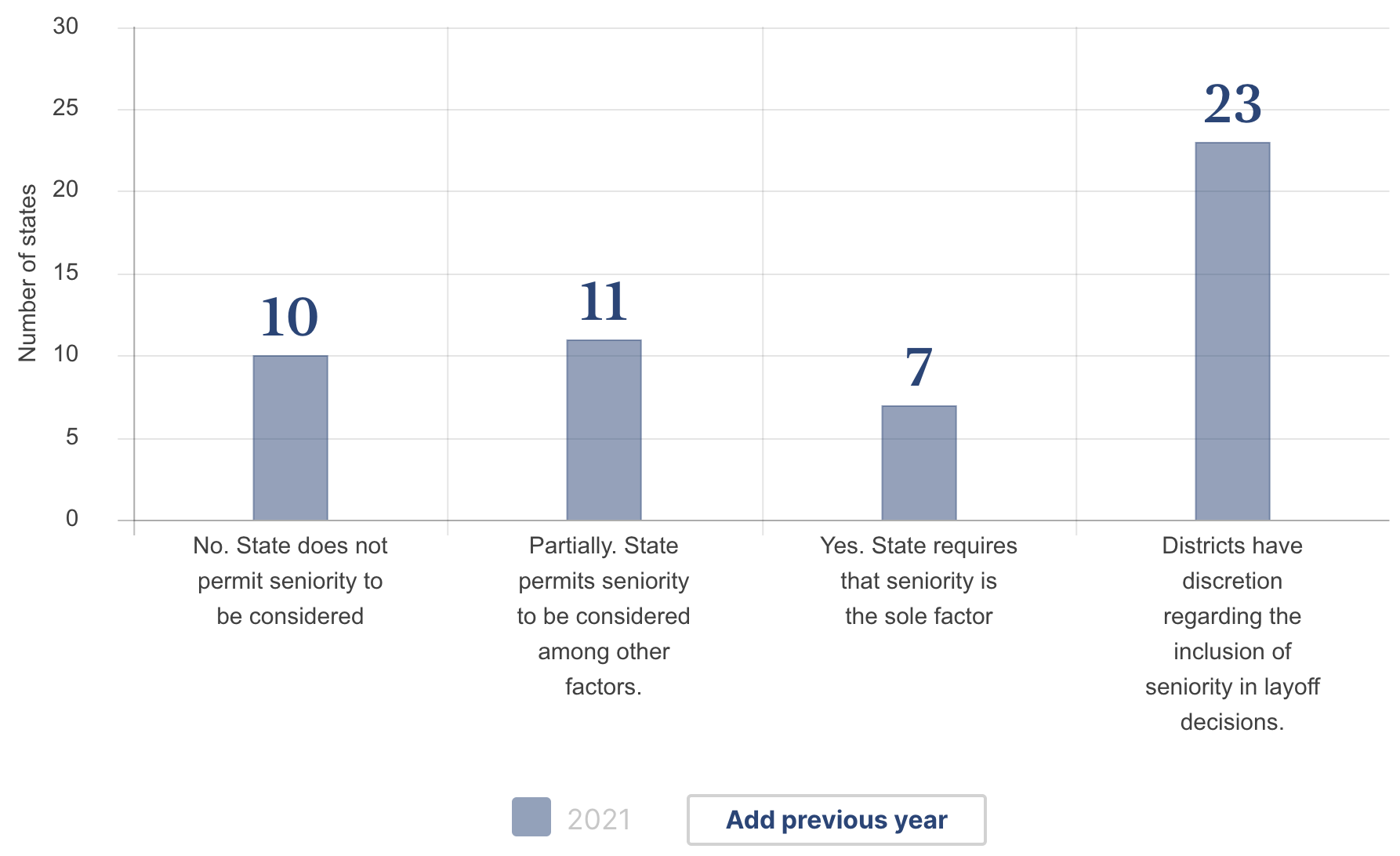
In 2021, NCTQ analyzed state laws on the use of seniority in layoff decisions. We found that only ten states do not allow districts to consider seniority, and eighteen states either permit them to consider it among other factors or require it as the sole factor. In twenty-three states, districts have discretion regarding the inclusion (or exclusion) of seniority in layoff decisions.

Figure 1. Do states require teacher seniority to be considered when making layoff decisions?
1

Source: National Council on Teacher Quality. 

NCTQ also published a report on district layoff policies. We found that forty-six of the 148 districts in our sample (nearly a third) of the largest districts across the U.S. use seniority as the primary or sole criterion for teacher layoffs. This has remained relatively stable over the past five years. In twenty-eight of these districts, seniority is the only criterion considered when teacher layoffs need to happen. This is a troubling state of practices that will perpetuate inequities for students. We found one hopeful note: The data also showed that a more holistic approach to layoffs—using multiple criteria including performance and/or seniority—has become more prevalent; the number of districts using multiple criteria increased by roughly 10 percentage points compared to seven years ago.

What should state and district leaders do?

The writing is on the wall: Given impending budget cuts, declines in student enrollment, and the imbalance between new hires made in response to the pandemic and currently shrinking numbers of funded positions, teacher layoffs are imminent. District and state leaders need to stop focusing on teacher shortages writ large, and start focusing on policies and practices to strategically manage and staff schools.

States should begin by requiring that school districts consider classroom performance as a factor in determining which teachers are laid off when a reduction in force is necessary, and stop using seniority as the sole criterion. Where there is flexibility in state law, such as the twenty-three states mentioned above that give districts discretion in using or eliminating seniority, districts should seize the opportunity to eliminate seniority or at the very least, expand to additional criteria.

In addition to performance, states and districts have a variety of additional criteria to use when making tough layoff decisions:

  • Specific consideration of student needs (e.g., reading specialists)
  • School and district needs, such as whether a teacher has highly sought or shortage-subject qualifications (e.g., dual language speakers or special education teachers)
  • School characteristics (e.g., a school designated for support because of low-performing status)
  • Pathways to the classroom: whether a teacher has taken a specific, district-sponsored pathway to the classroom (e.g., Grow Your Own programs)
  • Whether the teacher performs additional duties (e.g., department chair)
  • The teacher’s attendance and discipline records

Many states and districts are already heeding these warnings and taking important steps. After the “Great Recession” of 2008, Charlotte-Mecklenburg Schools (NC) gave their principals discretion over layoff decisions. The principals used performance as one of their criteria, targeting teachers who earned low evaluation ratings, along with other measures, including whether teachers had previously retired, were recently hired, unlicensed, non-tenured, or taught elective subjects. Evaluation of the approach found that on average, by using these additional criteria and giving principals more discretion, the district reduced total job losses and laid off fewer effective teachers than they would have following a last-in-first-out policy.

Additionally, a recent report by E4E highlighted two examples of alternative approaches. In Minneapolis (MN), following the passage of a 2019 state law that stopped requiring the use of seniority as the only criterion in layoffs, the district and union negotiated in the contract the use of additional criteria that prioritized teacher diversity, such as keeping licensed teachers from underrepresented groups, teachers who graduated from Grow Your Own programs, and teachers in schools designated as “racially isolated.” In Oregon, advocates successfully worked to change state law so teachers with cultural or linguistic expertise are prioritized over more senior teachers. These new policies will soon be used: Minneapolis Public Schools’ (MN) most recent budget proposal indicates that about 40 teacher positions will be cut. Similarly, just last week, Salem-Keizer Public Schools (OR) announced that more than 400 public school employees will lose their jobs at the end of the school year to balance district budget forecasts.

Also hearteningly, a number of districts (Brevard Public Schools (FL), Chicago Public Schools (IL), Clayton County Public Schools (GA), Cleveland Metropolitan School District (OH), and Cobb County School District (GA), among others) have named performance as the sole criterion or the preponderant criterion for teacher layoffs. More districts can be found in our Teacher Contract Database.

Where do we go from here?

Given the rapid shifts in the teacher labor market as well as current and impending teacher layoffs, state and district policymakers, along with their unions, under the watchful gaze of local advocacy organizations, must center student needs when defining the criteria and processes to use for teacher layoffs. To advance the companion goals of diversifying the teacher workforce and supporting teacher effectiveness, we must design and implement thoughtful means of reducing the teacher workforce that will benefit all students. If we stand aside and continue with the status quo, students will suffer the costs—especially our most vulnerable and historically disadvantaged students.

Editor’s note: This was first published by NCTQ.

view
School administrators and teachers meeting

How some schools are changing staffing styles due to shortages

Jeff Murray
5.2.2024
Flypaper

While it seems likely that the end of ESSER funding in September will engender a(nother) seismic shift in the school staffing conversation, education leaders are—for the moment—still talking about teacher shortages, long-term vacancies, hard-to-staff specialties, burnout, dissatisfaction, and attrition. On top of that, they seem interested in talking about how they’ve staffed their schools in light of these realities. A new report from the Center on Reinventing Public Education (CRPE) synthesizes lessons learned from dozens of interviews of school leaders practicing what is termed “strategic staffing.”

At its base, “strategic staffing” is about moving away from the traditional one teacher, one classroom model and implementing strategies like establishing new pathways into the teaching profession, creating new structures for differentiated professional development and pay scales, and rethinking the daily work of teachers and support staff.

CRPE analysts interviewed forty-two leaders (principals, superintendents, etc.) and technical assistance providers working in six different school systems. All the systems are anonymous in this write-up and little description or differentiation is provided, except to say that the list includes both traditional districts and charter management organizations, and that some systems are in right-to-work states, while others are in collective-bargaining states. Interviewees were already well-versed in the tenets of strategic staffing, and were able to answer researchers’ questions regarding the origins and growth of their models, their implementation efforts, stakeholder support and opposition, barriers and enabling factors, and outcomes.

The analysis does not say when the interviews were conducted, though most leaders report that they’d been implementing strategic staffing for “more than three years” at the time of the interview. Several leaders report using federal Covid-relief funds to support their strategic efforts, though that’s not the only funding source noted, and there is no specific discussion of pandemic-era staffing. The overwhelming sense is that these new protocols for recruiting, deploying, supporting, and retaining talent are responses to persistent staffing concerns that predate the pandemic.

The report identifies seven strategies that two or more of the systems have implemented. The most common are creating new teacher leadership roles (which enable teachers to advance in their careers without leaving instruction) and personalized teacher development (defined as providing opportunities that support leadership development as well as teachers’ daily work and personal growth). Other common strategies were redesigned schedules and workloads, broadened recruitment programs, and additional compensation for staffers who take on additional responsibilities or exhibit strong performance. Every system covered in the report was implementing at least three non-traditional staffing strategies, with one system reporting five simultaneous efforts. Leaders explained in their interviews that they believed no one strategy by itself would adequately move the needle on staffing concerns, and that they were working to implement everything they could.

The bulk of the CRPE report discusses challenges, both big and small, that leaders faced in their efforts to make changes. The most frequently-cited—and most difficult to overcome—emerge from the codified aspects of traditional education models. For example, teacher licensure requirements limit who can be recruited to teach and which classes/subjects can be covered by any given teacher; class size requirements complicate team teaching efforts; state-mandated pay scales often forbid bonuses to incentivize teachers to take on new/additional roles; and collective bargaining agreements contain myriad ironclad clauses and requirements based on the oldest of old-school teaching models.

Some leaders, however, offered anecdotes of hope. For example, one system found that union leaders were willing to be more flexible than expected in their interpretation of contract terms, and another discovered that a longstanding district “policy” regularly cited as the reason they couldn’t hire part-time paraprofessionals didn’t even exist! But these fortuitous outcomes weren’t the norm. Policies and prohibitions that looked like roadblocks to change generally were just that.

Leaders also reported another category of potential barriers that were ultimately more permeable. These include inflexible data systems that, in one example, only track student outcome data (attendance, test scores, discipline, etc.) for a single-teacher classroom structure; creating a master schedule for all teachers and support personnel to accommodate new forms of collaboration; HR and other central office staff resistant to changes in recruiting, hiring, and training of teachers; and school-level processes, such as how students are assigned to teachers at the beginning of the grading period, semester, or year. These, leaders say, can be overcome with enough effort and buy-in from staff.

In the end, this report is more about starting points than results. For example, the authors write: “Because of sampling limitations and our reliance on leaders’ recollections and self-reports, the findings do not represent the full breadth of leaders’ experiences, nor the chances that other leaders may encounter similar experiences.” Translation: School systems—while often bound by similar rules, traditions, and norms—are staffed by individuals whose devotion to those strictures can vary widely. “Further,” the authors add, “we do not claim a causal relationship between the strategic school staffing initiatives and the leaders’ reported efficacy.” This is an important caveat because there is really no efficacy information provided at all. Did these six school systems fully solve their staffing issues with what often sound like Herculean (and sometimes Sisyphean) efforts? No idea. And even if they did, how are their students faring in the wake of the changes they were able to make? Again, no clue. It makes sense to think that schools and their students in 2024 might benefit from a refresh of the staffing style of the previous hundred years. But this report is more about compiling a roster of possible ideas than proving their effectiveness.

SOURCE: Lisa Chu, Lydia Rainey, and Steven Weiner, “‘So hard, but so rewarding’: How school system leaders are scaling up strategic school staffing models,” Center on Reinventing Public Education (March 2024).

view
Fordham Gadfly image

Cheers and Jeers: May 2, 2024

The Education Gadfly
5.2.2024
Flypaper

Cheers

  • The Maryland state board of education appointed interim superintendent Carey Wright to a permanent role. —Washington Post
  • Indianapolis Public Schools plans to transfer ownership of a district building to a KIPP charter school and help finance a renovation at the site. —Chalkbeat
  • A Connecticut school found success banning phones with Yondr bags, and even many students came to appreciate it. —Washington Post

Jeers

  • Equity grading grows in popularity, a part of a larger trend of education consultants selling dubious theories to schools at a high price. —RealClearInvestigations
  • A combination of records numbers of applications and FAFSA issues made this year’s college enrollment season uniquely chaotic. —New York Times
  • A new book addresses the very real problem of Black students’ underrepresentation in advanced education programs, but the author seems to encourage the idea that the programs are racist and should be ended rather than mended. —Teen Vogue
view
Fordham Gadfly image

What we're reading this week: May 2, 2024

The Education Gadfly
5.2.2024
Flypaper
  • New York State’s budget law weakens mayoral control of the Big Apple’s schools and empowers the United Federation of Teachers. —Michael Bloomberg, Bloomberg
  • Teachers unions are hopping onto the “ban phones” bandwagon. —Education Week
  • According to new federal data, enrollment in teacher preparation programs grew 12 percent nationally between 2018 and 2022. —The 74
  • Schools are implementing policies to skirt around the prohibition on affirmative actions. —The Dispatch
Fordham Logo

© 2026 The Thomas B. Fordham Institute
Privacy Policy
Usage Agreement

National

P.O. Box 110
Burke, VA 22009

202.223.5452

[email protected]

Ohio

P.O. Box 82291
Columbus, OH 43202

614.223.1580

[email protected]

Sponsorship

130 West Second Street, Suite 410
Dayton, Ohio 45402

937.227.3368

[email protected]