Mobile Navigation

  • National
    • Policy
      • High Expectations
      • Quality Choices
      • Personalized Pathways
    • Research
    • Commentary
      • Gadfly Newsletter
      • Flypaper Blog
    • Events
    • Scholars Program
  • Ohio
    • Policy
      • Priorities
      • Media & Testimony
    • Research
    • Commentary
      • Ohio Education Gadfly Biweekly
      • Ohio Gadfly Daily
  • Charter Authorizing
    • Application
    • Sponsored Schools
    • Resources
  • About
    • Mission
    • Board
    • Staff
    • Career
Home
Home
Advancing Educational Excellence

Main Navigation

  • National
  • Ohio
  • Charter Authorizing
  • About

National Menu

  • Topics
    • Accountability & Testing
    • Advanced Education
    • Career & Technical Education
    • Charter Schools
    • Curriculum & Instruction
    • ESSA
    • Evidence-Based Learning
    • Facilities
    • Governance
    • Personalized Learning
    • Private School Choice
    • School Finance
    • Standards
    • Teachers & School Leaders
    • Think Again
  • Research
  • Commentary
    • Gadfly Newsletter
    • Flypaper Blog
    • Gadfly Podcast
  • Events
  • Scholars Program

The Education Gadfly Weekly

Sign Up to Receive Fordham Updates

We'll send you quality research, commentary, analysis, and news on the education issues you care about.
Thank you for signing up!
Please check your email to confirm the subscription.

The Education Gadfly Weekly: An open letter to Bill Gates

Volume 25, Number 21
5.29.2025
5.29.2025

The Education Gadfly Weekly: An open letter to Bill Gates

Volume 25, Number 21
view
Bill Gates
High Expectations

An open letter to Bill Gates

The Gates Foundation’s support for education reform has done much good. As the Foundation expends vast sums during its final twenty years, Finn urges Bill Gates to use his resources—financial, yes, but also influence—to press for fundamental changes in K–12 policies and practices.

Chester E. Finn, Jr. 5.29.2025
NationalFlypaper

An open letter to Bill Gates

Chester E. Finn, Jr.
5.29.2025
Flypaper

A Texas showdown: school choice vs. state testing

Dale Chu
5.29.2025
Flypaper

From algebra to calculus (or stats!): Connecting the math pipeline

Elizabeth Huffaker, Ph.D. | Christina Claiborne
5.23.2025
Flypaper

Does tightening the screws on earning tenure benefit students?

Amber M. Northern, Ph.D.
5.29.2025
Flypaper

Is a virtual intervention the roadmap for algebra mastery?

Jeff Murray
5.27.2025
Ohio Gadfly Daily

#971: A “Quality Check” on school accountability, with Tom Toch and Lynn Olson

5.28.2025
Podcast

Cheers and Jeers: May 29, 2025

The Education Gadfly
5.29.2025
Flypaper

What we’re reading this week: May 29, 2025

The Education Gadfly
5.29.2025
Flypaper
view
Texas state house

A Texas showdown: school choice vs. state testing

Dale Chu 5.29.2025
Flypaper
view
Girl solving equation

From algebra to calculus (or stats!): Connecting the math pipeline

Elizabeth Huffaker, Ph.D., Christina Claiborne 5.23.2025
Flypaper
view
Teacher in front of classroom

Does tightening the screws on earning tenure benefit students?

Amber M. Northern, Ph.D. 5.29.2025
Flypaper
view
TNTP Unlocking Algebra SR image

Is a virtual intervention the roadmap for algebra mastery?

Jeff Murray 5.27.2025
Ohio Gadfly Daily
view

#971: A “Quality Check” on school accountability, with Tom Toch and Lynn Olson

Tom Toch, Lynn Olson, Michael J. Petrilli, Amber M. Northern, Ph.D. 5.28.2025
Podcast
view
Gadfly Guy

Cheers and Jeers: May 29, 2025

The Education Gadfly 5.29.2025
Flypaper
view
Fordham Gadfly image

What we’re reading this week: May 29, 2025

The Education Gadfly 5.29.2025
Flypaper
view
Bill Gates

An open letter to Bill Gates

Chester E. Finn, Jr.
5.29.2025
Flypaper

Dear Bill,

(I think I’m now old enough to use your first name, though we’ve only met once, quite a while ago.)

I don’t write “open letters” to important philanthropists very often (and they get answered even less often!). In fact, I’ve only done it twice before: once to you, back in 1998, then to Mark Zuckerberg and Priscilla Chan in 2016. Each was prompted by the launch of a major new venture in philanthropy by people with enough money to make a difference.

You’re doing that again, pledging what is surely the largest philanthropic offering in history—some two hundred billion—over the next twenty years, then shutting down the foundation that bears your name. So, first and foremost, thank you, primarily for your generosity, which is especially noticeable at a time when greed seems to be on the ascendancy in America, but also for your wisdom in planning to bring it to a landing yourself rather than (like Ford, MacArthur, and others) trusting that future pilots know which direction to fly.

People write you open letters all the time, I realize. A quick search revealed examples ranging from Mikhail Gorbachev to the policy director of the Idaho Cattle Association. (No doubt that’s why you rarely reply.) I hope this one will get your attention.

I write because your recently announced plans for the Gates Foundation alluded to education only in passing. They were mostly about global health, clearly now your top priority.

Yes, you mentioned “helping U.S. students have pathways to opportunity” as an ongoing interest of the Foundation—and thank you for that. Any number of worthy education-related missions, projects and organizations—the Thomas B. Fordham Institute among them—have come to depend (perhaps more than we should) on your generosity in this realm and, as you well know, the nation’s education shortcomings have hardly been resolved.

But I can also understand why education isn’t a top priority for you: it’s frustrating to deal with, it’s resistant to change, and what actually improves it is often hard to nail. Health has clear benchmarks—survival rates, longevity, infant mortality, and much more—as well as strategies that indisputably make it better both in the here and now and over time. Vaccinations prevent a host of illnesses (despite what certain U.S. government officials jabber to the contrary). Smallpox is essentially gone from the planet, and polio is under control almost everywhere. Your quest to eradicate malaria is plausible, both using today’s tools (mosquito nets, insecticides, etc.) to curb its incidence and finding a vaccine to prevent it.

It would, by comparison, be almost laughable to suggest that investments by the Gates Foundation—or anyone, really—would lead to the eradication of ignorance.

Yet education is not a realm to despair about. We know that some things actually work. Consider science-of-reading literacy instruction in the early grades. Consider high-quality urban charter schools. Consider large-scale policy moves like results-based school (and student) accountability. They’re not foolproof, not like a vaccine, and they do depend (like most things) on competent and sustained implementation. But when done right, they work.

Your foundation has done much good in this realm. I’m thinking of the proliferation of small schools, the development of measures to inform teacher evaluations, support for Common Core standards, some important help for charter schools, and today’s focus on math education. These and more deserve plaudits. So does the Foundation’s record of transparency about ventures that didn’t turn out so well.

What we haven’t seen from your education team is probing analysis of which investments really made a difference on the ground—and why. The Measures of Effective Teaching initiative, for example, was smart and bold, but its findings and lessons aren’t getting traction. Why? I think because it didn’t incorporate a political strategy to overcome union resistance, which was (and remains) fierce. By contrast, Common Core standards—for which you invested many millions in advocacy and strategy—have had staying power, albeit under different names in most states.

What should the future hold? How should the Gates Foundation navigate the next two decades in K–12 education? You could play it safe by continuing with the Foundation’s current goal: “To support schools in improving K–12 teaching and learning, with a focus on math as the cornerstone skill for academic success and greater opportunities in the workforce.”

Who could possibly object? And if you do this—and continue what seems to be the current practice of not upsetting established K–12 interests like teacher unions and local districts—you’ll be thanked, you’ll avoid controversy, and you may see incremental gains here and there. But that’s akin to distributing more mosquito nets instead of pressing for a malaria vaccine and fundamental changes in lifestyle. 

Alternatively, you could steel yourself to press for fundamental changes in K–12 policies and practices, no matter who protests. Team up with change agents, bold experimenters, and state/district/school leaders who have the vision and gumption (and leverage) to do things really differently.

Of course, that means supporting high-quality school choices—public, private, and unconventional (micro-schools, technology-based, etc.). It also means pushing to overhaul the lock-step structures, age-based grades, 180-day years, six-hour days, and Carnegie units that shape how schools are organized and staffed, and how kids move through them. It means challenging—not just challenging old ideas and ingrained practices but investing in effective modern alternatives. It means investing in gifted-and-talented education so that smart kids can learn more and move faster—and that smart kids from poor and minority circumstances don’t get left by the wayside.

There’s more, much more, and even a foundation as wealthy as yours must select. But please don’t select the easy, popular route full of established ventures and institutions that will gratefully accept your money but not do anything different than they’ve always done.

Real change on the ground—the kind that actually alters what schools do, who teaches, who goes to which schools, who gets paid how much, whose school years expand, whose graduation standards get more rigorous—means duking it out with the forces of resistance, which also means allying with those who are ready to fight on your side. So be brave and think big. Consider, for example, giant grants to districts willing to blow up the single salary scale and collective bargaining agreements. Yes, that may mean focusing for now on red states—and also engaging politically, using your own money for things the IRS won’t let the Foundation do.

Sure, keep the focus on needy kids and urban schools, but there are plenty of both in places where the governor and legislature—maybe even the mayor—will join with you. Shun the many places that will take the cash but not change their ways.

There are promising education strategies worth nurturing, cultivating—and discovering. Not all of them will succeed, which is why they must be properly researched, implemented with integrity, and evaluated with honesty.                            

So please include those honest evaluations, truth-tellers, and mechanisms—there are so many nowadays—to communicate what does and doesn’t work, and don’t shy away from denouncing folly and self-interest. Support brave experiments, including those opposed by the establishment. Don’t hesitate to support advocates and critics or to call out blunders by government officials (even those who may seek revenge). And please don’t neglect the policy angle.

It’s okay to work with practitioners, with actual districts, schools, and teachers, as that’s unquestionably where the education rubber meets the road. Yet they’re not the road builders, much less the surveyors who determine the routes or the engineers who ensure that roads are straight and solid, incorporating sturdy bridges where needed.

State and local officials are mostly the ones who do those things in K–12 education, along with—in a few key realms such as statistics and assessment—their federal counterparts.

They need support, too, not money so much as ideas, evaluations, advocates, encouragement—and critics. A key issue in American education today is inattention, partisanship, and a bit of cowardice among elected officials and those they appoint. You and the Gates Foundation can make a difference here, too.

Sure, you’ll be criticized. Changing education means upsetting apple carts, taking on vested interests, getting yelled at.  

Think about it this way as you set priorities for the decades ahead: it’s fine to help scale things that you know will be effective and that will get you thanked. But also consider the fact that what education needs most—and is least likely to get from government—is the courage and vision to try things that might not work and to endure the flak that comes with trying. These are best done by the private sectors in which you’re a leader.

Thanks for considering—and plaudits for accelerating your efforts.

Sincerely, Chester E. Finn, Jr.

view
Texas state house

A Texas showdown: school choice vs. state testing

Dale Chu
5.29.2025
Flypaper

Texas Governor Greg Abbott recently signed into law a universal education savings account program, breaking through years of legislative resistance. As the largest “day one” school choice program in the U.S., it marks a watershed victory for supporters—not just in the Lone Star State, but across the country. Yet even as Texas opens new doors for families, it may soon shut an important window into school quality. Lawmakers are locked in deliberations over House Bill 4, a proposal to eliminate the STAAR exam as currently administered. The bill has cleared both chambers in different forms, setting up a high-stakes negotiation that could reshape the state’s approach to accountability.

House Bill 4 would replace STAAR—now a summative end-of-year assessment—with a model  that tests kids in smaller segments throughout the school year. Notably, that shift entails moving away from criterion-referenced testing—which measures whether students meet specific grade-level standards—and toward norm-referenced testing, which evaluates students based on how they perform compared to their peers nationwide.

It also takes aim at the state’s A–F accountability system, introducing additional metrics—such as student participation in extracurricular activities—while requiring the Texas Education Agency to obtain legislative approval for all major changes to the ratings system. Importantly, HB 4 expands the use of locally chosen tests and other indicators for a portion of a district’s accountability rating. While such local indicators are meant to supplement—not replace—state-required assessments, the shift risks undermining equity and comparability across Texas as well as weakening the public’s ability to discern whether students are truly meeting grade-level expectations.

Taken together, the ESA win and the proposed testing overhaul reflect a growing sentiment that, because private schools receiving public funds aren’t subject to state testing, traditional public schools shouldn’t be either. Under Texas’s new law, ESA-participating schools will be required to administer a nationally norm-referenced test of their own choosing rather than the state exam. This prompted the claim that public schools deserve comparable flexibility.

The sequencing wasn’t accidental. Lawmakers couldn’t credibly revisit the long-standing architecture of standardized testing until a private school choice program was in place. While the push to reconsider STAAR may have been a logical consequence of how the ESA law was constructed, it also created a political opening. HB 4 wouldn’t eliminate testing outright, but it could set the stage for further erosion. Once annual exams lose their primacy, it’s easy to imagine the next phase—one where districts seek equal treatment with private schools and find a sympathetic audience in the legislature.

Anti-testers on the right

Once the domain of teachers’ unions and the political left, testing skepticism can now be found on the right—yet another example of the horseshoe theory of American politics. For the most ardent school choice proponents, statewide testing regimes are seen less as tools for transparency and more as barriers to innovation. It was only a matter of time before the two issues collided in full.

To be sure, most school choice programs come with some testing provisions, just not the state-mandated variety—an arrangement that many choice advocates view as a feature, not a flaw. If private schools can choose their own assessments, the argument goes, why shouldn’t public schools be granted the same flexibility?

That question spotlights the evolving relationship between two longstanding pillars of reform: school choice and test-based accountability. Though often cast in tension—especially as private schools receiving public funds sidestep state exams—the two approaches have historically been complementary. Transparent data has helped parents make informed choices, while the pressure of choice has, in turn, spurred public schools to improve. But as choice programs expand and skepticism toward standardized tests grows, the balance is tilting. A 2018 AEI paper by Mike McShane, Patrick Wolf, and Collin Hitt anticipated this moment early on:

A growing number of studies are finding that school choice programs can improve high school graduation rates, college attendance, and earnings—without producing gains in test scores. Conversely, studies of other school choice programs have found large short-term test score gains but no lasting benefits in terms of graduation rates or college attainment. Improving test scores appears to be neither a necessary nor sufficient condition for improving the later-life outcomes that truly matter.

In this view, short-term metrics like annual tests offer only a narrow snapshot of what matters, eliding, according to the authors, more important long-run outcomes like high school graduation, college attendance, or parent satisfaction. That seems to be the direction in Texas, where momentum is shifting—not just toward family-defined success, but also in response to the steady resistance to standardized testing that’s long simmered in education circles.

The federal backstop

House Bill 4 also gestures at a broader reorientation of the center of gravity when it comes to federal-state relations in education. One underappreciated provision in the bill would tie Texas’s commitment to annual testing to federal law. If Congress or the U.S. Department of Education were to relax existing testing mandates, the state would automatically follow suit—potentially eliminating annual testing altogether. The provision functions like a “trigger law”: if federal requirements disappear, so does the state’s. Without those federal guardrails, there’s little to stop abrupt policy changes that undermine comparability, consistency, and public understanding.

As Texas policymakers consider HB 4, the path forward demands careful calibration. It is entirely reasonable to want more useful, instructionally relevant assessments (though that’s not the proper role for state achievement tests). It also makes sense to expect that all publicly funded schools—regardless of governance model—be held to some common standards. For private schools receiving partial public funding, a sliding scale of accountability may be more appropriate. The challenge lies in designing a system that fosters innovation without erasing the public’s ability to judge results.

Abbott and his allies deserve credit for their long-fought ESA victory. But it should not become the pretext for permanently lowering expectations or obscuring outcomes in the public system. Especially in the wake of pandemic-era learning loss, the need for honest information about student achievement has never been greater. Without it, the very families empowered by choice may be left in the dark about whether their children are being well served.  


Update (June 2025): House Bill 4 ultimately died after the Texas House and Senate couldn’t reach a compromise—ending this round of the school choice vs. state testing standoff in a draw. The Senate aimed to preserve STAAR under a new name and keep oversight with the Texas Education Agency, while the House pushed to replace it with a nationally norm-referenced test. Neither side yielded, and the impasse sank the legislation. For accountability advocates, it’s a partial victory: a flawed bill was defeated, and the A–F rating system remains intact. However, the Senate’s bill would have curtailed ongoing legal challenges to the A–F system—a key opportunity that was missed. For now, STAAR survives—but the broader fight over assessment and accountability in Texas is far from over.

view
Girl solving equation

From algebra to calculus (or stats!): Connecting the math pipeline

Elizabeth Huffaker, Ph.D. | Christina Claiborne
5.23.2025
Flypaper

A new wave of middle school math policies is poised to reshape who gets access to advanced math options, and when. By automatically placing academically ready middle schoolers into Algebra I by eighth grade, “automatic enrollment” (also called “opt-out”) policies open the door for more students to take higher-level math courses, like calculus or statistics, before high school graduation. Such initiatives are gaining traction in state houses: North Carolina, Nevada, and, as of this year, Texas require schools to use state assessments to identify students for math acceleration. Virginia is set to follow suit. A new study of an early adopter district, Dallas ISD, identified clear impacts: eighth grade Algebra I enrollment rose by about 13 percentage points—a 50 percent increase. Hispanic students experienced the largest gains in access, narrowing the Hispanic–White enrollment gap by nearly 10 percentage points.

As outlined in a new EdResearch for Action brief that summarizes the research and history of Algebra I, auto-enrollment policies mark a meaningful shift from past practices. Historically, access to early Algebra I often relied on parent advocacy or teacher discretion, two mechanisms that often underidentified capable students from underrepresented and low-income backgrounds. By using objective criteria, automatic enrollment expands access to rigorous coursework while also avoiding the pitfalls of “one-size-fits-all” policies that either push all students into early Algebra I or delay access in middle school entirely.

While automatic enrollment is a powerful tool for expanding access, it’s most effective when paired with efforts that begin even earlier. Math readiness develops over time, through consistent instruction, support, and enrichment beginning in elementary school. Yet by the time students are considered for acceleration, many from underserved backgrounds may already be behind. In fact, only 28 percent of students across the country were proficient in eighth grade math according to the 2024 National Assessment of Education Progress (NAEP). Auto-enrollment policies are a launchpad at a critical moment, but without sustained investment in foundational math, they will also replicate pre-existing disparities in math preparation.

As these policies scale, it is also important for states and districts to consider their ripple effects on high school math course-taking. More students will reach eleventh and twelfth grade with the prerequisites to choose between statistics and calculus, courses that were previously out of reach for many. This new, more diverse batch of accelerated students may be less likely to have access to the information, role models, or institutional guidance to steer them through the more complex landscape of high school courses. A recent Fordham Institute study comparing outcomes for students who take these two advanced math options provides timely evidence to guide our thinking on how schools and families should help students navigate these options.

The authors’ findings are compelling: Calculus takers are more likely to pursue STEM and attend selective colleges, while statistics students achieve similar earnings and success in non-STEM fields. Rather than declaring a winner, the study suggests that the “best” advanced math course may depend primarily on students’ preferences and goals. However, without guidance, students may default to taking the most familiar or logistically convenient course, not the one most aligned to their aspirations or strengths. More worrisome, some may forgo taking college-level coursework altogether as these classes are not required for high school graduation. Without nudges to stay on a rigorous pathway, they may miss out on the very benefits that early Algebra I access was meant to unlock.

This raises an important policy question: Should automatic enrollment extend beyond Algebra I? Washington state already does this, automatically enrolling students into advanced courses (including AP Statistics and calculus) if they meet readiness criteria on tenth- and eleventh-grade tests. A recently published study of the Washington policy found results in line with the Dallas ISD evaluation: advanced enrollment increased, especially for students from groups typically underrepresented in those classes. Carrying forward auto-enrollment policies into later grades can encourage more students to recognize and pursue their math potential throughout secondary school, widening access to future opportunities.

However, current auto-enrollment policies are not designed to help students choose among advanced courses. Test scores alone can’t reveal whether a student is pursuing a STEM career, where AP Calculus might offer preparatory advantages. While providing high school upperclassmen more autonomy in course selection is appropriate, many find the decision landscape overwhelming: Dual-enrollment, AP, or IB? Statistics or calculus? Auto-enrollment mechanisms could be expanded to connect qualified students with guidance counselors or college admissions representatives to help students make considered, forward-looking decisions.

Effective math policy must also be forward-looking and backward-looking along the educational pipeline. Preparing a larger and more diverse pool of students to thrive in college and career depends on expanding access to advanced high school coursework. This requires identifying students for rigorous math opportunities in middle school, which relies on developing strong foundational skills in elementary grades. Despite a focus on individual courses—calculus, statistics, and Algebra I—the research highlighted by the Fordham study and the EdResearch brief ultimately underscores how important it is to support students across their entire K–12 trajectories, not just at isolated transition points.

view
Teacher in front of classroom

Does tightening the screws on earning tenure benefit students?

Amber M. Northern, Ph.D.
5.29.2025
Flypaper

The granting of tenure typically occurs after K–12 teachers have worked three years in the classroom. In many places, that’s it, just time-in-harness. Thankfully, however, some states do require that teachers meet specific benchmarks relative to student test performance or classroom observation scores. One would imagine that the latter would be preferable, but a recent study out of Tennessee puts that notion to the test: Does lengthening the tenure process, coupled with a measure of minimum effectiveness, improve teacher performance? Tennessee’s approach to tenure provides a natural experiment by which to investigate that question.

The Volunteer State has had a tenure policy for its K–12 teachers since 1951, with longevity being the sole criterion for earning the job protections it affords. The state’s Race to the Top grant, awarded in 2010, created a new teacher evaluation framework, and the passage of Public Chapter No. 70 in early 2011 connected the framework to tenure eligibility. Specifically, to be eligible for tenure, teachers needed to have completed five years of teaching and to have earned annual levels of effectiveness (LOE) scores above the state-determined cutoff in both years 4 and 5. (The LOE is an average based on three measures: 50 percent for classroom observations, 35 percent for value-added performance, and 15 percent for student achievement.)

Teachers who missed the cutoff point (which equated to the bottom third in LOE performance) could continue on a probationary contract in year 6 and beyond, but they could earn tenure only after scoring greater than 4 out of 5 on their LOE in two consecutive years. (In practice, few teachers were let go for not performing well enough to get tenure, despite that intention at the start.) These changes went into effect at the start of the 2011–12 school year.

Harvard researcher Eric Taylor leverages this policy change to see how various elements of the evaluation and tenure process impacted a teacher’s job performance. He uses data from 2008–15, four years before and after the start of the new program in 2011–12. He includes only ELA and math teachers in grades 4–8 who are in years 1–7 of their employment, both because Tennessee has long had annual tests in those grades and because newer teachers are most likely to be motivated by the tenure incentive. He uses a difference-in-differences design to assess the effects on  teachers hired in 2010 or 2011, relative to the announcement of the new tenure rules, implementation of the new performance measures, and other factors.

The comparison group were teachers hired in 2009 or earlier, prior to the 2012 evaluation reforms. The “treatment effect” is measured as the growth in performance between the first and second year (or second and third year) of a teacher’s career, but it is additional growth on top of the typical/predicted growth between those years that Taylor uses as the true impact of the new policy. (Typical growth is derived from the comparison group.)

His key finding is that teacher performance began improving before any rewards or consequences were in place. Teacher value-added scores increased by .05 of a standard deviation (SD) in anticipation of the new policy, with math and ELA teachers both improving—although math teachers improved more.

The linking of performance measures to earning tenure begins in year 4. However, little improvement appears in year 4 since so much improvement occurred earlier. Nearly two-thirds of teachers earn tenure after year 5 and their scores in year 6 no longer count for tenure, but their value-added gains persist and do not decline. In other words, teachers keep performing at higher levels even after earning tenure via the new scheme. Moreover, newly-tenured teachers improved a further .025 SD between years 5 and 6.

The non-tenured teachers (one-third) largely stayed in their jobs in year 6, showing that the new tenure rules did not increase or decrease typical attrition. Even though they didn’t (and probably never would) get tenure, teachers still didn’t leave on their own, nor were they forced out in any greater number than during the previous tenure scheme. That likely would not have been the case had districts been able to let go of low performers.

On balance, it seems that Tennessee’s efforts to improve teacher performance were beneficial for students. What would have made them even better? Getting rid of tenure entirely, as Florida, Kansas, North Carolina, and Wisconsin have done. As my favorite curmudgeon once said, “[S]hould teachers, often by the age of 25, obtain guaranteed lifetime employment in a school system on the basis of a few years of satisfactory evaluations? For that matter, should anyone get lifetime tenure in any job?”

Ok, I’ll answer his rhetorical question: No. A BIG, FAT no.

SOURCE: Eric Taylor, “Employee evaluation and skill investments: Evidence from public school teachers,” Annenberg Institute at Brown University (May 2024).

view
TNTP Unlocking Algebra SR image

Is a virtual intervention the roadmap for algebra mastery?

Jeff Murray
5.27.2025
Ohio Gadfly Daily

Research shows that students who pass Algebra I by ninth grade are more likely to graduate high school, attend college, and earn higher salaries when they enter the workforce. Since math skills build on each other over successive grade levels, passing Algebra I is predicated on mastery of a lot of prior content, not least of which is eighth-grade-level material. But recent NAEP data indicate that this is not an area where U.S. students currently shine very brightly. What can be done to get students back on track for this vital inflection point in their education? A new report looks at the effectiveness of a curricular support effort to boost students to the algebra starting line.

A team of researchers from TNTP examined three years of data (2021–2024) from more than 2,200 students across the country who used an online learning platform called Teach to One Roadmaps (Roadmaps) developed by New Classrooms. (A disclaimer included in the report implies a connection between the TNTP and New Classrooms organizations related to this project, but the nature of it is unclear.) We are given minimal data on the students in the study but are told specifically that this is not a nationally-representative sample. All were enrolled in an official Algebra I class, with most (66 percent) in ninth grade at the time. The remainder took the class as tenth graders. Their unidentified schools tended to serve higher-than-average proportions of low-income students (as measured by free and reduced-price lunch status and levels of Title I funding) and to have more Black and Hispanic students (23 percent and 50 percent, respectively, on average) than white students (11 percent). While all students were enrolled in Algebra I, their readiness for algebra concepts varied widely based on a beginning-of-year diagnostic assessment within the Roadmaps program. TNTP’s analysis also includes Roadmaps students’ scores on their states’ end-of-year math test per grade level.

The key to Roadmaps, launched in fall 2020, is a rigorous adherence to what is termed the “algebra ladder.” That is, a hierarchy of math skills that reach all the way back to elementary school grade levels and build upon each other sequentially. Mastering skill “A” means one has the prerequisite knowledge to begin learning skill “B.” Years of student achievement data bears out the readiness designation. Each state’s math standards differ, but New Classrooms’ proprietary “algebra ladder” is based on their research into commonalities between many different hierarchies. Details are included in the TNTP report. With a brief initial assessment, the Roadmaps program determines which of the approximately 100 foundational skills[1] a student has mastered and which remain incomplete. Students then receive instruction on the missing skills via text, videos, and practice problems. Short formal assessments follow, with more-nuanced instruction and practice based on the results, until mastery is reached and students can move on to the next missing skill. Formal details on how the Roadmaps work integrates with ongoing classroom instruction in Algebra I are lacking in this report, and that seems important; but more on this in a moment.

First, the findings. Roadmaps assessment results (including both unsuccessful and successful attempts) show that algebra proficiency improves when students master missing algebra-related concepts and skills, especially those from prior grades. Just 7 percent of students who knew fewer than one-third of all the skills from their current and prior grade levels met the passing scores on their state’s math test. By contrast, once students knew around four-fifths of all skills, test passage rates went up to 75 percent or more. Even better, there are some specific early skills that appear to help students build to algebra success more readily than others. That is, mastering every skill is ideal, but if time is short, learning the “key predecessor skills” is a viable alternative highly correlated with test passage success. Finally, students can obtain mastery of specific Algebra I skills (those correlated with the foundational skills they already know) even if they don’t yet know other foundational skills correlated with different Algebra I skills. In fact, students working on the most advanced concept and skill that Roadmaps indicates they’re ready for—even with other knowledge gaps from earlier grade levels—made up ground the fastest compared to peers who started at the bottom and took the ladder one rung at a time.

It sounds like magic, or perhaps lightning in a bottle. More rigorous research will likely be the determining factor of true success (although this analysis is already an extension of a previous study conducted by a different organization with similar findings). But it’s also possible that Roadmaps has unlocked the “science of algebra” (if I may be so bold to coin this phrase), akin to the science of reading which is already shaking up old, bad literacy instruction habits in states across the country to the enormous benefit of students.

We get some glimpses into classroom implementation here (and in related web pages), but there are still too many unanswered questions raised by the report to allow for anything more than speculation at this remove. The program requires a high-quality shared curriculum across all math classes in all grades and extended or double blocks (80-90 minutes) of Algebra I daily. Can schools do that? Money is also likely a factor, both per pupil annual costs and professional development training for teachers who play a primary role in guiding student work through the program.

TNTP’s recommendations reach from the schoolhouse to the statehouse, all geared toward growing student access to Roadmaps. But even with a perfectly smooth policy environment at the highest levels, the changes required in schools and classrooms read like a big deal. However, as with science of reading, it seems that if students were able to reach grade level mastery earlier, less time would be needed for catch-up in later grades. In fact, if Roadmaps is given the time and implementation it needs to work its magic—and if it is indeed as magical as it sounds—more students could be ready for Algebra I sooner than ninth grade, thus getting more students on the path to even more advanced math like calculus and/or statistics in high school. An intriguing but incomplete analysis.

SOURCE: “Unlocking Algebra: What the Data Tells us About Helping Students Catch Up,” TNTP (May 2025).


[1] Teach to One Roadmaps’ total algebra ladder comprises approximately 150 skills: 100 foundational and fifty specific to Algebra I mastery. This is important to note since students are learning both types of skills at the same time in the Roadmaps program.

view

#971: A “Quality Check” on school accountability, with Tom Toch and Lynn Olson

5.28.2025
Podcast
 

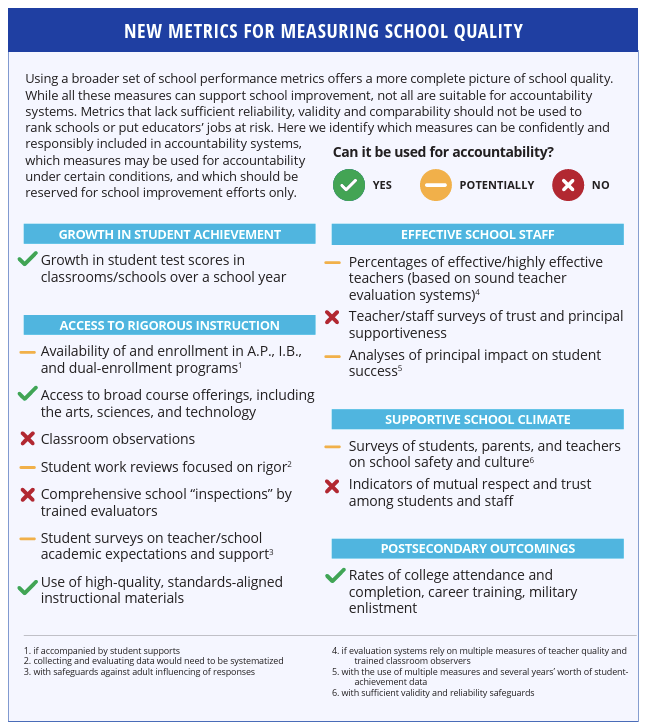
On this week’s Education Gadfly Show podcast, Tom Toch, director of FutureEd, and Lynn Olson, former deputy director at the Bill and Melinda Gates Foundation, join Mike and David to discuss Lynn’s new paper, “Quality Check: The New, Best Way to Measure School Performance.” Then, on the Research Minute, Amber shares a study on the economic effects of Universal Pre-Kindergarten programs, showing that UPK boosted workforce participation across nine states and cities.

Recommended content:

Quality Check
From the report, “Quality Check: The New, Best Way to Measure School Performance,” by Lynn Olson
  • “Quality Check: The New, Best Way to Measure School Performance” —Lynn Olson, FutureEd
  • “A New, Bipartisan Agenda for Raising Student Achievement” —Tom Toch, FutureEd
  • “The Full Measure of a School” —Erik W. Robelen, Education Next
  • “Ready or Not? A New Way to Measure Elementary and Middle School Quality” — Jing Liu, Seth Gershenson, and Max Anthenelli, Thomas B. Fordham Institute
  • “Universal Pre-K as Economic Stimulus: Evidence from Nine States and Large Cities in the U.S” — C. Kirabo Jackson, Julia A. Turner, and Jacob Bastian, NBER (May 2025)

Feedback Welcome: Have ideas for improving our podcast? Send them to Stephanie Distler at [email protected]. 

view
Gadfly Guy

Cheers and Jeers: May 29, 2025

The Education Gadfly
5.29.2025
Flypaper

Cheers

  • A balanced take on the Harvard saga by a well-known professor and critic. —Steven Pinker, The New York Times
  • Parents in rural Montana push back against a four-day school week. —Chalkbeat

Jeers

  • Chicago stopped penalizing students for missing class, and attendance plummeted. But the district let students graduate anyway.—Chalkbeat Chicago/WBEZ
  • In San Fransico, meanwhile, dubious “grading for equity” plans are underway for next school year. —The Voice of San Francisco
  • A Washington Post columnist tries to gaslight us into believing that American schools are doing fine. —Perry Bacon, Jr., The Washington Post
view
Fordham Gadfly image

What we’re reading this week: May 29, 2025

The Education Gadfly
5.29.2025
Flypaper
  • Since the pandemic, classroom disruptions have surged, prompting Texas lawmakers to push for stricter discipline policies. —The Texas Tribune
  • A federal judge dismissed a Massachusetts lawsuit in which parents claimed that popular but ineffective balanced literacy programs violated consumer protection law by falsely advertising research support, noting that the court is not equipped to evaluate the quality of education programs. —EdWeek
  • Many states picked diploma pathways over high school exit exams. Did students benefit? —Chalkbeat
Fordham Logo

© 2026 The Thomas B. Fordham Institute
Privacy Policy
Usage Agreement

National

P.O. Box 110
Burke, VA 22009

202.223.5452

[email protected]

Ohio

P.O. Box 82291
Columbus, OH 43202

614.223.1580

[email protected]

Sponsorship

130 West Second Street, Suite 410
Dayton, Ohio 45402

937.227.3368

[email protected]