Mobile Navigation

  • National
    • Policy
      • High Expectations
      • Quality Choices
      • Personalized Pathways
    • Research
    • Commentary
      • Gadfly Newsletter
      • Flypaper Blog
    • Events
    • Scholars Program
  • Ohio
    • Policy
      • Priorities
      • Media & Testimony
    • Research
    • Commentary
      • Ohio Education Gadfly Biweekly
      • Ohio Gadfly Daily
  • Charter Authorizing
    • Application
    • Sponsored Schools
    • Resources
  • About
    • Mission
    • Board
    • Staff
    • Career
Home
Home
Advancing Educational Excellence

Main Navigation

  • National
  • Ohio
  • Charter Authorizing
  • About

National Menu

  • Topics
    • Accountability & Testing
    • Advanced Education
    • Career & Technical Education
    • Charter Schools
    • Curriculum & Instruction
    • ESSA
    • Evidence-Based Learning
    • Facilities
    • Governance
    • Personalized Learning
    • Private School Choice
    • School Finance
    • Standards
    • Teachers & School Leaders
    • Think Again
  • Research
  • Commentary
    • Gadfly Newsletter
    • Flypaper Blog
    • Gadfly Podcast
  • Events
  • Scholars Program

The Education Gadfly Weekly

Sign Up to Receive Fordham Updates

We'll send you quality research, commentary, analysis, and news on the education issues you care about.
Thank you for signing up!
Please check your email to confirm the subscription.

The Education Gadfly Weekly: Help wanted: Ed-reform governors needed (again)

Volume 25, Number 30
7.31.2025
7.31.2025

The Education Gadfly Weekly: Help wanted: Ed-reform governors needed (again)

Volume 25, Number 30
view
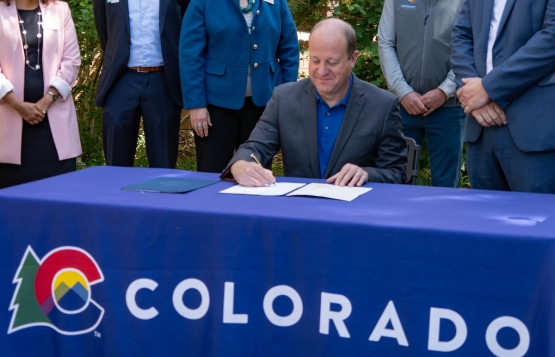
Colorado Governor Jared Polis
High Expectations

Help wanted: Ed-reform governors needed (again)

Once upon a time, governors were the most potent drivers of K–12 education reform in America. It started in the ’80s, propelled by leaders on both side of the aisle. Today is different. As choice-focused reforms burgeon in red states, there’s backsliding almost everywhere when it comes to standards, assessment and accountability, leadership is scarce, and bipartisanship is rare indeed. Could a new NGA report represent a return to form?

Chester E. Finn, Jr. 7.31.2025
NationalFlypaper

Help wanted: Ed-reform governors needed (again)

Chester E. Finn, Jr.
7.31.2025
Flypaper

Why high schools should help students land summer jobs

Michael J. Petrilli
7.31.2025
Flypaper

Thanks for the help, AI, but students still need to learn to write for themselves

Meredith Coffey, Ph.D.
7.31.2025
Flypaper

Why tens of thousands of Florida families didn’t use their private school scholarships

Jeff Murray
7.31.2025
Flypaper

#979: Is too much democracy hamstringing our schools? with Vlad Kogan

7.30.2025
Podcast
view
Teenager working in a grocery store

Why high schools should help students land summer jobs

Michael J. Petrilli 7.31.2025
Flypaper
view
Broken pencil

Thanks for the help, AI, but students still need to learn to write for themselves

Meredith Coffey, Ph.D. 7.31.2025
Flypaper
view
Parent walking with child to school

Why tens of thousands of Florida families didn’t use their private school scholarships

Jeff Murray 7.31.2025
Flypaper
view

#979: Is too much democracy hamstringing our schools? with Vlad Kogan

Vladimir Kogan, Michael J. Petrilli, David Griffith, Ph.D., Adam Tyner, Ph.D. 7.30.2025
Podcast
view
Colorado Governor Jared Polis

Help wanted: Ed-reform governors needed (again)

Chester E. Finn, Jr.
7.31.2025
Flypaper

The wide-ranging new report that Colorado Governor Jared Polis extracted from the National Governors Association (NGA) during his recently ended term as chairman kindled a lot of memories.

Once upon a time, back in what Gen Z views as prehistory—I’m talking about the 1980’s and ‘90’s, when I was middle-aged—state governors were the most potent drivers of K–12 education reform in America and the NGA was a major force for change.

It started in the ‘80s with an enormous amount of education reform, almost entirely at the state level, typically catalyzed by governors though sometimes by legislators and occasionally by business leaders. States periodically collaborated, both under NGA auspices and in smaller compacts such as the Southern Regional Education Board (SREB) and Education Commission of the States (ECS).

Their agendas varied but typically included higher standards, improved reporting, better teachers, stronger graduation rates, wider access to college, and early stirrings of accountability for schools and sometimes for students in the form of minimum-competency graduation tests. Many of these governor-reformers were southern—North Carolina’s Jim Hunt, Florida’s Bob Graham, Mississippi’s Bill Winter, Tennessee’s Lamar Alexander, South Carolina’s Dick Riley, Arkansas’s Bill Clinton, etc.—but not all. Their northern counterparts included Minnesota’s Al Quie, Wisconsin’s Tommy Thompson, Colorado’s Roy Romer and New Jersey’s Tom Kean.

It was quite a line-up—and stayed that way well into the ‘90’s.

Their occasional joint efforts could be powerful, as in the SREB’s piloting of state-level NAEP reporting and the multiyear “Time for Results” project that Alexander launched when he chaired the NGA. But sometimes they competed. I recall Alexander and Graham—Republican and Democrat—amiably racing to see whose state could first enact a merit pay program for teachers.

The apogee of their collective influence on the country as a whole was surely the “Charlottesville Summit” of 1989, where forty-nine governors, together with President George H.W. Bush—“I want to be the education president”—agreed, for the first time in history, on an ambitious set of national education goals to be achieved by century’s end.

Bush reiterated those six lofty goals in his State of the Union Address in January 1990 and a month later, at its annual winter meeting, the NGA adopted them along with specific objectives that clarified and amplified them.

Four years later, prompted by President Bill Clinton, who had been a force for ed-reform both as governor and within the NGA (which he chaired in 1986–87, immediately following Alexander), Congress passed the “Goals 2000: Educate America Act” and the “Improving America’s Schools Act,” precursor and foundation-builder for No Child Left Behind (NCLB) in 2001. These set the course for federal education policy for two decades, until ESSA rolled it partway back in 2015.

The governors’ insistence on better achievement data also played a major role in the statutory retooling of NAEP in 1988, in the state-specific reports of student performance that followed, and in the establishment of NAEP’s “achievement levels” that today comprise the closest thing we have to national education standards.[1]

Gubernatorial ed-reform energy continued through the ‘90’s, as the National Education Goals Panel followed up on Charlottesville and associated federal laws, and as school choice made its debut, with the pioneering Milwaukee voucher program authorized in 1989 and the pathbreaking Minnesota charter-school law enacted two years later.

Many more “education governors” surfaced, too, such as Michigan’s John Engler, Ohio’s George Voinovich, Massachusetts’s Bill Weld, and Texas’s George W. Bush, who famously brought his experience and zeal from Austin to Washington when he moved into the Oval Office in January 2001. 

Why do I recount all this prehistory? Partly because I was there, partly because it really made a difference, but also to contrast it—in two ways—with the present-day situation.

The first contrast, unsurprisingly, involves partisanship. Back in prehistoric times, lots of states were purple and most of the reforming within them entailed a degree of cooperation across party lines—which is also why many of those reforms proved fairly durable. So, too, the multistate collaborations, not just within the SREB and NGA—where the hand-off from Alexander to Clinton, for instance, was seamless and “Time for Results” forged onward—but also the ad hoc reform panels and commissions that kept up the momentum. That was true of the “Goals Panel,” of the National Council on Education Standards and Testing (co-chaired by Colorado’s Romer and South Carolina’s Carroll Campbell), and of the National Assessment Governing Board, which has always had one governor from each party among its members—and often supplying much of its oomph.

The second contrast has to do with that oomph. When ed-reform was hot, governors generated much of the heat—and the NGA was a force to be reckoned with, not only influencing federal policy but also as a forum for reform ideas, for staff support, for enlisting expertise, and for lively debates, comparisons, and competitions.[2]

Fast forward to 2025

Not so today. As choice-focused reforms burgeon in red states, there’s backsliding almost everywhere when it comes to standards, assessment, and accountability, and bipartisanship is rare indeed. With a small number of exceptions—Youngkin in Virginia, Polis in Colorado, and Huckabee in Arkansas come to mind—governors have turned to other issues, sometimes including the cultural conflicts that today dominate education discourse, and few seem to resist the omnipresent (union-driven) pushback against testing and accountability. 

As for the NGA, from time to time it returns to education, most recently the worthy initiative spearheaded by Colorado’s Polis, who chaired the group from July 2024 until two weeks ago. He launched a multi-faceted project called “Let’s Get Ready: Educating All Americans for Success,” and within his one-year term, pressed NGA to create and issue a pretty good blueprint for education reform across a number of fronts. (More on this below.)

But his predecessor, Utah’s Spencer Cox had a different priority—a good one, to be sure, encouraging Americans to “disagree better,” get out of their silos, foster good citizenship, and transcend some of the bitter partisanship. And his successor, Oklahoma’s Kevin Stitt, wants to “reignite the American Dream.”

Yes, there’s still an education piece within Stitt’s plan. Yes, NGA has an ongoing gubernatorial “Task Force on Education, Workforce and Community Investment.” And yes, the NGA staff still contains an able “program director for K–12 education,” with a strong team, within its multi-purpose Center for Best Practices. Far be it from me to suggest that they ignore the topic. Yet only episodically is K–12 education reform high on their agenda and there’s scant continuity from year to year—a fatal flaw for a realm that only ever changes when the pressure for change is sustained over many years, election cycles, and party switches.

It has to be added that NGA’s latest K–12 offering—Polis’s legacy—is comprehensive but lacks edge. The Let’s Get Ready report contains good stuff, particularly the parts that focus on career preparation, and its “roadmap for governors” is sound, as far as it goes. But the report—and roadmap—range over such vast territory as to have no real focus. I find myself nodding in agreement with—for instance—its recommendations for statewide data systems and focusing on outcomes. Yet when you look closely, it wants so many different outcomes that no leader of any jurisdiction, much less a governor, has the bandwidth or clout to work on all of them. It’s common knowledge that an elected official with a four- or even eight-year term must select a few key targets—provided they want to get something done—and shoot all their arrows at those targets, not get diverted onto a hundred other worthy efforts even if all carry the “education” label.

Combine the vastness of the Polis legacy menu and the unlikelihood that Governor Stitt or his successors will push the NGA to double down on that menu—every new leader (in this case with a one-year term) is tempted to declare their own glittering priority—and I find it unrealistic to count on NGA to juice the ed-reform effort that so urgently needs a lot of juice.

Some individual governors will stick with—or rediscover—that an educated population is key to just about everything else they want their states to achieve. At a time when national leadership for this activity has been so lacking—not just Trump and team, also Biden and his, plus a vacuum among business leaders—I applaud the governors that work at it. But there aren’t nearly enough of them and nowadays they mostly work in isolation.

All things considered, prehistory has seldom looked better.

 

[1] That saga began immediately after the release of A Nation at Risk in 1983, when many education-minded governors sought better data than was then available on how their states were doing in producing educated children. The NAEP “study group” that Lamar Alexander chaired urged that this well-respected national testing program be revamped in a number of ways, including the release of state-level data, and the National Assessment Governing Board, which I chaired for two years at its outset, realized that Charlottesville’s third goal—that every child become “proficient” in core subjects—would be meaningless until some authoritative body determined what constitutes proficiency and how to gauge its attainment. I go into this history in some depth in Assessing the Nation’s Report Card.

[2] It’s tedious to slog through their conference transcripts, but if you have the sitzfleisch, see here.

view
Teenager working in a grocery store

Why high schools should help students land summer jobs

Michael J. Petrilli
7.31.2025
Flypaper

Much of the education world is obsessed these days (and rightly so) with preparing students for the world of work. That is certainly the case within the subculture of career and technical education, but a growing number of policymakers and advocates are expressing an interest in making sure that all students, even those heading straight to college after high school, develop the real-world “durable skills” that their future employers will demand.

The impulse is great. But as with so many other skills that we hope our young people will develop, we quickly assume that what’s needed is some new school-based program or course or curriculum. What if, instead, the way to teach work skills is to encourage teenagers to, you know, work?

There’s a growing interest in work-based learning, such as apprenticeships and internships during high schoolers’ junior and senior years. But there’s also a recognition that placing lots of students in such opportunities is nigh impossible, given transportation and liability challenges, not to mention that a lot of workplaces don’t know what to do with sixteen- and seventeen-year-olds.

But other workplaces absolutely do. In particularly, the kinds of businesses that have long hired teenagers for after-school, weekend, and summer work. Helping students access jobs at fast-food restaurants, swimming pools, smoothie shops, summer camps, and other entry-level employers would be a much more productive effort for education systems than helping them develop workplace skills while sitting in classrooms. That’s akin to trying to build soccer skills by having kids watch Premier League games rather than just letting them play.

Thankfully, some schools are ahead of this curve. So reports Education Week’s Elizabeth Heubeck, who found several high schools that are helping kids land jobs by hosting summer job fairs and/or partnering with non-profit employment agencies.

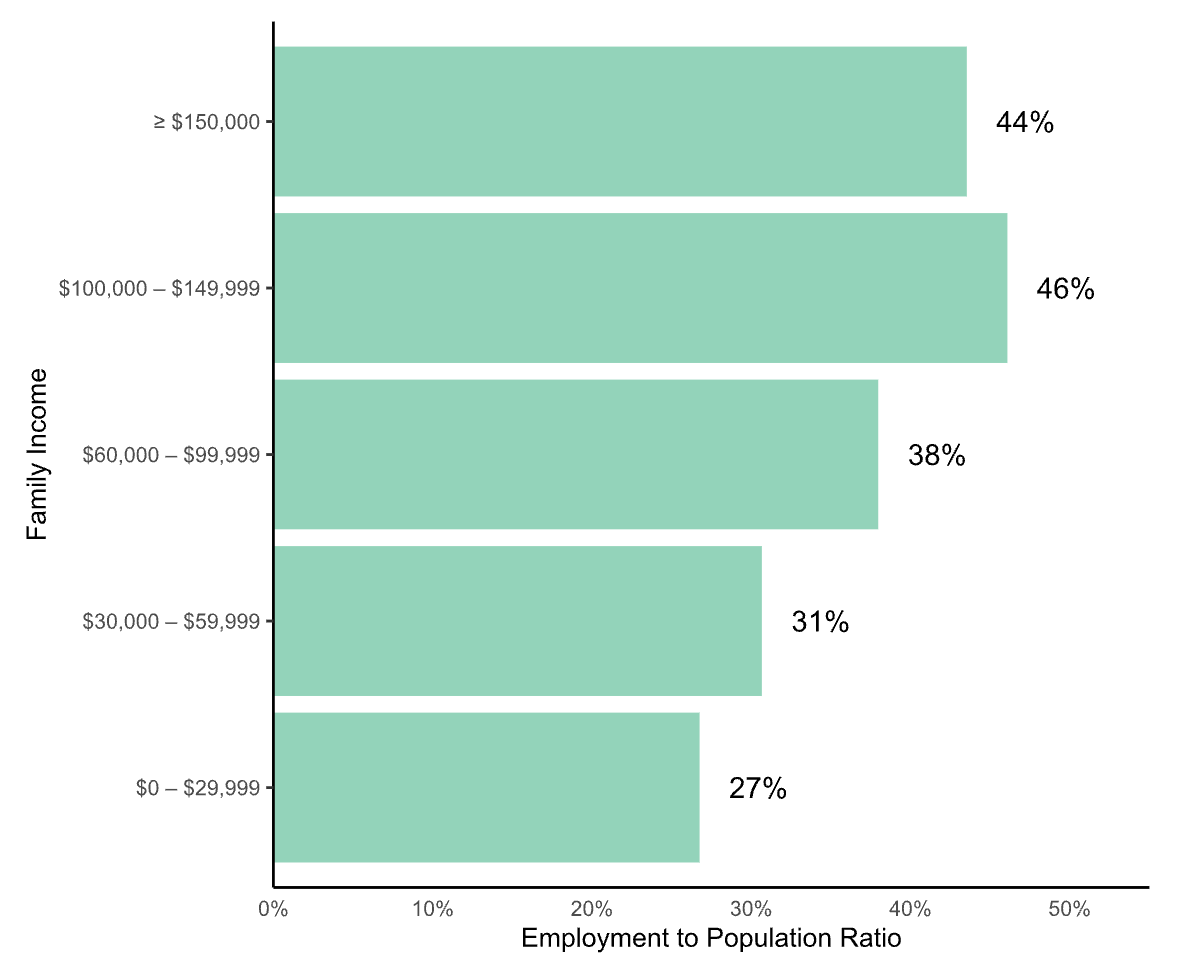
But we need a lot more of that. Especially since, counterintuitively, America’s most affluent kids are more likely to work during the summer. (See figure 1.) A 2024 Labor Department study found that:

The likelihood of a young person being employed during the summer months is strongly associated with their family’s income. A young person from a family with a higher income is more likely to be employed during the summer months than a young person from a family earning less. For example, nearly half (46 percent) of youth from families earning between $100,000 and $149,999 per year were employed, whereas about only a quarter of young people (27 percent) from families earning less than $30,000 had summer employment.

Figure 1. Percent of youth employed by family income, June to August 2023

1

Source: U.S. Department of Labor and its analysis of CPS Basic Monthly Samples (June–August 2023) accessed via IPUMS.

Kids growing up in high poverty neighborhoods without many nearby workplaces, plus fierce competition for the limited jobs available, have a much tougher time finding work. That’s why some cities have created summer jobs programs to overcome these challenges—programs that show real educational benefits for participants.

But schools and municipalities could do so much more. One possibility is to let teenagers work during part of the school day—say, every morning or afternoon—“for credit.” Even a so-called “low-skill” job builds a track record, confidence, and some valuable skills. Combine that with mentorship and academic courses and we might have junior- and senior-year experiences that are much more engaging, relevant, and fruitful than the ones that many kids sleep walk-through now.

In the meantime, educators in schools nationwide, and especially CTE programs, should ask themselves a simple question: Could we be doing more to help our students find summer work?

view
Broken pencil

Thanks for the help, AI, but students still need to learn to write for themselves

Meredith Coffey, Ph.D.
7.31.2025
Flypaper

Since ChatGPT exploded onto the scene in November 2022, educators have grappled with how and whether to engage AI for student writing. States, districts, and universities have scrambled to develop AI policies. Anecdotally, I’ve heard from teachers who ban it completely—their students must now write all major assignments by hand, in class—and others who believe that any limits are futile, and therefore they place none at all. Most, of course, fall somewhere in between.

These are tough questions, and doubly so because students haven’t been writing enough since well before the advent of ChatGPT. In a 2022 survey, only 4 percent of English language arts (ELA) teachers reported that their students in grades 3–12 met the expert recommendation of sixty daily writing minutes. Only 31 percent reported their students reaching even half that goal. The findings are consistent with a 2016 survey that found that third and fourth graders spent an average of twenty-five minutes a day writing, as well as national data from 2011, which revealed that only 25 percent of middle schoolers and 31 percent of high schoolers wrote for thirty minutes or more daily.

Trends in assessments and expectations seem to bear out a deemphasis on students’ writing. High school end-of-course exams have reduced writing requirements. As of 2022, for example, Virginia students can substitute the simplistic, low-bar ACT WorkKeys Business Writing test for the state’s longstanding Standards of Learning writing exam. The SAT recently dropped its essay portion (and, long ago, the separate writing test that the essay portion had replaced). Most alarmingly, it’s apparently now acceptable for an English professor to declare that AI can do the work of “learning to write” for students.

We can cite everything from No Child Left Behind to the advent of ChatGPT as a reason for insufficient writing time. But regardless of the catalyst, what’s important is that students at all levels keep writing. Here’s why.

First, learning to write helps students learn to read. And goodness knows students need help with reading. Handwriting letters and words can boost very young readers’ understanding of letter-sound relationships and advance their automaticity in reading words. Later, writing helps with understanding sentence and text structure. If you put sentences or paragraphs together yourself, that builds your understanding of how others are constructing their own sentences and texts. Eventually, the same goes for more sophisticated choices in reading and writing, like style and genre.

Writing also boosts students’ content knowledge and cognitive development. Especially when writing by hand, students are more likely to retain the information they’re writing about—and that’s true across subjects. What’s more, a recent study shows that it’s specifically important for students to write without AI. Not only were students who used AI to craft their essays unable to remember much of what they had written, but also, compared to peers who didn’t use AI, their brain scans revealed less neural activity when it came to creativity, integrating information, and self-monitoring. That aligns with yet more research demonstrating that writing improves analysis and inference skills. We already know that relying on Google Maps is rotting our spatial memories. Relying on AI for writing may well inhibit the development of children’s and adolescents’ brains.

What’s more, a lack of classroom attention to writing tends may create extra harm to the most vulnerable students. Struggling writers—especially those with learning disabilities—need more time for writing practice, and students with initially weaker skills show more gains from writing interventions than their more skilled peers. Explicit instruction around writing strategies benefits all students, but particularly students with disabilities and English learners.

So what can educators and policymakers do?

First, keep students writing, from short tasks (e.g., sentence mechanics practice and concise summaries) to long-form writing (e.g., persuasive essays and personal narratives). They should be writing not only in ELA, but also in social studies, science, art, and music, to improve their writing skills while enhancing their knowledge and reasoning in those subject areas. Writing practice need not come at the expense of content instruction. Writing summaries of or responses to new content, for example, can accomplish both simultaneously. Especially in our age of AI, this may mean more in-class writing and more pen and paper. So be it!

No less crucial, however, is the need to improve teacher training on how to teach writing. There’s ample evidence that teacher preparation programs spend little time on writing pedagogy, and as a result, many educators don’t feel confident in their abilities to teach writing, with teachers in low-income schools feeling even less prepared in this realm than their peers in high-income settings.

I’m not arguing that anyone can or should keep AI out of schools. Not only is it now a fact of life, but it can also offer great tools for differentiating instruction, expediting lesson planning, and even polishing writing. In fact, the same study that found that using AI to write an essay was bad for brain activity also found that using AI after writing an essay actually increased brain activity. We have a lot left to learn, especially with such rapid technological advancement. But what we do know is that we can’t afford to give up on teaching students to write. And that means that we don’t surrender writing instruction to our AI overlords.

view
Parent walking with child to school

Why tens of thousands of Florida families didn’t use their private school scholarships

Jeff Murray
7.31.2025
Flypaper

For more than twenty-five years, Florida has been ground zero for school choice expansion. Among the many options for families are charter schools, private schools, tax-credit programs, microschools, ESAs, vouchers for students with special needs, homeschooling, and more. This diverse landscape makes the Sunshine State a perfect laboratory for analyzing what works—and what doesn’t—in the realm of school choice. A new report looks at a thorny issue specific to vouchers: why tens of thousands of Florida families who applied for and received private school scholarships ended up not using them.

In 2023, Governor Ron DeSantis removed the previous income-based eligibility limits on the Florida Tax Credit Scholarship and the Family Empowerment Scholarship for Educational Options, making both private-school tuition-support programs available to every K–12 student in the state. Caps on the number of available scholarships were also eliminated. This resulted in a surge of applications, awardees, and users—to the tune of a 70 percent increase in usage in two years. That usage would have been even higher, but 41,000 families that applied for and were awarded scholarships for their children from these two programs did not ultimately use them. Step Up for Students, a Scholarship Funding Organization approved by the Florida Department of Education to administer the various scholarship programs available to residents, wanted to know why. Researchers Ron Matus and Dava Cherry emailed over 32,000 of these families in January and February of 2025. Using reminders and a drawing for ten $100 gift cards as incentives, they eventually received 2,739 completed surveys.

Approximately 40 percent of survey respondents’ children were Hispanic, approximately 31 percent were White, and 23.5 percent were Black. Thus, survey respondents were more likely to be Black and Hispanic, and less likely to be White, than families who received and actually used their scholarships. Survey respondents were also less likely to be in the highest income tier and more likely not to have reported their incomes than the families who used the scholarships. However, 40 percent of respondents who did report incomes were below 185 percent of the Federal Poverty Guidelines. Interestingly, a majority of survey respondents (50.3 percent) reported a bachelor’s degree or above as their highest level of educational attainment, followed by some college but no degree (14.5) and associate-level degrees (14.3). Less than 3 percent of respondents indicated they had an education level below high school graduation. Survey respondents with multiple children indicated using a variety of school types, with zoned or assigned public schools the single largest category (36.9 percent), followed by private schools (25.2) and charter schools (13.3). Fifty-five percent of respondents said they were somewhat satisfied or very satisfied with their child’s school at the time they applied for the scholarship, while 30.2 percent were somewhat dissatisfied or very dissatisfied.

Despite the fact that they ultimately didn’t use their awards, the vast majority of respondents indicated a strong desire for those scholarships, and Black and Hispanic parents were likelier to say the scholarship was very important to them (94.3 percent) than White parents (77.6). Higher income parents, with a similar spread, were more likely to say the scholarship was very important to them than their lower-income counterparts. Specifically, a desire for more individual attention and smaller class sizes was the most-commonly-cited reason for applying for the private school scholarships, with Black parents and low-income parents being the most motivated by this factor.

So why didn’t these relatively well educated and motivated families use the scholarships they applied for? Just over a third of respondents (34.7 percent) said there were no available seats at the private school they wanted, and 19.7 percent said the scholarship amount—both programs provide an average of $8,000 per year—wasn’t enough to cover tuition at their desired school. Another 19.6 percent were specifically concerned about affording additional fees beyond tuition. Just under 10 percent cited lack of transportation to and from school, and 5.8 percent said the school they were interested in was too far away to be practical for them every day, with or without transportation provided.

A third of parents (36.5 percent) who didn’t use their scholarships ended up switching school types anyway (such as moving from a traditional district school to a charter). Destinations included brick-and-mortar charters, virtual schools, and open-enrollment district schools. And those who moved were twice as likely to express satisfaction (20.4 percent) with their new school than to express dissatisfaction (10.5), regardless of destination. Two-thirds of respondents said they’d apply for the scholarships again, including 63 percent of those who switched school types and 55.5 percent of those who were satisfied after doing so.

Overall, two things seem to be going on. First, universal eligibility with no caps incited a sort of widespread “speculation” among families looking for a different choice, and many applied without a concrete plan as to how their scholarships could or would be used. Since Florida does not require scholarships to be used once awarded, families were free to choose other options that they determined were a better fit without any sort of penalty.

Second, the longstanding barriers to voucher usage that have been commonly associated with choice programs in various states—lack of open seats, finding reliable transportation, and affording out-of-pocket expenses—are still present in Florida, and universal eligibility does not alleviate them. The only element that has changed in Florida is that folks who would normally be deterred from applying by these roadblocks are emboldened by open eligibility and no enrollment caps to try their luck anyway. Eligibility for future years is not impacted by failing to use an award, but families do have to apply again in future years, which 66.7 percent of survey respondents indicated they would do. Thus, while many families were able to capitalize on the new, unlimited eligibility model, that model was still not robust enough for tens of thousands of other families still dissuaded by the same old troubles voucher families have faced since their inception.

SOURCE: Ron Matus and Dava Cherry, “Going with Plan B: Why thousands of Florida parents didn’t use their school choice scholarships,” Step Up for Students (July 2025).

view

#979: Is too much democracy hamstringing our schools? with Vlad Kogan

7.30.2025
Podcast
 

On this week’s Education Gadfly Show, Vlad Kogan—professor and director of undergraduate studies at The Ohio State University—joins us to discuss his forthcoming book, No Adult Left Behind: How Politics Hijacks Education Policy and Hurts Kids (out August 21).

Then, on the Research Minute, Adam highlights new findings from the National Bureau of Economic Research on the long-term benefits of participation in scholastic sports.

Recommended content:

  • “No Adult Left Behind: How Politics Hijacks Education Policy and Hurts Kids” —Vladimir Kogan

  • “When School Board Elections Lose Their Voice” —Anna J. Egalite, Education Next

  • “The Benefits of Scholastic Athletics” — James J. Heckman, Colleen P. Loughlin, and Haihan Tian, NBER (July 2025)

Feedback Welcome: Have ideas for improving our podcast? Send them to Stephanie Distler at [email protected].

Fordham Logo

© 2026 The Thomas B. Fordham Institute
Privacy Policy
Usage Agreement

National

P.O. Box 110
Burke, VA 22009

202.223.5452

[email protected]

Ohio

P.O. Box 82291
Columbus, OH 43202

614.223.1580

[email protected]

Sponsorship

130 West Second Street, Suite 410
Dayton, Ohio 45402

937.227.3368

[email protected]