Mobile Navigation

  • National
    • Policy
      • High Expectations
      • Quality Choices
      • Personalized Pathways
    • Research
    • Commentary
      • Gadfly Newsletter
      • Flypaper Blog
    • Events
    • Scholars Program
  • Ohio
    • Policy
      • Priorities
      • Media & Testimony
    • Research
    • Commentary
      • Ohio Education Gadfly Biweekly
      • Ohio Gadfly Daily
  • Charter Authorizing
    • Application
    • Sponsored Schools
    • Resources
  • About
    • Mission
    • Board
    • Staff
    • Career
Home
Home
Advancing Educational Excellence

Main Navigation

  • National
  • Ohio
  • Charter Authorizing
  • About

National Menu

  • Topics
    • Accountability & Testing
    • Advanced Education
    • Career & Technical Education
    • Charter Schools
    • Curriculum & Instruction
    • ESSA
    • Evidence-Based Learning
    • Facilities
    • Governance
    • Personalized Learning
    • Private School Choice
    • School Finance
    • Standards
    • Teachers & School Leaders
    • Think Again
  • Research
  • Commentary
    • Gadfly Newsletter
    • Flypaper Blog
    • Gadfly Podcast
  • Events
  • Scholars Program

The Education Gadfly Weekly

Sign Up to Receive Fordham Updates

We'll send you quality research, commentary, analysis, and news on the education issues you care about.
Thank you for signing up!
Please check your email to confirm the subscription.

The Education Gadfly Weekly: Give parents wide latitude on ESA uses—and give teachers their own accounts, too

Volume 23, Number 6
2.9.2023
2.9.2023

The Education Gadfly Weekly: Give parents wide latitude on ESA uses—and give teachers their own accounts, too

Volume 23, Number 6
view
Quality Choices

Give parents wide latitude on ESA uses—and give teachers their own accounts, too

Recent news stories have pushed the narrative that parents are using education savings accounts to buy items of questionable educational value and relevance, including chicken coops, trampolines, and tickets to SeaWorld. But perhaps ESAs’ permissiveness is a feature, not a bug—and perhaps officials would be wise to go one step further and give teachers their own accounts.

Mike Goldstein 2.9.2023
NationalFlypaper

Give parents wide latitude on ESA uses—and give teachers their own accounts, too

Mike Goldstein
2.9.2023
Flypaper

Soft-on-consequences discipline is terrible for teachers

Daniel Buck
2.9.2023
Flypaper

Racial and ethnic gaps in advanced STEM achievement: 3 takeaways from recent research

Brandon L. Wright
2.7.2023
Flypaper

An examination of cream-skimming and pushout data among voucher students

Amber M. Northern, Ph.D.
2.9.2023
Flypaper

Re-evaluating the cost of test-based retention policies

Jeff Murray
2.9.2023
Flypaper

#856: Why education savings accounts won’t bring educational pluralism, with Ashley Berner

2.8.2023
Podcast

Cheers and Jeers: February 9, 2023

The Education Gadfly
2.9.2023
Flypaper

What we're reading this week: February 9, 2023

The Education Gadfly
2.9.2023
Flypaper
view

Soft-on-consequences discipline is terrible for teachers

Daniel Buck 2.9.2023
Flypaper
view

Racial and ethnic gaps in advanced STEM achievement: 3 takeaways from recent research

Brandon L. Wright 2.7.2023
Flypaper
view

An examination of cream-skimming and pushout data among voucher students

Amber M. Northern, Ph.D. 2.9.2023
Flypaper
view

Re-evaluating the cost of test-based retention policies

Jeff Murray 2.9.2023
Flypaper
view

#856: Why education savings accounts won’t bring educational pluralism, with Ashley Berner

Michael J. Petrilli, Adam Tyner, Ph.D., David Griffith, Ph.D., Ashley Berner 2.8.2023
Podcast
view

Cheers and Jeers: February 9, 2023

The Education Gadfly 2.9.2023
Flypaper
view

What we're reading this week: February 9, 2023

The Education Gadfly 2.9.2023
Flypaper
view

Give parents wide latitude on ESA uses—and give teachers their own accounts, too

Mike Goldstein
2.9.2023
Flypaper

“Chicken Coops, Trampolines and Tickets to SeaWorld: What Some Parents are Buying with Education Savings Accounts.” That’s the title of a news story from The 74, cross-posted to the The Guardian, about states like Arizona that are passing laws giving parents money to use for private or homeschooling. The emailed version is titled “ESA Boondoggle.” The charge? “Some find the rules, as one former state chief put it, ‘incredibly permissive.’”

Under the excitable headline is a balanced article. These Arizona parents aren’t just buying books and tutoring with their education accounts; they’re also buying kayaks, skating lessons, and roping lessons. One poor vendor gets the raised-eyebrow treatment: “The sword casting instructor, for example, said he would teach students ‘archaeology, physics, history and metallurgy.’”

I’m not here to debate the usual stuff: Who decides, parents or educators, on the last 1 percent of dollars spent? Who decides what is a reasonable expenditure?

Instead, my contrarian take is four-part:

1. All these scary examples seem good to me. The number one enemy of K–12 is boredom.

2. Public school teachers are already—and appropriately—doing all of these things. (More on that below.) It’s not just parents.

3. Public schools are hit or miss on what they’ll approve. So many teachers have to privately fundraise for their individual pet projects. But they shouldn’t! The stuff that only one teacher wants to do is precisely what will make it a unique experience for the kids.

4. My proposal: Rather than hem in the ESA program, we should create “Teacher Mega-ESAs” for precisely this type of individual teacher spending. A few such teacher choice programs already exist, but they are small. A Boston elementary school teacher has twenty kids at $25,000 per student per year of government spending. Why is her discretionary share of that $500,000 just a few bucks? Why couldn’t she control $10,000 per year (2 percent) to spend directly on her students? Why does a school administrator get to control all 100 percent?

—

What follows are requests from public school teachers on DonorsChoose. They want all these so-called “bad examples” of parent “boondoggle” spending. Yet I think they’re good ideas! (And yes, you should pick one and donate.) Parents and teachers alike should have the right to spend on discretionary items like these.

Coach Smith, at Noble High School in Oklahoma, wants kayaks:

We would like to start a lesson teaching student how to kayak. Our school has a pond on location along with Lake Thunderbird and Lexington Wildlife Management Area and nearby private ponds. We have access to personal kayaks, but we need more to conduct a lesson that can involve everyone in class…. From my experience, if people do not spend time in the outdoors, they are not concerned with the impacts relating to it.

Did you say trampoline? Mrs. Bustos at Lundy Elementary in Texas needs one:

My little preschool students are super creative, active, and kind. They deserve a variety of outdoor playtime games to keep their big minds engaged and promote creativity throughout outdoor play. A trampoline, sandbox, and sand toys will enhance their current playground equipment by giving them extra choices in their daily outdoor play. They currently have a playground with two slides and it gets pretty crowded when all three classes are outside during recess.

Mr. Pierce, an elementary and preschool teacher at Bokoshe Elementary in Oklahoma, will teach roping. His ask is a couple of junior roping kits from Colorado Saddlery, includes “dummy steer head, rope, gloves, stakes, [and] durable training rope.”

Mr. Simmers in Alaska is giving skating lessons to his students. He needs to buy ice skating trainers for the adjustable ice skates he’s already purchased.

The chicken coops? I found five pages of teachers buying those (plus two different teachers named “Mrs. Coop”). How would you not donate to Mrs. LaCour in Arizona, and her “Chick It Out” project?

My students are Egg-Cellent scholars. They love to do hands-on projects, as well as engage in experiential learning. By far, this Chick It Out project will have these scholars seeing and doing “the why” of learning. These resilient scholars will delight in making connections to the real world by hatching and brooding their own chicks at school.

The SeaWorld trip? Public schools subsidize those types of trips every year, and in high-poverty schools, they sometimes pay the whole way after a nominal fundraising effort. DonorsChoose doesn’t seem to allow in-person trips, but teachers have a backdoor. Mrs. Roberts, for example, at Caloosa Elementary in Florida is seeking matching T-shirts for their school trip to Busch Gardens.

People, come freaking on. Don’t you remember how the field trip was the best day of the school year? When did you all become grinches? Let’s free teachers to do more of that, not less. Way more.

Oh, and the sword-casting guy. Honestly, if I lived nearby, I would take our two kids this weekend for his six-hour session. My kids know zero metal working or woodworking. (Dad, um, is not handy like that.) This is a great use of ESA money, in my opinion.

You be the judge. Here’s the sword guy’s website. Doesn’t that look legit?

If you agree that this seems like a glorious six-hour learning experience compared to the other 1,000 hours per year of school, then join me in not just letting ESAs push the edges a bit in appropriate spending, but also freeing public school educators with new Teacher Mega-ESAs for their professional discretion.

Editor’s note: Mike Goldstein wishes he had set aside way more cash for individual teacher spending when he ran a Boston charter school.

view

Soft-on-consequences discipline is terrible for teachers

Daniel Buck
2.9.2023
Flypaper

I’ve lost count of the number of teachers I know who have either left their school or entirely abandoned education because of student behavior. A student physically threatened a friend, and the administration provided no consequence. This friend quit soon thereafter. Another started a family and just couldn’t remain emotionally present as a father while dealing with chaos at work all day. At one particularly unruly school, I lost track of how many teachers up and left mid-year; they put their keys on their desks and walked out the doors.

While most discussion about student behavior understandably focuses on its impact on students—the telos of a school is educating children, after all—too often the effects on teachers are simply overlooked. They’re collateral damage that seldom gets a mention.

My experience is typical. According to poll from the National Education Association, for example, amid fears of a coming teacher shortage, almost half of all teachers report a desire or plan to quit because of school climate and safety.

I’m into my seventh year teaching. I’ve taught in rich schools and poor schools, private and public, middle school and high school. My class schedule has been both unforgivingly busy and also free to the point of leaving me bored at midday. I’ve had great administrators and terrible ones. I’ve used more curricula than I care to count. I’ve spent entire Saturdays and Sundays grading and prepping. But nothing has left me more stressed or anxious than student discipline.

It was worst in my first year of teaching, when both my classroom management skills were at their weakest and the school in which I taught was distinctly weak-kneed. Every day was chaos, and the unpredictability of it scared me the most. What insult would fly across the room? Would I have to break up a fight today? For what educational failure or emotional damage was I responsible because of the chaos in this room? I still remember one student laughing at me after I asked him to sit down.

But it wasn’t just me. An experienced educator across the hall quit that year and checked into a mental hospital because of the verbal abuse she suffered from students. The shift from “these students are disrespectful” to “I am unworthy of respect” comes quickly, and it’s emotionally crushing.

In an open letter to Milwaukee Public Schools, one teacher described how her former feelings of joy and excitement about her job have changed to “fear of how my colleagues and I will be abused for yet another day.” What began as regular instances of students cussing out teachers or acting in deliberate insubordination escalated to a scenario where teachers are just trying to put out “bigger fires” like fights and vandalism.

One dismayingly popular policy that fosters such disorder is the eradication of punitive discipline like suspensions. We have countless case studies—from cities like Milwaukee, Philadelphia, and Pittsburgh to entire states like Illinois and California—that demonstrate the necessity of discipline. When policies bar schools from using suspensions and instead make them rely on soft approaches like “positive behavior interventions and supports” (PBIS) or “restorative justice,” then misbehavior, bullying, classroom disruptions, and more severe behavior all flourish.

It’s worth noting that the cities and states mentioned above demonstrate that this behavioral pandemonium is a systemic problem, not a result of individual teachers with inadequate classroom management skills. I liken it to sailors. One captain may get from point A to point B regardless of the state of their craft or the weather, but it would certainly be easier if their boat hasn’t sprung holes and the sun is shining. Certain teachers will succeed no matter their environment, but the only way a school is going to be calm and orderly is if there’s a schoolwide approach to discipline that’s enforced consistently and uniformly. And that’s what “discipline reform” has eroded.

Unsurprisingly, most teachers support tougher behavior policies. A Fordham survey from 2019 found that teachers report “putting up with more misbehavior than they used to.” While they see value in restorative justice and PBIS as add-ons, they believe that suspensions remain a necessary part of any behavioral structure. It’s easy to sloganeer in support of abolishing suspensions in policy proposals or from social justice advocacy groups. It’s harder to support these naive policies when you’re the teacher in the hallway breaking up a fight or in a classroom trying to teach the majority of eager students over the din of a noisy few in the back.

And while the emotional toll is perhaps the greatest consequence on teachers, it’s also just hugely time consuming. More misbehavior means more paperwork and more time meeting with administrators, speaking with parents, and wondering whether your response was correct or incorrect or if today will be better or worse than yesterday.

And of course, none of this touches on the lost learning, academic mediocrity, and emotional harm that chaotic environments inflict upon students, all of which are very real.

If we really want to support educators—as so many institutions, advocates, and politicians claim to want to do—keeping student behavior in check is an important, too often overlooked place to begin.

view

Racial and ethnic gaps in advanced STEM achievement: 3 takeaways from recent research

Brandon L. Wright
2.7.2023
Flypaper

Editor’s note: This is an edition of “Advance,” a newsletter from the Thomas B. Fordham Institute written by Brandon Wright, our Editorial Director, and published every other week. Its purpose is to monitor the progress of gifted education in America, including legal and legislative developments, policy and leadership changes, emerging research, grassroots efforts, and more. You can subscribe on the Fordham Institute website and the newsletter’s Substack.

“Less than 10 percent of the U.S. STEM workforce is Black or Hispanic,” says a recent study by Penn State’s Paul Morgan and colleagues, even though they make up 32 percent of the population. It rightly points out two reasons this is a problem: It reduces the country’s scientific innovation and economic competitiveness, and it lessens the earning potential of Black and Hispanic Americans, as the career income of those who major in STEM are 26–40 percent higher than comparable peers in other fields.

This is consistent with other research, including the work of Raj Chetty, an economist at Harvard. According to a 2019 study he did with Alex Bell and colleagues, “Drawing more low-income and minority children into science and innovation could increase their incomes—thereby reducing the persistence of inequality across generations—while stimulating growth by harnessing currently under-utilized talent.”

In another 2018 study Chetty and colleagues conducted, they found that, compared to White peers, Black and Hispanic Americans are significantly more likely to fall behind their parents economically, and are significantly less likely to exceed them. The situation is especially dire for Black children: When their families are in the top fifth of the income distribution, only 18 percent will remain there as adults; and when their families are in the bottom fifth, just 2.5 percent will make it to the top fifth. For White children, those figures are 41 percent and 10.6 percent, respectively.

This matters for schools, says Morgan et al., because “very high levels of STEM proficiency during adolescence are strongly related to STEM doctoral degree completion and knowledge production.” In other words, boosting the science and math proficiency of our young Black and Hispanic students would likely improve their economic mobility, as well as America’s scientific innovation and economic competitiveness. So, using the Early Childhood Longitudinal Study, Kindergarten Class of 2010–11, the research team set out to better understand these gaps in elementary school—in particular, when they emerge, how large they are, how stable they are throughout those six years, and how well twenty-two different student, family, and school factors explain them.

In short, they find that Black- and Hispanic-White disparities, defined as the percentage of students in each subgroup in the overall top 10 percent of science and math achievement: (1) already exist when students start kindergarten; (2) are sizable, between 9 and 11 percentage points; (3) are quite stable from grades K–5, all the years the study examines; and (4) are pretty well explained by those twenty-two factors.

It’s an important and interesting study, and you should read it in full, but I found three takeaways particularly noteworthy.

1. Those student, family, and school factors explain most of the Hispanic-White gap, but not the Black-White gap, and the researchers aren’t sure why.

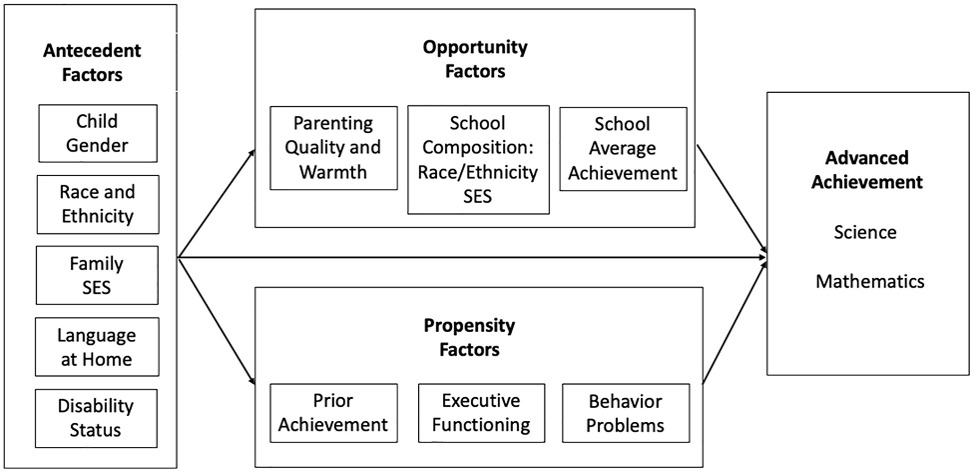
If the goal is to reduce these disparities in advanced achievement in math and science, we have to know why they exist. Is it family income? Prior achievement? School quality? Parent effects? Systemic racism? The team did this by looking at “antecedent, opportunity, and propensity factors influencing advanced achievement,” which they note is a “well-validated theory of achievement growth.” They illustrated the framework with the following figure:
1

They found that the factors “mostly explain” the Hispanic-White disparities, but that the Black-White disparities “were not fully explained and remained both practically and statistically significant.”

They note that this is consistent with other work, citing a 2004 study by Roland Fryer and Steven Levitt, which found that “Black- but not Hispanic-White achievement gaps in reading and mathematics among observationally similar kindergarten students increase over time.” Fryer and Levitt also weren’t sure why.

Morgan et al. say this needs to be studied further. And indeed it does.

2. Students who speak multiple languages at home were more likely to achieve at advanced levels in math and science.

The researchers found that “non-English-language use in the home repeatedly predicts a greater likelihood of displaying advanced science or mathematics achievement.” This is consistent with other work, including a 2014 study by Andrea Stocco and Chantel Prat and a 2018 study by Andree Hartanto, Hwajin Yang, and Sujin Yang.

Indeed, the 2018 study, which used two large U.S. datasets, found that “bilingualism positively predicted teacher-rated mathematical reasoning, emergent numeracy skills, and test scores on either mathematical word problems or standardized mathematical assessments.” The link persisted as children transitioned from kindergarten to first grade.

Morgan et al. hypothesize that “bilingualism may facilitate the learning of the complex rules and procedures integral to supporting advanced STEM achievement.” It does this, suggests the 2014 study, because of the “need to flexibly select and apply rules when speaking multiple languages.”

Perhaps this is why, as Morgan’s team points out, “Children who are English language learners have been reported to be more likely to be identified as gifted during elementary school,” citing a large-scale 2020 study.

3. Further support for the “big-fish-little-pond” theory.

This theory claims that students at schools with higher average math achievement “may adopt lower self-concepts, leading to lower effort and achievement in science and mathematics by the affected students,” according to Morgan et al. And this is consistent with what they found: Children attending elementary schools with higher math achievement were less likely themselves to be high achievers—objectively, not relative to their classmates—a sort of negative peer effect. The impact was as strong as attending a school with a high rate of poverty, as defined by the proportion of students eligible for free lunch. In fact, only race, ethnicity, and gender were more significant negative factors.

This is also consistent with a 2008 study by the University of Oxford’s Herbert Marsh and colleagues, which found that the big-fish-little-pond effect is “remarkably robust, generalizing over a wide variety of different individual student and contextual level characteristics, settings, countries, long-term follow-ups, and research designs.”

—

I’ve long argued that advanced education is important for two reasons. One, it helps maximize the potential of participating students, which is something every child deserves. And two, in better developing the talent of these advanced students, it supports America’s economic, scientific, and technological prowess in an increasingly competitive global market.

And for just as long, I’ve lamented how poorly American schools have done this for America’s low-income, Black, Hispanic, and Native American children—all of whom are less likely to participate in advanced education programs and achieve at advanced levels.

This research on science and math achievement and the STEM workforce starkly demonstrates all of this—the gaps, their causes, and their consequences. The good news is that such dire findings often serve as a call to action. And in better understanding why these disparities exist and persist, we’re better able to identify, develop, and test solutions.

———

QUOTE OF NOTE

“My analysis indicates that gifted and talented programs are a small or negligible contributor to racial segregation in U.S. elementary schools. Eliminating all gifted and talented programs nationally would have a minimal impact on standard measures of racial segregation, and the presence of a gifted and talented program does not appear to causally impact the racial composition of enrollments over time.”

—Owen Thompson, “Gifted and Talented Programs Don’t Cause School Segregation,” Education Next, January 31, 2023

———

THREE STUDIES TO STUDY

“Self-Regulated Learning and Motivation Among Gifted and High Achieving Students in Science, Technology, Engineering, and Mathematics Disciplines: Examining Differences Between Students From Diverse Socioeconomic Levels,” by Nurit Paz-Baruch and Hnade Hazema, Journal for the Education of the Gifted, OnlineFirst, January 28, 2023

“Self-regulated learning (SRL) is an active process that assists students in managing their thoughts, behaviors, and emotions to navigate their learning experiences successfully. The study examined the differences in motivation and SRL between gifted and high achievers (GHAs) and typical achievers (TAs) in science, technology, engineering, and mathematics (STEM) disciplines by addressing the contribution of socioeconomic status (SES)… The results indicated that among GHAs, all motivation measures were significantly higher than those of TAs, especially among students from low-SES environments. GHA students reported using more SRL strategies than TA students regarding organization, metacognition, time and learning environment, peer learning, and effort regulation. Students from low-SES environments reported using more organization strategies than those from high-SES environments, whereas TA students surpassed their GHA counterparts in critical thinking.”

“Prospective Teachers’ Beliefs About Human Intelligence in a Turkish Sample,” by Fatih Kaya, M. Talha Kaya, and Sumeyye Kaya, Journal for the Education of the Gifted, OnlineFirst, January 27, 2023

“Research consistently reports a moderate to a strong relationship between intelligence and academic performance. For about a century, the concept of intelligence has often been used in the definition of giftedness and the identification of gifted students along with other data sources, although some experts are against it. An understanding of prospective teachers' beliefs about intelligence is important to unearth how they perceive intelligence and giftedness. We replicated Warne and Burton's (2020) study with 157 prospective Turkish teachers… Like the original study, the Turkish sample showed an understanding of the relationship between education and intelligence; however, the items about biological and genetic influences on intelligence, the plausible causes of group differences, the life outcomes of intelligence, and a cross-cultural comparison of intelligence had a low response uniformity in both studies…”

“‘You Are so Smart!’: The Role of Giftedness, Parental Feedback, and Parents’ Mindsets in Predicting Students’ Mindsets,” by Michiel Boncquet, Jeroen Lavrijsen, Maarten Vansteenkiste, Karine Verschueren, and Bart Soenens, Gifted Child Quarterly, Volume 66, Issue 3, April 2022

“Although it has been hypothesized that gifted students are at risk for adopting a fixed mind-set, research revealed inconsistent results. We aimed to clarify this by differentiating between two operationalizations of giftedness (high cognitive ability and formal identification as gifted) and how these relate to students’ beliefs about intelligence and effort. Also, we examined the role of parental antecedents on students’ beliefs. Participants were 3,329 seventh-grade students and their parents. Only being labeled as gifted was related to adopting a fixed mind-set. Regarding parental antecedents, parents’ intelligence and effort beliefs were related to students’ corresponding beliefs. Furthermore, parental feedback was associated with students’ beliefs, which was most pronounced when student-reports of feedback were used. In particular, person-oriented feedback related positively to a fixed mind-set and negatively to students’ appreciation of the role of effort in academic performance, while process-oriented feedback showed the opposite pattern…”

———

WRITING WORTH READING

“Parents irked as Alpine School District cancels 3rd grade gifted program,” Daily Herald [Utah], Sarah Hunt, February 3, 2023

“Governor signs proclamation naming February as Gifted Education Month in Kentucky,” Kentucky Teacher, Joe Ragusa, February 2, 2023

“The College Board strips down its A.P. curriculum for African American Studies,” New York Times, Anemona Hartocollis and Eliza Fawcett, February 1, 2023

“NYC high school admissions is overwhelming. It rewards parents like me.” Chalkbeat New York, Bliss Broyard, January 30, 2023

“The emotional characteristics of gifted children,” Exploring Your Mind, José Padilla, January 30, 2023

“In memoriam: Marcia Gentry, scholar, friend, mentor, mother, and wife,” Gifted Child Quarterly, Sally Reis and Matt Fugate, January 27, 2023

“High expectations—and frustrations: Stories of twice exceptional students desperately seeking support,” ADDitude, ADDitude Editors, January 27, 2023

“Selective standards under scrutiny as NYC Council debates school admissions,” New York Daily News, Cayla Bamberger, January 25, 2023

“As my family found out, KY schools are denying services to gifted children,” Lexington Herald Leader, Barry Saturday, January 24, 2023

“Gifted Specialists fill broad needs of 20% of students,” Madison County [Alabama] Record, Gregg Parker, January 20, 2023


view

An examination of cream-skimming and pushout data among voucher students

Amber M. Northern, Ph.D.
2.9.2023
Flypaper

Several studies show that a combination of market pressures and state or authorizer policies help prevent public charter schools from “cream-skimming”—enrolling high-achieving, less-challenging, or less-costly-to-educate students—and shunning or forcing out low-achieving, more-challenging, and more-costly-to-educate students. The extent to which these practices may occur in private school choice programs, however, is less understood, as most states generally allow private schools to follow their own admissions and retention criteria. In an effort to shed some light on the matter, a recent report from Joseph Waddington, Ron Zimmer, and Mark Berends examines the data from private schools participating in Indiana’s statewide voucher program.

Analysts use eight years of data (2010–11 through 2017–18) from the Indiana Department of Education, which includes information on students attending district, charter, magnet, and private schools (including voucher and non-voucher students). Critical to the study design, almost all students in Indiana must participate in statewide testing, including private schools that take part in the voucher program. Analysts focus on the students who switched schools between school years and distinguish between structural moves (meaning that students are moving into schools with higher grade levels) and non-structural moves (meaning they switched schools for any other reason). Their primary outcomes are math and English language arts achievement and potential differences in the creaming/pushout status of students with special needs (SPED) and those learning English (English language learners/ELL), since those needs are generally costlier to address.

For the pushout analysis, the scholars examine whether students made a non-structural move. They want to see whether low-achieving or costlier-to-educate voucher-receiving private school students are more likely to transfer out of a private school and into a district school compared to similar students who are voucher-eligible (but not voucher-using) and make a non-structural move from their traditional public school. The primary question is whether students have below average achievement in math and ELA relative to peers in their school each year.

For the cream-skim analysis, they examine whether students made either a structural or non-structural move between years, since there could be motivation to “cream” a student regardless of whether they reached the terminal grade of their previous school. They look at whether a student has above-average achievement—again relative to their peers in their school each year—and no discipline issues (the analysts have suspension/expulsion data only from the public schools). They are examining the difference in the relative likelihood of making a move for a high-achieving/less-disruptive/less-costly-to-educate student who receives a voucher to attend a private school, compared to those same types of voucher-eligible students who make a move without a voucher.

Analysts find no evidence that private schools are cream-skimming higher-performing, less-disruptive, or less-costly-to-educate students from district schools. They also do not find strong evidence that pushout occurs relative to English language learners and students with special needs. However, they do find evidence consistent with the claim that the lowest-achieving voucher students are being pushed out of private schools at a modestly higher rate than their similarly low-achieving, voucher-eligible traditional public school peers (1 to 3 percentage points higher)—as well as their higher-achieving voucher-using private school peers (3 to 9 percentage points higher).

Note that this is a descriptive—not causal—study. Which means that the so-called “pushout” data could also be consistent with any number of voluntary student departure scenarios, such as that private school is too hard (or too easy) for students; that voucher students are having trouble making friends or otherwise fitting in; or that the commute from home to school is too long. We need more information to determine the mechanisms behind the observed outcomes. Still, the lack of obvious cream-skimming and minimal pushout are both encouraging findings, seeing that private school choice programs have far fewer mandated guardrails to prevent them from occurring.

SOURCE: Joseph Waddington, Ron Zimmer, and Mark Berends, “Cream Skimming and Pushout of Students Participating in a Statewide Private School Voucher Program,” Annenberg Institute at Brown University (August 2022).

view

Re-evaluating the cost of test-based retention policies

Jeff Murray
2.9.2023
Flypaper

What does it cost to retain a less-than-proficient student and provide him or her with remediation and additional support? In a new research brief, Boston University professor Marcus Winters says the amount is lower than previous analysts, including himself, have estimated and goes on to show why.

Key to Winters’s framework is that cost accrues both to the taxpayers who fund the additional time and work and to the students who are held back, as they are likely delayed from entering the job market because of their extra time in school. Winters asserts that previous analyses did not account for these timeframes properly, as taxpayers don’t fund extra education for a retained student until she stays in school beyond her expected high school graduation date. In other words, a youngster who repeats third grade was always going to be on the school’s roster that second year, but as a fourth grader rather than a third grader. Although it is possible that she will remain a grade level behind for eight more years and thus require that extra year of taxpayer-funded education, data suggest that one of several other outcomes is likely to occur before then: catching up and rejoining her previous grade cohort, leaving that system for another (such as a private school or an out-of-state district), or dropping out of school entirely.

Laying aside the relative undesirability of some of these outcomes, the math speaks for itself. Allocating a full year of additional funding as a necessary cost of retention is incorrect. The same goes for the cost of lost wages to the student herself. Winters and other analysts include not only the first year of lost wages (due to a delayed grade twelve) but also multiple additional years of decreased raises afterward due to delayed entry. Even assuming that catching up with wage growth is impossible, a retained student is still more likely to enter the workforce—one way or the other—less than a year behind expectation. Calculations must be made accordingly.

To illustrate, Winters returns to previously published analyses of Florida’s third grade retention policies. A study that looked at the first cohort of third graders retained in Florida in 2002–03, on which Winters was an analyst, indicated clearly that students who remained in their schools through graduation were only delayed by 62.8 percent of a year. Yet the cost calculations assumed a full year’s delay. Rerunning those numbers with the proper delay factor—and even including the full reported cost of interventions intended to boost student achievement—yields a taxpayer cost 34 percent lower than originally estimated. Lost wages were similarly overestimated in the previous analyses.

While there are adjunct costs to holding students back, the benefits could easily outweigh those costs. Yes, a retained student might spend a few less months in the labor market, but the career earnings potential of being able to read fluently (as opposed to being illiterate) should easily surpass those fleeting losses. That’s what retention—and robust support—aims to do for students who are struggling to read.

Retention policies should go hand in hand with a robust set of supports in place to make sure that those who are off track can make up ground as quickly and simply as possible. While there are adjunct costs to holding students back, these have been exaggerated in previous research and can be minimized even further by a focus on boosting student achievement. Future discussions of the merits of retention policies should proceed from this more realistic assessment.

SOURCE: Marcus A. Winters, “The Cost of Retention Under a Test-Based Promotion Policy for Taxpayers and Students,” American Education Research Association (AERA) Journal (December 2022).

view

#856: Why education savings accounts won’t bring educational pluralism, with Ashley Berner

2.8.2023
Podcast
 

On this week’s Education Gadfly Show podcast, Ashley Berner of Johns Hopkins University tells us why education savings accounts are unlikely to lead to educational pluralism. Then, on the Research Minute, Adam Tyner discusses a study on remediation for middle school students that had very different short-term versus long-term effects.

Recommended content:

  • “Will ESAs change America’s definition of ‘public education?’: An interview with Ashley Berner” —Rober Pondiscio
  • “Partisanship and American education” —Ashley Berner
  • “2 more states approve universal school voucher programs” —K-12 Dive
  • “From School Choice to Parent Choice” —City Journal
  • The study that Adam reviewed on the Research Minute: David N. Figlio and Umut Özek, “The Unintended Consequences of Test-Based Remediation,” National Bureau of Economic Research Working Paper (January 2023).

Feedback Welcome:

Have ideas for improving our podcast? Send them to our producer Nathaniel Grossman at [email protected].

view

Cheers and Jeers: February 9, 2023

The Education Gadfly
2.9.2023
Flypaper

Cheers

  • One writer proposes an Advanced Placement course about the technological breakthroughs that helped produce the Great Acceleration and Enrichment of the past 200 years. —James Pethokoukis
  • “Black students need better schools, not lower standards.” —Jason Riley
  • In a surprising reversal of policy, New Jersey will allow public charter schools in the state to add an additional 2,299 students to their rosters. —North Jersey
  • Career-based pathways are one reason that student graduation rates are up in Oakland high schools. —The Oaklandside

Jeers

  • New York City schools will be allowed to grade their own students’ Regents exams, despite evidence of grade manipulation in the past. —Chalkbeat New York
  • Two decades of stagnant student test scores suggest that the Programme for International Student Assessment (PISA) has been pushing faulty analysis for its member countries. —Education Next
view

What we're reading this week: February 9, 2023

The Education Gadfly
2.9.2023
Flypaper
  • A new study makes a compelling case that there is racial bias in K-12 student referrals and discipline, although socio-economic status could account for much of the disparities. —Brookings Institution
  • “After the release of NAEP revealed the worst-ever decline in math scores, the Khan Academy founder is sounding the alarm.” —The 74
  • Advances in artificial intelligence and big data could lead to a “Big Bang” in education research. —Mark Schneider
  • To fortify the American Dream, the federal government should focus on programs that address the barriers to intergenerational social mobility. —Scott Winship
  • Donald Trump, Ron DeSantis, and other possible Republican presidential candidates are making education issues central to their campaigns despite mixed results in 2022. —New York Times
Fordham Logo

© 2026 The Thomas B. Fordham Institute
Privacy Policy
Usage Agreement

National

P.O. Box 110
Burke, VA 22009

202.223.5452

[email protected]

Ohio

P.O. Box 82291
Columbus, OH 43202

614.223.1580

[email protected]

Sponsorship

130 West Second Street, Suite 410
Dayton, Ohio 45402

937.227.3368

[email protected]