Mobile Navigation

  • National
    • Policy
      • High Expectations
      • Quality Choices
      • Personalized Pathways
    • Research
    • Commentary
      • Gadfly Newsletter
      • Flypaper Blog
    • Events
    • Scholars Program
  • Ohio
    • Policy
      • Priorities
      • Media & Testimony
    • Research
    • Commentary
      • Ohio Education Gadfly Biweekly
      • Ohio Gadfly Daily
  • Charter Authorizing
    • Application
    • Sponsored Schools
    • Resources
  • About
    • Mission
    • Board
    • Staff
    • Career
Home
Home
Advancing Educational Excellence

Main Navigation

  • National
  • Ohio
  • Charter Authorizing
  • About

National Menu

  • Topics
    • Accountability & Testing
    • Advanced Education
    • Career & Technical Education
    • Charter Schools
    • Curriculum & Instruction
    • ESSA
    • Evidence-Based Learning
    • Facilities
    • Governance
    • Personalized Learning
    • Private School Choice
    • School Finance
    • Standards
    • Teachers & School Leaders
    • Think Again
  • Research
  • Commentary
    • Gadfly Newsletter
    • Flypaper Blog
    • Gadfly Podcast
  • Events
  • Scholars Program

The Education Gadfly Weekly

Sign Up to Receive Fordham Updates

We'll send you quality research, commentary, analysis, and news on the education issues you care about.
Thank you for signing up!
Please check your email to confirm the subscription.

The Education Gadfly Weekly: Catholic schooling and private school choice

Volume 26, Number 3
1.22.2026
1.22.2026

The Education Gadfly Weekly: Catholic schooling and private school choice

Volume 26, Number 3
view
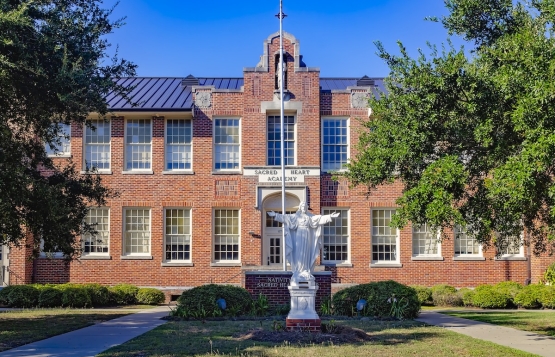
Sacred Heart Academy in Biloxi Mississippi
Quality Choices

Educational choice is giving new hope to Catholic schools

Today is one of the most hopeful times for Catholic education since the early 1960s, when tuitions started to rise and enrollments started their long decline. Today’s private-school choice programs solve that problem.

Mike McShane 1.22.2026
NationalFlypaper

Educational choice is giving new hope to Catholic schools

Mike McShane
1.22.2026
Flypaper

Classrooms aren’t battlegrounds

Dale Chu
1.22.2026
Flypaper

Showing up for success: How two high-poverty D.C. schools tackle chronic absenteeism

Josh Boots
1.22.2026
Flypaper

Student outcomes are better in non-union versus unionized public schools

Jeff Murray
1.20.2026
Ohio Gadfly Daily

Education savings accounts: Boffo or bonkers? | Episode 1002 of The Education Gadfly Show

1.21.2026
Podcast
view
Student raising her hand

Classrooms aren’t battlegrounds

Dale Chu 1.22.2026
Flypaper
view
Frederick Douglass Memorial Bridge

Showing up for success: How two high-poverty D.C. schools tackle chronic absenteeism

Josh Boots 1.22.2026
Flypaper
view
Teacher union status and student outcomes SR image

Student outcomes are better in non-union versus unionized public schools

Jeff Murray 1.20.2026
Ohio Gadfly Daily
view
Michael J. Petrilli

Education savings accounts: Boffo or bonkers? | Episode 1002 of The Education Gadfly Show

Michael J. Petrilli, David Griffith, Ph.D., Amber M. Northern, Ph.D. 1.21.2026
Podcast
view
Sacred Heart Academy in Biloxi Mississippi

Educational choice is giving new hope to Catholic schools

Mike McShane
1.22.2026
Flypaper

Last year, the College of Cardinals elected a new pope to lead the Catholic Church. Leo XIV, born Robert Prevost in Chicago, Illinois, was installed on May 18th in St. Peter’s Square.

Just six months later, he published an Apostolic Letter titled “Drawing New Maps of Hope,” outlining his vision for Catholic education. It is a fascinating document because it comes at a time of change in Catholic education in America. Emphasizing the idea of hope is an appropriate one because I think today is one of the most hopeful times for Catholic education, certainly in my lifetime, and perhaps stretching back even farther.

The story of Catholic schooling in America is well trod ground for those in the education policy world. Anti-Catholic bigotry in the mid-19th century drove Catholics to create an expansive, parallel education system to public schools. Enrollment in that system peaked in the early 1960s at more than 5.2 million students in almost 13,000 schools. By the year 2000, the number had been cut in half, to 2.6 million students attending 8,146 schools. By 2020, it had fallen to 1.6 million students in 5,981 schools.

Why did this happen? There were a lot of reasons. A few, in no particular order:

  • Explicit anti-Catholicism decreased in public schools.
  • The numbers of priests, nuns, and religious sisters declined, ruining the human capital model.
  • Other free options like charter schools emerged (often explicitly copying traits of Catholic schools).

Catholic schools closing has been a terrible thing. Nicolle Stelle Garnett and Margaret Brinig wrote a fantastic, if depressing, book a little more than a decade ago called Lost Classroom, Lost Community that documented the cost to the social fabric of communities when Catholic schools closed. Crime goes up, disorder goes up, and communities become less cohesive.

But it isn’t just communities that are hurt. Students are hurt, as well. Recent research by David Figlio dug into the different types of schools that participate in Florida’s Tax Credit Scholarship Program and found that students who attend Catholic schools perform better than students who attend other, non-Catholic private schools. This remains even after controlling for demographic characteristics that might explain the variation in performance. In fact, Figlio writes, “I found similar patterns—a consistent apparent Catholic school advantage—across every other dimension I investigated: household size, parental marital status, racial and ethnic identification, and student gender identification.” Closing Catholic schools means narrowing opportunity for students.

If you’ve gotten this far, you might be wondering, “Hey didn’t this guy start by saying this is a hopeful time for Catholic education in America?”

Correct. This is a hopeful time in Catholic education in America, and we can look to Florida to see why.

As Ron Matus and Lauren May have documented, after long periods of decline, enrollment in Florida Catholic schools is on the rise, and substantially. Using data from the National Catholic Education Association and looking at the top ten states by Catholic school enrollment over the decade from 2013–14, they found that Florida was the only state to see an increase in enrollment. While the total U.S. Catholic school population declined by 14.2 percent over that time period, Florida’s Catholic school enrollment grew 9.2 percent.

Florida is not alone. Iowa Catholic schools saw an enrollment increase around 4 percent from 2023–24 to 2024–25.

What do these two states have in common? If you’re reading this Substack, you’ve probably already figured it out: robust educational choice.

Families want Catholic education, but they can’t afford it. Private school choice programs solve that problem.

It is important that leaders in Catholic education and in the church more broadly understand both the incredible opportunity that choice provides, as well as its consonance with the vision that Pope Leo lays out in “Drawing New Maps of Hope.”

As he writes:

The educational community is a “we” where teachers, students, families, administrative and service staff, pastors, and civil society converge to generate life. This “we” prevents water from stagnating in the swamp of “it has always been done this way” and forces it to flow, to nourish, to irrigate.

Educational choice programs are one source of water into the swamp of “it has always been done this way.” Rather than relying on financial models that are no longer fit for purpose, Catholic schools can benefit from the flows of public dollars, via families, into their schools.

Now, they might need to make some changes. Schools might need to invest in communicating their culture to integrate new students and families into their community. They might finally be able to build out their infrastructure for students with special needs that they have been hoping to serve but have been unable to do so due to cost. They also might need to fight for students in a more competitive environment than they were used to. But the Pope is encouraging them to do so!

For those skeptical, it is important to also see how choice is complementary to the values and charisms Pope Leo shared. He writes:

The family remains the first place of education. Catholic schools collaborate with parents; they do not substitute them because the “duty … devolves primarily on them.” The educational alliance requires intentionality, listening, and co-responsibility. It is built with processes, tools, shared assessments. It is both hard work and a blessing: when it works, it inspires trust; when it fails, everything becomes more fragile.

Educational choice puts parents in the place of prominence that Pope Leo describes. Choice sees parents as their child’s primary educators and welcomes schools to collaborate with them to teach and form their child. It is not easy, as the Pope recognizes. It takes communication, compromise, and maturity. But when it works, it creates incredible institutions where the whole of a child can flourish.

There is an old joke about the non-Catholic kid who enrolled in a Catholic school who went home after the first day and, when his mother asked how it went, replied, “man, these people take math seriously, they’ve got a guy nailed to a plus sign in every classroom!”

But that ubiquitous image in the Catholic classroom is perfect for thinking about Catholic schools in America today. At first glance, we see suffering, hopelessness, and a figure stripped and bleeding. But we all know that isn’t the end of the story. It is actually a symbol of new life and new hope.

It is my hope that Catholic school leaders embrace Pope Leo’s exhortation to be bold and embrace the challenges and opportunities to provide a life-changing education for the millions of students who desperately need it.

Editor’s note: This was first published by the author on his Substack, Informed Choice.

view
Student raising her hand

Classrooms aren’t battlegrounds

Dale Chu
1.22.2026
Flypaper

The grownups are fighting harder and louder than they have in years, both in words and deeds, about education, as well as everything else. Across the political spectrum, schools are treated not as civic institutions but as battlegrounds in a broader struggle over identity, power, and national belonging. In rhetoric and increasingly in policy, education is framed in existential terms, with nearly every issue cast as a fight for the nation’s soul. The temperature is high, the language martial, and the stakes are described as nothing less than civilizational.

This escalation among adults comes at a moment when war and conflict are not abstract tropes in political speech but real headlines, from a U.S. operation in Venezuela to renewed talk of military action against Iran and strategic bluster over Greenland’s place in our great power rivalry. This war-footing posture is not limited to one party; in education, nearly everyone now speaks the language of culture war. The current administration, however, has leaned into it in striking ways, characterizing certain ideas, curricula, and educators as national threats. Indeed, the president once called upon his supporters to “lay down their very lives” against what he described as racial indoctrination in K–12 schooling.

Yet for all the funhouse-mirror war talk, the reality inside most classrooms is strikingly prosaic. Teachers are not manning ideological barricades; they are managing behavior, trying to cover material, and scrambling to fill gaps left by chronic absenteeism and staffing shortages. Although the charged political rhetoric may spook a few teachers—primarily in red states—from discussing current affairs, most classrooms carry on without incident. But that surface stability masks deeper problems, according to a New York Times book review of “The Cradle of Citizenship” by journalist James Traub:

The real crisis… is not that students are learning about 1619 rather than 1776, or the reverse. It is that so many are learning nothing at all… If students do want to engage, their dependence on social media simplifies their views. As Traub discovers, their credulousness toward online sources renders them dependent on present-day culture war influencers whose historical claims they are unprepared to challenge. Against this tide, teachers struggle to get their students to see how the world of the past could be both alien and instructive in a way that might stoke their skepticism.

Students are not pawns in a pitched battle so much as victims of academic neglect, nearly all of whom will graduate high school with little understanding of history or government.

The evidence here is sobering. The latest national results show that only about 14 percent of eighth graders scored at or above the proficient level in U.S. history, and only 22 percent did so in civics, while scores in both subjects continue to fall as part of a disappointing decade-long decline. More students now score in the lowest categories, unable to answer even basic questions about the Constitution or the Civil War. Many can read the Gettysburg Address without recognizing that soldiers died in the conflict.

We also lack comprehensive state-level civics data, so policymakers cannot answer even simple questions like whether there was a “Mississippi Miracle” in civics the way we have for the “Southern Surge” in reading. Expanding NAEP civics assessments at the state level could fill this gap, providing a clearer picture of what works and what doesn’t. Traub’s excellent new book documents a range of issues in civics education, from curriculum gaps to classroom realities, and readers should consult it for a deeper understanding of how students are—or aren’t—learning the foundations of democracy.

Math and reading scores have long been troubling, but history and civics are particularly consequential because students who lack basic knowledge in these areas are more susceptible to polarization, mistrust, and civic breakdown. At the same time, Uncle Sam has scaled back research capacity and sent mixed signals about his commitment to assessment and accountability, potentially leaving researchers and policymakers with less evidence of how students are faring.

That remains the real education challenge—and today’s air war among adult factions isn’t helping the country to meet it. The effect is not just theatrical. When education policy is framed as a struggle for the heart of the republic, the machinery of governance starts to bend toward drama rather than evidence. As political pundit Jonah Goldberg explains:

When you invoke war as the analogue to something else, you’re trying to steal the authority and permission that war gives… trying to say that the rules don’t apply… War causes people to… follow orders. That’s why politicians love to invoke war—to sidestep the messy rules… War fever is seductive and intoxicating…

It’s one thing to draw on the urgency of Sputnik-era education reform, when the nation mobilized to strengthen math and science without turning classrooms into weaponized battlegrounds. It’s quite another to ratchet up the language to the point that Washington’s handling of schools feels like a life-or-death cause—so much so that the very essentials of teaching and learning are pushed to the margins.

None of this is to deny that partisan signaling exists in schools. Traub documents real political battles in places like Texas and Florida, as well as Minnesota and Illinois, and he did encounter isolated examples of overt ideological expression by teachers. But those cases were the exception, not the rule. Far more common was a quieter reality: educators trying to do their jobs while navigating shifting directives and political pressure from above. The danger of today’s martial spectacle is that it turns what should be treated as an urgent national imperative—getting students back on track—into a permanent emergency. Emergencies reward theatrics, demand loyalty, and short-circuit judgment. In the end, the central conflict in K–12 education is not good versus evil or red versus blue, but seriousness versus stupidity. And too many adults, including those with the most power, have mistaken performative combat for serious thinking, to the detriment of the students they claim to be fighting for.

view
Frederick Douglass Memorial Bridge

Showing up for success: How two high-poverty D.C. schools tackle chronic absenteeism

Josh Boots
1.22.2026
Flypaper

Across the country, student attendance post-pandemic remains a crisis. For the thousands of school principals who added “reduce chronic absenteeism” to their 2026 New Year’s resolutions, please know that you are not alone. According to a recent report from the American Enterprise Institute, chronic absenteeism remains 57 percent higher than it was before the pandemic. In 2024, the national rate dropped only slightly to 23.5 percent. The rate in Washington, D.C.—where my organization, EmpowerK12, is based—while improving, still hovers near 40 percent.

Fifteen states and jurisdictions have adopted a goal of cutting chronic absenteeism in half by 2027. But progress is uneven, and without school-based strategies that work, that target may remain out of reach.

This includes D.C. Chronic absenteeism is one of the most pressing challenges facing the city’s schools, and its ripple effects are increasingly visible beyond the classroom. A recent investigation by the Washington Post found that widespread breakdowns in the city’s approach to truancy have contributed to a troubling spike in youth crime. Middle school students have been especially affected, with truancy rates at triple pre-pandemic levels.

EmpowerK12 research finds that for every day of missed class, a student’s score on the city’s test (called “CAPE”) declines by one point. When the difference between the assessment’s “Meeting Expectations” and “Partially Meeting Expectations” levels is just twenty-five points, every day of school attended counts.

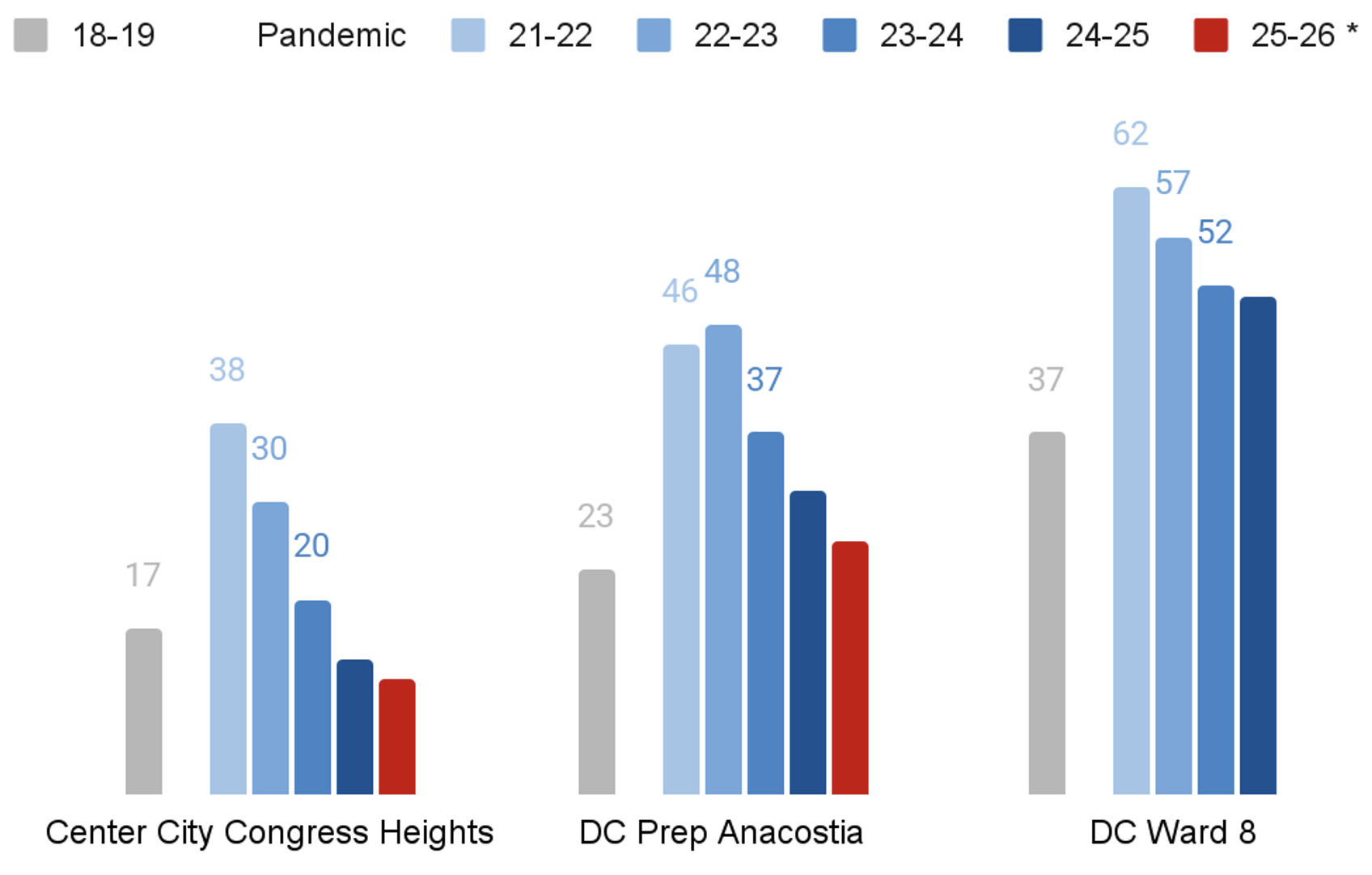
This article tells the story of Center City Congress Heights and D.C. Prep Anacostia, two of the city’s high-poverty schools showing that significant and sustained attendance improvement is possible. Students in pre-K through eighth grade at both schools saw chronic absenteeism rates double after the return to in-person schooling during the pandemic. Now their rates are at the lowest levels of any school east of the Anacostia River in D.C.’s most impoverished communities of Ward 8, where half of the students are chronically absent. (See figure 1.)

Figure 1: Student chronic absenteeism rates in D.C. Ward 8, Center City Congress Heights, and D.C. Prep Anacostia, 2018–2026

1

* School chronic absenteeism rates as of the end of November 2025

The strategies behind their success are not complicated, but they are deliberate and sustained. They begin with a belief that attendance is everyone’s job and that no intervention works without first building trust through quality relationships and cultivating a sense of belonging.

At both schools, the work to improve attendance begins long before the first day of school. Over the summer, staff at D.C. Prep Anacostia review attendance data from the previous year and identify students who may need support. The school holds one-on-one meetings with families to create personalized plans. Sometimes that means providing alarm clocks or arranging wake-up calls, or the plan may include incentives like gift cards or special snacks. These plans are not just written and forgotten. They are tracked weekly and adjusted as needed. “We start our attendance planning in the summer,” said D.C. Prep Anacostia’s Vice Principal Kia Coleman. “Using data, meeting with families, and setting real goals. It is not just about getting students here. It is about making sure they feel celebrated when they do.”

At Center City Congress Heights, the message is just as clear. During the first parent night of the year, the school lays out its expectations and asks for families to mutually hold the school accountable in return. Staff make clear that attendance matters, not only because it affects grades, but because it affects access to unique learning opportunities. Every newsletter includes attendance updates. Teachers and leaders recognize progress and follow up when students miss time. Staff conduct home visits when necessary, and they do not shy away from difficult conversations.

According to Principal Niya White, that level of honesty is possible only because the relationships are already in place. “We talk about shared accountability between staff and families, and back again,” White said. “That means holding each other to high expectations, being clear from the start, and following through with both recognition and consequences.”

While the staff at both schools take attendance seriously, they also know that students are more likely to show up when school feels like a place where they belong. That sense of belonging is cultivated through opportunities for joyful learning, creating a sense of community, and academic momentum.

At D.C. Prep Anacostia, attendance gets celebrated publicly and often. The school’s “Golden Clock” competition rewards homerooms that reach 95 percent attendance for the week. Three clocks earn a pizza party. Five clocks get the class a spot in the school’s Hall of Fame. Ten clocks win a field trip. Students also earn door prizes and school store rewards. The tone is upbeat, but the message is serious: Your presence matters.

Students at Center City Congress Heights are offered similar motivators. Every other week, and sometimes more often, every student has an opportunity to experience a field trip. They are a key part of the school’s instructional model and a powerful incentive. Students understand that missing class can mean missing out, and staff reinforce that connection consistently, linking attendance to participation, grades, and long-term academic growth.

Just as important as the incentives are the systems of follow-through. At both schools, data are used early and often. Teachers and leaders monitor daily attendance trends, flag concerns early, and adapt interventions based on what each student and family needs. Families of students who are at risk of chronic absenteeism receive check-ins through phone calls or home visits as early as the first week of school, and when necessary, discussions address the academic consequences of chronic absences, including summer school and grade level retention.

Even these conversations are framed with care. At the core of both schools’ approach is the belief that families want their children to succeed, and that schools have a responsibility to help make that possible. When teachers and staff speak with parents about attendance, rather than insinuating blame, they emphasize problem-solving and partnership.

Their all-hands-on-deck philosophy to boldly improving attendance sets these schools apart from other schools where staff often think attendance work is someone else’s or another city government responsibility. At D.C. Prep and Center City, the challenges and solutions belong to everyone—and so does success.

The primary ingredient that encompasses everything is the development of strong, trusting relationships amongst educators, students, and families to create a true sense of belonging at school for everyone. Then they focus in equal measure on utilizing data early and often, identifying meaningful incentives and consequences, communicating the importance of high attendance standards, and problem solving the support each student and family needs to meet high standards.

What is happening at D.C. Prep Anacostia and Center City Congress Heights is not theoretical. It is real, replicable, and already making a difference. These schools show what it looks like when staff share ownership, when data are used with intention, and when students feel like they belong. If D.C. is serious about improving outcomes for its young people, it must be equally serious about learning from the schools that are already getting it right.

view
Teacher union status and student outcomes SR image

Student outcomes are better in non-union versus unionized public schools

Jeff Murray
1.20.2026
Ohio Gadfly Daily

Researchers looking at the impacts of teachers union membership on schools have had an easier time focusing on finance-related outcomes—including former students’ earning power as adults—rather than academic achievement. While not the first research to do so, a new working paper exploits a natural experiment to try and overcome the non-random nature of union membership in order to examine student outcomes more directly.

In 2011, Wisconsin enacted Act 10, which effectively made union membership optional. The legislation also specifically curtailed public-sector unions’ collective bargaining rights and required them to hold annual elections to remain legally certified. Prior to Act 10, over 98 percent of Badger State teachers were union members. After its passage, that eventually dropped below 50 percent and roughly half of the state’s 400 union locals were not re-certified by public school teachers.

Morgan Foy, a researcher from the University of Illinois Urbana-Champaign, uses individual-level data on all public school teachers from the Wisconsin Department of Public Instruction (DPI) from 2006–2022. These include demographic characteristics, schools where they worked, and grades and subjects taught. He also was given access to de-personalized data on all public school students in the state over the same time period. These include demographics, attendance and disciplinary records, and standardized test scores for grades 3–8 and 10. Foy normalized exam scores to keep them consistent in the wake of test changes in various subjects and years of the study. DPI data began linking teachers and their students in 2017, thus Foy is able to create a classroom-level teacher value added measure from that point. Union re-certification election results came from the Wisconsin Employment Relations Commission and teacher survey data regarding union membership came from NCES.

Importantly, the methodology hinges on two timely but unrelated developments. The first is that, while Act 10 eventually affected all of public education, implementation dates varied across districts because changes only kicked in when an active collective bargaining agreement ended and a new one began. The second is that, starting in January 2016, state law required all union dues to be itemized as part of reporting by political action committees. This allowed for precise data on who was and wasn’t a union member, a level of detail that was previously unavailable.

As a preliminary finding, Foy reports that higher-performing teachers, as measured by value added, are less likely to remain union members relative to their lower-performing peers after union decertification, keeping in mind that individual teachers could still opt to be union members even if their local organizations were decertified. Relatedly, he finds no difference in who opts in and who opts out of union membership by value-added score when they have this choice. “This is consistent,” he concludes, “with the idea that lower-performing teachers value the representation benefits that unions provide relatively more than higher-performing teachers.”

Exploiting the staggered decertification process experienced by local teachers’ unions over time, Foy finds positive impacts on student outcomes in districts with less union membership compared to districts with more membership. Specifically, by three years after decertification, student test scores in math, English language arts, science, and social studies increased by over 5 percent of a standard deviation, and student attendance increased by roughly 1 percent (in average days attended) five years after decertification. Additionally, Foy determines that these benefits are not due to changes in the composition of the teaching force following a loss of union representation, as he found no evidence of differences in teacher turnover rates with or without decertification. Rather, his value-added analysis indicates that teachers who were employed both pre- and post-decertification increased their productivity in decertified districts compared to districts whose union membership remained stable.

Foy concludes from his unique analysis that ending “union protections” for teachers results in direct academic and nonacademic benefits for students. Unfortunately, the mechanisms at work are unclear. (It’s definitely not increased teacher pay or more classroom inputs, as the data available indicate neither of these occurred in districts where unions were decertified.) Instead, Foy surmises that “union efforts to insulate workers may adversely affect the quality” of teaching from the start. And only by ending the union representation system will many teachers reach their full productivity and quality.

SOURCE: Morgan Foy, “Selection and Performance in Teachers’ Unions,” NBER Working Paper (October 2025).

view
Michael J. Petrilli

Education savings accounts: Boffo or bonkers? | Episode 1002 of The Education Gadfly Show

1.21.2026
Podcast
 

This week on The Education Gadfly Show, Mike Petrilli goes solo. After recently playing ESA skeptic at an international school choice conference, Mike walks through where he now stands on education savings accounts—laying out the strongest arguments in their favor and explaining why he’s increasingly unconvinced the tradeoffs are worth it.

Then, on the Research Minute, Amber Northern highlights new research using Michigan data to examine what happens when students with disabilities switch from traditional public schools to charter schools, focusing on changes in attendance and academic outcomes.

Recommended content:

  • Joyful classrooms, but zero public transparency: Inside an ESA micro-school | Episode 987 of The Education Gadfly Show —Thomas B. Fordham Institute
  • Rethinking ESA policy design — Katherine Bathgate, EdChoice
  • How Do Charter Schools Serve Students with Disabilities? Lessons from Michigan —Scott Imberman and Andrew Johnson, REACH (2026)

Feedback Welcome: Have ideas for improving our show in 2026? We would love to hear them. Send them to [email protected]

Fordham Logo

© 2026 The Thomas B. Fordham Institute
Privacy Policy
Usage Agreement

National

P.O. Box 110
Burke, VA 22009

202.223.5452

[email protected]

Ohio

P.O. Box 82291
Columbus, OH 43202

614.223.1580

[email protected]

Sponsorship

130 West Second Street, Suite 410
Dayton, Ohio 45402

937.227.3368

[email protected]