For years, “knowing what time it is” has circulated on the right as a kind of political shibboleth, coming into sharp relief with the “Flight 93 election” and later popularized by figures like Russell Vought, the current director of the Office of Management and Budget. The phrase is meant to distinguish self-described post-liberals from more traditional conservatives (i.e., those aligned with Reagan and Bush) who are seen as still believing that the old rules of American politics apply, that institutions can be trusted to muddle through incrementally, and crucially, that the country is not on the brink of existential collapse. To “know the time” implies an aggressive antipathy toward federal bureaucracy and a belief that the left wields vast, entrenched power. In education policy, that posture has made the U.S. Department of Education a recurring target.
Those who “know the time” often view schools as beyond salvation, demand an all-or-nothing purge, and are fixated on preempting perceived ideological threats—whether a pro-trans agenda, controversial campus policies, or other culture war flashpoints—rejecting the slow, painstaking work of gradual reform.
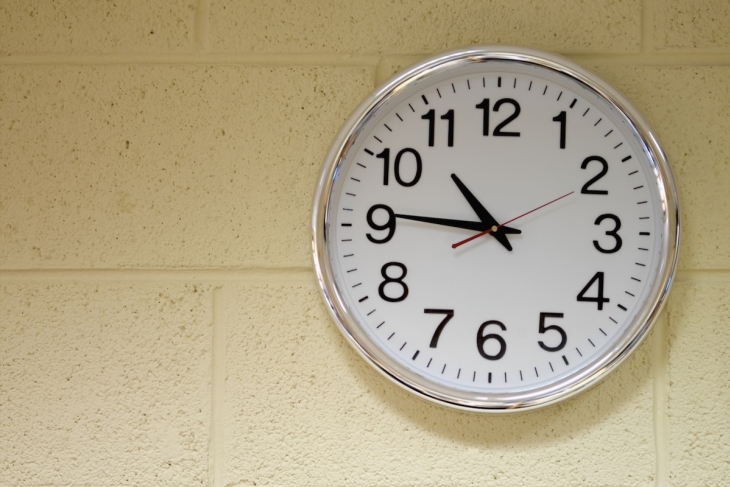
In an uncanny parallel, not knowing what time it is now finds a literal expression in New York City schools. The recent ban on smartphones has brought attention to the fact that some students cannot read analog clocks. As one high school English teacher in Manhattan lamented:
The constant refrain is “Miss, what time is it?” It’s a source of frustration because everyone wants to know how many minutes are left in class… It finally got to the point where I started saying, “Where’s the big hand and where’s the little hand?”
Could there be a more glaring indictment of our education system’s failure to instill rudimentary skills or to keep students engaged in learning? Versions of this story have surfaced repeatedly over the past decade, including reports involving college students. There have been many shifts since Millennials and Gen Xers were in school—away from mental arithmetic, timed math drills, and memorized multiplication tables and toward looser, less structured approaches—but too often these routines faded without a serious reckoning over their value. Telling time looks less like an outdated relic than a casualty of a broader drift away from rigor and mastery.
It would be easy to dismiss this as trivial or just treat it as a proxy for larger cultural battles. But the more important lesson is about priorities. Schools today face immense external pressures—from technology, AI, and other societal changes—but those forces do not absolve them of the responsibility to be clear about what students must know and be able to do.
When students emerge from school without basic competencies, parents naturally begin to wonder what schools are prioritizing and whether the fundamentals are being inculcated at all. The analog clock is simply the latest emblem of these gaps. Just as the Constitution places our most cherished liberties on a high shelf, difficult to damage during moments of populist passion, so too should education place foundational skills beyond the reach of dubious trends or even well-intentioned experiments.
Taken together, the figurative and literal “time” problems feed each other. A populace that lacks basic competencies is more vulnerable to polarization, mistrust, and civic breakdown, but the damage is not confined to what people know. It also shows up in how they speak. The language of “knowing what time it is” does more than signal urgency. It licenses coarseness. It encourages a style of politics in which disagreement is treated as moral failure, institutions are seen as enemies, and restraint is equated with naïveté. Over time, that posture hardens into habit. Profanity, derision, and cruelty become normalized not because they persuade, but because they cease to shock and are accepted as routine.
As Ismar Volić, a professor of mathematics at Wellesley College, explains:
Misleading statistics, sham metrics, cooked numbers, and erroneous alternative science herald a precipitous decline of rigorous thinking, starting with the erosion and weaponization of that rigor’s foundation—mathematics… Whether these numbers are manipulated, fabricated, or real, both sides of the aisle deploy them to elicit an emotional response from us… Greater numeracy leads to greater agency in political decision making and can make us better consumers of democracy.
At the same time, a political movement convinced that institutions are beyond repair becomes more susceptible to social upheaval and less committed to the temperance, continuity, and procedural norms that protect liberal democracy itself. In K–12 education, the same impulse treats innovation as a virtue and traditional competencies as obstacles to progress rather than prerequisites for it. America’s education system does not suffer from a lack of ambition; it suffers from a lack of competence.
If anything, the clock story is best read as yet another warning. Foundational skills can erode quietly, and the consequences are easy to dismiss—until it’s too late. Many young staffers in Washington today have never known a world outside of performative politics, where their bosses preen on social media, squabble on TV, or stage spectacles rather than doing the dull, tedious work of legislating. That muscle memory—the discipline, patience, respect for process, and even for one another—has already atrophied. If schools fail to instill the fundamentals—numeracy, literacy, decency, integrity—the vicious cycle of decline will continue, leaving an entire generation habituated to civic callousness and contempt.