
Across the country, student attendance post-pandemic remains a crisis. For the thousands of school principals who added “reduce chronic absenteeism” to their 2026 New Year’s resolutions, please know that you are not alone. According to a recent report from the American Enterprise Institute, chronic absenteeism remains 57 percent higher than it was before the pandemic. In 2024, the national rate dropped only slightly to 23.5 percent. The rate in Washington, D.C.—where my organization, EmpowerK12, is based—while improving, still hovers near 40 percent.
Fifteen states and jurisdictions have adopted a goal of cutting chronic absenteeism in half by 2027. But progress is uneven, and without school-based strategies that work, that target may remain out of reach.
This includes D.C. Chronic absenteeism is one of the most pressing challenges facing the city’s schools, and its ripple effects are increasingly visible beyond the classroom. A recent investigation by the Washington Post found that widespread breakdowns in the city’s approach to truancy have contributed to a troubling spike in youth crime. Middle school students have been especially affected, with truancy rates at triple pre-pandemic levels.
EmpowerK12 research finds that for every day of missed class, a student’s score on the city’s test (called “CAPE”) declines by one point. When the difference between the assessment’s “Meeting Expectations” and “Partially Meeting Expectations” levels is just twenty-five points, every day of school attended counts.
This article tells the story of Center City Congress Heights and D.C. Prep Anacostia, two of the city’s high-poverty schools showing that significant and sustained attendance improvement is possible. Students in pre-K through eighth grade at both schools saw chronic absenteeism rates double after the return to in-person schooling during the pandemic. Now their rates are at the lowest levels of any school east of the Anacostia River in D.C.’s most impoverished communities of Ward 8, where half of the students are chronically absent. (See figure 1.)
Figure 1: Student chronic absenteeism rates in D.C. Ward 8, Center City Congress Heights, and D.C. Prep Anacostia, 2018–2026
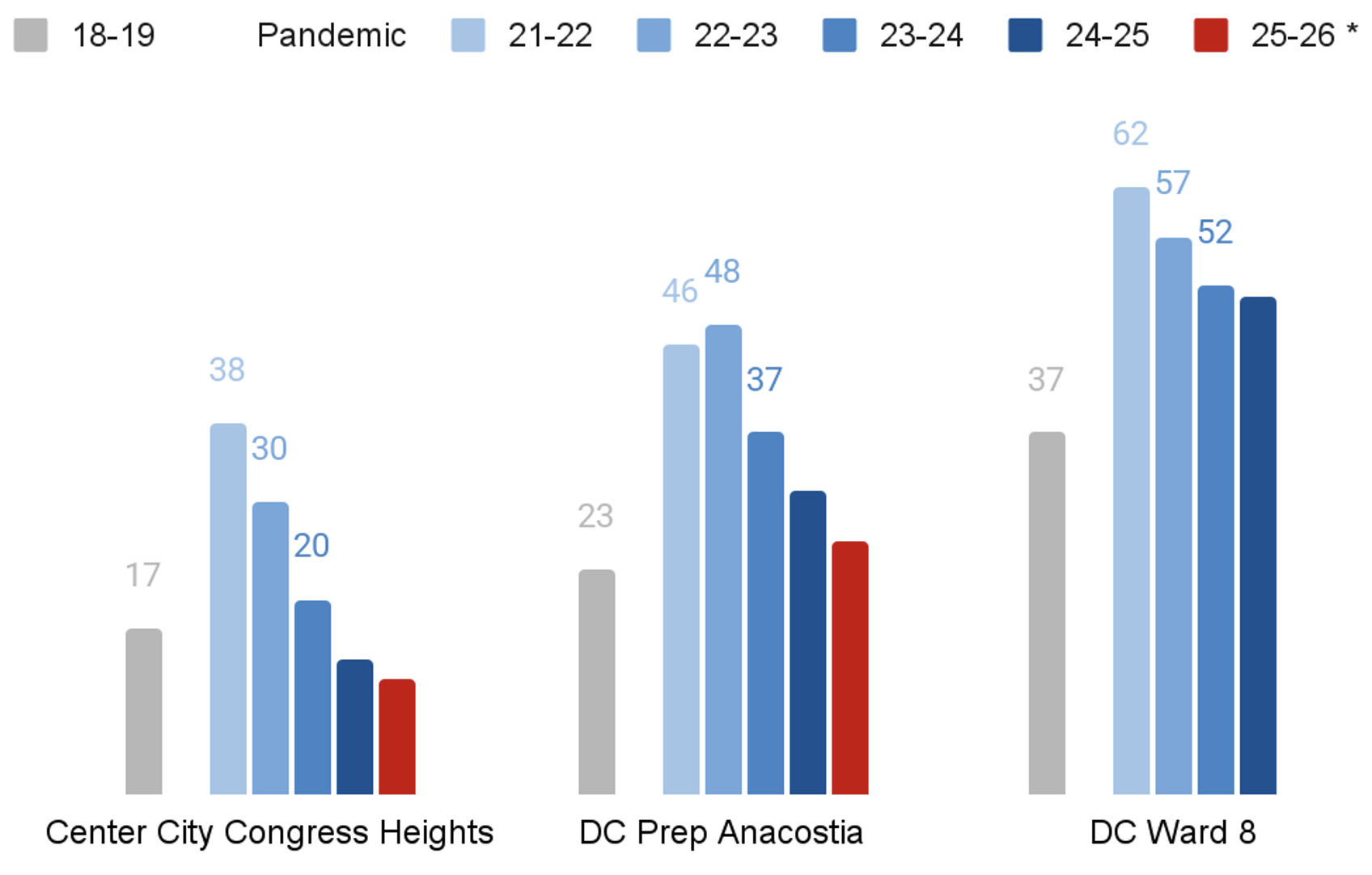
* School chronic absenteeism rates as of the end of November 2025
The strategies behind their success are not complicated, but they are deliberate and sustained. They begin with a belief that attendance is everyone’s job and that no intervention works without first building trust through quality relationships and cultivating a sense of belonging.
At both schools, the work to improve attendance begins long before the first day of school. Over the summer, staff at D.C. Prep Anacostia review attendance data from the previous year and identify students who may need support. The school holds one-on-one meetings with families to create personalized plans. Sometimes that means providing alarm clocks or arranging wake-up calls, or the plan may include incentives like gift cards or special snacks. These plans are not just written and forgotten. They are tracked weekly and adjusted as needed. “We start our attendance planning in the summer,” said D.C. Prep Anacostia’s Vice Principal Kia Coleman. “Using data, meeting with families, and setting real goals. It is not just about getting students here. It is about making sure they feel celebrated when they do.”
At Center City Congress Heights, the message is just as clear. During the first parent night of the year, the school lays out its expectations and asks for families to mutually hold the school accountable in return. Staff make clear that attendance matters, not only because it affects grades, but because it affects access to unique learning opportunities. Every newsletter includes attendance updates. Teachers and leaders recognize progress and follow up when students miss time. Staff conduct home visits when necessary, and they do not shy away from difficult conversations.
According to Principal Niya White, that level of honesty is possible only because the relationships are already in place. “We talk about shared accountability between staff and families, and back again,” White said. “That means holding each other to high expectations, being clear from the start, and following through with both recognition and consequences.”
While the staff at both schools take attendance seriously, they also know that students are more likely to show up when school feels like a place where they belong. That sense of belonging is cultivated through opportunities for joyful learning, creating a sense of community, and academic momentum.
At D.C. Prep Anacostia, attendance gets celebrated publicly and often. The school’s “Golden Clock” competition rewards homerooms that reach 95 percent attendance for the week. Three clocks earn a pizza party. Five clocks get the class a spot in the school’s Hall of Fame. Ten clocks win a field trip. Students also earn door prizes and school store rewards. The tone is upbeat, but the message is serious: Your presence matters.
Students at Center City Congress Heights are offered similar motivators. Every other week, and sometimes more often, every student has an opportunity to experience a field trip. They are a key part of the school’s instructional model and a powerful incentive. Students understand that missing class can mean missing out, and staff reinforce that connection consistently, linking attendance to participation, grades, and long-term academic growth.
Just as important as the incentives are the systems of follow-through. At both schools, data are used early and often. Teachers and leaders monitor daily attendance trends, flag concerns early, and adapt interventions based on what each student and family needs. Families of students who are at risk of chronic absenteeism receive check-ins through phone calls or home visits as early as the first week of school, and when necessary, discussions address the academic consequences of chronic absences, including summer school and grade level retention.
Even these conversations are framed with care. At the core of both schools’ approach is the belief that families want their children to succeed, and that schools have a responsibility to help make that possible. When teachers and staff speak with parents about attendance, rather than insinuating blame, they emphasize problem-solving and partnership.
Their all-hands-on-deck philosophy to boldly improving attendance sets these schools apart from other schools where staff often think attendance work is someone else’s or another city government responsibility. At D.C. Prep and Center City, the challenges and solutions belong to everyone—and so does success.
The primary ingredient that encompasses everything is the development of strong, trusting relationships amongst educators, students, and families to create a true sense of belonging at school for everyone. Then they focus in equal measure on utilizing data early and often, identifying meaningful incentives and consequences, communicating the importance of high attendance standards, and problem solving the support each student and family needs to meet high standards.
What is happening at D.C. Prep Anacostia and Center City Congress Heights is not theoretical. It is real, replicable, and already making a difference. These schools show what it looks like when staff share ownership, when data are used with intention, and when students feel like they belong. If D.C. is serious about improving outcomes for its young people, it must be equally serious about learning from the schools that are already getting it right.