Mobile Navigation

  • National
    • Policy
      • High Expectations
      • Quality Choices
      • Personalized Pathways
    • Research
    • Commentary
      • Gadfly Newsletter
      • Flypaper Blog
    • Events
    • Scholars Program
  • Ohio
    • Policy
      • Priorities
      • Media & Testimony
    • Research
    • Commentary
      • Ohio Education Gadfly Biweekly
      • Ohio Gadfly Daily
  • Charter Authorizing
    • Application
    • Sponsored Schools
    • Resources
  • About
    • Mission
    • Board
    • Staff
    • Career
Home
Home
Advancing Educational Excellence

Main Navigation

  • National
  • Ohio
  • Charter Authorizing
  • About

National Menu

  • Topics
    • Accountability & Testing
    • Advanced Education
    • Career & Technical Education
    • Charter Schools
    • Curriculum & Instruction
    • ESSA
    • Evidence-Based Learning
    • Facilities
    • Governance
    • Personalized Learning
    • Private School Choice
    • School Finance
    • Standards
    • Teachers & School Leaders
    • Think Again
  • Research
  • Commentary
    • Gadfly Newsletter
    • Flypaper Blog
    • Gadfly Podcast
  • Events
  • Scholars Program

The Education Gadfly Weekly

Sign Up to Receive Fordham Updates

We'll send you quality research, commentary, analysis, and news on the education issues you care about.
Thank you for signing up!
Please check your email to confirm the subscription.

The Education Gadfly Weekly: Calculus, statistics, and the capstone course question

Volume 25, Number 16
4.24.2025
4.24.2025

The Education Gadfly Weekly: Calculus, statistics, and the capstone course question

Volume 25, Number 16
view
Student doing calculus

Calculus, statistics, and the capstone course question

Are high school students better served by completing their math studies with calculus or statistics? This question has provoked lively debate in the education world, in the mathematics world, and in the college admissions world. But remarkably little is known for certain about what difference—if any—it actually makes.

Amber M. Northern, Ph.D., Michael J. Petrilli 4.24.2025
NationalFlypaper

Calculus, statistics, and the capstone course question

Amber M. Northern, Ph.D. | Michael J. Petrilli
4.24.2025
Flypaper

The Department of Education meets “Office Space”

Frederick M. Hess
4.24.2025
Flypaper

The ESSER hangover is here

Marguerite Roza
4.24.2025
Flypaper

Can targeted communications boost student participation in opt-in tutoring?

Jeff Murray
4.24.2025
Flypaper

#966: Is calculus king? Rethinking math pathways, with Matt Giani

4.23.2025
Podcast

Cheers and Jeers: April 24, 2025

The Education Gadfly
4.24.2025
Flypaper

What we’re reading this week: April 24, 2025

The Education Gadfly
4.24.2025
Flypaper
view
Office Space screengrab

The Department of Education meets “Office Space”

Frederick M. Hess 4.24.2025
Flypaper
view
Fallen piggy bank

The ESSER hangover is here

Marguerite Roza 4.24.2025
Flypaper
view
Teenager doing homework on computer

Can targeted communications boost student participation in opt-in tutoring?

Jeff Murray 4.24.2025
Flypaper
view

#966: Is calculus king? Rethinking math pathways, with Matt Giani

Matt Giani, Michael J. Petrilli, Amber M. Northern, Ph.D., David Griffith, Ph.D. 4.23.2025
Podcast
view
Fordham Gadfly image

Cheers and Jeers: April 24, 2025

The Education Gadfly 4.24.2025
Flypaper
view
Fordham Gadfly image

What we’re reading this week: April 24, 2025

The Education Gadfly 4.24.2025
Flypaper
view
Student doing calculus

Calculus, statistics, and the capstone course question

Amber M. Northern, Ph.D. | Michael J. Petrilli
4.24.2025
Flypaper

Are high school students better served by completing their math studies with calculus or statistics? This question has provoked lively debate in the education world, in the mathematics world, and in the college admissions world. But remarkably little is known for certain about what difference—if any—it actually makes.

For years, selective college admissions offices have looked for calculus on applicants’ transcripts. In fact, 92 percent of admissions officers in 2024 said that “faculty places a high priority on calculus for demonstrating a rigorous math curriculum,” and about three-quarters of them ranked AP Calculus in the top four math courses that carry the most weight in admissions decisions. Yet, paradoxically, 95 percent of them also acknowledged that “calculus is not necessary for all students.” This tension recently led The Hechinger Report’s Jill Barshay to ask, “Is calculus an addiction that college admissions officers can’t shake?”

Like all addictions, this one may be detrimental, especially if it eclipses statistics (or other rigorous data science courses) that also teach valuable quantitative skills that may be more easily transferable to any number of other career fields: skills like evaluating data to identify patterns, trends, and biases; being able to test a hypothesis; and understanding probability and distributions.

Some believe that college students who plan to major in STEM careers should continue to take calculus, but that non-STEM majors will be better served—with more careers open to them—if they choose a different math pathway, including Statistics as the capstone course.

But is that true?

Today we know too little about how high schoolers’ participation in calculus or statistics influences their future outcomes, much less about that smaller pool of students who take advanced courses in either subject. To help fill this knowledge gap, we’re releasing a new study today, Calculus or Statistics: Does it Matter? It addresses primarily a small but influential segment of the American college-going population—a population that is integral to our country’s economic growth and competitiveness, as they are tomorrow's leaders, scientists, and innovators.

In the study, we ask a host of consequential questions about this special world of mostly college-bound high achievers and their choice of advanced courses. Do students who choose one path over the other attend and graduate college at the same rates? Do they earn comparable salaries? Do they end up employed in similar industries? Knowing what the future holds for otherwise similar, high-achieving students strikes at the heart of the calculus-versus-statistics debate: Does the choice actually matter in the long run?

Fortunately, three talented scholars were also interested in investigating these questions: Associate Professor Matt Giani from the University of Texas-Austin, his research assistant Franchesca Lyra, and Fordham’s National Research Director Adam Tyner. Dr. Giani specializes in social mobility research and has extensive experience analyzing statewide longitudinal data through UT Austin’s Education Research Center (ERC). We’ve had the pleasure of working with him previously on a study about industry-recognized credentials, on which Dr. Tyner also collaborated as project manager. 

Using data from over 5.2 million Texas public high school graduates from 2003 through 2020, the researchers first analyzed course-taking patterns and inequalities in math course participation. To ensure fair comparisons in their analysis of postsecondary outcomes, they focused on the roughly 178,000 students who took either AP Calculus AB (equivalent to one semester of college calculus) or AP Statistics from 2015–2020. That’s roughly 3.4 percent of the much larger sample. Those two groups of students already shared a number of characteristics, but by applying additional weighted adjustments, the analysts were able to create two “observably equivalent” groups. These adjustments accounted for a wide range of factors, including student characteristics, prior performance, course-taking patterns, high school attended, and graduation year.

Their analysis yielded five key findings.

  1. Rising Popularity of Statistics. Participation in statistics has risen rapidly as access to coursework has expanded, while calculus enrollment has remained relatively flat.
  2. Persistent Equity Gaps. Although broader access to advanced math is a “rising tide” that lifts all boats, it has not reduced socioeconomic or racial disparities in participation.
  3. Better Outcomes with Advanced Math. Students who complete relatively higher math courses in high school tend to achieve better postsecondary educational outcomes and higher earnings.
  4. STEM Advantage for Calculus Students. Calculus takers are more likely to enroll in selective colleges and pursue STEM majors but no more likely than statistics students to earn degrees.
  5. No Long-Term Earnings Edge for Calculus. Despite its STEM advantage, taking AP Calculus AB does not lead to higher long-term earnings compared to AP Statistics (at least after eight years).

Based on these results, Dr. Giani and co-authors drew several useful implications, including the need to strengthen popular but often unstandardized non-calculus pathways with robust standards, curricula, and assessments. They also reiterated that diversified math pathways alone will not close equity gaps. That’s because higher-income, White, and Asian students are still more likely to enroll in advanced courses than their peers. So, the real challenge is ensuring that students from all backgrounds are prepared to succeed in and have access to rigorous advanced math (more on that below).

We offer three additional takeaways based on the study’s findings.

First, students, families, and admissions counselors need to know that AP Statistics is not inferior to AP Calculus, at least when it comes to long-term earnings and choice of industry or career field. At about eight years after college graduation, AP Calculus students are estimated to outearn their AP Statistics peers by $1,888 annually, an advantage of about 4 percent. By year ten, the raw difference declines to $1,622 annually (3 percent), but the difference is no longer statistically significant (nor are there any statistically significant differences in salary after that point, up to roughly eighteen years when our study period ends).

The report finds that AP Calculus students are more likely to be employed in manufacturing, health care, oil and gas, and construction, whereas AP Statistics students are more likely to be employed in finance and insurance, accommodation and food services, administrative services, information, real estate, and arts and entertainment.

Yet neither calculus nor statistics takers have cornered the market in math-intensive industries. While calculus students have an edge in engineering-heavy fields like oil and gas, statistics students excel in data-driven sectors like finance and IT. Nor are there significant differences between the two groups in their probability of employment in professional and scientific industries, which include many prestigious sub-industries such as legal services, accounting, and scientific research and development. This suggests that both pathways can lead to success in quantitative careers—and that there’s work to be done to educate parents, families, and admissions officers about data science and its practical benefits.

Second, we need to adjust the standard math sequence to prepare high achievers for either advanced statistics or calculus as their capstone course. Advanced students tend to take Algebra I in eighth grade, geometry in ninth, Algebra II in tenth grade, pre-calculus in eleventh, and calculus in twelfth grade. But if both calculus and statistics can lead to successful careers in mathematics, we should adjust course pathways so that students are prepared to take either of them as their capstone class.

Critical to those efforts is reworking Algebra II to include statistics, probability, and other topics relevant to data science. CSU-Northridge math professor Kate Stevenson explained to EdSource that few of today’s Algebra II teachers find time for statistics standards, “So what would a third year look like with a better balance between statistics and algebraic skills? Could we repeat less of Algebra I if we did the integrated pathway? Or what parts of the algebra curriculum could really belong in pre-calculus rather than in Algebra II?”[1]

Similarly, if students aren’t planning on taking calculus, pre-calculus might be replaced with a trigonometry and probability course or perhaps introductory programming for data analysis.

Finally, we must start building a wider pipeline of advanced math students. To address the persistent equity gaps found in the report, we turn our attention to the overwhelming majority of high school students who did not take an advanced math class. In 2019, just 16 percent of high school graduates took calculus and 17 percent took probability and statistics. Of the calculus takers, 46 percent were Asian, 18 percent were White, 9 percent were Hispanic, and 6 percent were Black.

We can stipulate that not all students will be attracted to college or even to math-centric fields. But they should make those choices based on their interests and capabilities, not because of meager opportunities and weak mathematics instruction. So if we want to increase the numbers above, we’ll need to also increase access to advanced course-taking in low-income schools. Equally or more importantly, we must start building a wider pipeline of advanced math students in the early elementary grades. For starters, that means allowing early entry into kindergarten for kids who are ready; universally screening all students for “gifted” services; automatically enrolling students into higher math courses if their test scores indicate readiness; and encouraging grade skipping for those who are already exceeding grade-level standards.

Too few states are implementing these policies. And that needs to change. That’s because all of us should not only be concerned about the minority of students for whom advanced math courses are relevant, but the majority whose K–12 mathematics preparation may render those courses out of reach.


 

[1] Some states and districts are already redesigning middle and high school mathematics, often working with the Dana Center, located at the University of Texas at Austin. Over twenty states are working together to make mathematics more relevant to students and useful to their future careers.

view
Office Space screengrab

The Department of Education meets “Office Space”

Frederick M. Hess
4.24.2025
Flypaper

The U.S. Department of Education has been cut down to half its previous size. Over the past month, as more than a thousand former employees carted their belongings out of the building at 400 Maryland Avenue, they were greeted by protesters denouncing the clumsy cuts and callous execution. Social media provided a stark contrast, as Trump supporters cheered the paring of the federal bureaucracy.

Me? I kept finding myself thinking of Mike Judge’s cult workplace comedy Office Space. (Amazon aptly describes it as the tale of “a white-collar worker [who] rebels against corporate drudgery.”) Since January, DOGE has evoked thoughts of the film’s “two Bobs,” the consultants brought in to reduce headcount at the cookie-cutter tech firm Initech. I can see Bob Porter in the standard-issue meeting room, cheerfully explaining, “We’re gonna be getting rid of these people here.... First, Mr. Samir Naga–...Naga–...Naga–...not gonna work here anymore, anyway.”

In principle, I wholeheartedly endorse what Secretary of Education Linda McMahon said when she announced the cuts: “Today’s reduction in force reflects the Department of Education’s commitment to efficiency, accountability, and ensuring that resources are directed where they matter most: to students, parents, and teachers.” That’s exactly right—cuts are a means, not an end.

I mean, it’s no secret that there’ve been deep-rooted problems in the culture of ED. There were the endless meetings, frequently missed deadlines, the FAFSA debacle, the failed audits, a sprawling communications office, and an extreme number of unanswered emails and calls. There were employees who maybe were capable but putting in, at best, probably ten or twenty hours a week of actual work. Mark Schneider, the former director of the Institute of Education Sciences (IES), recently discussed the sense that many staff were more focused on protecting their own fiefdoms than anything else. In an anecdote that would’ve warmed the two Bobs’ hearts, he related:

When I first showed up at IES, we brought in [consulting firm] McKinsey & Co. to do an analysis of how to improve the efficiency and effectiveness of the organization. They went around and interviewed people—staffers, program officers—to try to get some idea of what was going on.... They interviewed one of the program officers who said to this outside consultant, “I’m never giving up this contract. You will have to pry it out of my dead hands.” I mean, that’s a stupid thing to say, but it’s also illegal. This is a long-term project officer who admitted to an outside person that they had been totally captured, totally in bed with the contract shop.

Reading accounts of departing workers, I’ve been struck by how frequently they described working for ED in ceremonial rather than substantive terms. There was the employee who said, “This is an assault on public education, because...a person like me, who came from nothing from Toledo, Ohio, from nothing, can end up working in a place like this.” Another staffer, who’d been at the department for a decade, explained, “My goal was to work at all these wonderful places, learn as much as I can about education and then go to the federal government as a culminating experience: the final step of my career.” Reading these heartfelt testimonies, I kept thinking that these seemed like nice people, but for the life of me I could find nothing that left the impression their roles were necessary or useful.

It all brought to mind the scene in Office Space where the two Bobs are interviewing checked-out Initech employee Tom Smykowski about his job:

Bob Slydell: “What would you say...you do here?”

Tom Smykowski: “Well look, I already told you! I deal with the goddamn customers so the engineers don’t have to! I have people skills! I am good at dealing with people! Can’t you understand that? What the hell is wrong with you people?”

Through decades spent interacting with ED, I’ve imagined that conversation many times. But the issue isn’t just unnecessary employees; it’s organizational culture. It’s kludge. It’s misaligned incentives. It’s accountability (or lack thereof). Until the DOGE posse came to town, ED officials hadn’t sketched a vision for addressing any of this inefficiency in anything but the most platitudinous sense. They never explained how they were streamlining processes, eliminating redundancy, evaluating performance, or altering incentives.

Motivation is partly about the individual, but it’s also a function of organizational culture. I’m reminded of the Office Space scene where protagonist Peter Gibbons explains Initech to the two Bobs:

Peter: The thing is, Bob, it’s not that I’m lazy, it’s that I just don’t care.

Bob Porter: Don’t...don’t care?

Peter: It’s a problem of motivation, all right? Now if I work my ass off and Initech ships a few extra units, I don’t see another dime, so where’s the motivation? And here’s something else, Bob: I have eight different bosses right now.

Bob Slydell: I beg your pardon?

Peter: Eight bosses.

Bob Slydell: Eight?

Peter: Eight, Bob. So that means that when I make a mistake, I have eight different people coming by to tell me about it. That’s my only real motivation, is not to be hassled. That and the fear of losing my job. But you know, Bob, that will only make someone work just hard enough not to get fired.

Thus far, the cuts have been made in a manner that’s frequently seemed chaotic and ham-fisted. That’s not a great way to reset organizational culture. There’s been no explanation for why some units were cut and others were not. Civil service rules dictated a strategy of axing some whole units while keeping the entirety of others. This is nobody’s idea of how to streamline operations.

Then there’s the stuff that seems intentionally punitive, like the ban on all telework and the intensive scrutiny of when staff are badging in and out. Was there too much telework at ED? Absolutely. Was it being abused? Absolutely. Were new rules and restrictions in order? Absolutely. But imposing Office Space–style cubicle culture is going to alienate talented professionals who have viable alternatives and will make it tougher to recruit competent staff. That’s a recipe for cultivating mediocrity.

The goal shouldn’t be a culture where staff quietly mumble, a la Peter Gibbons, “So I was sitting in my cubicle today, and I realized, ever since I started working, every single day of my life has been worse than the day before it.” As Secretary McMahon has said, it should be a culture of accountability, efficiency, and competence. Well, by that standard, the exodus from 400 Maryland was only the beginning. Now comes the hard work of creating that culture.

Editor’s note: This was first published by Education Next.

view
Fallen piggy bank

The ESSER hangover is here

Marguerite Roza
4.24.2025
Flypaper

Lately, I’ve been asking audiences (mostly comprised of public school district leaders) to rate ESSER. Thumbs up for success, down for disaster. The most common answer, by far, is a tepid something in between.

I think that’s right. Had there been no relief funds, pandemic-era K–12 enrollment drops would have forced districts to downsize (and lay off staff) in the middle of trying to reopen. And often, students received essential emergency supports, like food or supplies for homeless students, thanks to schools’ efforts. While many systems struggled to stand up learning recovery efforts, some students did benefit from tutoring and summer school, and many will continue to get value from efforts to update reading instruction.

At the same time, hindsight is 20/20. In systems where test scores continue to decline, particularly among students in the bottom quartile, some may regret not investing differently.

One investment that deserves particular reflection was the tendency of districts to bring on so many staff even as enrollment fell and is predicted to continue to drop.

1

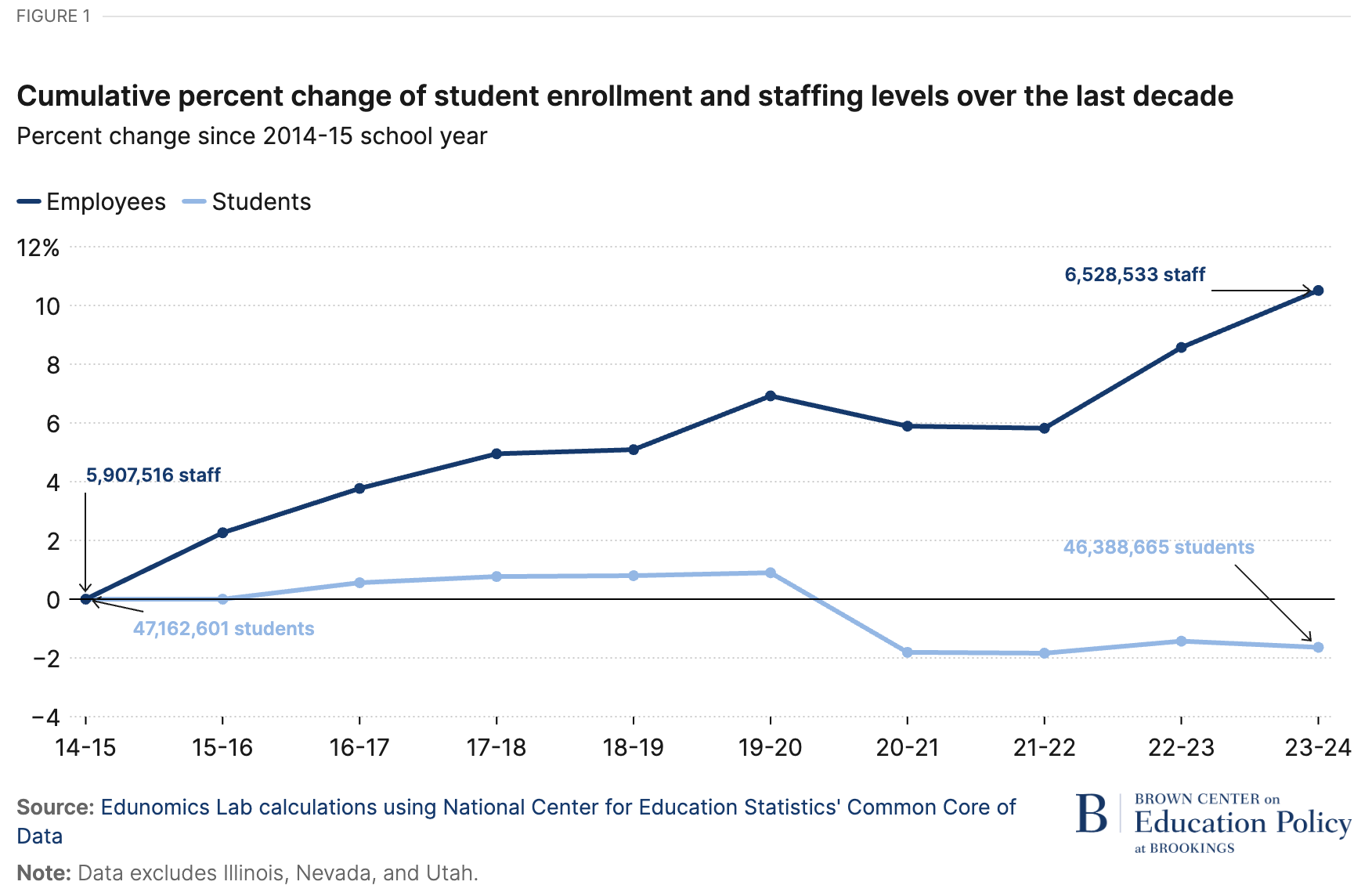
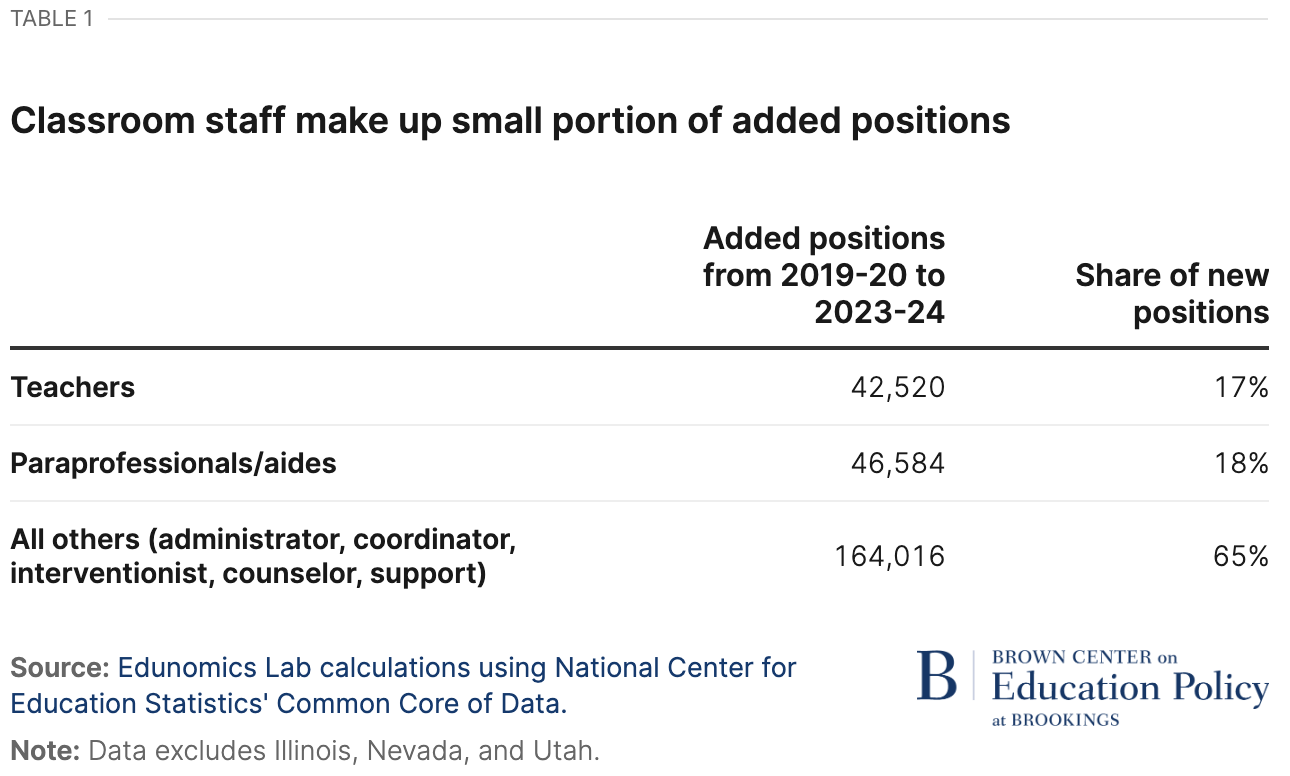
Conventional wisdom assumes more employees means better services for students, but the pace of the hiring bonanza warrants real concern. In our analysis of NCES staffing data, we find districts added well over 200,000 positions between 2019–20 and 2023–24, with very few of the newly added positions being in teaching roles (17 percent). Another 18 percent were aides. The remaining 65 percent of the added positions took on non-teaching roles of administrators, coordinators, counselors, interventionists, coaches, and student support staff (roughly evenly split between administrative and specialist roles). Many new roles undoubtedly involved a “promotion” from the existing teacher ranks, typically with higher pay (or more days of the current pay rate).

2

One worry is that these newly created non-teaching positions were filled by what had been some of the strongest teachers, and the replacement teachers aren’t as effective. The best math teacher got “promoted” to being a math coach. Filling the resulting teacher openings amidst teacher shortages (triggered in part by the mass hiring) meant pulling from deeper into a thinning applicant pool, potentially filling classrooms with weaker candidates (or worse, leaving unfilled roles covered by substitutes). As a result, many students spent their post-pandemic years in a classroom with a less effective teacher. If history is any guide, rapid hiring tends to lower the average teacher quality for the students who needed it most.

Could the addition of so many new administrators and specialists be beneficial enough that it more than offsets the reduction in teacher quality? Can’t the reading coach help the new teacher hire get a lot better? Now that the kids have a counselor to talk to, won’t that free up the teacher’s bandwidth?

Perhaps. But it’s unclear whether that theory holds up. With teacher effectiveness being such an important determinant of student outcomes, districts might have prioritized teacher quality over staffing quantity. For instance, districts could have paid the most effective teachers to take on more students, lead summer programs and intercessions, or work in the highest-need schools and classrooms.

Either way, now that ESSER is gone, districts are struggling to afford their larger, better-paid workforces. For some, the resulting budget reductions are leaving districts worse off in that they are depleting reserves, raising fees on students, or reducing days of schooling. Unpopular cuts anger parents and staff, and can consume leaders who may end up with less bandwidth to focus on learning.

The current budget cycle has districts trying to reduce their workforce via hiring freezes and layoffs. An open question is whether districts will shrink their administrator and specialist ranks, and if so, will those employees (formerly some of the stronger teachers) be exited from the system or return to the classroom? Average teacher quality hangs in the balance, especially where those employees had been some of the more effective teachers previously.

Where districts do resort to “seniority-based” layoffs (still in effect in many areas), disruptions will impact the highest-poverty schools the most.

It will be a few years before the dust settles and data can help clarify the magnitude of ESSER-triggered teacher quality effects. My guess is we’ll once again be reminded of what should be obvious: When it comes to staffing, quality matters more than quantity. Some students were worse off as a result of the ESSER-induced mass hiring. And some districts have been financially destabilized by the use of one-time money for permanent labor expenses.

As with most hangovers, the bigger question is whether we’ll ever learn.

Editor’s note: This was first published by the Brookings Institution.

view
Teenager doing homework on computer

Can targeted communications boost student participation in opt-in tutoring?

Jeff Murray
4.24.2025
Flypaper

Pandemic-era disruptions to education resulted in an unprecedented influx of federal funds to K–12 schools, some of which was used to address lost student learning. Summer school, one-to-one technology, academic enrichment, and virtual resources were among the myriad remedies deployed, but none was thought to hold more promise than tutoring. Studies indicate far less positive impact than hoped for from tutoring, particularly for those students who fell furthest behind. What happened? A new report from the journal Educational Researcher digs into one charter network’s implementation efforts and finds evidence that could explain the problem.

A trio of California-based researchers partnered with Aspire Public Schools, a large network of charter schools in the state with locations in the Bay Area, the Central Valley, and Los Angeles. At the start of the spring semester of 2021, all 7,000 Aspire middle and high school students received personal electronic devices and free access to an unnamed on-demand virtual tutoring platform covering content in core academic subjects. The service was available 24/7, but the research team doesn’t delve into details on when students used it other than to say they are aware of instances where it was incorporated into classroom time. In other words, this is not a study of embedded versus non-embedded tutoring.

The researchers examined student usage of the platform in that initial semester and tested the efficacy of targeted messaging to incentivize that use. To test the latter, they randomly assigned student households to a control group or to one of three treatment arms involving communications to students only, to parents only, or to both students and parents together. The researchers designed and disseminated the communication pieces using several different styles and tones; employing print (flyers and mailers), email, and text message; and utilizing various approaches such as reminders, appeals to social norms, accountability, and valuing of the academic subject. These were separate from whatever outreach individual schools or teachers were providing, which were received by all students and were not tracked as part of the experiment.

In the control group, only 19 percent of students ever accessed the platform during the semester and engaged in a tutoring session. Those control group students who did access it attended, on average, 4.3 tutoring sessions and exchanged 146.05 messages with a tutor. But the average control group student—when including those who never accessed the platform—participated in a mere 0.80 sessions and exchanged twenty-seven messages with a tutor via the platform. Ninth grade students and students with higher prior course performance were most likely to participate, and several individual schools clocked substantially higher take-up rates.

Did targeted messaging boost participation? Results varied depending on who received the communications, whether only the student, only the parent, or both parent and student. Students who only received messaging directly used the tutoring platform at about the same rate as their control group peers. Students whose parents received messaging were 5.7 percentage points more likely to access the tutoring platform than the control group. However, neither the number of sessions attended nor number of messages exchanged with tutors differed significantly from their control group peers. In other words, targeting parents alone seemed to induce a one-time sign-on but not students’ continued usage of the platform. The most effective communication approach engaged both student and parent. Such students were 8.6 percentage points more likely to use the platform. Additionally, they attended 1.4 sessions, on average, and exchanged 64.6 messages with tutors, both of which represent statistically significant increases over control group peers—even if those numbers are still very low.

The researchers make some effort to connect participation in tutoring with learning gains, but their outcomes are limited to course grades, and they therefore considered the small positive impact as merely “suggestive evidence.” There are no data provided on how much the charter network spent to implement this tutoring service, but whatever it was, the bang for that buck was clearly just a whimper. Despite the promise of tutoring, Aspire students reaped nearly no benefit from it—like many other students nationwide.

Ultimately, the researchers focus on the opt-in nature of the tutoring program as the primary reason for low overall usage and the fact that lower-performing students—those who need academic supports the most—were least likely to access it. “Helping the students who need it most will require a coordinated effort between educators and families to provide students with embedded, personalized learning opportunities,” they offer. Translation: Recovering lost learning can’t be optional, and all adults must be on board with requiring additional work to get it done. To which we could add, at five years and counting, time is quickly running out.

SOURCE: Carly D. Robinson, Biraj Bisht, and Susanna Loeb, “The Inequity of Opt-in Educational Resources and an Intervention to increase Equitable Access,” Educational Researcher (April 2025).

view

#966: Is calculus king? Rethinking math pathways, with Matt Giani

4.23.2025
Podcast
 

On this week’s Education Gadfly Show podcast, Matt Giani, professor and researcher at the University of Texas at Austin, joins Mike and David to discuss whether there’s a one-size-fits-all math pathway for students, as explored in Calculus or Statistics: Does It Matter?—a new study he coauthored for the Thomas B. Fordham Institute. Then, on the Research Minute, Amber shares a study that examines whether Indiana’s statewide private school voucher program has had any competitive effects on public school student outcomes.

Recommended content:

  • Matt Giani, Franchesca Lyra, and Adam Tyner. Calculus or Statistics: Does it Matter?, Thomas B. Fordham Institute (April 2025).
  • Heena Kuwayama and Adam Tyner. Advanced Math Pathways in New England, Thomas B. Fordham Institute (April 2025).
  • The National Working Group on Advanced Education, Building a Wider, More Diverse Pipeline of Advanced Learners, Thomas B. Fordham Institute (June, 2023).
  • Anna J. Egalite and Andrew D. Catt, Effects of the Indiana Choice Scholarship Program on Public School Students’ Achievement and Graduation Rates, Sage Journals (2025)

Feedback Welcome: Have ideas for improving our podcast? Send them to Stephanie Distler at [email protected]. 

view
Fordham Gadfly image

Cheers and Jeers: April 24, 2025

The Education Gadfly
4.24.2025
Flypaper

Cheers

  • Indiana passed a landmark property tax law that shifts hundreds of millions in school funding towards charter schools. —WFYI Indianapolis
  • New Jersey Democrats have a rare chance to lead on education by backing advanced coursework, rewarding great teachers, and expanding strong charter schools—bold, sensible reforms that are too important to ignore. —Matthew Yglesias, Slow Boring
  • This week North Dakota became the 47th state to legalize charter schools, prioritizing choice and high standards for parents, students, and families across the state. —KFYR-TV
  • The closure of ten underenrolled Denver public schools is nudging families and students into higher-performing schools, many of which are charters.  —Chalkbeat

Jeers

  • Due to recent cuts at the Centers for Disease Control and Prevention (CDC), the federal health agency denied a request to assist Milwaukee city schools in managing hazardous lead levels. —CNN
  • A Utah judge struck down the state’s new private school choice program as unconstitutional, relying on the state’s dubious Blaine Amendment. —K-12 Dive
view
Fordham Gadfly image

What we’re reading this week: April 24, 2025

The Education Gadfly
4.24.2025
Flypaper
  • Babies, toddlers, children, and teens are negatively impacted by parental device use; parents need to keep their own screen time to a minimum and put their phones down around their children. —The Dispatch
  • One Montgomery County parent argues that the current Supreme Court case over religious freedoms and LGBTQ-themed books could have been avoided with a little grace. —Megan K. Stack, The New York Times
  • The Supreme Court case concerning religious charter schools could split conservative justices—if some apply the doctrine of originalism. —Los Angeles Times
Fordham Logo

© 2026 The Thomas B. Fordham Institute
Privacy Policy
Usage Agreement

National

P.O. Box 110
Burke, VA 22009

202.223.5452

[email protected]

Ohio

P.O. Box 82291
Columbus, OH 43202

614.223.1580

[email protected]

Sponsorship

130 West Second Street, Suite 410
Dayton, Ohio 45402

937.227.3368

[email protected]