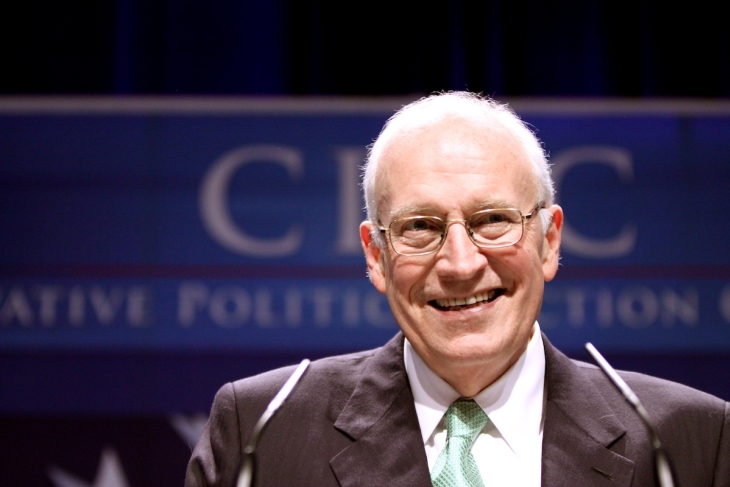
Dick Cheney passed away yesterday at the age of 84. As one of his domestic policy advisors during his time as Vice President, I was deeply saddened by the news; especially as I think about my own aging parents (my mom is 81 and my dad is 90).
I had the great fortune of serving in the Office of the Vice President during the first two years of the Bush–Cheney administration. My path to that role was equal parts luck and ambition. From the moment I moved to Washington, D.C., in the early ’90s, I dreamed of working at the White House. As an immigrant from Iran who didn’t become a doctor, lawyer, or engineer, nothing felt more like achieving the American Dream than serving there.
As an education reformer, I was especially drawn to the administration’s deep commitment to education, rooted in the “compassionate conservatism” of the time. Having worked on the Bush–Cheney transition, I first met Scooter Libby as he was assembling what became a small but mighty domestic policy team. Thanks to Cesar Conda, who led that team, I was invited to join.
At first, I wasn’t sure how my background in education policy would fit within Cheney’s portfolio. But I figured if an education policy guru like Jon Schnur could work for Vice President Gore, I could maintain my bona fides by working for Vice President Cheney while broadening my experience. I also appreciated Cheney’s deep understanding of the Middle East; an interest we shared, in my case as an Iranian American, and in his from his time at Halliburton.
The decision to join his team turned out to be one of the best of my career. Say what you will about his legacy, whether it’s his post-9/11 record or his recent endorsement of Kamala Harris, Dick Cheney stood by what he believed in. That’s a rare quality in public life today.
The role of the Vice President is a straightforward one: You do what the President asks. Education was very much President Bush’s domain, so opportunities to engage the Vice President (or his wife, who was deeply respected in education circles) were limited. Yet in our weekly domestic policy meetings, I found him to be highly engaged in understanding how No Child Left Behind, or NCLB (the first bill that was introduced in Congress), was doing. He had a dry wit (something that took me a while to get used to), and eventually, I discovered ways to engage him in the work.
One example stands out. Bill Hansen, then Deputy Secretary under Rod Paige at the Department of Education, once called asking if the Vice President might meet with the department’s senior team at Airlie Conference Center. I had no idea if Cheney would agree, but not only did he say yes, he seemed to genuinely enjoy it. We flew to Airlie Conference Center on Marine Two to talk with the team about the administration’s first 90 days and give the team a morale boost considering the news pieces at the time indicating that the White House was calling all the shots when it came to education policy (which is normal when a President makes a policy idea their priority).
Another part of my job was to help keep the conservative coalition, many of whom I knew from my time at the Heritage Foundation, aligned with the President’s NCLB goals. It was a challenging task, to say the least. Eventually, I asked the Vice President if he’d attend one of those meetings to lend his credibility. Again, his answer was a simple “yes.” Conservatives trusted him, and his presence made a real difference.
Of course, his role as President of the Senate was the most valuable. While 9/11 changed everything, Cheney’s long-standing relationships on Capitol Hill were critical as we worked to bring a very different approach to education into the Republican fold.
After 9/11, his focus naturally shifted to national security. I tried to contribute in a different way, helping in a war room designed to ensure that America’s actions in Afghanistan weren’t perceived by Muslim and Arab communities as a war against Islam. As a Muslim American who believed in coalition building, I felt called to that work. Eventually, though, I returned to my roots at the Department of Education.
Reading the vitriol directed at Cheney on social media now, even upon his death, I can’t help but wish his critics had met the man I knew. I didn’t agree with him on everything, but serving him was one of my greatest honors. Many reporters who once went after him (remember the energy task force?) now look back on him and that era with respect.
It’s hard, in hindsight, to give public leaders the grace they deserve when they’re making hard choices in real time. Leadership often means making quick decisions, staying the course, and remaining true to one’s core convictions. I’m not sure what his Vice Presidency would have looked like in today’s social media age, but I know this: For Dick Cheney, it was always about service to country—period.
Rest in peace, Mr. Vice President.