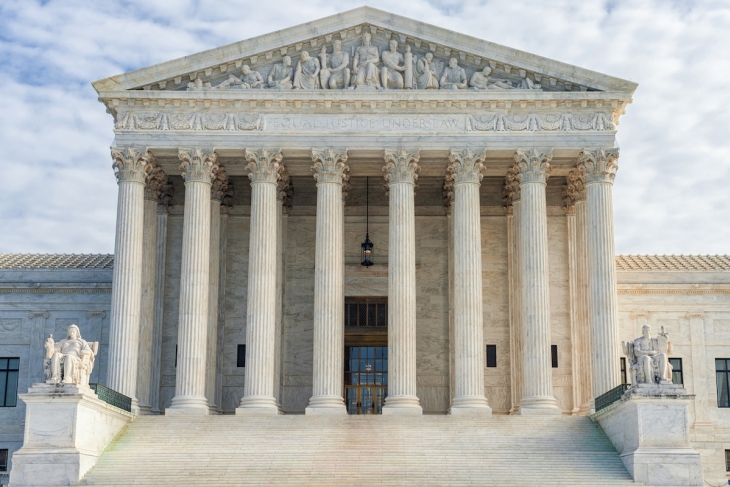
The last two weeks of April featured a rare doubleheader at the Supreme Court, as the justices took up two cases dealing with the intersection of religious liberty and public education. In both instances, plausible outcomes could thrust the courts ever deeper into the daily operation of U.S. schools, with attendant line-drawing, hair-splitting, and interference likely for decades to come.
But the Court has a way out of that thicket that would respect the secular nature of public schooling while guaranteeing parents’ their right of free expression. And that is to declare that states must find a way to provide taxpayer support for a pluralistic education system, one that funds religious schools in addition to the public schools—though not necessarily through the charter school mechanism.
This approach might sound like judicial overreach, but it is much preferable to the road we are otherwise heading down—one that will bring endless lawsuits about the rules surrounding charter schools, as well as litigation to determine when and how religious parents can opt their children out of lessons and programs that public schools mandate but that parents find objectionable. The latter issue was at play in last week’s case, Mahmoud v. Taylor. The particular question was whether the school district in Montgomery County, Maryland violated parent’s First Amendment rights by not letting them opt their children out of early-elementary lessons on LGBTQ themed storybooks—books that clearly carry messages at odds with their religious views.
That question is easy, though, compared to others that might follow, as Justice Ketanji Brown Jackson noted. For example, do parents of faith have the right to insist that their children not be assigned to gay teachers? To pull their high school students out of biology classes that discuss human evolution? Is it feasible, much less educationally advisable, to turn our public schools into an a la carte experience?
Imagine that last week’s case had been about Montgomery County, Ohio, instead of Montgomery County, Maryland. There, religious parents have the ability to send their children to private schools—including religious schools—at taxpayer expense, thanks to Ohio’s multi-faceted school-choice options. That’s not the case in Montgomery County, Maryland, where the district schools are the only taxpayer-funded options. (Someone might inform Justice Jackson, who asserted that religious parents could always opt for religious private schools instead of public ones, without acknowledging the burden of paying for tuition.)
For states with private school-choice programs, the courts could show more deference to public school districts, knowing that religious parents have the option of exiting those schools entirely, rather than on a lesson-by-lesson basis. And to do so with the support of government funding.
Such an approach would also be helpful when it comes to the issue at play in the other half of the double-header, this week’s St. Isidore of Seville v. Drummond. Here the question is whether the state of Oklahoma, and the 46 other states with charter school laws, are discriminating against nonprofit religious organizations by prohibiting them from applying to create and run public charter schools aligned with their faiths.
This case hinges on whether charter schools are “state actors,” i.e., public schools. If so, they clearly trigger the first Amendment’s Establishment Clause and cannot be religious. The contrary view is that charter schools should be considered private, in which case Oklahoma is indeed guilty of “rank discrimination,” as Justice Brett Kavanaugh put it, by not allowing religious entities to win contracts to run faith-based schools — in the same way that it would be unfair to disallow Catholic Charities from managing government-funded food banks or foster care services.
That may be so. Yet for the Court to mandate that states support religious charter schools against their will would be to create massive upheaval in the charter sector. After all, federal and state law and practice for thirty years have rested on the assertion that charter schools are, in fact, public schools, and therefore state actors. For example, they must accept all applicants and, if oversubscribed, use lotteries, not selective admissions, to determine who will attend. Could states require religious charter schools to abide by these same rules? Meaning that, for example, they would have to admit students and families who don’t adhere to their faith? What about LGBTQ children or families? (St. Isadore claims that it will accept everyone.) What’s more, a determination that charter schools are private may mean—especially in blue states—that they’ll no longer be eligible for state formula funding, putting their very existence at risk.
But here, too, the Court could take a wider view. It could rule that so long as states provide some vehicle to support religious education, they would not be required to do so through the charter school mechanism specifically. In the case of Saint Isidore, it could simply participate in Oklahoma’s existing tax credit scholarship initiative. Indeed, Justice Jackson wondered aloud about Oklahoma’s voucher program—perhaps an indication that she’s already seeing the big picture.
Mandating that states provide public support for religious schools might sound like a long shot. No doubt it would lead to massive bellyaching in blue states and from the usual suspects in teachers unions and the rest of the education blob. But beyond being a grand slam for kids and families, it might be the best way to avoid constant judicial micromanagement of our public schools for decades to come.