The school choice movement continues to rack up dramatic wins in states nationwide, with particular strength this year in the South. The most recent victories came in Georgia, where Governor Brian Kemp persuaded his legislature to create a program targeting students at the state’s worst-performing public schools, and in Alabama, where Governor Kay Ivey signed a bill to create education savings accounts worth up to $7,000 per child. Legislators in Mississippi, Tennessee, and Louisiana are all working on kindred bills that should get across the finish line within weeks. Meanwhile, Texas Governor Abbott took down several anti-school choice Republican lawmakers during Super Tuesday’s primaries, dramatically increasing the likelihood that the Lone Star State will soon pass a Texas-size private school choice plan. Add to that tally new programs enacted in recent years in Arizona, Iowa, and West Virginia, as well as expansions in Ohio, Indiana, and Florida.
No doubt, the growth of “educational freedom,” as many advocates now call it, is a fantastic development. We take consumer choice for granted in practically every aspect of American society except K–12 education. It’s long past time for schools to be subjected to the same competitive forces that almost every other organization in America. And in our huge, diverse society, it makes sense to embrace a pluralistic school system that allows families to find educational institutions that match both their values and their hopes and dreams for their children.
Under the surface of these victories, however, an important debate is brewing: how to balance the drive for educational freedom with other essential values, including fairness and fiscal responsibility. Simply put: Must the expansion of school choice result in windfalls for America’s wealthiest families, particularly those that already send their children to fancy private schools? Especially when that means blowing big holes in state budgets?
Back when a coalition of conservatives and Black liberals successfully pressed for America’s first school voucher program in Milwaukee in the early 1990s, the focus was on low-income students of color. Their argument was clear and morally compelling: We needed to level the field by allowing disadvantaged kids trapped in the then-atrocious Milwaukee Public Schools to access the city’s high-quality private schools, including Catholic and Lutheran ones. After all, as we used to say, “rich families already have school choice—it’s time that poor families do, too.” Similar (and similarly successful) arguments were made in Cleveland and Washington, D.C.
As the school choice movement matured, advocates pushed for ever-larger swathes of families to qualify for private school scholarships courtesy of taxpayers. It wasn’t hard to argue that working-class families should have these options, given that the tuition in most private schools, even less expensive ones like Catholic schools, was out of reach for them, too—or, at least, seriously oppressive to family budgets, possibly meaning that only one child could attend. But some advocates made the case that expanding eligibility to more and more families, regardless of their wealth, would help build long-lasting support for school choice. It’s no secret that affluent families have more political juice than poor folks. Many school choice supporters even adopted the adage, long embraced by progressive Democrats, that “a program for the poor is a poor program.”
Perhaps so, but the drive for “universal school choice” presents a fiscal challenge while also triggering a different sort of “fairness” dilemma. When school choice programs allow students to move from public to private schools, they generally save taxpayers money because the publicly-funded scholarships are worth less per pupil than what the public spends on public schools. But when the government starts to subsidize students already enrolled in private schools, it’s effectively a brand-new public expense. Those kids weren’t already attending school with taxpayer assistance. And with about 9 percent of students in most states attending private schools—and those children coming disproportionately from wealthy families—adding them to the public rolls can add up fast. Maybe bringing these families into the school choice coalition helps politically—but surely it also hurts for taxpayers to see millions of dollars flow to prosperous elites who don’t need the money.
Now for the good news: A handful of states have found a way to champion both educational freedom and fiscal conservatism. In Ohio, Governor Mike DeWine and his Republican legislative allies dramatically expanded school choice in the Buckeye State last summer, making all families eligible for scholarships—i.e., universal school choice. However, they also adopted a sliding scale to link scholarship amounts to family incomes. Those making up to about $135,000 for a family of four receive the full scholarship amounts (between about $6,000 and $8,500 per student, depending on grade level). Above that level, scholarships are gradually reduced, up to incomes around $235,000. Families earning more than that may still receive scholarships, but they are much smaller—about $600 for an elementary student.
Figure 1: Ohio EdChoice scholarship amounts (grades K–8) for a family of four, by household income
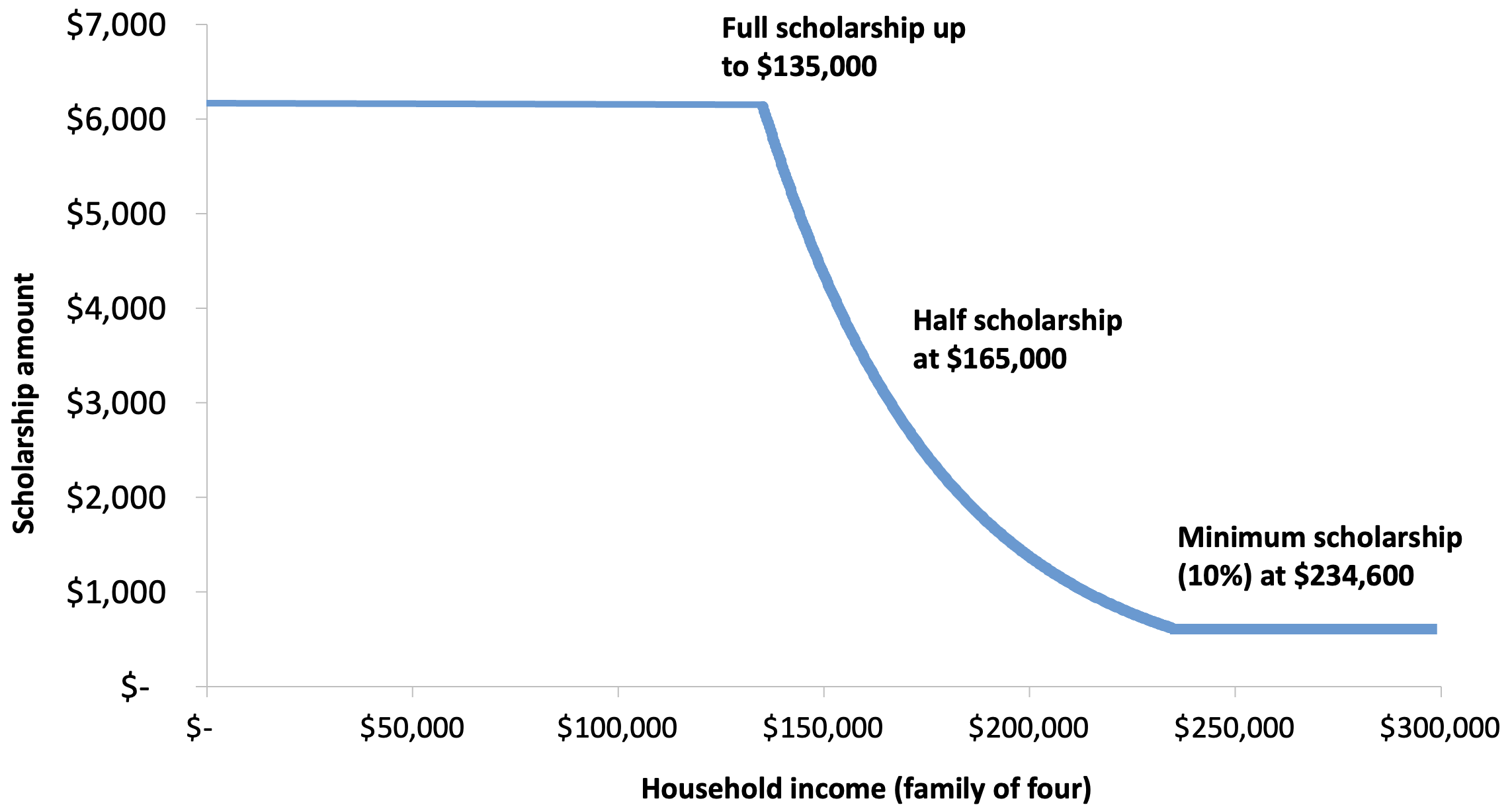
Note: This figure is based on projections by the Ohio Legislative Service Commission that the full scholarship amount for grades K–8 will be $6,165. Though not displayed, the sliding scale works similarly in high school.
By sharply reducing scholarship amounts for the most affluent families, Ohio policymakers saved taxpayers a ton. That’s because the richest families in Ohio, as elsewhere, are the ones most likely to already have their kids in private schools, paying tuition out of their own pockets. Adding all of those students to the state’s balance sheet, at full freight, would be a sizable expense.
My colleague Aaron Churchill has calculated that, by instituting a sliding scale and limiting the wealthiest families to partial scholarships (rather than providing full scholarships to everyone), Ohio lawmakers saved the state about $300 million—this on a $440 million program. In other words, a universal school choice program without a sliding scale leading to partial scholarships would have been about 68 percent more expensive.
Oklahoma also uses a sliding scale for its private school choice program, and the pending bill in Louisiana would do the same. Other states should follow suit. Conservative lawmakers can still move toward universal school choice, but by using a sliding scale, they can avoid blowing big holes in state budgets, while also fending off the charge that they’re giving juicy windfalls to the rich, replacing private tuition dollars, with public and introducing a new sort of unfairness.
By all means, conservatives, keep fighting for school choice. But don’t give up on fiscal responsibility while you do it.