When President Donald Trump stopped by a Cleveland charter school in September, he promised to “establish the national goal of providing school choice to every American child living in poverty.” Although he initially pitched the idea of a $20 billion school choice program, the details on how that would work—and what other policy changes he might pursue—were a bit murky.
Trump’s nomination of school choice supporter Betsy DeVos for education secretary affirmed his commitment to expanding school choice, but the nomination also brought a bit more clarity to Trump’s agenda (or at least made it easier to speculate). DeVos has a widely cited history with vouchers, and the media immediately zeroed in on the possibility that the new administration would champion not just public charter schools, but private school choice as well.
As the saying goes, there’s more than one way to skin a cat—and there are plenty of ways that the new administration could push for private school choice. On Wednesday, the Thomas B. Fordham Institute and the Hoover Institution hosted an event aimed at exploring three specific options: a new competitive grant program, Title I portability, and revisions to the tax code.
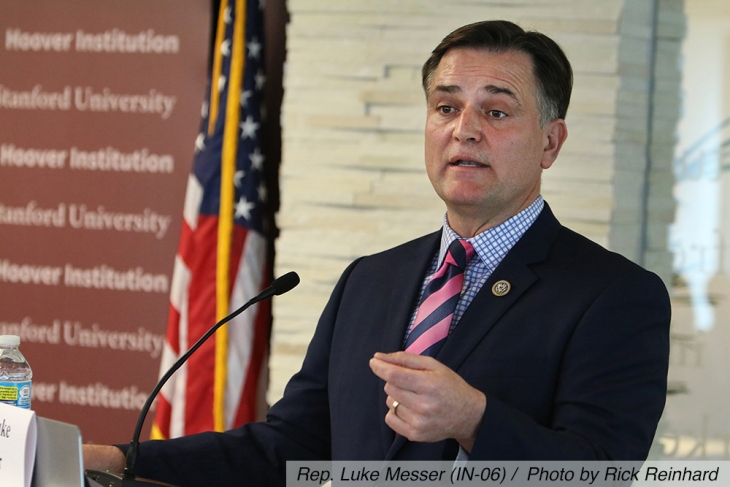
Representative Luke Messer, congressman for Indiana’s sixth congressional district and a longtime advocate for school choice, opened the event by describing the background and context behind the new possibilities. He explained that although personal experience has proven the American dream to be possible for him, things don’t work out that way for everyone. “For the first time in my lifetime,” he said, “we have Americans who are starting to doubt” that hard work leads to prosperity.
According to the congressman, this looming doubt doesn’t mean all hope is lost. The 2016 election brought in not only a “new cavalry” of leaders, but also an opportunity for the federal government to get involved in school choice “in a big, robust way.” To achieve maximum impact, Messer outlined three values for the new administration to live by: dreaming big, emphasizing the practicality of school choice, and standing firm on “the moral case for choice.”

(Panelists from left to right: Virginia Gentles, Joanne Weiss, Andy Smarick, and McKenzie Snow / Photo by Rick Reinhard)
Joining Representative Messer at the event was a panel of experts from a variety of education policy backgrounds. Before diving into the three options, the panelists discussed their concerns about the federal government championing private school choice. Is it even a good idea for Uncle Sam to get involved? Joanne Weiss, who oversaw the federal Race to the Top program as a senior Obama Administration official, noted her concern that school choice could end up like other bipartisan efforts that transformed into partisan issues because of the federal government’s involvement. “So much of choice is freedom from government regulation,” she explained. “So I’m worried about what happens if the government leans into it. Incredible vigilance and restraint and humility are going to be required.” The rest of the panelists seemed to agree.

(Andy Smarick / by Rick Reinhard)
Then event moderator, and Fordham Institute president, Mike Petrilli steered the conversation to the three options at hand, starting with a new competitive program to promote school choice. Andy Smarick, the current president of the Maryland State Board of Education and a fellow at the American Enterprise Institute, referenced the federal charter school grant program as evidence that Uncle Sam could successfully manage a choice-related grant competition without micromanaging. He pointed out that the federal charter school grant program has a twenty year history in which it has funded more than four thousand schools. Despite this influence, “no one would say that the federal government has done a hostile takeover of charter schooling,” he argued. How was it possible? According to Smarick, it’s all about having “the right mindset from the start.” Because the federal government deferred to state policy and only supplied small start-up grants to charters in states that had freely chosen to allow them, the program produced outsized benefits with minimal federal intrusion. The key to making sure the feds practice this kind of restraint in the future is what Smarick calls the Lamar Alexander answer: “We know what the Department of Education will do,” Smarick said. “So we’ll write it into statute that you can’t do that.”

(Joanne Weiss / by Rick Reinhard)
Weiss offered additional insight into why a grant program could be the best approach. Competitions, she explained, are “good vehicles for changing the status quo” because they incentivize innovation and creativity. They’re also voluntary: “Only those with the interest and political will and local support apply,” she said. “And that increases the chances for implementation success.”
Next the panel explored Title I portability. McKenzie Snow, a policy analyst from the Foundation for Excellence in Education, pointed out that Title I has become nothing more than a compliance exercise—despite being a $16 billion federal funding program, it’s had no meaningful impact on achievement. One way to potentially increase outcomes would be to allow states to permit education dollars to follow low-income children if they switch schools, even if their chosen school is a private one. Snow was careful to clarify that if this was the case, funds wouldn’t actually flow to private schools—instead, they would be deposited into parent accounts to be spent directly on education costs.
While many argue that Title I portability is too complicated to implement, Snow argued that there are plenty of creative solutions. It starts, she said, with shifting Title I eligibility so that the poorest students—not just those who are academically struggling—receive funds. As for potential problems with disbursing funds, Snow pointed to the structure of Nevada’s ESA program as a potential solution.
Although a new grant program and Title I portability are fascinating, appealing prospects, Petrilli pointed out that the final option, a change in the federal tax code, could be the easiest to get through congress.

(Virginia Gentles / by Rick Reinhard)
Virginia Gentles, senior policy adviser at the American Federation for Children, offered two possibilities, both of which center on changes that are meant “to complement what’s going on at the state level.” The first is to alter 529 plans so that they can be used for K–12 education costs. In its current form, a 529 plan allows parents to deposit money into a college savings account where funds grow and can be withdrawn tax free. Expanding 529 plans to include K–12 schooling already has support in Congress—but might not help many low-income students.
The second option is to create a federal tax credit for individuals or corporations who contribute to scholarship granting organizations. These types of programs already exist in seventeen states, and like 529 plans, there are already proposals floating around Washington to add a federal tax credit. Although both options are promising, the common theme of restraining federal influence reemerged: Gentles was clear that participating private schools and scholarship-granting organizations shouldn’t be forced to comply with a host of new regulations.
Despite varying ideas and solutions, the panelists could all agree on one thing: The Trump team is serious about making good on its school-choice promise. This is not a debate that is likely to go quietly into the night.