
In early 2025, the National Center for Education Statistics (NCES) was largely dismantled. The Trump administration, acting through the Elon Musk–led Department of Government Efficiency (DOGE), cut NCES’s federal staff from 103 employees to three, removed its commissioner, and canceled roughly three-quarters of its contracts. This disrupted or halted much of its important statistical work. That is a problem that must be remedied. The question is how. A new report from the American Statistical Association (ASA) argues that the answer is not to recreate what was dismantled, but to build a new and better agency.
Written by Shelly Wilkie Martinez and Stephen Provasnik, A Vision and Strategy for Remaking the National Center for Education Statistics is a starting point. And to that end, the ASA is seeking public feedback as it moves into a second phase, expected to commence in 2027, that will refine the vision and develop a fuller roadmap for rebuilding NCES.
The report begins from two propositions that are sometimes—mistakenly—treated as contradictory.
The first is that NCES performs an indispensable national function. States, school districts, colleges, researchers, policymakers, and families need objective, trustworthy statistics to understand what is happening in American education, make comparisons, and track changes. No collection of states, universities, think tanks, or private companies can sufficiently accomplish this.
The second proposition holds that the pre-2025 NCES wasn’t working well enough. The report argues that the agency was constrained for years by insufficient internal capacity, slow and inaccessible products, fragmented data systems, and difficulty keeping pace with changing information needs. Simply recreating that version of the agency would restore many of those same weaknesses.
The ASA’s proposed solution—rebuild rather than recreate—has a useful historical precedent. Forty years ago, NCES faced a different kind of crisis, and Washington rejected the status quo and made it better by asking what America’s education statistics agency should look like. Today’s situation presents the same opportunity.
In 1986, a National Academy of Sciences report delivered a scathing judgment of NCES as it then was. Creating a Center for Education Statistics: A Time for Action identified serious problems with the agency’s capacity, statistical standards, timeliness, and ability to meet the nation’s information needs.
Its message to the powers that be boiled down to this: Undertake fundamental reform or consider eliminating the center. NCES survived. More important, it improved.
I saw part of that rebuilding firsthand. From 1985 to 1988, Chester E. Finn, Jr. served as the U.S. Assistant Education Secretary responsible for the Office of Educational Research and Improvement, or OERI, where NCES was housed. I served as OERI’s chief of staff. The late Emerson Elliott, who led NCES during this period and later became its first presidentially appointed commissioner, was the career federal civil servant at the center of the effort to turn the agency around. The rebuilding involved multiple actors from outside the federal government and across the legislative and executive branches.
The goal was not to defend everything NCES had been doing. It was to make the agency worthy of the mission it had been given. That history matters now more than ever, given what DOGE did to it last year.
The NCES crisis of 1986 was different from today’s. The agency had not just undergone an abrupt and massive reduction in force, as happened under DOGE. Rather, years of declining capacity and organizational weakness had left it struggling to carry out its responsibilities.
The National Academies panel identified shortcomings involving data quality, timeliness, statistical standards, staffing, contracting, dissemination, and responsiveness to users. It questioned whether NCES had the capacity and institutional commitment necessary to function as the nation’s education statistical agency.
The political setting is worth remembering. This was the Reagan era. President Reagan had come to office seeking to abolish the newly created Education Department, but the national report A Nation at Risk had helped make school reform a national concern. And the statistical function at issue was much older than the department itself. Collecting and disseminating information on the condition of American education had been a federal responsibility since the original education agency was created in 1867.
Washington could have responded defensively by protecting the agency, rejecting the criticism, and asking for more money. It could have responded destructively by declaring NCES a failure and eliminating it.
Instead, policymakers largely chose a third course. They rebuilt it.
Finn later recalled that he and Education Secretary William Bennett agreed that NCES needed “tuning up, speeding up, and beefing up.” NCES also became a budget priority within OERI. Whenever additional OERI resources became available, NCES tended to get them, even when that frustrated other OERI units. Bennett fully supported that approach. With Emerson Elliott leading the center, OERI also pressed for faster, clearer data.
NCES hired a chief statistician, developed written statistical standards, sought more systematic advice from researchers and data users, expanded and upgraded its data collections, and worked to improve the timeliness and usefulness of its publications. The Education Department pressed for faster dissemination, while Congress strengthened the agency’s status and its capacity to cooperate with states.
The changes worked. By 1992, a follow-up National Academies review found that NCES had upgraded or replaced several data collections, added new data series, and sought outside statistical advice. Its budget tripled between 1987 and 1991. More important, the review reported “nearly unanimous agreement” among researchers, professional associations, and congressional analysts that NCES data and reporting had markedly improved.
The turnaround was visible outside the agency as well. In 1992, Education Week reported that Congress had given NCES a “ringing vote of confidence,” pointing to a 33 percent House-approved budget increase and Elliott’s confirmation as the first presidentially appointed commissioner of education statistics.
The turnaround endured. Decades later, NCES Commissioner Peggy Carr described the 1986 report as having “initiated NCES’s modernization and ushered in new levels of professionalism and productivity.” By then, NCES had become a trusted, professionally independent source of federal education statistics.
That experience offers both reassurance and warning. Federal institutions can recover from serious failure. But successful recovery requires more than putting back what was lost.
Some similarities between 1986 and 2026 are striking. But the differences may be even more important. Here is a table I’ve created (with the assistance of ChatGPT) suggesting some of the major differences.
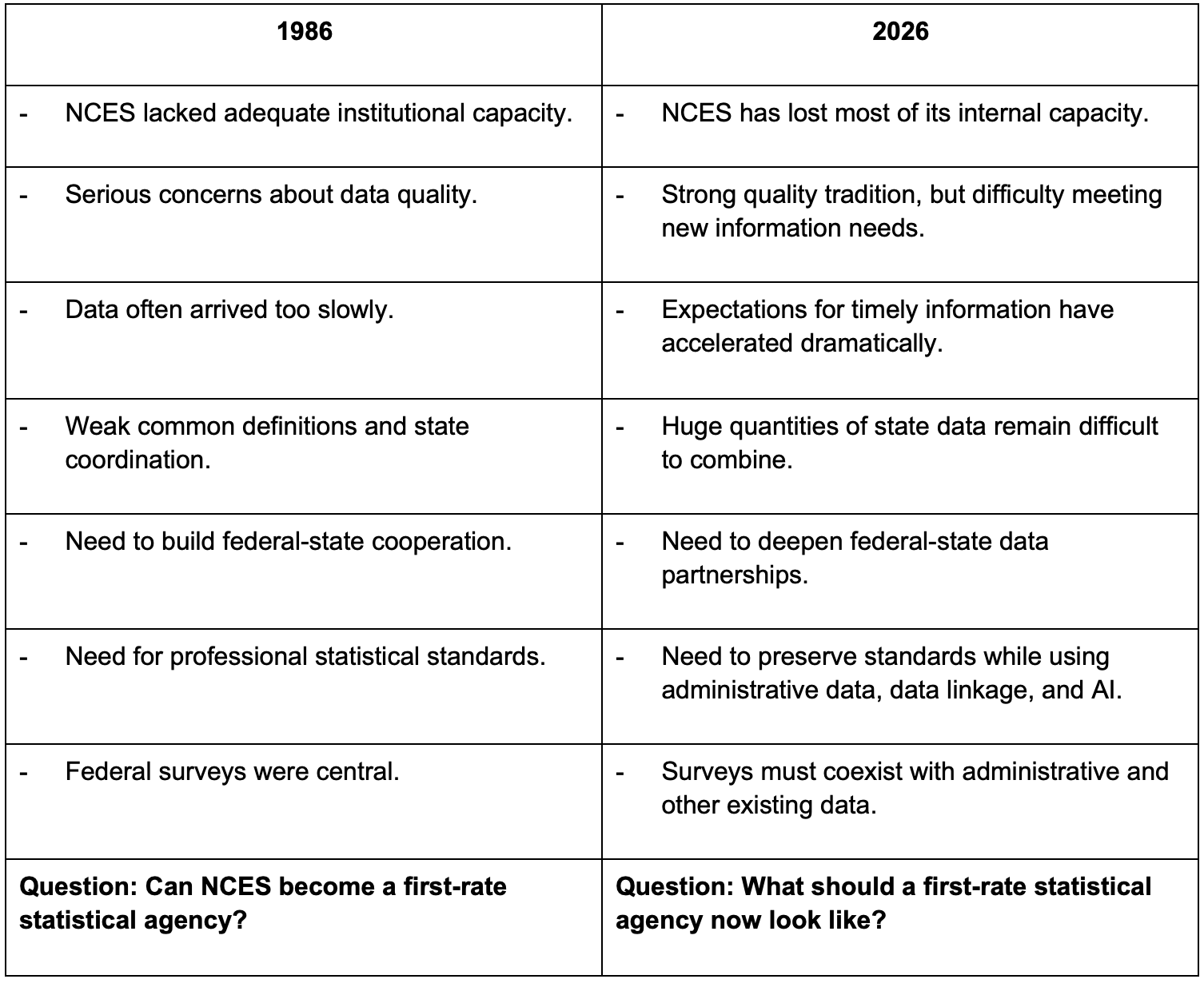
The last distinction in the form of a question is the most important. In 1986, the question was whether NCES could become the statistical institution the country needed.
In 2026, we already know that it can. It did. The question now is whether the institution that emerged from that earlier rebuilding is suited to a radically different information environment.
It would be a mistake to tell this story as though everything at NCES was working until the 2025 cuts. Problems were evident earlier.
In 2022, another National Academies report, A Vision and Roadmap for Education Statistics, called for NCES to develop a bolder strategic approach and make better use of administrative records, new technologies, partnerships, and emerging sources of information. Carr herself called that report an ambitious successor to the 1986 study and said it could guide NCES into the future.
Another important call for change came from inside the Trump administration itself. In May 2025, Education Secretary Linda McMahon brought Amber Northern, then on leave from the Thomas B. Fordham Institute, into the department as a senior adviser charged with reimagining the Institute of Education Sciences, of which NCES is a part. McMahon said that even as the administration sought to “return education to the states,” educators still needed accurate data to make good decisions.
Northern described her assignment as looking at IES “with fresh eyes” and working with the education community on its rebuild. Her February 2026 report, Reimagining the Institute of Education Sciences: A Strategy for Relevance and Renewal, combines a critique of the old operation with a defense of NCES’s essential functions.
Northern’s report, like the ASA’s, views national statistics as indispensable and says NCES’s core collections and the National Assessment of Educational Progress (NAEP, the “Nation’s Report Card”) should be preserved and strengthened. It also calls for overhauling the agency’s many data collection efforts, arguing that some of them overlap, contain outdated questions, or no longer justify their cost.
Northern proposes making NCES’s data easier to use through the use of modern technology, as well as connecting education information more effectively with data held by the Departments of Labor, Health and Human Services, Commerce, and other agencies. The goal, her report says, should include better understanding the nation’s “education-to-employment ecosystem.”
There is considerable overlap here with the National Academies report and what the ASA now proposes. They all differ in diagnosis, emphasis, and proposed remedies. But at a high level, they share the two aforementioned propositions: The federal government still needs a credible national education-statistics capacity, and simply recreating the pre-2025 system would miss an opportunity for modernization.
The most interesting proposal in the ASA report is a call for NCES to move from what the authors describe as a “survey-centric” model toward a “curation-centric” one. For much of its history, the agency approached an information problem by asking what data the federal government needed to collect. It then designed a survey, gathered the information, checked it, and published the results.
Today, however, enormous amounts of potentially useful information already exist in state longitudinal data systems, school district records, and other federal agencies. So a modern NCES should increasingly begin with a different question: What reliable information already exists, and how can we make it useful? That means helping establish common definitions and quality standards, strengthening states’ data capacity, linking information across different systems, protecting students’ privacy, and supplementing existing information with federal surveys when needed.
NCES would, in other words, remain a producer of statistics, but it would become something else, as well.
For decades, federal education statistics have helped answer fundamental questions: Who attends school? Who graduates? How much do schools spend? What do students know? We still need those answers.
But another reason to expand NCES’s role, according to the ASA report, is that families and policymakers increasingly want to know what happens next. Where do different credentials and pathways lead? What do students typically earn afterward? What becomes of students who leave college without earning a degree?
Answers to those questions frequently require connecting education data to other information such as workforce participation and employee earnings. That’s a harder technical and institutional task than simply compiling data, and one that places NCES at the intersection of the nation’s education-data systems and its broader federal statistical infrastructure. The National Academies panel also calls for NCES to take on this integrative role.
The experience of the first rebuilding 40 years ago and the demands of the current one suggest five principles.
First, rebuild expertise, not simply headcount. NCES needs enough statisticians, survey experts, data scientists, and other professionals to effectively oversee its work. Contractors will remain important, but government must possess the expertise to direct them rather than outsource too much of its institutional capacity.
Second, protect professional independence. Education statistics have value only if governors, educators, researchers, Republicans, Democrats, and the public trust that political officials cannot dictate what the numbers say. The first rebuilding strengthened NCES partly by strengthening its identity as a professional statistical agency. Today’s rebuild must do the same. Congress also should examine whether NCES needs a stronger external governance structure. NAEP, arguably the crown jewel of NCES, already has an independent, nonpartisan governing board that sets policy while NCES administers the assessment. A comparable arrangement for some or all of NCES could be one way to reinforce statistical integrity and professional independence across administrations.
Third, treat states as partners, not simply data suppliers. Much of the information a 21st-century NCES needs originates in state and local systems. Washington should help make those systems stronger and their information more comparable while respecting the federal structure of American education.
Fourth, make timeliness and accessibility part of quality. A statistic can be methodologically sound and still have limited value if it arrives years after people need it. The challenge is becoming faster without sacrificing rigor.
Fifth, connect education to opportunity. The nation needs to know not only what happens inside schools and colleges but how education connects to employment, earnings, mobility, and adult life.
None of this exonerates the Trump administration’s decision to dismantle NCES in 2025. Rebuilding the agency will require restoring expertise, capacity, and institutional protections. But that restoration should be the starting point, not the goal.
Forty years ago, I watched Washington confront an education statistics agency that clearly needed help. Finn, Elliott, their colleagues, many career employees inside OERI and NCES, and congressional staff responded by asking what America needed the institution to do. And then they set about creating an agency that did just that. Today’s circumstances may be different, but the principle isn’t.
Beltway arguments about federal agencies too often leave us with two choices: Defend the bureaucracy or destroy it. The history of NCES suggests there’s a third option: Rebuild it, this time for the next 40 years.