Recent events—some near, some far—have made me wonder whether traditional public schools should be seen as part of the government or as civil society institutions—Hobbesian Leviathans or Burkean “little platoons”?
As an education reformer, my impulse is to bemoan the impersonal, bureaucratic, sclerotic nature of the American education system, especially the traditional, district-operated K–12 version that remains dominant today. Nobody who has spent time around local, state, or federal education policy could deny the Kafkaesque nature of the myriad, overlapping, and often non-sensical rules—many of them embedded in teachers union contracts—that govern the daily lives of educators and thus the educational experience of their pupils.
As a supporter of school choice, I’m eager to see school district monopolies face competition from charter and private schools—non-profit entities that surely qualify as exemplars of civil society in action, sitting as they do between the public sector and the private sphere of home and family.
But I’m finding it harder these days to argue that traditional public schools aren’t also civil society institutions.
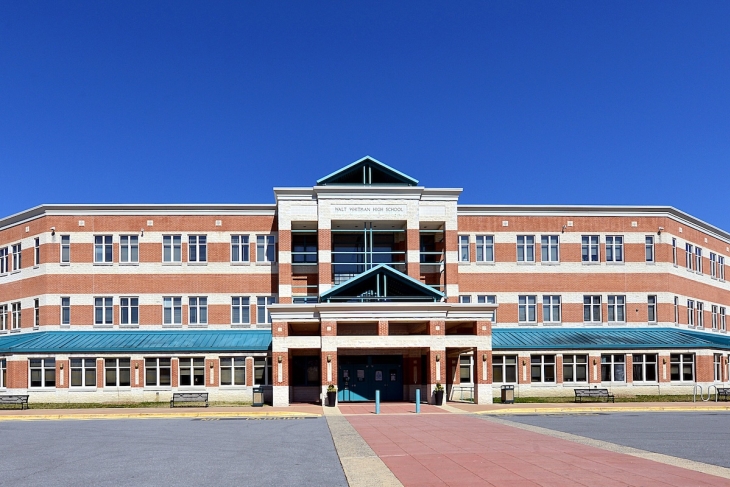
Let’s start with the school closest to me, Walt Whitman High School in Bethesda, Maryland, and in particular with its principal, Greg Miller. (My two sons attend the school; Whitman is part of the Montgomery County Public Schools or MCPS.)
Mr. Miller is in his second year in this role, after serving as assistant principal for four years before that. And he has had quite a start to 2026.
First, someone spray-painted an Islamophobic statement on the side of the school.
Then a group of underclassmen were frog-marched out of a vacant house, in handcuffs, literally across the street from the school, with hundreds of students watching from inside the atrium, after the teens were busted for trespassing and doing drugs, all during lunchtime.
Next, a math teacher (and coach of the wrestling team) watched his house burn down due to a faulty battery in the garage, with the school community rallying to support him and his family.
Finally, a junior on the girls’ wrestling team died suddenly a few days later.
Through this string of challenges and tragedies, there was Mr. Miller—writing to parents, consoling students, coordinating responses, even speaking at the girl’s funeral.
Along the way, I’m sure he also did his “day job.” But after all this, it’s hard for me to see him as a “government bureaucrat.” No, he’s more like the mayor of a small town. He’s a community leader—like a minister or rabbi. And I’m sure he’s not the only public school principal worthy of the moniker.
This is further reason to reject the temptation to call public schools “government schools.” Walt Whitman doesn’t feel like part of the government to me, especially not now. It’s part of the community.
I’m hardly the first to notice this. Almost a decade ago, Andy Smarick wrote in National Affairs that:
…although some conservatives derisively refer to the district system of “government schools,” this veils the vast array of civil-society activity associated with these state bodies. Though their schools are publicly governed, regulated, and funded, districts are intertwined with countless voluntary associations, including PTAs, booster clubs, alumni associations, service organizations, sports teams, bands, tutoring groups, and much more. These district schools host community plays in their auditoriums, craft fairs in their cafeterias, junior sports leagues on their fields, and so on. The government is undeniably a part of this landscape, but the web of involved civil-society actors isn’t merely scenic; it’s indispensable to the health of the ecosystem.
Civil society in Minneapolis
I’m also thinking about public schools as civil society because of what has been happening in Minnesota. I’ve been moved by what I’ve learned, not so much about the protests and the so-called “resistance” (though much of that is inspiring, too), but about the acts of community action that have sprung up to assist affected families—neighbors helping neighbors in their time of need. And guess which institution was often in the middle of it? The public schools. Here’s how the Washington Post described it:
Over the weeks, Columbia Academy, like the district’s four other schools, had taken on an entirely new identity. It was still a place of learning, even if 210 of its 700 students were now studying at home. But now it was also a food bank, a counseling hotline, a missing persons task force, an immigration resource center and a refuge.
“We are the first call,” said Sherk, a first-year principal who has worked in the district for two decades. “They don’t call the police. They don’t even sometimes call their neighbors or different organizations. They call the school.”
Notably, it tended to be small school districts and charter schools that were the heart of the action. Friends tell me that the Minneapolis Public Schools—a large, lumbering bureaucracy—was much less responsive.
Maybe this can teach us something, too. Maybe public-school systems—especially the large ones in big cities, like Minneapolis, or the huge countywide ones like MCPS—can rightly be thought of as “the government.” But individual public schools themselves may be some of the strongest civil society institutions we’ve got left.
So, call them government school systems if you must. But please don’t call my local public school a “government school.” It is part of the community, and it and its peers are worth celebrating, conserving, and cherishing, now and for years to come.