
Going into this year’s state budget debates, the biggest question in K–12 education was how lawmakers would handle school funding. Ohio has been implementing the Cupp-Patterson school funding formula since FY22. While it has garnered praise from the establishment, its inputs-driven approach has produced expensive funding prescriptions, resulting in a messy formula “phase-in” over the past four years and concerns about its long-term sustainability. Other structural flaws, such as the persistent use of inflated economically disadvantaged rates and guarantees for districts with declining enrollment, have also blemished the plan.
With the budget process speeding to the finish line, we now have three funding plans on the table. In his budget, Governor DeWine fully phased-in Cupp-Patterson, but also proposed to scale back its guarantees and—likely in a cost-conscious move—declined to update the formula “inputs” (e.g., educator salaries and benefits) that have risen significantly in recent years. In a clearer break from Cupp-Patterson, the House essentially froze the formula and put forward a “bridge” plan that would fund the vast majority of districts through a massive guarantee.
This week, the Senate unveiled its school funding proposal. The upper chamber adhered more closely to the governor’s approach—preserving the basic outline of Cupp-Patterson—but with substantive modifications. In a nutshell, it:
- Fully phases-in the increased base per-pupil funding called for under Cupp-Patterson (same as governor);
- Constrains formula costs by declining to update the inputs (same as governor);
- Removes a smallish guarantee that provides excess funds outside of the formula to a handful of districts (i.e., supplemental targeted assistance, which presently costs the state about $50 million per year).
- However, unlike the governor’s bolder approach to dialing back guarantees, the Senate fully maintains the largest and most expensive guarantees (i.e., temporary transitional aid and formula transition supplement, which together cost the state roughly $300 million this year);
- Phases-in a revised funding element intended to support low-income students;
- Introduces a new performance-based component.
Now to the details…
Overall funding levels
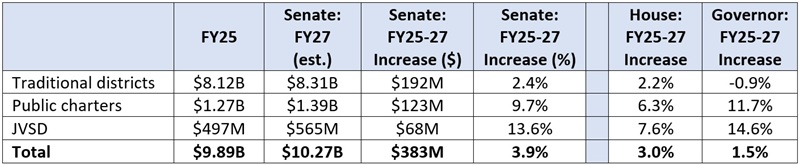
The Senate plan is the most generous of the three proposals, with state foundation aid for public schools increasing by $383 million from FY25 to FY27 (up 3.9 percent). Traditional districts—despite having lost significant enrollments in recent years—receive an average funding bump of 2.4 percent, the highest among the plans. Meanwhile, public charter school and joint-vocational school district (JVSD) funding rises by 9.7 and 13.6 percent respectively under the Senate plan. The increases for these growing sectors clock-in below the governor’s proposal, but above the House plan. For charters, the decline relative to the governor’s plan likely reflects a proposed reduction to their equity supplement—a disappointing move that will be covered in more detail in a forthcoming piece on charter-specific issues.
Table 1: State foundation funding under the Senate plan
Beyond total amounts, the Senate proposes a few structural changes. The most notable relate to funding for low-income students, guarantees, and performance-based funding.
Disadvantaged pupil impact aid (DPIA)
DPIA is a critical element of the formula. Its goal is to drive additional state aid to schools serving the most low-income students. The funding stream, however, has become a hot mess due to increasingly inaccurate data on “economically disadvantaged” students, as universal federal meals eligibility—the current method to identify poor students—has expanded rapidly across Ohio. Instead of targeting funds to the neediest students, the state has been misallocating DPIA due to large-scale over-identification. Inflated headcounts have led to ill-gotten windfalls for many mixed-income districts, while at the same time reducing DPIA for truly high-poverty schools.
The Senate plan takes commendable steps forward in fixing DPIA. In FY26, the state would calculate a composite “economically disadvantaged” enrollment, which is 75 percent based on the current (but flawed) meals-driven headcount, and 25 percent based on more accurate “direct certification” headcount, a method that identifies low-income students based on other means-tested programs like SNAP or Medicaid. In FY27, the split would be 65 percent meals-based and 35 percent direct certified. This composite enrollment measure would then drive DPIA to schools.
This is a good start, but it still allows bad data to deliver the majority of DPIA. A more aggressive phase-out would create a 50/50 enrollment split in FY26 and move to full direct certification in FY27. The Senate also did not increase the base DPIA amount (presently $422 per economically disadvantaged pupil). As the bill is finalized, lawmakers should strongly consider increasing the DPIA base. This would compensate for the lower, but more accurate, direct certification rates while also concentrating more dollars on low-income students.
Guarantees
One of the most-discussed issues this year has been guarantees. The conversation started with Governor DeWine coming out strong against continuing to fund “empty desks,” which is what guarantees do when districts with declining enrollments receive these non-formula subsidies. In his budget outline, he ratcheted back the guarantee bases—the historical funding benchmarks under which current state aid cannot fall. The lower bases result in a quicker sunsetting of the guarantee and fewer districts covered by them.
Unfortunately, the Senate did not follow the governor’s lead on guarantee-base reductions. The heftier guarantees premised on FY20 and FY21 state funding levels—with generally higher enrollment data from those years baked in—remain fully intact under its plan. The chamber, however, did remove a smallish guarantee-like element known as “supplemental targeted assistance.” And thankfully, it didn’t go the direction of the House and implement a huge guarantee based on FY25 funding. In LSC funding projections, the Senate plan would entail some modest cuts in more than 100 districts’ state funding (relative to current amounts), though the reductions are not nearly as steep as what the governor has proposed.
Performance-based funding
The Senate funding plan provides additional funds to districts (though not charters or JVSDs) that achieve one of the following: (1) four-or five-star Overall state ratings; (2) three-star and above ratings on the Progress dimension; or (3) increased Progress rating by one or more stars compared to the year prior. Districts receive an additional $26 per pupil times the number of stars they receive on the Overall or Progress dimension, whichever is higher. For example, a district that earns five stars Overall would receive $130 per pupil in performance funding.
At face value, the idea of performance-based funding linked to state ratings has merit. But the way the Senate designed the proposal is flawed. Here’s why:
1) The funds (for both years of the biennium) are awarded based on 2023-24 ratings. The problem here is that districts already know whether they will qualify for these funds. That means the dollars provide zero incentive for districts to improve. Why work any harder for students if the results are already on the books? A performance-based system must be based on prospective ratings to be an effective motivator.
2) The rating criteria are far too lax. Roughly 400 districts—about two in three—met the Overall or Progress rating criteria in 2023–24. When a large majority of districts are eligible, the element isn’t rewarding true excellence. For many districts, the funding would be little more than a nominal payment for being barely better than average. The approach is also regressive, apt to favor high-wealth districts that typically fare better on the Overall rating than less advantaged districts.
3) The funds are given to entire districts, which makes it improbable that they’ll ever be used to reward the educators who helped drive the results. In all likelihood, the funds will go into districts’ general operating budgets to cover day-to-day expenses instead of being distributed as merit-based bonuses. This, too, undermines any intended financial incentive for schools and educators to improve student outcomes.
***
Overall, the Senate plan is superior to the House’s unacceptable guarantee-driven system. It is also superior to the governor’s plan in terms of its transition to a revamped DPIA. But relative to the governor, the Senate plan falls short when it comes to guarantees, a couple of important charter funding streams, and its questionable performance-based component. As policymakers head into conference committee, they should incorporate the best of all three proposals and produce a fiscally responsible, student-centered funding system.