Interdistrict open enrollment is one of the most important—yet commonly overlooked—forms of school choice in Ohio. Under this longstanding policy, students can attend a nearby district that may be higher-performing or provide programs and courses not offered by their home district. For some students, open enrollment might cut commute times (if they live near district boundaries) or allow them to attend schools with relatives or friends. It could even help families on the move, as a student can maintain enrollment in their current school, even if their address changes. Open enrollment may be the only viable school choice option for many families living in rural parts of the state.
Over the past decades, countless thousands of Ohio families and students have benefitted from this option. Today, about five in six districts open their doors to non-residents—the decision to do so is voluntary under state law—and nearly 75,000 students statewide attend a nearby district via open enrollment. Previous work from Fordham found that open enrollment provides academic benefits, particularly for lower-income students.
Storms clouds, however, are threatening to wash away this popular option. And for some students, it’s already raining. Recently, news broke from Northeast Ohio that Cuyahoga Falls and Norton school districts will pull the plug on open enrollment, sending more than 500 students back to their home districts (or to charter or private schools). Over the past couple years, other stories throughout the state also indicate that a growing number of districts are either discontinuing or scaling back open enrollment.
These are stark reminders that open enrollment remains a “voluntary” program in which school boards choose whether to admit non-residents. Under such a policy, the financial incentive matters immensely. In districts with unused capacity (of which there are many in Ohio), they can fill empty seats by open-enrolling students—and improve their finances if the funding per open-enrollee exceeds the incremental cost of serving them, such as paying for instructional materials or perhaps some added costs associated with operating full rather than half-full classrooms (like keeping a teacher’s aide).
Historically, Ohio provided sufficiently generous funding to encourage district participation. Under the Kasich-era student funding formula, the state provided a standard amount that applied statewide: $6,020 per open-enrollee in the last year it was used. This per-pupil funding covered the incremental cost of adding open-enrollees—largely filling empty desks in existing classrooms—for most districts. Because the finances worked out, student participation steadily rose from 2013–21, as indicated in the chart below.
Figure 1: Interdistrict open enrollment participation, FY13 to FY26
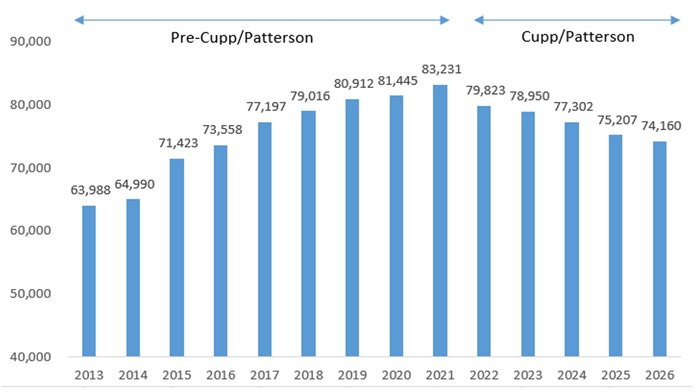
The economics changed for the worse when Ohio adopted the Cupp-Patterson funding formula. As discussed previously, this model treats open-enrollees just like resident students for the purposes of funding. In practice, this means a funding cut for open enrollment in many districts. Because the Cupp-Patterson model applies a district’s state share percentage to an open-enrollee’s per-pupil funding, a mid-wealth district may receive just $4,000 to $5,000 per open-enrollee, while a high-wealth district receives even less. Given the funding reductions, it’s not surprising to see a downturn in open enrollment.
But smaller funding amounts caused by the application of the state share is not the only problem. The guarantees embedded in Cupp-Patterson wreak further havoc on the financial incentives. When districts are on the guarantee, accepting open-enrollees may not generate any additional state aid. They are no longer funded by their current headcounts (including open-enrollees) but instead based on a historical funding level.[1] This year, 267 districts or about two in five, are on the guarantee. Those districts, especially the ones receiving the largest amounts, have virtually no incentive to open-enroll additional students.[2]
To fix this mess, Ohio should restore its former method of funding open enrollment. Rather than dragging open enrollment into the complexities of the formula—as Cupp-Patterson does—a flat per-open-enrollee amount would make perfectly clear the funding incentive for participation. And if set at $6,020 per student (or somewhere above it for inflation), the amount would restore confidence that open-enrolling students is fiscally sound. Going back to the old approach would avoid complications with the guarantee. Even if a district was on the guarantee during the Kasich era, it still received $6,020 per open-enrollment student. Finally, a reversion may not impose a substantial expense to the state (net of what it currently spends to fund open-enrollees), as the previous method counted open-enrollees in their home district and then transferred the funds to their district of attendance.
While sensible at first blush, Cupp-Patterson erred by treating open-enrollees the same as resident students for funding purposes. As the story from Cuyahoga Falls and Norton reminds us, open-enrollment students are different from resident students—districts do not have the same legal obligation to educate them—and open-enrollees should be treated differently under the formula. In their case, the per-pupil funding acts as a financial incentive and is critical in determining the access students have to public schools outside of their home district.
Ohio families and students shouldn’t be left in the lurch because of a misguided formula change. With more districts curbing access to their schools, it’s time for lawmakers to fix the method for funding open enrollment.
[1] If a district’s formula prescription is narrowly below a historical benchmark, then open-enrolling students could move it off the guarantee and onto the formula. In that case, a district would receive additional per-pupil funding for an open-enrollee.
[2] There is a complex mechanism, however, in Cupp-Patterson that tries to discourage districts from cutting open enrollment for existing open-enrollees (as Norton and Cuyahoga Falls did).