Mobile Navigation

  • National
    • Policy
      • High Expectations
      • Quality Choices
      • Personalized Pathways
    • Research
    • Commentary
      • Gadfly Newsletter
      • Flypaper Blog
    • Events
    • Scholars Program
  • Ohio
    • Policy
      • Priorities
      • Media & Testimony
    • Research
    • Commentary
      • Ohio Education Gadfly Biweekly
      • Ohio Gadfly Daily
  • Charter Authorizing
    • Application
    • Sponsored Schools
    • Resources
  • About
    • Mission
    • Board
    • Staff
    • Career
Home
Home
Advancing Educational Excellence

Main Navigation

  • National
  • Ohio
  • Charter Authorizing
  • About

National Menu

  • Topics
    • Accountability & Testing
    • Advanced Education
    • Career & Technical Education
    • Charter Schools
    • Curriculum & Instruction
    • ESSA
    • Evidence-Based Learning
    • Facilities
    • Governance
    • Personalized Learning
    • Private School Choice
    • School Finance
    • Standards
    • Teachers & School Leaders
    • Think Again
  • Research
  • Commentary
    • Gadfly Newsletter
    • Flypaper Blog
    • Gadfly Podcast
  • Events
  • Scholars Program

Reports, Books

Displaying 241-268 of 268 results
Report
8.1.2001
Charter Schools, Teachers & School Leaders

Personnel Policy in Charter Schools

Dale Ballou, Michael Podgursky

When schools are held accountable for results and freed from red tape governing personnel decisions, they take advantage of their freedom by adopting innovative strategies for hiring and rewarding teachers, according to this new report by economists Michael Podgursky and Dale Ballou. This study is based on a survey administered to a random sample of 132 public charter schools that have been operating for at least three years.
Report
1.1.2001
Governance, Teachers & School Leaders

Professionalism and the Public Good: A Brief History of Teacher Certification

Jeffrey Mirel, David L. Angus

Why does our system of teacher certification emphasize training in pedagogy rather than subject-matter knowledge? The answer can be found in this report, which traces the emergence of state control over teacher certification. The focus is on efforts by the teacher education establishment to gain monopoly control over the licensing of teachers.

Report
12.1.2000
Accountability & Testing, Governance

Education 2001: Getting the Job Done, A Memorandum to the President-Elect and the 107th Congress

Michael J. Petrilli, Chester E. Finn, Jr., Marci Kanstoroom, Ph.D., Diane Ravitch, Bruno V. Manno, Kelly Amis

President Bush campaigned on a strong education-reform platform, promising the American people that for the first time in a long time, commonsense?not special interest groups?would dictate federal education policy. Just before he entered the Oval Office, we handed him a briefing book on steps he could take to help transform the K-12 education system. In this "Memorandum to the President-Elect and the 107th Congress," we explained how the federal government has wasted billions of dollars on ineffective programs and offered suggestions for making continued federal funding matter.

Report
9.1.2000
Standards

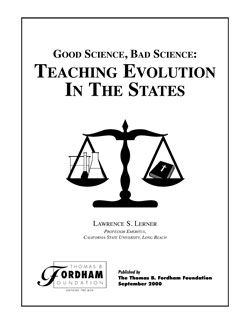
Good Science, Bad Science: Teaching Evolution in the States

Lawrence S. Lerner

More than one-third of the states get low grades for the standards they have developed for teaching evolution, according to this new report. This report is the first comprehensive analysis of how each state handles evolution in its science standards for the public schools.

Report
6.1.2000
Private School Choice

Parochial Schools and Public Aid: Today's Catholic Schools

Christopher Connell

How much government aid do parochial schools and their students actually receive? Connell finds that public aid flows to church-affiliated schools through many channels, though amounts vary greatly from state to state. This report is especially timely in light of the Supreme Court's important decision upholding government aid to religious schools.

Report
4.1.2000
School Finance, Governance

Can Philanthropy Fix Our Schools? Appraising Walter Annenberg's $500 Million Gift to Public Education

Carol Innerst, Alexander Russo, Raymond Domanico

According to this new study, Ambassador Annenberg's gift has left only small footprints on the urban school systems it set out to reform. Good intentions and a generous checkbook were not enough to transform troubled urban schools. This report includes case studies of New York (by Raymond Domanico), Chicago (by Alexander Russo) and Philadelphia (by Carol Innerst) and an afterword by Chester E.Finn Jr. and Marci Kanstoroom.

Report
4.1.2000
Curriculum & Instruction, Standards

Politicizing Science Education

Paul Gross

Science as a search for truth has come under attack from both the left and the right. This report explores four case studies of threats to the integrity of science education.

Report
4.1.2000
Curriculum & Instruction

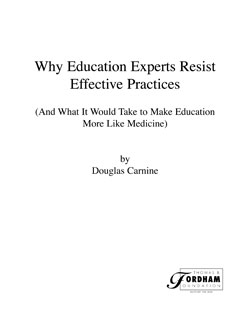
Why Education Experts Resist Effective Practices (And What It Would Take to Make Education More Like Medicine)

Douglas Carnine

Education experts tend to ignore research-based practices like Direct Instruction and instead embrace constructivist methods that are not backed by good research. This report by Douglas Carnine explains why.

Report
1.15.2000
Standards

The State of State Standards 2000

Michael J. Petrilli, Chester E. Finn, Jr.

According to this comprehensive report, only five states combine solid academic standards with strong school accountability.

Report
1.1.2000
Governance

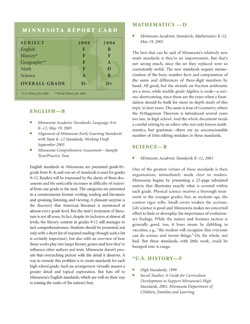
Strange Brew: Minnesota's Motley Mix of School Reforms

Mitchell B. Pearlstein

Minnesota was the first state to embrace many important education reforms, from statewide open enrollment to charter schools to tax credits for parents paying certain education expenses. This report, written by Dr. Mitchell Pearlstein, President of the Minneapolis-based Center of the American Experiment, tells the stories behind Minnesota's unique policy experiences. What lay behind Minnesota's worthy innovations? Who was responsible for the bad ideas? Mitch's short answer: governors were behind most of the proposals that expanded education choice, while the flawed policies emerged from the state's education bureaucracy.

Report
1.1.2000
Standards, Teachers & School Leaders

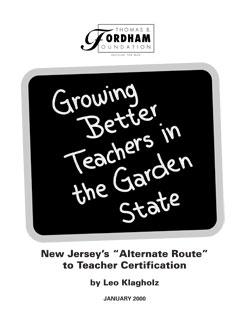
Growing Better Teachers in the Garden State

Leo Klagholz

This report explains how New Jersey has implemented high standards for teachers without causing a teacher shortage by creating an alternative certification program.

Report
11.1.1999
Teachers & School Leaders

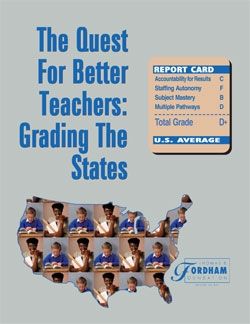
The Quest For Better Teachers: Grading The States

Michael J. Petrilli, Chester E. Finn, Jr., Marci Kanstoroom, Ph.D.

Most states are beginning to get serious about boosting the quality of their teaching force. Unfortunately, most of the steps they are taking point in the wrong direction. This 'report card' contains plenty of evidence of that fact-together with some happy exceptions and hopeful signs.

Report
10.1.1999
Charter Schools

Why Charter Schools? The Princeton Story

Chiara R. Nappi

Nappi tells the engaging story of how Princeton parents tried to change 'the system' from within but had to resort to starting a charter school in order to raise academic standards.

Report
7.1.1999
Standards

Making Standards Work: A Case Study of Washington State

Mary Beth Celio, Lauren O' Toole, Paul T. Hill, Robin Lake

This report takes a close look at the implementation of standards-based reform in one state, Washington, and asks why it was successful in some places but not others.

Report
7.1.1999
Governance

Better Teachers, Better Schools

Chester E. Finn, Jr., Marci Kanstoroom, Ph.D.

According to this 250-page volume, proposed federal and state policies aimed at boosting teacher-quality may well worsen the problem. Instead of adding even more politics-governance to the teacher training system, policymakers should open up the profession to well-educated individuals and should hold principals accountable for student learning.

Report
4.20.1999
Governance, Teachers & School Leaders

The Teachers We Need and How to Get More of Them

A policy statement endorsed by governors, chief state school officers, state board members, prominent education thinkers and analysts, and veteran practitioners, which sets forth principles and policies to guide states as they prepare to hire a teaching force for the 21st century.

Report
12.1.1998
Governance

Better By Design? A Consumer's Guide to Schoolwide Reform

James Traub

This book is a guide to ten of today's best-known school designs. It is meant for parents, teachers, school board members, philanthropists, civic leaders and other 'consumers' who must evaluate which, if any, of these models they want to pursue.

Report
10.1.1998
Charter Schools, Standards

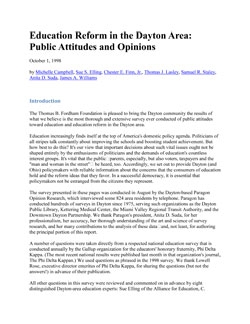
Education Reform in the Dayton Area: Public Attitudes and Opinions

A survey of attitudes towards education reform in Dayton (where Mr. Fordham lived). View the survey results which show, among other things, overwhelming support for parental choice, charter schools, and higher standards.

Report
10.1.1998
Accountability & Testing

Filling In the Blanks: Putting Standardized Tests to the Test

Gregory J. Cizek

Cizek provides a helpful primer on standardized testing. He identifies key terms, clarifies important distinctions between types of tests, and explains how to interpret (and not to interpret) their scores.

Report
7.1.1998
Curriculum & Instruction

Remediation in Higher Education: A Symposium

Robert M. Costrell, David H. Ponitz, Laurence Steinberg, David W. Breneman, William N. Haarlow

Is remediation in additional-topics providing a valuable service to society? Or does it amount to paying for someone's education twice? Read competing views of the issue in this rare Fordham look at the higher-education system.

Report
7.1.1998
Advanced Education

The Tracking and Ability Grouping Debate

Tom Loveless

Tracking and ability grouping strategies differ widely from school to school. They diverge even more widely from their portrayal in the popular criticisms of the 1980s. This report digs into the sensitive matter of whether those criticisms are valid today. The answer tells a more complicated and more honest story than we have heard before on this topic.

Report
7.1.1998
Standards

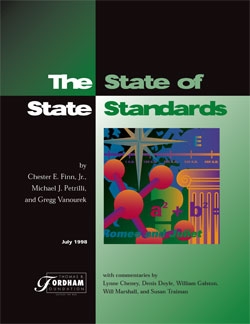
The State of State Standards (1998)

Michael J. Petrilli, Chester E. Finn, Jr., Gregg Vanourek

Three Fordham staff members analyze trends spotted in academic standards across the disciplines. They found that too many state standards are vague, anti-knowledge, entranced with 'relevance,' and focused on teaching rather than learning.

Report
7.1.1998
Accountability & Testing, Governance

Spending More While Learning Less: U.S. School Productivity in International Perspective

Herbert J. Walberg

With OECD data, Walberg shows that the United States' educational system is the 'least productive in the developed world.'

Report
3.1.1998
Standards

State Math Standards

Ralph A. Raimi, Lawrence Braden

In this review of state math standards, authors Raimi and Braden found a disturbing lack of 'mathematical reasoning' in most of the 47 state standards they examined; only three states earned 'A's' while 16 states flunked.

Report
3.1.1998
Standards

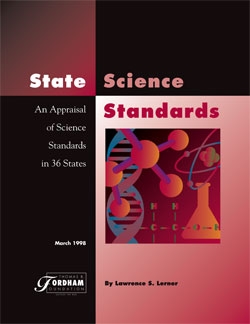
State Science Standards

Lawrence S. Lerner

This review of state science standards is the final in our series of reports analyzing state standards in the five core content areas. For this review, author Lawrence S. Lerner analyzed the science standards of 36 states and found that state science standards are the strongest of the five disciplines we studied. Based on his analysis, six states earned 'A' grades, seven earned 'B's,' and only nine flunked.

Report
2.1.1998
Standards

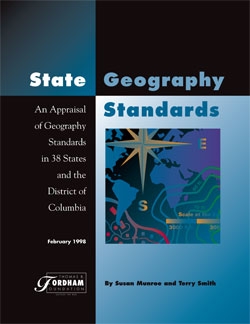
State Geography Standards

Terry Smith, Susan Munroe

This is the third in a series of reports on state standards published by the Fordham Foundation and is our first-ever look at state standards for geography. Authors Susan Munroe and Terry Smith found reason for hope in a few of the excellent standards they found (like Colorado's), but most of the documents they analyzed were extremely weak; only six states earned 'A's' or 'B's,' while 18 states failed.

Report
2.1.1998
Standards

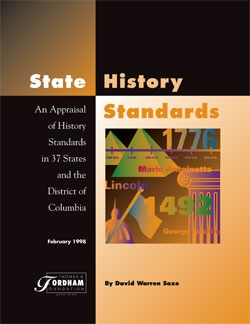
State History Standards

David W. Saxe

The second in a series of evaluations of state standards, this is our first review of state history standards. In his analysis, author David W. Saxe offers a scathing indictment of state history standards, which he judged to be little better than the oft-ridiculed National History Standards; four earned 'A's' or 'B's,' while 19 states flunked.

Report
7.1.1997
Standards

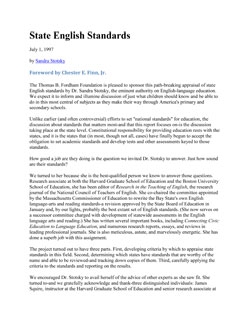
State English Standards

Sandra Stotsky

Dr. Sandra Stotsky, the eminent authority on English language education, led off a Fordham series of standards reviews with a detailed critique of the English/Language Arts standards of 28 states. Massachusetts' were found to be the strongest, a beacon for other states to emulate.

Pagination

  • First page « First
  • Previous page ‹ Previous
  • Page 1
  • Page 2
  • Page 3
  • Page 4
  • Page 5
  • Page 6
  • Page 7
  • Page 8
  • Current page 9

Type

  • (-) Book (10)
  • Commentary (17478)
  • Event (51)
  • Podcast (380)
  • (-) Report (258)
  • Video (98)

Topics

  • Accountability & Testing (45)
  • Advanced Education (17)
  • Career & Technical Education (4)
  • Charter Schools (47)
  • Curriculum & Instruction (37)
  • ESSA (6)
  • Evidence-Based Learning (5)
  • Governance (81)
  • Personalized Learning (4)
  • Private School Choice (8)
  • School Finance (31)
  • Standards (49)
  • Teachers & School Leaders (37)

Date

  • 2026 (8)
  • 2025 (7)
  • 2024 (8)
  • 2023 (9)
  • 2022 (7)
  • 2021 (7)
  • 2020 (8)
  • 2019 (9)
  • 2018 (7)
  • 2017 (9)
  • 2016 (10)
  • 2015 (5)
  • 2014 (13)
  • 2013 (18)
  • 2012 (18)
  • 2011 (19)
  • 2010 (7)
  • 2009 (9)
  • 2008 (11)
  • 2007 (7)
  • 2006 (9)
  • 2005 (9)
  • 2004 (7)
  • 2003 (9)
  • 2002 (4)
  • 2001 (8)
  • 2000 (9)
  • 1999 (5)
  • 1998 (11)
  • 1997 (1)
Fordham Logo

© 2026 The Thomas B. Fordham Institute
Privacy Policy
Usage Agreement

National

P.O. Box 110
Burke, VA 22009

202.223.5452

[email protected]

Ohio

P.O. Box 82291
Columbus, OH 43202

614.223.1580

[email protected]

Sponsorship

130 West Second Street, Suite 410
Dayton, Ohio 45402

937.227.3368

[email protected]