Mobile Navigation

  • National
    • Policy
      • High Expectations
      • Quality Choices
      • Personalized Pathways
    • Research
    • Commentary
      • Gadfly Newsletter
      • Flypaper Blog
    • Events
    • Scholars Program
  • Ohio
    • Policy
      • Priorities
      • Media & Testimony
    • Research
    • Commentary
      • Ohio Education Gadfly Biweekly
      • Ohio Gadfly Daily
  • Charter Authorizing
    • Application
    • Sponsored Schools
    • Resources
  • About
    • Mission
    • Board
    • Staff
    • Career
Home
Home
Advancing Educational Excellence

Main Navigation

  • National
  • Ohio
  • Charter Authorizing
  • About

National Menu

  • Topics
    • Accountability & Testing
    • Advanced Education
    • Career & Technical Education
    • Charter Schools
    • Curriculum & Instruction
    • ESSA
    • Evidence-Based Learning
    • Facilities
    • Governance
    • Personalized Learning
    • Private School Choice
    • School Finance
    • Standards
    • Teachers & School Leaders
    • Think Again
  • Research
  • Commentary
    • Gadfly Newsletter
    • Flypaper Blog
    • Gadfly Podcast
  • Events
  • Scholars Program

Governance

Displaying 1411-1426 of 1426 results
Report
12.3.2004
Governance

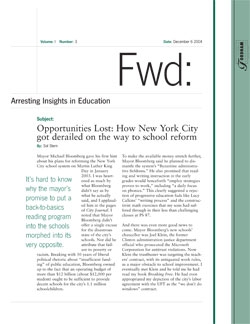
Fwd: Opportunities Lost: How New York City got derailed on the way to school reform

Sol Stern

How did New York City's experiment in school reform, once so promising, become such a mess? Author Sol Stern explains in this third edition of Fordham's new Fwd: series of short articles of interest to K-12 education reformers.
Report
5.1.2003
Governance

Better Leaders for America's Schools: A Manifesto

This report, published jointly by the Fordham Institute and The Broad Foundation, contends that American public education faces a 'crisis in leadership' that cannot be alleviated from traditional sources of school principals and superintendents. Its signers do not believe this crisis can be fixed by conventional strategies for preparing, certifying and employing education leaders. Instead, they urge that first-rate leaders be sought outside the education field, earn salaries on par with their peers in other professions, and gain new authority over school staffing, operations and budgets.

Report
5.1.2002
Governance

Thomas B. Fordham Foundation: Five Year Report

Chester E. Finn, Jr.

The Thomas B. Fordham Foundation's first-ever Five-Year Report reviews our major education reform activities, products and expenditures, both in the national reform arena and in Dayton, from 1997 through 2001 and sums up the work of the Foundation from its rebirth in the mid-1990s until today. In the report, we endeavor to show what we think we've accomplished, where our efforts have fallen short, and what we've learned.

Report
12.1.2001
School Finance, Governance

Seven Studies in Education Philanthropy

John Barry, Peter Frumkin, Joe Williams, Leslie Lenkowsky, Lew Solomon, Paul T. Hill, Margaret Raymond, Emily Spencer, Bruno V. Manno

The Thomas B. Fordham Foundation asked experts to share their knowledge and ideas on topics related to effective education philanthropy. Here are seven papers that answer some of philanthropists' most important questions in the education reform arena.

Report
10.21.2001
Governance

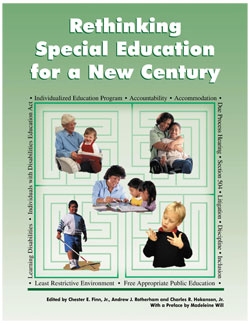
Rethinking Special Education for a New Century

Chester E. Finn, Jr., Andrew J. Rotherham, Charles R. Hokanson, Jr.

Recommending sweeping changes in federal special ed policy, this new volume of 14 papers scrutinizes the education now being received by 6 million U.S. children with disabilities. Jointly published with the Progressive Policy Institute, the report will help shape discussion of the next reauthorization of the Individuals with Disabilities Education Act (IDEA). It identifies the problems that now beset this important program, analyzes their causes, and suggests solutions. All who care about the education of children with special needs will want to read it for themselves.

Report
10.1.2001
Governance

Dayton Education in 2001: The Views of Citizens and Parents

Chester E. Finn, Jr., Jacqueline Howell Luksic

This unique survey compares the views of parents with children in private, public and charter schools on the quality of their own schools as well as a range of education reform issues. Conducted in Dayton, Ohio, home to one of the nation's fastest growing charter school programs as well as a strong private voucher program, the data show that, while public school parents are generally less satisfied with their children's present schools, the overwhelming majority of parents and non-parents support bold reform in the public school system. The survey also shows strong support among all groups for publicly funded vouchers, higher academic standards and performance pay for teachers.

Report
10.1.2001
Governance

Evolution of the New American Schools: From Revolution to Mainstream

Jeffrey Mirel

This report traces an initiative that was launched a decade ago by business and government leaders seeking to spark a transformation of K-12 education in American. The New American Schools Development Corporation (NASDC) vowed to cast aside traditional ideas about schools and apply a no-nonsense, business-savvy approach to the design and deployment of "break-the-mold" schools. Ten years later, New American Schools (as the organization is now named) looks a lot more like a member of the education establishment. Mirel's fascinating report shows how this happened.

Report
9.1.2001
School Finance, Governance

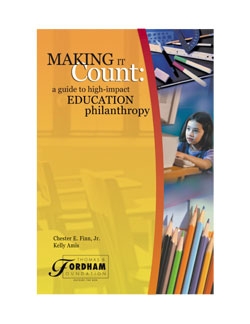
Making it Count: A Guide to High-Impact Education Philanthropy

Chester E. Finn, Jr., Kelly Amis

Charitable giving in the U.S. is at an all-time high, as is the public's concern with the state of our K-12 education system. This guide provides practical advice for the philanthropist who is fed up with the status quo and eager to support effective education reforms. Making it Count reviews the state of U.S. public education, examines different ways that philanthropists are trying to improve it, explains why some strategies work better than others, profiles a number of education philanthropists, and recounts the experiences of the Thomas B. Fordham Foundation.

Report
1.1.2001
Governance, Teachers & School Leaders

Professionalism and the Public Good: A Brief History of Teacher Certification

Jeffrey Mirel, David L. Angus

Why does our system of teacher certification emphasize training in pedagogy rather than subject-matter knowledge? The answer can be found in this report, which traces the emergence of state control over teacher certification. The focus is on efforts by the teacher education establishment to gain monopoly control over the licensing of teachers.

Report
12.1.2000
Accountability & Testing, Governance

Education 2001: Getting the Job Done, A Memorandum to the President-Elect and the 107th Congress

Michael J. Petrilli, Chester E. Finn, Jr., Marci Kanstoroom, Ph.D., Diane Ravitch, Bruno V. Manno, Kelly Amis

President Bush campaigned on a strong education-reform platform, promising the American people that for the first time in a long time, commonsense?not special interest groups?would dictate federal education policy. Just before he entered the Oval Office, we handed him a briefing book on steps he could take to help transform the K-12 education system. In this "Memorandum to the President-Elect and the 107th Congress," we explained how the federal government has wasted billions of dollars on ineffective programs and offered suggestions for making continued federal funding matter.

Report
4.1.2000
School Finance, Governance

Can Philanthropy Fix Our Schools? Appraising Walter Annenberg's $500 Million Gift to Public Education

Carol Innerst, Alexander Russo, Raymond Domanico

According to this new study, Ambassador Annenberg's gift has left only small footprints on the urban school systems it set out to reform. Good intentions and a generous checkbook were not enough to transform troubled urban schools. This report includes case studies of New York (by Raymond Domanico), Chicago (by Alexander Russo) and Philadelphia (by Carol Innerst) and an afterword by Chester E.Finn Jr. and Marci Kanstoroom.

Report
1.1.2000
Governance

Strange Brew: Minnesota's Motley Mix of School Reforms

Mitchell B. Pearlstein

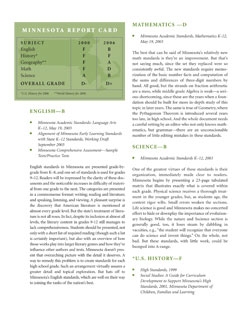
Minnesota was the first state to embrace many important education reforms, from statewide open enrollment to charter schools to tax credits for parents paying certain education expenses. This report, written by Dr. Mitchell Pearlstein, President of the Minneapolis-based Center of the American Experiment, tells the stories behind Minnesota's unique policy experiences. What lay behind Minnesota's worthy innovations? Who was responsible for the bad ideas? Mitch's short answer: governors were behind most of the proposals that expanded education choice, while the flawed policies emerged from the state's education bureaucracy.

Report
7.1.1999
Governance

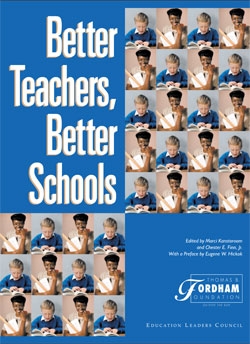
Better Teachers, Better Schools

Chester E. Finn, Jr., Marci Kanstoroom, Ph.D.

According to this 250-page volume, proposed federal and state policies aimed at boosting teacher-quality may well worsen the problem. Instead of adding even more politics-governance to the teacher training system, policymakers should open up the profession to well-educated individuals and should hold principals accountable for student learning.

Report
4.20.1999
Governance, Teachers & School Leaders

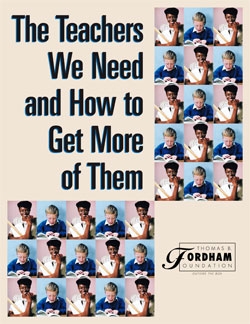
The Teachers We Need and How to Get More of Them

A policy statement endorsed by governors, chief state school officers, state board members, prominent education thinkers and analysts, and veteran practitioners, which sets forth principles and policies to guide states as they prepare to hire a teaching force for the 21st century.

Report
12.1.1998
Governance

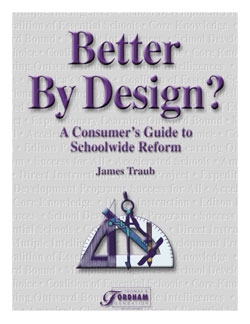
Better By Design? A Consumer's Guide to Schoolwide Reform

James Traub

This book is a guide to ten of today's best-known school designs. It is meant for parents, teachers, school board members, philanthropists, civic leaders and other 'consumers' who must evaluate which, if any, of these models they want to pursue.

Report
7.1.1998
Accountability & Testing, Governance

Spending More While Learning Less: U.S. School Productivity in International Perspective

Herbert J. Walberg

With OECD data, Walberg shows that the United States' educational system is the 'least productive in the developed world.'

Pagination

  • First page « First
  • Previous page ‹ Previous
  • Page 40
  • Page 41
  • Page 42
  • Page 43
  • Page 44
  • Page 45
  • Page 46
  • Page 47
  • Current page 48

Type

  • Book (3)
  • Commentary (1249)
  • Event (2)
  • Podcast (81)
  • Report (78)

Topics

  • Accountability & Testing (507)
  • Advanced Education (267)
  • Career & Technical Education (84)
  • Charter Schools (1118)
  • Curriculum & Instruction (1604)
  • ESSA (129)
  • Evidence-Based Learning (843)
  • Facilities (25)
  • (-) Governance (1426)
  • Personalized Learning (51)
  • Private School Choice (142)
  • School Finance (169)
  • Standards (190)
  • Teachers & School Leaders (1466)

Date

  • 2026 (159)
  • 2025 (192)
  • 2024 (189)
  • 2023 (177)
  • 2022 (184)
  • 2021 (220)
  • 2020 (156)
  • 2019 (56)
  • 2018 (11)
  • 2017 (13)
  • 2016 (4)
  • 2015 (4)
  • 2014 (5)
  • 2013 (8)
  • 2012 (11)
  • 2011 (7)
  • 2010 (1)
  • 2009 (2)
  • 2008 (5)
  • 2007 (4)
  • 2006 (1)
  • 2005 (1)
  • 2004 (1)
  • 2003 (1)
  • 2002 (1)
  • 2001 (6)
  • 2000 (3)
  • 1999 (2)
  • 1998 (2)
Fordham Logo

© 2026 The Thomas B. Fordham Institute
Privacy Policy
Usage Agreement

National

P.O. Box 110
Burke, VA 22009

202.223.5452

[email protected]

Ohio

P.O. Box 82291
Columbus, OH 43202

614.223.1580

[email protected]

Sponsorship

130 West Second Street, Suite 410
Dayton, Ohio 45402

937.227.3368

[email protected]