Mobile Navigation

  • National
    • Policy
      • High Expectations
      • Quality Choices
      • Personalized Pathways
    • Research
    • Commentary
      • Gadfly Newsletter
      • Flypaper Blog
    • Events
    • Scholars Program
  • Ohio
    • Policy
      • Priorities
      • Media & Testimony
    • Research
    • Commentary
      • Ohio Education Gadfly Biweekly
      • Ohio Gadfly Daily
  • Charter Authorizing
    • Application
    • Sponsored Schools
    • Resources
  • About
    • Mission
    • Board
    • Staff
    • Career
Home
Home
Advancing Educational Excellence

Main Navigation

  • National
  • Ohio
  • Charter Authorizing
  • About

National Menu

  • Topics
    • Accountability & Testing
    • Advanced Education
    • Career & Technical Education
    • Charter Schools
    • Curriculum & Instruction
    • ESSA
    • Evidence-Based Learning
    • Facilities
    • Governance
    • Personalized Learning
    • Private School Choice
    • School Finance
    • Standards
    • Teachers & School Leaders
    • Think Again
  • Research
  • Commentary
    • Gadfly Newsletter
    • Flypaper Blog
    • Gadfly Podcast
  • Events
  • Scholars Program

Accountability & Testing

Displaying 481-503 of 503 results
Report
4.19.2011
Accountability & Testing, Governance

ESEA Briefing Book

Michael J. Petrilli, Chester E. Finn, Jr.

Political leaders hope to act soon to renew and fix the Elementary and Secondary Education Act (ESEA, also known as No Child Left Behind). In this important paper, Thomas B. Fordham Institute President Chester E. Finn, Jr. and Executive Vice President Michael J. Petrilli identify 10 big issues that must be resolved in order to get a bill across the finish line, and explore the major options under consideration for each one. Should states be required to adopt academic standards tied to college and career readiness? Should the new law provide greater flexibility to states and districts? These are just a few of the areas discussed. Finn and Petrilli also present their own bold yet "reform realist" solutions for ESEA. Read on to learn more.
Report
3.15.2011
Accountability & Testing

American Achievement in International Perspective

Michael J. Petrilli, Janie Scull

The latest results of the Programme for International Student Assessment (PISA) garnered all the usual headlines about America's lackluster performance and the rise of competitor nations. And to be sure, the findings that America's 15-year-olds perform in the middle of the pack in both reading and math are disconcerting for a nation that considers itself an international leader, priding itself on its home-grown innovation, intellect, and opportunity. But that's not the entire story. Read on to learn more.
Report
12.14.2010
Accountability & Testing

Are Bad Schools Immortal?

David A. Stuit

This study from the Thomas B. Fordham Institute finds that low-performing public schools—both charter and traditional district schools—are stubbornly resistant to significant change. After identifying more than 2,000 low-performing charter and district schools across ten states, analyst David Stuit tracked them from 2003-04 through 2008-09 to determine how many were turned around, shut down, or remained low-performing. Results were generally dismal. Seventy-two percent of the original low-performing charters remained in operation—and remained low-performing-five years later. So did 80 percent of district schools. Read on to learn more.
Report
8.27.2010
Accountability & Testing

2009-10 Ohio Report Card Analysis

Emmy L. Partin, Terry Ryan, Bianca Speranza

Each year the Thomas B. Fordham Institute conducts an analysis of urban school performance in Ohio. We found that in 2009-10, 26 percent of public school students (district and charter) in Ohio's Big 8 urban communities attended a school rated A or B by the state, 28 percent attend a C-rated school, and 47 percent attended a school rated D or F.

Report
11.20.2009
Accountability & Testing, Charter Schools

Seeking Quality in the Face of Adversity: 2008-09 Fordham Sponsorship Accountability Report

Kathryn Mullen

As a charter school sponsor (authorizer), Fordham submits an accountability report to the Ohio Department of Education at the end of November each year. The report includes profiles of each Fordham-sponsored school, as well as graphics comparing the achievement data of our schools, their home districts, and statewide averages. You'll also find pertinent information on Ohio charter school spending over the last decade, and in the introduction, a timely analysis of the political and legislative environment impacting Ohio charters in 2008-09 that explains why the title, "Seeking Quality in the Face of Adversity," is befitting.

Report
3.24.2009
Accountability & Testing

When Private Schools Take Public Dollars: What's the Place of Accountability in School Voucher Programs?

Michael J. Petrilli, Chester E. Finn, Jr., Christina Hentges, Amber M. Northern, Ph.D.

Voucher opponents often argue that it's unfair to hold public schools accountable for results under the No Child Left Behind Act and various state rules while allowing private schools that participate in school voucher programs to receive taxpayer dollars without similar accountability. In pursuit of a reasonable middle ground, we sought the advice of twenty experts in the school-choice world. This paper presents their thoughts and opinions, as well as Fordham's own ideas.

Report
2.19.2009
Accountability & Testing

The Accountability Illusion

Yun Xiang, Michael Dahlin, John Cronin, Donna McCahon

In this study of the No Child Left Behind Act system and Adequate Yearly Progress (AYP) rules for 28 states, we selected 36 real schools that vary by size, achievement, diversity, etc. and determined which ones would or would not make AYP when evaluated under each state's accountability rules. If a school that made AYP in Washington were relocated to Ohio, would it still make AYP?

Report
11.19.2008
Accountability & Testing, Charter Schools

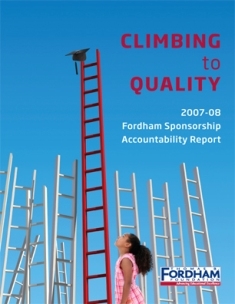
Climbing to Quality 2007-2008 Fordham Sponsorship Accountability Report

Kathryn Mullen

This yearly report covers Fordham's sponsorship practices throughout the year as well as newsworthy events related to our sponsored charter schools. You can also find detailed reports on all of Fordham-sponsored schools. Each school report contains information on the school's academic performance, educational philosophy, and compliance for the 2007-2008 school year.

Report
8.25.2008
Accountability & Testing

Education Olympics 2008: The Games in Review

Stafford Palmieri, Amber M. Northern, Ph.D.

This report has a simple aim: to present results from international assessments so readers can judge for themselves how American students stack up globally. It shows how the U.S. has performed internationally in education in recent years, and it provides a glimpse of how education looks in several top-performing nations.

Report
10.4.2007
Accountability & Testing

The Proficiency Illusion

Deborah Adkins, G. Gage Kingsbury, Michael Dahlin, John Cronin

NCLB allows each state to define proficiency as it sees fit and design its own tests. This study compares state tests to benchmarks laid out by the Northwest Evaluation Association to evaluate proficiency cut scores for assessments in twenty-six states. The findings suggest that the tests states use to measure academic progress and student proficiency under NCLB are creating a false impression of success, especially in reading and especially in the early grades.

Report
4.1.2007
Accountability & Testing, Governance

Crystal Apple: Education Insiders' Predictions for No Child Left Behind's Reauthorization

Michael J. Petrilli, Coby Loup

January 8, 2007, was the fifth birthday of the No Child Left Behind Act. This isn't just another milestone to be celebrated (or mourned). The law is now due for an update from Congress. But will NCLB be reauthorized on schedule? What changes are likely? No one knows for sure, but the ubiquitous 'Washington insiders' might be in a better position than others to cast prognostications. While not a 'representative sample' of thousands, their inside knowledge adds valuable insight.

Report
11.30.2006
Accountability & Testing, Charter Schools

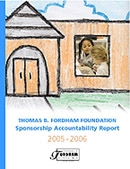
2006 Thomas B. Fordham Foundation Sponsorship Accountability Report

Terry Ryan, Kathryn Mullen

For information on Fordham's unique role as a charter school sponsor in Ohio, there's no better source than The Thomas B. Fordham Foundation Sponsorship Accountability Report 2005-06. The report offers a comprehensive account of Fordham's sponsorship policies and practices-as well as individual profiles of all Fordham-sponsored schools. Included in the profiles are descriptions of each school's educational program, school philosophy, and overall academic performance based on state achievement data.

Report
11.1.2006
Accountability & Testing

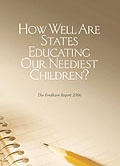
The Fordham Report 2006: How Well Are States Educating Our Neediest Children?

The Fordham Report 2006: How Well Are States Educating Our Neediest Children? appraises each state according to thirty indicators across three major categories: student achievement for low-income, African-American, and Hispanic students; achievement trends for these same groups over the last 10-15 years; and the state's track record in implementing bold education reforms. It finds that just eight states can claim even moderate success over the past 15 years at boosting the percentage of their poor or minority students who are at or above proficient in reading, math or science.

Report
8.29.2006
Accountability & Testing, Standards

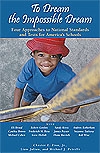
To Dream the Impossible Dream: Four Approaches to National Standards and Tests for America's Schools

Michael J. Petrilli, Chester E. Finn, Jr.

Education policy leaders from across the political spectrum flesh out and evaluate several forms that national standards and testing could take.

Report
9.14.2005
Accountability & Testing, Curriculum & Instruction

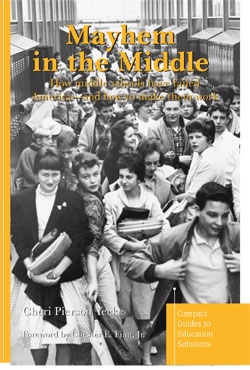
Mayhem in the Middle: How middle schools have failed America, and how to make them work

Chester E. Finn, Jr., Cheri Pierson Yecke

American middle schools have become the places "where academic achievement goes to die." So says Cheri Yecke, K-12 Education Chancellor of Florida and author of the new Fordham report Mayhem in the Middle: How middle schools have failed America, and how to make them work. Today's middle schools have succumbed to a concept of "middle schoolism" in which a strong academic curriculum is traded for one that focuses more on emotional and social development, and less on learning the basics. And the achievement data reflects "middle schoolism's" results. In 1999, U.S. eighth graders scored nine points below average on the TIMSS assessment of math. What's more, these same eighth graders had outperformed the average by 28 points as fourth graders in 1995! According to Fordham President Chester E. Finn, Jr., "Trying to fix high schools while ignoring middle schools is like bandaging a wound before treating it for infection."

Report
9.8.2005
Accountability & Testing, Teachers & School Leaders

Personality Test: The dispositional dispute in teacher preparation today, and what to do about it

William Damon

The standards of the National Council for Accreditation of Teacher Excellence (NCATE) are of critical import for America's future teaching corps and will wield disproportionate influence for decades to come. Over the past fifteen years, 25 states have outsourced the approval of teacher preparation programs to NCATE by adopting or adapting its standards as their own; the other 25 have various 'partnerships' with the organization. Which makes it all the more disturbing that central to these standards is the call for teachers to possess certain 'dispositions' such as particular attitudes toward 'social justice.' As Professor William Damon of Stanford University explains in Fordham's latest Fwd: Arresting Insights in Education, NCATE's framing of the 'dispositions' issue has given education schools 'unbounded power over what candidates may think and do.' This is leading to (understandable) charges of ideological arm-twisting and Orwellian mind-control.

Report
1.30.2004
Accountability & Testing, Standards

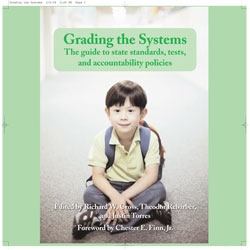
Grading the Systems: The guide to state standards, tests, and accountability policies

Chester E. Finn, Jr., Richard W. Cross, Theodor Rebarber

Co-published by the Thomas B. Fordham Foundation and AccountabilityWorks, with support from the Smith Richardson Foundation, this report looks at six elements of K-12 accountability systems in 30 different states. Each state is rated on standards, test content, alignment of tests to standards, test rigor, testing trustworthiness and openness, and accountability policies. The major conclusion: while some states have the basis of a sophisticated and rigorous accountability system in place, no state has every element of a serious standards-based education reform package in place. And few states are as open to evaluation as they ought to be.

Report
10.24.2003
Accountability & Testing, School Finance, Charter Schools

The State Testing Program for Ohio and How It Works: A Primer for Charter Schools

Amy Germuth

With the passage of the politics-governance Act (NCLB), states have had to adjust their accountability systems to comply with federal law. As a result, in the summer of 2003 Ohio's Governor Taft signed House Bill 3, which dramatically changed the state's assessment system and what it means for charter schools. This report helps charter school leaders coordinate their testing and data reporting procedures to meet state and federal guidelines, in the hope that all students might surpass Ohio's academic expectations.

Report
1.1.2003
Accountability & Testing

Can Failing Schools be Fixed?

Ronald C. Brady

Will the sanctions for failing schools laid out in the politics-governance Act (NCLB) succeed in turning those schools around? This report draws on the results of previous efforts to overhaul failing schools to provide a glimpse at what may be expected from NCLB-style interventions. The results: no intervention strategy has a success rate greater than 50%, so policymakers are urged to consider additional options for children trapped in failing schools.

Report
2.1.2002
Accountability & Testing

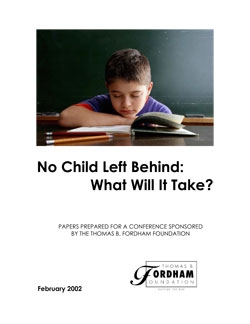
No Child Left Behind: What Will it Take?

Mark D. Reckase, Billie J. Orr, Matthew Gandal, Lisa Graham Keegan

Just one month after President Bush signed the politics-governance Act into law, a provocative set of expert papers commissioned by the Thomas B. Fordham Foundation explores the legislation's key features: it's testing and accountability provisions. The papers identify the questions left unresolved by Congress and the many hurdles facing the U.S. Education Department and states, districts, and schools as they try to make this ambitious law a reality. The papers also offer suggestions for clearing those hurdles.

Report
12.1.2000
Accountability & Testing, Governance

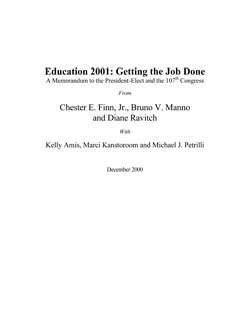
Education 2001: Getting the Job Done, A Memorandum to the President-Elect and the 107th Congress

Michael J. Petrilli, Chester E. Finn, Jr., Marci Kanstoroom, Ph.D., Diane Ravitch, Bruno V. Manno, Kelly Amis

President Bush campaigned on a strong education-reform platform, promising the American people that for the first time in a long time, commonsense?not special interest groups?would dictate federal education policy. Just before he entered the Oval Office, we handed him a briefing book on steps he could take to help transform the K-12 education system. In this "Memorandum to the President-Elect and the 107th Congress," we explained how the federal government has wasted billions of dollars on ineffective programs and offered suggestions for making continued federal funding matter.

Report
10.1.1998
Accountability & Testing

Filling In the Blanks: Putting Standardized Tests to the Test

Gregory J. Cizek

Cizek provides a helpful primer on standardized testing. He identifies key terms, clarifies important distinctions between types of tests, and explains how to interpret (and not to interpret) their scores.

Report
7.1.1998
Accountability & Testing, Governance

Spending More While Learning Less: U.S. School Productivity in International Perspective

Herbert J. Walberg

With OECD data, Walberg shows that the United States' educational system is the 'least productive in the developed world.'

Pagination

  • First page « First
  • Previous page ‹ Previous
  • Page 9
  • Page 10
  • Page 11
  • Page 12
  • Page 13
  • Page 14
  • Page 15
  • Page 16
  • Current page 17

Type

  • Book (1)
  • Commentary (397)
  • Event (6)
  • Podcast (45)
  • Report (44)

Topics

  • (-) Accountability & Testing (503)
  • Advanced Education (265)
  • Career & Technical Education (84)
  • Charter Schools (1115)
  • Curriculum & Instruction (1588)
  • ESSA (129)
  • Evidence-Based Learning (833)
  • Facilities (25)
  • Governance (1407)
  • Personalized Learning (51)
  • Private School Choice (138)
  • School Finance (166)
  • Standards (190)
  • Teachers & School Leaders (1448)

Date

  • 2026 (35)
  • 2025 (47)
  • 2024 (44)
  • 2023 (47)
  • 2022 (54)
  • 2021 (47)
  • 2020 (50)
  • 2019 (65)
  • 2018 (18)
  • 2017 (17)
  • 2016 (7)
  • 2015 (19)
  • 2014 (26)
  • 2013 (1)
  • 2012 (2)
  • 2011 (3)
  • 2010 (2)
  • 2009 (3)
  • 2008 (2)
  • 2007 (2)
  • 2006 (3)
  • 2005 (2)
  • 2004 (1)
  • 2003 (2)
  • 2002 (1)
  • 2000 (1)
  • 1998 (2)
Fordham Logo

© 2026 The Thomas B. Fordham Institute
Privacy Policy
Usage Agreement

National

P.O. Box 110
Burke, VA 22009

202.223.5452

[email protected]

Ohio

P.O. Box 82291
Columbus, OH 43202

614.223.1580

[email protected]

Sponsorship

130 West Second Street, Suite 410
Dayton, Ohio 45402

937.227.3368

[email protected]