
Commentary
National testing goes international
Welcome to Australia, home to kangaroos, dingoes, and an increasingly vocal debate over establishing national education standards.
Welcome to Australia, home to kangaroos, dingoes, and an increasingly vocal debate over establishing national education standards.
Gadfly tries to flutter his wings on the sunny side of issues and therefore resists chiding Secretary Spellings for her recent flip-flop on "highly qualified teachers." It's true, as others
Christine Campbell, Michael DeArmond, Kacey Guin, and Deborah WarnockCenter on Reinventing Public EducationSeptember 2006
Free markets, for all their virtues, do a poor job of distributing public goods like education, right? Anti-capitalist gobbledygook, says columnist Robert Samuelson.
Craig D. JeraldThe Center for Comprehensive School Reform and ImprovementAugust 2006
Matthew DeBell and Chris ChapmanNational Center for Education StatisticsSeptember 2006
Weather doesn't attract people to Washington, D.C. The summers are often grey and humid, the winters grey and cold. But at certain moments, Washington can be among the most beautiful cities in the world. September 11, 2001, was such a day.
Life was rough for charter school supporters immediately after the release of the recent National Center for Education Statistics (NCES) study of charter schools (see here). But newer test results out of Philadelphia and Massachusetts show that all the anti-charter hype was just more hypocrisy.
School superintendent Roger Schmiedeskamp of Manning, Iowa, is learning the hard way that applying modern management principles to public education can be risky. Greater transparency? Aggressive community outreach? Stripping away all pretense?
Sixth-grader Abby Adam loves to send instant online messages to her friends, and she could just spend hours tinkering away on the social networking site MySpace.com.
Malcolm Gladwell--author of Blink and The Tipping Point, bestselling books on shelves from Miami to Mombasa--recently pontificated in The New Yorker on school discipline. His piece denounces the "age of zero tolerance" by pointing to, of all people, Robert Oppenheimer.
Didn't feel the passion of Labor Day? Not to worry. Just pick up the Ohio Education Association's (OEA) new handbook for collective bargainers--complete with the introduction "Prepare for Battle," a rousing call to arms by OEA's own Dr. Strangelove, researcher Patricia A. Turner.
Late summer in Ohio is open season on charter schools. With the release of the Ohio Department of Education's (ODE) state report cards on school achievement, critics have launched repeated volleys aimed at tearing down the state's charter school program. This year's carping is especially vicious as state elections loom in November.
Ohio's schoolchildren aren't being well served by the state's mediocre (or worse) learning expectations. That's just one of the findings of Fordham's The State of State Standards 2006, a new report which evaluates state academic standards.
At first glance, young Americans' college prospects seem bright. Four in five high-school students expect to complete a college degree, and most parents are behind them, with six out of 10 agreeing a college education is "absolutely necessary" for their child. Sadly, only one-third of all high school students will actually earn a college degree.
This school year marks the first that Ohio gets serious about the Ohio Graduation Tests (OGT). Students in the class of 2007 will be required to pass the OGT in order to receive a high school diploma. It's a critical first step on the road to ensuring that the state's high school diplomas carry more weight both with universities and with potential employers.
Advocates of educational choice always wonder why, if the goal of education is lofty learning by students, people quarrel so fiercely about the means of getting there. Case in point: Jake Heichert, a high school senior from St. Paul, who designed his own lesson plans and curricula.
Last year alone, forty-four states bet the farm--the Phat Farm?--on physical education classes. They're hiring more phys ed teachers, requiring more classroom hours, and bringing in state directors to get American youths' modern-day "Battle of the Bulge" under control.
In the Times on August 9, Diana Jean Schemo, referring to the "Coleman Report" and to my 2004 book, Class and Schools, wrote that "while schools can make a difference for individual students, the fabric of children's lives outside of school can either nurture, or choke, what progress poor children do make academically" (see
Jason C. Snipes, Glee Ivory Holton, Fred Doolittle, and Laura SztejnbergMDRCJuly 2006
Standards-based reform is one of the two driving engines of education improvement in the United States and has been at least since 1989.
A.A. Milne had it right: The greatest joy of childhood is the freedom to do nothing. But one can't do nothing forever, as Christopher Robin reminded Pooh in the last of Milne's classic children's stories."I'm not going to do nothing no more," Christopher Robin said."Never again?" asked Pooh.
Rocker Eddie Van Halen had a famously tough time concentrating in class and now, thanks to a provocative study by Thomas Dee of Stanford, we know why. Eddie Van Halen's teacher was a woman.
Two-thirds of schoolchildren in America attend class in states with mediocre (or worse) expectations for what their students should learn. That's just one of the findings of Fordham's The State of State Standards 2006, which evaluates state academic standards. The average state grade is a 'C-minus'--the same as six years earlier, even though most states revised their standards since 2000.

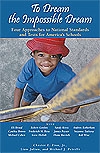
Education policy leaders from across the political spectrum flesh out and evaluate several forms that national standards and testing could take.
Last month, University of Chicago law professor Richard Epstein penned a provocative Wall Street Journal op-ed showing how both the conservative and liberal blocs on the Roberts Supreme Court inconsistently apply basic Constitutional principles in support of their own policy preferences.
Textbook publisher Pearson Scott Foresman is now offering an interactive software program in history and social studies aligned to state standards, i.e. programs whose content will differ from place to place. Not the worst idea, provided the state's standards are worthy and that students can trust the images on their computer screens.
Polls are focused measures of public opinion and policymakers and--especially--politicians tend to take them seriously. But a poll is like a piece of plastic sheeting: if transparent and free of bias, public opinion shines through; if colored by a particular agenda, certain wavelengths of public opinion are filtered out.