
Mobile Navigation

  • National
    • Policy
      • High Expectations
      • Quality Choices
      • Personalized Pathways
    • Research
    • Commentary
      • Gadfly Newsletter
      • Flypaper Blog
    • Events
    • Scholars Program
  • Ohio
    • Policy
      • Priorities
      • Media & Testimony
    • Research
    • Commentary
      • Ohio Education Gadfly Biweekly
      • Ohio Gadfly Daily
  • Charter Authorizing
    • Application
    • Sponsored Schools
    • Resources
  • About
    • Mission
    • Board
    • Staff
    • Career
Home
Home
Advancing Educational Excellence

Main Navigation

  • National
  • Ohio
  • Charter Authorizing
  • About

National Menu

  • Topics
    • Accountability & Testing
    • Advanced Education
    • Career & Technical Education
    • Charter Schools
    • Curriculum & Instruction
    • ESSA
    • Evidence-Based Learning
    • Facilities
    • Governance
    • Personalized Learning
    • Private School Choice
    • School Finance
    • Standards
    • Teachers & School Leaders
    • Think Again
  • Research
  • Commentary
    • Gadfly Newsletter
    • Flypaper Blog
    • Gadfly Podcast
  • Events
  • Scholars Program

Topics

Displaying 451-480 of 610 results
Report
5.1.2002
Governance

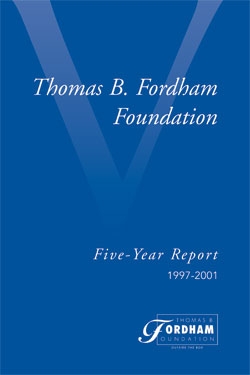
Thomas B. Fordham Foundation: Five Year Report

Chester E. Finn, Jr.

The Thomas B. Fordham Foundation's first-ever Five-Year Report reviews our major education reform activities, products and expenditures, both in the national reform arena and in Dayton, from 1997 through 2001 and sums up the work of the Foundation from its rebirth in the mid-1990s until today. In the report, we endeavor to show what we think we've accomplished, where our efforts have fallen short, and what we've learned.

Commentary
4.24.2002

Test protests thinning out in Massachusetts

Opponents of high-stakes testing in Massachusetts are running out of time to convince a public that has largely accepted testing and academic standards, according to reporter Ed Hayward of the Boston Herald.

Commentary
4.24.2002

Adoption and Adaptation: New York State School Districts' Responses to State Imposed High School Graduation Requirements: An Eight-Year Retrospective

Chester E. Finn, Jr.

David Monk, John W. Sipple and Kieran Killeen, New York State Educational Finance Research ConsortiumSeptember 10, 2001

Commentary
4.24.2002

Exploring the Democratic Tensions within Parents' Decisions to Homeschool

Chester E. Finn, Jr.

Kariane Mari Welner, Teachers College, Columbia UniversityMarch 2002

Commentary
4.24.2002

Mustering the Armies of Compassion in Philadelphia: An Analysis of One Year of Literacy Programming in Faith-Based Institutions

Kelly Scott

Bill Hangley, Jr. and Wendy S. McClanahan, Public/Private VenturesFebruary 2002

Commentary
4.24.2002

Implementing the Boston Teachers' Contract

Chester E. Finn, Jr.

Boston Municipal Research BureauMarch 2002

Commentary
4.24.2002

Charter schools spark positive changes in Dayton

What effect do charter schools have on school districts as a whole? Do they inspire improvements in regular district schools or merely drain money from the district's budget?

Commentary
4.24.2002

New teacher of the year went from the trenches to the classroom

President Bush introduced the 2002 teacher of the year-a retired Army colonel from southern California-at a Rose Garden ceremony yesterday.

Commentary
4.24.2002

Can state standards & market-based reforms be reconciled?

Chester E. Finn, Jr.

Both standards-based and market-style reforms come from outside the system but they follow different theories and many people believe they are incompatible.

Commentary
4.24.2002

The Effects of Town Tuitioning in Vermont and Maine

Katherine Somerville

Christopher W. Hammons, Milton & Rose D. Friedman FoundationFebruary 2002

Commentary
4.17.2002

The war on charter schools

Chester E. Finn, Jr.

I'm not prone to paranoia but lately I see an awful lot of folks bent on stopping the charter movement dead in its tracks and I also see them making much headway. I don't think it exaggerates to say that a war is being waged against charter schools. As with many wars, however, both sides have something to answer for.

Commentary
4.17.2002

Bridging the Gap Between Standards and Achievement

Chester E. Finn, Jr.

Devotees of professional development for teachers will be interested in this thoughtful paper by Harvard education professor Richard F. Elmore, published by the Albert Shanker Institute.

Commentary
4.17.2002

Parents protest income-based integration

San Francisco made headlines last year when it announced that it would begin integrating some schools on the basis of income. This year, the school board in Cambridge, Massachusetts voted to do the same thing. Many experts are excited about this new strategy for diversifying schools, particularly since courts have begun to limit the use of race in student assignments.

Commentary
4.17.2002

Will teenagers connect with higher standards?

Researchers believe that teenagers who feel "connected" at school are less likely to be violent or suicidal, to abuse drugs or to get pregnant. A major study released last week tried to identify features of schools where teenagers are likely to feel connected.

Commentary
4.17.2002

Quality Teachers: Can Incentive Policies Make a Difference?

Terry Ryan

Lynn Cornett and Gale Gaines, Southern Regional Education Board2002

Commentary
4.17.2002

Rankings & Estimates. Rankings of the States 2001 and Estimates of School Statistics 2002

Chester E. Finn, Jr.

National Education Association2002

Commentary
4.17.2002

The Cost of Accountability

Carolyn Minter Hoxby, National Bureau of Economic ResearchApril 2002

Commentary
4.17.2002

Charter Schools in New York: A New Choice in Public Education

Kelly Scott

Charter Schools Institute, State University of New YorkMarch 2002

Commentary
4.17.2002

Alignment Among Secondary and Post-Secondary Assessment in Five Case Study States

Chester E. Finn, Jr.

Vi-Nhuan Le, RAND Corporation2002

Commentary
4.10.2002

The battle over testing and drill-based instruction, up close and personal

James Traub visits the front lines in the class war over standardized testing in a cover story in this week's New York Times Magazine. First he reports from a low-achieving school in Mount Vernon, New York, where he observes "test preparation with a vengeance," but, he notes, test prep that seems to work.

Commentary
4.10.2002

Are AP classes losing their luster?

High school Advanced Placement (AP) classes have long been viewed as the gold standard for secondary education, something that more high schools should offer and more students, especially disadvantaged students, should avail themselves of. But this respected program has taken some hits in recent months, according to an article in Sunday's Los Angeles Times.

Commentary
4.10.2002

A good middle school is hard to find

Which are in worse shape, high schools or middle schools? Jay Mathews writes that one thing he has learned from talking to parents for the past 20 years is that "there are no good middle schools," even in the wealthiest neighborhoods. But a small group of schools being launched under the KIPP banner may be changing that.

Commentary
4.10.2002

When is a small high school a good one?

Chester E. Finn, Jr.

There's wide agreement that U.S. high schools urgently need reforming, due to their dismaying drop out rates, paltry test scores and the testimony of employers and college professors that their graduates are ill-prepared for adult challenges. There is also wide agreement that the sprawling "comprehensive" high school devised by James B.

Commentary
4.10.2002

Scientific Research in Education

Chester E. Finn, Jr.

edited by Richard J. Shavelson and Lisa Towne, National Research Council Committee on Scientific Principles for Education Research, National Academy of Science2002

Commentary
4.10.2002

Taking Charge: Urban High School Students Speak Out About MCAS, Academics and Extra-Help Programs

Chester E. Finn, Jr.

Mass Insight EducationMarch 2002

Commentary
4.10.2002

Coming of Age in the 1990s: The Eighth Grade Class of 1988 12 Years Later

Chester E. Finn, Jr.

National Center for Education StatisticsMarch 2002

Commentary
4.10.2002

Title I: Education Needs to Monitor States' Scoring of Assessments

Chester E. Finn, Jr.

General Accounting OfficeApril 2002

Commentary
4.10.2002

Japanese schools cut back to five-day week

Over the objections of parents and local officials, the Japanese government announced last week that the school week would be scaled back to five days, with the curriculum pared back as well. See "Public Schools Start 5-day Week," Yomiuri Shimbun, April 6, 2002.

Commentary
4.10.2002

Designing School Accountability Systems: Towards a framework and process

Chester E. Finn, Jr.

Brian Gong, Council of Chief State School OfficersJanuary 2002

Commentary
4.3.2002

The Preschool Establishment Strikes Back

Chester E. Finn, Jr.

Americans tend to feel warm, proud, and a mite smug when they hear the phrase "Head Start." Aside from Social Security, it's the most beloved of all federal domestic programs. But no complacency is warranted. Head Start is one of those swell ideas from the 1960's that urgently needs reforming for the 21st Century.

Pagination

  • First page « First
  • Previous page ‹ Previous
  • Page 12
  • Page 13
  • Page 14
  • Page 15
  • Current page 16
  • Page 17
  • Page 18
  • Page 19
  • Page 20
  • Next page Next ›
  • Last page Last »

Type

  • Commentary (606)
  • Report (4)

Topics

  • Accountability & Testing (1)
  • Charter Schools (1)
  • Curriculum & Instruction (1)
  • Governance (1)

Date

  • (-) 2002 (0)
  • September 2002 (67)
  • October 2002 (78)
  • November 2002 (41)
  • May 2002 (51)
  • March 2002 (38)
  • June 2002 (22)
  • July 2002 (79)
  • January 2002 (46)
  • February 2002 (40)
  • December 2002 (52)
  • August 2002 (69)
  • April 2002 (37)
Fordham Logo

© 2026 The Thomas B. Fordham Institute
Privacy Policy
Usage Agreement

National

P.O. Box 110
Burke, VA 22009

202.223.5452

[email protected]

Ohio

P.O. Box 82291
Columbus, OH 43202

614.223.1580

[email protected]

Sponsorship

130 West Second Street, Suite 410
Dayton, Ohio 45402

937.227.3368

[email protected]