
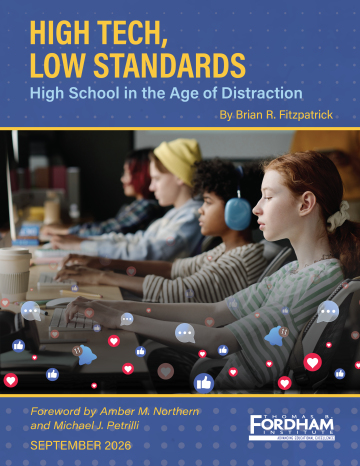
High Tech, Low Standards: High School in the Age of Distraction
A new national survey finds that school-issued devices, AI misuse, and grade inflation are undermining learning and leaving many students feeling unprepared for the future.

Remediation in Higher Education: A Symposium
Is remediation in additional-topics providing a valuable service to society? Or does it amount to paying for someone's education twice? Read competing views of the issue in this rare Fordham look at the higher-education system.
The State of State Standards (1998)
Three Fordham staff members analyze trends spotted in academic standards across the disciplines. They found that too many state standards are vague, anti-knowledge, entranced with 'relevance,' and focused on teaching rather than learning.

Spending More While Learning Less: U.S. School Productivity in International Perspective
With OECD data, Walberg shows that the United States' educational system is the 'least productive in the developed world.'

The Tracking and Ability Grouping Debate
Tracking and ability grouping strategies differ widely from school to school. They diverge even more widely from their portrayal in the popular criticisms of the 1980s. This report digs into the sensitive matter of whether those criticisms are valid today. The answer tells a more complicated and more honest story than we have heard before on this topic.

State Math Standards
In this review of state math standards, authors Raimi and Braden found a disturbing lack of 'mathematical reasoning' in most of the 47 state standards they examined; only three states earned 'A's' while 16 states flunked.
State Science Standards
This review of state science standards is the final in our series of reports analyzing state standards in the five core content areas. For this review, author Lawrence S. Lerner analyzed the science standards of 36 states and found that state science standards are the strongest of the five disciplines we studied. Based on his analysis, six states earned 'A' grades, seven earned 'B's,' and only nine flunked.
State History Standards
The second in a series of evaluations of state standards, this is our first review of state history standards. In his analysis, author David W. Saxe offers a scathing indictment of state history standards, which he judged to be little better than the oft-ridiculed National History Standards; four earned 'A's' or 'B's,' while 19 states flunked.
State Geography Standards
This is the third in a series of reports on state standards published by the Fordham Foundation and is our first-ever look at state standards for geography. Authors Susan Munroe and Terry Smith found reason for hope in a few of the excellent standards they found (like Colorado's), but most of the documents they analyzed were extremely weak; only six states earned 'A's' or 'B's,' while 18 states failed.
State English Standards
Dr. Sandra Stotsky, the eminent authority on English language education, led off a Fordham series of standards reviews with a detailed critique of the English/Language Arts standards of 28 states. Massachusetts' were found to be the strongest, a beacon for other states to emulate.