Mobile Navigation

  • National
    • Policy
      • High Expectations
      • Quality Choices
      • Personalized Pathways
    • Research
    • Commentary
      • Gadfly Newsletter
      • Flypaper Blog
    • Events
    • Scholars Program
  • Ohio
    • Policy
      • Priorities
      • Media & Testimony
    • Research
    • Commentary
      • Ohio Education Gadfly Biweekly
      • Ohio Gadfly Daily
  • Charter Authorizing
    • Application
    • Sponsored Schools
    • Resources
  • About
    • Mission
    • Board
    • Staff
    • Career
Home
Home
Advancing Educational Excellence

Main Navigation

  • National
  • Ohio
  • Charter Authorizing
  • About

National Menu

  • Topics
    • Accountability & Testing
    • Advanced Education
    • Career & Technical Education
    • Charter Schools
    • Curriculum & Instruction
    • ESSA
    • Evidence-Based Learning
    • Facilities
    • Governance
    • Personalized Learning
    • Private School Choice
    • School Finance
    • Standards
    • Teachers & School Leaders
    • Think Again
  • Research
  • Commentary
    • Gadfly Newsletter
    • Flypaper Blog
    • Gadfly Podcast
  • Events
  • Scholars Program

The Education Gadfly Weekly

Sign Up to Receive Fordham Updates

We'll send you quality research, commentary, analysis, and news on the education issues you care about.
Thank you for signing up!
Please check your email to confirm the subscription.

On school discipline, let’s not repeat all our old mistakes

Volume 14, Number 29
6.24.2014
6.24.2014

On school discipline, let’s not repeat all our old mistakes

Volume 14, Number 29
view
High Expectations

Lacking Leaders: The Challenges of Principal Recruitment, Selection, and Placement

A school’s leader matters enormously to its success and that of its students and teachers. But how well are U.S. districts identifying, recruiting, selecting, and placing the best possible candidates in principals’ offices? To what extent do their practices enable them to find and hire great school leaders? To what degree is the principal’s job itself designed to attract outstanding candidates?

6.24.2014
NationalReport

Lacking Leaders: The Challenges of Principal Recruitment, Selection, and Placement

6.24.2014
Report

On school discipline, let’s not repeat all our old mistakes

Michael J. Petrilli
7.16.2014
Blog

At ed schools, a low degree of difficulty

7.16.2014
Flypaper

Tony Bennett, exonerated

The Education Gadfly
7.16.2014
Blog

Ode to Weird Al

7.16.2014
Resource

VIDEO: On the Rocketship: Expanding the high-quality charter school movement

7.2.2014
Video

Assessing and Evaluating Teacher Preparation Programs

Robert Pondiscio
7.16.2014
Blog

The Case Against Exit Exams

Pamela Tatz
7.16.2014
Blog
view

On school discipline, let’s not repeat all our old mistakes

Michael J. Petrilli 7.16.2014
Blog
view

At ed schools, a low degree of difficulty

7.16.2014
Flypaper
view

Tony Bennett, exonerated

The Education Gadfly 7.16.2014
Blog

Ode to Weird Al

Michael J. Petrilli, Dara Zeehandelaar Shaw, Ph.D., Amber M. Northern, Ph.D., Pamela Tatz 7.16.2014
Resource
view

VIDEO: On the Rocketship: Expanding the high-quality charter school movement

7.2.2014
Video

view

Assessing and Evaluating Teacher Preparation Programs

Robert Pondiscio 7.16.2014
Blog
view

The Case Against Exit Exams

Pamela Tatz 7.16.2014
Blog
view

Lacking Leaders: The Challenges of Principal Recruitment, Selection, and Placement

6.24.2014
Report

By Daniela Doyle and Gillian Locke, Public Impact
Foreword By Chester E. Finn, Jr. and Amber M. Northern

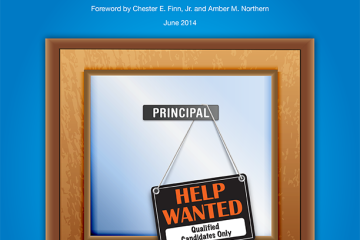
A school’s leader matters enormously to its success and that of its students and teachers. But how well are U.S. districts identifying, recruiting, selecting, and placing the best possible candidates in principals’ offices? To what extent do their practices enable them to find and hire great school leaders? To what degree is the principal’s job itself designed to attract outstanding candidates?

In Lacking Leaders: The Challenges of Principal Recruitment, Selection, and Placement, authors Daniela Doyle and Gillian Locke examine five urban school districts that have sought to improve their principal-hiring processes in recent years. They find some strengths—but also plenty of challenges:

  • The principalship is a high-pressure job in which the school head’s authority is generally not commensurate with his or her responsibility. It’s also a job that does not pay very well. Put these shortcomings together and it’s not surprising that many high-ability individuals are loath to seek such a position.
  • Recruitment of leadership talent beyond a district’s own boundaries is limited and uneven. Most principals are therefore selected from a group of individuals already on the district payroll. While there is nothing inherently wrong with that, not much strategic thought goes into how to identify talent or find the best fit between the skillset of a new principal and the needs of a specific school.
  • Districts have built into their selection-and-hiring processes many sensible practices—and cronyism is less of an issue than it used to be. Yet those same rubrics don’t collect much hard data on candidates’ prior effectiveness in improving student outcomes.

In the authors’ words,

Our primary finding is that principal-hiring practices—even in pioneering districts—continue to fall short of what is needed, effectively causing needy schools to lose out on leaders with the potential to be great. Our research suggests, however, that better hiring practices alone are only part of the solution. Districts must also re-imagine the principal’s role so that it is a job that talented leaders want and are equipped to execute successfully.

Among their key recommendations are the following:

  1. Make the job more appealing—and manageable. Give principals the power to lead, including authority over key staffing decisions, operations, and resources.
  2. Pay great leaders what they are worth. Compensation must be commensurate with the demands, responsibilities, and risks of the job—and should reward success in this challenging role.
  3. Take a proactive approach to recruitment. Develop criteria to identify promising candidates both inside and outside of the district and actively seek them out. At the same time, identify and prepare internal candidates systematically and early—and eliminate barriers that might discourage high-potential candidates.
  4. Insist on evidence of a candidate’s prior success in boosting pupil achievement.
  5. Evaluate candidates against the competencies and skills demonstrated by successful principals.
  6. Design the placement process to match individual schools’ needs with particular candidates’ strengths.
  7. Continually evaluate hiring efforts. Collect and analyze all relevant data, and then develop metrics by which to assess each stage of the process, particularly in relation to the school results that follow.

Register for the July 31 event 'Steering great leaders into the principal's office'
 

INFOGRAPHIC

On a mobile device? View the Lacking Leaders infographic.

____________

If you have questions about the book, please email Dara Zeehandelaar.

view

On school discipline, let’s not repeat all our old mistakes

Michael J. Petrilli
7.16.2014
Blog

Just as the education-reform movement is starting to figure out how to use test-score data in a more sophisticated way, the Obama administration and its allies in the civil-rights community want to take us back to the Stone Age on the use of school discipline data. This is an enormous mistake that repeats almost exactly the nuance-averse way we looked at test-score data in the early days of NCLB.

We all know that there are real problems with the ways that discipline is meted out in some American schools today. You can find campuses where huge numbers of students are suspended or expelled, particularly African American and Latino teenagers, mostly boys. A few years later, those young people are likely to end up in America’s bloated prison system, causing all manner of societal suffering along the way, not to mention blighting their own lives. “Zero tolerance” policies—removing administrator discretion and treating all offenses as equally injurious—have arguably made things worse.

I whole-heartedly support efforts to improve the ways that schools handle these issues; tips and training on creating a positive school culture and reducing suspensions and expulsions are welcome. Nor do I doubt that some of America’s 100,000-plus schools discriminate against minority children. I’ve heard Russlynn Ali, former assistant secretary for civil rights at the U.S. Department of Education, talk about the district where a black Kindergartener gets suspended for pulling a fire alarm while a white tenth grader does the same thing and gets off with a warning. That’s wrong, and I’m grateful that students who face such discriminatory actions can file complaints with the Office of Civil Rights.

Yet the administration’s recent decision to apply “disparate impact theory” to its school-discipline enforcement policy is highly problematic and surely destined to prove counterproductive. It is also certain to have a chilling effect on the use of appropriate discipline measures, which puts the entire school-improvement project at risk.

The key part of the administration’s ill-conceived discipline policy states,

The administration of student discipline can result in unlawful discrimination based on race in two ways: first, if a student is subjected to different treatment based on the student’s race, and second, if a policy is neutral on its face—meaning that the policy itself does not mention race—and is administered in an evenhanded manner but has a disparate impact, i.e., a disproportionate and unjustified effect on students of a particular race.

As the eminent legal scholar Richard Epstein explains in his recent Education Next article,

Much of the analysis turns on the word “unjustified.” Disproportionate rates should not be regarded as unjustified merely because they reflect higher rates of improper behavior by minority students than by white students. But this point is never explicitly acknowledged in the ED and DOJ guidance.

This is the heart of the matter. What if African American and Latino students actually misbehave at higher rates than do white and Asian students? If that’s the case, then race-neutral discipline policies, fairly applied, will result in a greater proportion of minority students receiving punishments. Yet the administration is saying that educators whose legitimate, even necessary, actions produce that result can still be charged with discrimination. Epstein rightly asks,

Just what sanction should apply to a school where discipline is imposed on a color-blind standard yet has statistically imperfect outcomes? Should some white students be summarily suspended, expelled, or otherwise sanctioned to make the numbers come out correctly? Or should schools give a pass to black students who have committed serious offenses in order to achieve the same ends?

Lamentably, it cannot surprise us if minority students today misbehave at “disproportionate” rates. African American and Latino children in America are much more likely to face challenges that put them “at risk” for antisocial behavior. They are more likely to be poor (and much more likely to be extremely poor); more likely to grow up in a single-parent family (nearly always headed by a mother, which is especially problematic for boys); and much more likely to live in neighborhoods where poverty is concentrated. Civil-rights enforcers should, at minimum, consider these “background variables.” Yet the administration’s policy looks at race alone. Few social scientists, regardless of ideology, would consider such an approach sound.

Can the administration not take a lesson from America’s experience with the uses of test-score data in making judgments about educators and schools? In that realm, we’ve made significant progress over the past fifteen years. “Back then,” we typically evaluated schools based on average test scores alone. Under No Child Left Behind, we added some nuance by disaggregating proficiency rates by racial and other subgroups. Still, that law became notorious for labeling schools as failures just because they served large proportions of poor students, even though some of those schools were making encouraging annual gains with their populations. We’re finally looking at growth over time, not just a snapshot in time, and, when it comes to teachers, we’re complementing test-score data with observations and other on-the-ground information.

Yet self-styled accountability hawks, such as Dropout Nation’s RiShawn Biddle, applaud the crude use of student-discipline data. Their argument, as far as I can tell, is that discrimination happens and that the administration’s crusade is necessary lest bad actors—bad adult actors, that is—be let off the hook. But again, the question isn’t whether some schools out there are violating students’ civil rights; surely they are, and they should be sanctioned for it. It’s equating “disparate impact” with “racial discrimination.”

C. Todd Jones, a deputy assistant secretary in the office for civil rights in the George W. Bush administration, has explained why this is so pernicious.

Remember, OCR investigations which result in evidence of a violation almost always end with a consent agreement. This means that in the real world, OCR will be pushing for consent agreements binding districts where the only evidence that they did anything wrong will be statistical.

A nation that presumes that law enforcement investigation is necessary based on statistical disparity is a nation that is disposing of the presumption of lawful behavior. As one who used to enforce these laws, I am quite certain that there are districts that are discriminating against people on the basis of race just as certainly as I am convinced that other districts are not. However, when our chief law enforcement agency encourages review in this manner, it will push an ever shifting collection of school leaders into a presumption of unlawful behavior that is only to be satisfied by someone else’s (OCR’s) evaluation of the remaining evidence. This inevitably will force those school leaders to ignore that which they cannot otherwise quantify, which is a diminution of the professional trust of administrators just as surely as zero-tolerance policies are.

President Obama’s policy will have a predictable effect: eliminating suspensions and expulsions as an option for school administrators. Districts (and charter schools) will simply decide that enforcing any discipline code is too risky. Such a policy will further erode adult authority in our schools, encourage educators to keep disruptive students in classrooms, and curtail the learning of those students’ peers—with a “disparate impact” on those who come to school ready and eager to learn.

Educators often complain that policymakers stack the decks against them. In this case, regrettably, they’re not wrong.

An earlier version of this article appeared on Flypaper.

view

At ed schools, a low degree of difficulty

7.16.2014
Flypaper

Twelve years ago, my wife and I went back to school. Not the same one, though: she went to medical school and I went to education school. I don’t think I’ll shock even the gentlest reader by asserting that the former was harder than the latter, but I would like to offer a glimpse of how differently rigorous they were.

Here’s a reconstruction of a typical conversation from our school days:

Me: “How was school, dear?”

Wife: “I have to master the circulatory system by Monday or repeat the entire year. How was school, dear?”

Me: “I have to write a one-page reflection on what education should be.”

Wife: [Mutters oaths, none of them Hippocratic.]

I can’t imagine a professional school more rigorous than medical school. And I’ll leave aside for now how crazy hard it is just to get in, or the I-can’t-believe-it’s-not-illegal madness of what happens after a doctor graduates. (Free romance tip: marry a doctor after she’s finished residency, not before.) But say what you want about it—and my wife and her classmates did, believe me—those med students learned how to be doctors.

Me? This ed student’s classes generally went like this: a professor would speak for a bit on some theoretical matter, then we’d break into small groups to discuss it for an extravagantly long time, then we’d get back into a big group and share our opinions some more. I remember a class one evening in which you could not speak unless you had been tossed an inflatable ball. My wife’s classes did not go like this.

If memory serves, the only tests I ever took were the state certification exams. These were parlor games compared to the board exams my wife took. I tried some sample questions and decided, hey, seven out of ten ain’t bad; she retreated to an undisclosed location for a week of dawn-to-nightfall study. I’m now certified to teach multiple subjects in two states. These certifications tell you as much about my competence as your license tells me how well you drive.

In education school, I received constant encouragement to be a “reflective practitioner.” The thing is—and it’s the thing that still bugs me—I don’t recall learning how to do anything. Pilots aren’t trained by forming small groups to discuss the atmosphere. Cadets don’t become cops by writing weekly responses to Crime and Punishment. Law students have to pass the bar before their opinions are anything you’d pay for.

The logic was, I believe, that we would receive our practical training on the job. And I guess I did. But it was rather in the manner one would learn by being told to find the manual after the starboard engines quit. The hard way is not the worst way to learn; one would, however, expect more enlightened pedagogy from a school of education.

What do I wish I’d learned? I wish I’d learned what I’m still trying to figure out now, fourteen years into my career: How to teach my students to read well, for one. A close second is what to do when they can’t. But hell, I’d have settled for learning how to take attendance, or collect papers, or manage a fire drill properly.

I also wish my experience was an unfortunate anomaly. Instead, a new report on our schools of education by the National Council on Teacher Quality augments my dismay: barely a third do an adequate job in reading instruction, around one in five do so in math, and under 10 percent do well in both simultaneously. Would we tolerate doctors coming out of medical school with commensurate ignorance of treating fevers and mending broken limbs?

Teachers are known to speak wistfully of the public’s greater esteem for other professions. Having seen all it takes to practice medicine, there’s no doubt in this teacher’s mind that doctors earn their respect. Having seen all it takes to get hired to teach, I’d say we practitioners have some reflecting to do.

Peter Sipe teaches at a public middle school in Boston. This article originally appeared in the Boston Herald. 

view

Tony Bennett, exonerated

The Education Gadfly
7.16.2014
Blog

Last week, Indiana's Inspector General exonerated former state superintendent Tony Bennett of any wrongdoing for changing the grade of a high performing charter school. As Gadfly readers surely remember, Bennett sought the change when preliminary results from the state's new accountability system failed the “face validity” test (the school—well known for getting great outcomes for low-income children—inexplicably received a middling grade). His political opponents accused him of favoritism and forced him from his subsequent role running Florida's education system; now we know that he was simply doing his job (and doing it well). The decisions of public servants surely deserve our scrutiny, but if we wanted talented people to take these grueling positions, we need to stop with the baseless, personal attacks.

In the shadow of the NEA’s fascinating convention last week, the AFT held its own con-fab this weekend, breaking some news along the way. First, in light of the NEA’s demand that Education Secretary Arne Duncan resign, the AFT took a slightly more circumspect approach: they commanded President Obama to put Duncan on an “improvement plan” and decreed that Duncan should resign if he doesn’t switch to more union-friendly positions. Meanwhile, the AFT also passed a resolution calling for teachers to provide more input into Common Core implementation—a significantly watered-down version the resolution passed by the Chicago Teachers Union, which called for the national union to flat-out oppose the standards.

Course Access is relatively new state-level program that affords students the opportunity to supplement their education with course offerings in third-party providers in online, blended, and/or face-to-face formats. Today, the Foundation for Excellence in Education released a new white paper highlighting the opportunities that Course Access programs provide and lessons we can learn from early implementers. Good stuff!

Ode to Weird Al

7.16.2014
Resource

Pardon the Gadfly

Mike and Dara talk school discipline, teacher-prep programs, and high school exit exams.

Amber's Research Minute

Amber gets practical about school choice. Making School Choice Work Michael DeArmond, Ashley Jochim, and Robin Lake, (Seattle, WA: Center on Reinventing Public Education, July 2014).

Mike: This is your host Mike Petrilli of the Thomas B. Fordham Institute, here at the Education Gadfly Show and online at edexcellence.net. Now, please join me welcoming my cohost, the Weird Al of education policy, Dara Zeehandelaar.

Dara: How did I know you were going to say that?

Mike: I love these news songs that Weird Al is out with. I have to admit, I’m a big Weird Al fan. I mean, go figure. Word play, parody singing, he's got it all. Do you have a favorite Weird Al song?

Dara: I don’t find him particularly funny or entertaining?

Mike: What, are you serious?

Dara: Yeah, and this is not just now? This has been since whatever the … in the 90s and “Eat It.”

Dara: See, I just … I think that he's clever, but it’s not really my cup of tea, maybe for the same reason that I can’t stand karaoke and I really don’t like cover bands, either.

Mike: Oh, Dara. What is this?

Dara: I hate fun. I hate fun, Mike.

Mike: There it is. You have now alienated most of our listeners, all right, with all of that.

Dara: I hate fun.

Mike: You are somebody who likes to go run for fun. That right there is a sign.

Dara: I’d rather listen to the original, and if that means a DJ instead of a cover band at a party, then fine.

Mike: You don’t listen to Weird Al because of the music. You listen because of the funny lyrics.

Dara: Okay.

Mike: “Just eat it. Just eat it.” That is my favorite, I have to say.

Dara: Why?

Mike: Because I never quite understood the original lyrics on that one, “Just beat it.” Anyway, “Just Eat It,” that was a great song.

Dara: It’s funny. I never really … I knew you—

Mike: You don’t like puns either, do you?

Dara: I knew you … It’s because I hate fun and I’m not funny.

Mike: You know …

Dara: I knew you were going to come in and ask me …

Mike: You know, the ironic thing is—and I hope this is irony, but maybe it’s not—is that Dara’s actually very good at our April Fool’s Day Gadfly efforts. She comes up with some of the best ideas. You are funny.

Dara: Because I’m always the straight man. I’m the last with the joke. I’ll think of the punchline like two hours after the joke, so I can do the straight stuff, but I’m not … I’m just not very clever, Mike, it’s true.

Mike: If you haven’t, check out Weird Al’s new song “Word Crimes.” It’s an ode to those grammar hawks like Pamela and a lot of fun. Okay, let’s play Pardon the Gadfly. Pamela, kick us off.

Pardon the Gadfly

Pamela: Mike, in today’s Gadfly, you argue that the Obama administration’s application of disparate impact theory to its school discipline enforcement policy is an enormous mistake. Can you elaborate?

Mike: It’s a really, really big enormous mistake? Is that what you had in mind?

Pamela: Yeah, about that.

Mike: Okay, yeah. Here's the deal. Dara, look, totally understand the point that there are schools out there that are not doing school discipline well. They don’t have a strong school culture. They resort to a lot of suspensions and even expulsions, and in some of these schools, you look at the numbers, and it’s mostly black and Latino boys who are being expelled and suspended in high numbers.

The office of civil rights looks at this and says, “We've got to do something about this.” Okay, I certainly understand that there may be schools out there that are not doing this well, and that might even be discriminating, and it’s the job of office of civil rights to deal with that.

Here's the problem. They’ve come out with this policy that said explicitly to administrators, “Even if you have a policy that is race neutral, and you apply it in a race neutral way - okay, there's no evidence that you’re treating, in other words, African-American kids differently than white kids - you can still be found guilty of discrimination if it has a disparate impact.” In other words, if you end up suspending more black or Latino kids than white or Asian kids, I think that’s nuts. What do you think?

Dara: From a former teacher perspective, I had no idea what the discipline policy at my school was. I didn’t even know how to discipline a student should that occur. I think that this is perhaps giving too much credit that there is actual thought put into these policies. I mean, at my school, discipline was handled by one person. It was the assistant principal.

Mike: You were at a big high school.

Dara: I was at a large urban school, and beyond that, I had no idea how my school handled discipline. Suspension, in-house suspension, sent home. Search me. I think in order for any discipline policy to work, you have to … In order for any discipline policy to work, you have to acknowledge that most people have no idea what they’re doing.

Mike: You mean the teachers don’t have a good strategy, and that the schools don’t have an actual plan. I mean, you go into some of these high-performing schools, including high-performing charter schools and some Catholic schools, and they do. They have a school-wide approach to these issues, and they say very explicitly, “Here's how we handle these things. Here's how we try to create a positive learning environment.”

They train the teachers on it, and the whole hope is to get to the point where you don’t have to suspend kids or discipline kids because you’re sweating the small stuff, and you're making sure that these problems don’t happen in the first place, but if they do happen, they have a plan for dealing with them, right? I totally get it. We should help schools get much better at this than they are today, but some of those charter schools still end up from time to time suspending kids, and in my view, that's okay. That’s important because you know what? It’s not just about the kids who get suspended, and what's the best way to handle their problems, maybe help them get back on the straight and narrow.

It’s also about all the other kids, and we know that disruptive students, one disruptive kid can have a huge negative impact on student achievement if teachers feel like they have no option but to keep that kid in the class.

Dara: Right, so I think that ultimately, I’m agreeing with you, but what I think is important is that you can’t … You can’t include something like disparate impact theory saying that a discipline policy has a disparate impact when it implies that there is a discipline policy to begin with.

Mike: Gotcha. Very, very good. Okay, topic number two.

Pamela: Also in today’s Gadfly, Boston middle school teacher Peter Sipe argues that ed. schools don’t prepare teachers well enough for the classroom, illustrating his point by comparing his ed. school experience with his wife’s medical school experience. Should ed. schools focus more on practical training, or should teachers continue to gain that with on-the-job experience.

Mike: Oh, Dara, this piece is just aggravating. It’s so well-written, but he shows … I mean, his wife’s in there cramming for exams learning practical things like, I don't know, how to cut open bodies and stuff, and he's sitting around talking education theory for hours on end. Why are our ed. schools seem so against teaching teachers practical stuff that might help them in the classroom?

Dara: Okay, you just said a lot there, Mike, and I will briefly say and not dwell on the fact that I highly disagree with the author.

Mike: Okay.

Dara: That training teachers and training doctors are two completely different things. Okay, so I’m going to put that aside for a second. Putting aside the faulty analogy here, the question that Pamela asks is should ed. schools focus more on practical training. The fact is, they do. Part of the traditional ed. school preparation is a large amount of student teaching.

Mike: Mmm-hmm (affirmative).

Dara: What they are lacking, however, is meaningful feedback and reflexivity on that student teaching experience.

Mike: Yeah.

Dara: I think it’s … You have to … Saying that ed. schools don’t have any practical training is misleading. They do.

Mike: All right, that’s fair. Student teaching.

Dara: There's very little guidance, and especially the fact that you unleash a new teacher in a classroom with zero supervision, there's another big failing, right, that you assume that once you’ve given them this training that they do have the practical skills and they have a once-a-year observation or maybe twice with the new teacher mentor or something like that. I think that really what is lacking here is meaningful practical preparation.

Is there too much theory taught in ed. schools? Probably, but saying that there is no practical knowledge is not entirely accurate, I think.

Mike: All right. Let me talk about my own experience. Many, many moons ago now, going through to ed. school, University of Michigan, right? I did this on the side, had my political science degree, and then I got my teaching certification on the side, and yes, I did student teaching, so that was practical, did not get a whole lot of great feedback, but otherwise, the courses I took, they were both super easy - I mean, everybody knew you were going to get an A without doing any work. It was totally different than my poli-sci classes, but also, they were all theory.

I mean, we sat around talking about Piaget. Fine, okay, but then you pick up the book, like the newish, recent book by Doug Lemov, and here he says, “Here's these practical things I’m going to teach you about how to be an effective teacher, how to stand in front of the room, what to do when the kids come in, how to make eye contact, how to ask questions.”

Ed. schools by and large have said, “No, no, no, we are not about that. That is vocational training. That is the kind of thing that might happen at one of those two-year community colleges. We are part of academia, and as part of academia, what we do is we talk about … We have a body of scholarship, and we share that, and we do research, and we share that too.” All of which is to say, well, fine, then you know what? Maybe four-year colleges should not be training teachers because they seem to think it’s below them to provide practical help for their teachers.

Med schools don’t seem to worry about this. I don’t think law schools, business schools … Most of these other professional schools seem to understand that part of their job is to help their graduates actually succeed on the job.

Dara: I think “n” of two here, right, I think that your experience is not what we should be aiming for and this idea that you can include vocational training into teacher preparation is absurd.

Mike: Thank you.

Dara: My experience was different from yours. I went through an alternative certification program, and half of my boot camp classes were theory, and we learned about Piaget too, but the other half, literally, one of classroom class assignments for our class was “What are you going to do on the first school? Write a first-year lesson plan.”

Mike: Good.

Dara: Teaching icebreaker activities. Teaching classroom management.

Mike: Good.

Dara: I did have some of that practical training in my experience. Interestingly, obviously, my theory classes were taught by university professors. The practical classes were taught by teachers.

Mike: Yeah, makes sense. By the way, can we get Piaget out of the curriculum? I mean, that guy just really annoys me. How about Paulo Freire, for God’s sake. You didn’t have Paulo Freire.

Dara: I did have Freire. I liked Freire.

Mike: You liked Freire? Are you serious? He tried to run the schools down there in South America. It was a complete disaster.

Dara: Not until grad school, all right.

Mike: Pamela, topic number three.

Pamela: During the Common Core transition, 21 states will continue to make students pass exit exams in order to graduate from high school, and 10 of these states will switch to tougher Common Core aligned tasks. Anne Hyslop argues in a recent policy brief that unless states address the possible consequences, this could be a disaster. How should states handle this?

Mike: So Dara, this is not going to be a disaster because I can’t imagine any state is going to be dumb enough to say, “Hey, we’re going to use a much tougher test, and we’re going to set these super high cut scores, and we’re not going to change our policies around graduation requirements at all.” Anne is right to say that states have to figure out a plan and how they’re going to handle this transition.

Dara: I think that is an excellent point. We’re not headed towards disaster, and obviously states have to thing strategically about this, but they already did this the first time they implemented a high school exit exam. For example, in California, students take the CAHSEE, the exit exam, in the 10th grade for the first time. They have up until the 12th grade to pass it, and it’s already aligned with the state standards, just not necessarily at a 10th grade level. This question of high school exit exams aligned to state standards is not a new one, and it hasn’t been disastrous yet.

Mike: All right, but what states will need to do, most likely, is they had to set two different passing scores, right? The whole promise of Common Core is to have a high cut score that meaningfully measures college and career readiness. For 11th graders or 12th graders, you say, “If you hit this score, we predict that you will be able to go take credit-bearing courses in college or get a decent paying job.” You’ve got to make sure that is maintained.

That should not be the level that you have to hit in order to graduate from high school because we’re pretty sure that the first few years it’s going to be something like a third of our kids who are hitting that level, and we are not going to flunk two-thirds of the kids and not give them high school diplomas. That means you got to set a lower level as well that indicates more some kind of basic literacy and numeracy. That is what should be tied to high school graduation.

Dara: I think I agree with you and all, so channel checker for a moment, which is to say that a smart exit exam system will also be used by the state university system, and instead of having an SAT or an ACT or something like that, that you have this test whose results can be applied more universally. Again, it’s do you get a diploma? Are you college and career ready, and for entrances into the high education system.

Mike: That’s a tough one, I have to say. I don’t think we’re going to much success in getting colleges to use it for their admissions necessarily, but there is a move to make them or encourage them to use it for placement. They’ve got these other tests out there. They use Accuplacer and other things to decide if the kid ends up in remedial education, and the hope is say, “Hey, if you pass the park or smarter balance at the college and career-ready level, that should mean that you do not have to take a remedial course.” End of story.

Dara: It was worth the plug.

Mike: It was worth the attempt, Dara. Very nicely said. Okay, that’s all the time we've got for Pardon the Gadfly. Now it’s time for everyone’s favorite, Amber’s Research Minute.

Amber’s Research Minute

Amber, welcome back to the show.

Amber: Thank you, Mike.

Mike: So Amber, Dara loves Weird Al. I’m just wondering if you do too.

Dara: Dara does not.

Amber: I used to think he was pretty creepy. Still think he's kind of creepy?

Mike: He did used to look … He still looks a little creepy.

Amber: Yeah, the hair and the lankiness, I don't know.

Mike: I’m not asking you to kiss the guy. I just want to know like do you find his songs funny?

Amber: Oh, funny. I mean, I guess in some elementary school way, right?

Dara: I just don’t find him particularly entertaining, that's all.

Mike: I am now out on a limb.

Dara: Did Nico find him entertaining, Mike?

Mike: I did have Nico watch “Word Crimes,” and yes, Nico thought it was very funny, especially the line about hitting the guy over the head with a sledge hammer or something like that. That stood out to Nico.

Dara: So, makes sense.

Mike: Fine. They always say never ask a question you don’t know the answer to. All right, you and Dara. No sense of humor at all.

Amber: Sorry.

Mike: What you got for this week, Amber?

Amber: We've got a new report out from the Center for Reinventing Public Education called Making School Choice Work. It surveys 4000 parents and interviews other civic leaders in eight choice-rich cities: Baltimore, Cleveland, Denver, Detroit, Indy, New Orleans, Philly, Washington DC, and helps …

The report’s purpose was to help civic leaders in these cities, help them improve their existing choice system, regardless of whether these parents have kids in charter or traditional schools.

Three key findings: One, the majority of parents are actively choosing a school for their child, though they also report considering just one or two schools, so the natural question is how many options are there to begin with, and then on that question, about half report that if their current school was not available, there were no other schools that would satisfy them.

Number two, parents identify a number of barriers to choosing schools, including inadequate information, transportation, and a lack of quality options. Not understanding which schools their child was eligible to attend was the most often-cited barrier. Those challenges were not unique to the charter or the district sector.

Last, responsibility for schools often fall to multiple parties: school districts, charter school authorizers, state agencies, and so on and so forth, and too many cooks in the kitchen makes it difficult for parents to navigate information they found, so we know this. Phoenix has 28 school districts. Houston has 19. If you think about a charter operator trying to coordinate an enrollment timeline, for instance, and having to negotiate agreements with all those districts would be a nightmare. They give you some pragmatic examples of what these governance challenges, how they’re impeding quality school choice.

In the end, they recommend that in some cases, we need to change laws to ensure districts and charter authorizers are working together. Maybe we need to address … Governance seemed to be the big thing that they ended up with because you just got a morass of different people with their hands in the pie, and they cannot coordinate, and parents are confused in some cases. Anyway, I think some of this stuff we knew, but to have this information out of the mouths of parents is exceedingly helpful.

Mike: That point about governance, Robin Lake from CRPE  has been writing about Detroit especially, though I think this probably certainly applies to cities in Ohio we know too where you’ve got multiple authorizers, many of whom aren’t there in the city. They’re all of the state of Michigan, and they may be authorizing schools that are not very good, right?

Amber: Right.

Mike: There's nobody in charge, right? There's nobody … Somebody in Detroit, if the mayors say, “Hey, we've got to shut down these bad charter schools,” there’s not a lot … He can’t do it, right?

Amber: That’s right.

Mike: On the one hand, you say, “Look, this is dynamic. There's a free market. There's a lot of competition.” On the other hand, it feels a little bit like the wild west, and when you’ve got a real quality problem, say, “I don't know how to get our hands around this.” It’s a problem.

Amber: It’s a problem.

Dara: Did they have any recommendations or observe any differences in cities that had a common application?

Amber: Not that I am aware of. The drilldown they did was Denver, and what they're going to do, I mean, they said … I mean, it’s apparently a whole body of work. The next reports are going to drill down in each of these cities, so I’m anticipating that they’ll address that question in upcoming reports.

Mike: You would think that the common application should help, and that’s something that’s important. Look, CRPE does great work on just getting these details right. In my view, the big argument on school choice is over. I can’t imagine that we’re going to …

Mike: We’re not going to go back to a day when parents don’t have choices. Now the question is, how we make the system work, as they said in the title here. How do we get the infrastructure? How do we deal with quality? How do we deal with these different trade-offs around flexibility and regulation. All of these things, which in some ways are very wonky and technical, but they’re critical.

Dara: Isn’t this striking that the key barrier from a parent’s point of view is “Can my kid go to that school? Are they allowed?”

Mike: Sure, sure, yes.

Dara: How do I find out if they’re allowed?

Mike: How do I find out? It’s confusing.

Dara: That’s the most basic question, right?

Mike: You would think that GreatSchools and some of these other folks that are focused on providing parent information, this should be fixable. I mean, we should be able to figure out a way to get good information to parent that … That one … There are some other problems that might be harder to deal with, right?

Dara: Right, so like a charter support organization, like here in DC, like The Focus, like a group like that.

Mike: Yeah, sure, or something that's really parent facing, like GreatSchools that says, “We’re going to make sure that parents have a way, either online or in some kind of walk-up, walk-in center where they can get clear information on “Here are the choices. If you want sometimes within a mile of your house, here's what you might look at. Three miles, five miles.”

Dara: That’s right.

Mike: Here's the best information we have in terms of whether these are quality choices. I mean, that should be doable at this point.

Amber: I agree, like a central warehouse, right? A parent’s not like, “Okay, I've got to call the charter school up the road,” or if you asked your district school, like, “What are my options?” Not a huge incentive there to answer that question, which we found out in previous research.

Mike: Absolutely. Good. Okay, thank you, Amber. That is all the time we've got for the Research Minute and the Education Gadfly Show. Until next time.

Dara: I’m Dara Zeehandelaar.

Mike: And I am Mike Petrilli of the Thomas B. Fordham Institute signing off.

Announcer: The Education Gadfly Show is a production of the Thomas B. Fordham Institute located in Washington DC. For more information, visit us online at edexcellence.net.

 
view

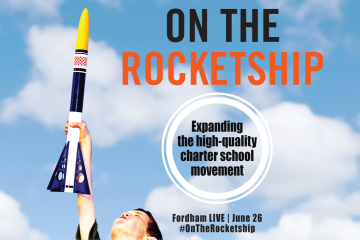
VIDEO: On the Rocketship: Expanding the high-quality charter school movement

7.2.2014
Video

Richard Whitmire’s forthcoming book, On the Rocketship: How Top Charter Schools are Pushing the Envelope, is “the best account yet of what is happening with charters,” says the Washington Post’s Jay Mathews. But big questions still abound: Can Rocketship and other high-performing schools scale up quickly, a la the “Fibonacci sequence”? Can charters do so without falling into the pitfalls of the past? Will struggling urban areas embrace this form of school choice? And what about smug suburbs?

Join the Fordham Institute for a conversation with Whitmire and a panel of experts about his book, the Rocketship network, and the future of charter schooling. 

view

Assessing and Evaluating Teacher Preparation Programs

Robert Pondiscio
7.16.2014
Blog

An increasingly bright and pitiless spotlight is being shined on America’s schools of education. With the encouragement of the federal government, states are developing systems to tie student performance data to teacher preparation programs; competition and comparisons with alternative certification programs are bringing additional pressure to bear. The upshot for those who train our teachers is increased scrutiny and ever-louder calls to prove that the teachers they turn loose on the nation’s classrooms can actually do the jobs they were trained, certified, and licensed to do. Against this backdrop, a task-force report from the American Psychological Association aims to offer a practical resource for accreditors, state education departments, and policymakers seeking to improve teacher-preparation programs. The report focuses on three data sources that are “well-established scientific methods that have evolved from the science of psychology” and that the authors argue should form the basis of all credible evaluation systems: value-added assessments; standardized observation protocols; and surveys of graduates, employers, and students. To their credit, the report authors are clear-eyed, taking pains to note the “utility and limitations” of value-added and the other proffered evaluation systems—but maintaining that we should judge the merits of teacher-prep programs “with the best evidence that can be obtained now, rather than the evidence we might like to have had, or that might be available in the future.” The report offers thirteen recommendations for evaluating teacher-prep programs, the most important of which is to insist that such programs have “strong affirmative, empirical evidence of the positive impact of their graduates on preK–12 student learning.” This is welcome news for schools, students, and future teachers, if not for the accountability-averse programs that produce them. “In some cases these recommendations will require a cultural change in teacher preparation,” the authors note with understatement. Anticipating pushback, they note “there will always remain some aspects of teaching that may not be evaluated, but this should not deter us from addressing those that can and should be addressed.” Indeed.

SOURCE: Frank C. Worrell, et al., Assessing and Evaluating Teacher Preparation Programs (Washington, D.C.: American Psychological Association, 2014.

view

The Case Against Exit Exams

Pamela Tatz
7.16.2014
Blog

Twenty-one states will continue administering exit exams in ELA and math while transitioning to the higher standards, we learn from this new policy brief from the New America Foundation’s Anne Hyslop. Ten of these states plan to replace their current exams with new PARCC or Smarter Balanced tests. This could be a disaster, she argues, unless states grapple with the consequences of shifting to the significantly tougher tests that are about the augment the significantly higher standards. (The passing score for most exit exams is currently set at the eighth grade level; if states shift the standard to true “college and career readiness,” huge proportions of students will flunk.) Hyslop points to Washington State as offering a “model transition plan”: The class of 2014 will have to pass the old exam and an end-of-course math test. The classes of 2015 and 2016 will have the option of using the old test, a specially made “bridge” test, or the new Smarter Balanced test. The classes of 2017 and 2018 will have the option of the bridge or the new test. And all subsequent classes will need to take the Smarter Balanced test. Now is the time for other states to put similar plans in place.

Anne Hyslop, “The Case Against Exit Exams,” New America Education Policy Brief (Washington, D.C.: New America Foundation, July 2014).

Fordham Logo

© 2026 The Thomas B. Fordham Institute
Privacy Policy
Usage Agreement

National

P.O. Box 110
Burke, VA 22009

202.223.5452

[email protected]

Ohio

P.O. Box 82291
Columbus, OH 43202

614.223.1580

[email protected]

Sponsorship

130 West Second Street, Suite 410
Dayton, Ohio 45402

937.227.3368

[email protected]