Choice and Federalism: Defining the Federal Role in Education
Break the ESEA stalemate
Break the ESEA stalemate

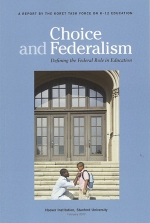
Earlier this week, the Koret Task Force of Stanford’s Hoover Institution, which I have the privilege of chairing, issued a bold proposal (primarily crafted by Russ Whitehurst) for totally rebooting the federal role in primary-secondary education.
Washington insiders will, of course, dismiss it as “politically unrealistic” precisely because it is so sweeping and radical. Maybe it will turn out to be. But with ESEA reauthorization in stalemate, the parties at loggerheads, and a total breakdown of the former “consensus” painfully visible, perhaps a sweeping, radical reboot is precisely what is most needed. States that find this reboot appealing can follow the Task Force’s proposal. States that prefer some version of the status quo may stick with it.
The Task Force begins by explaining why neither top-down accountability (à la NCLB) nor total devolution of authority to states and districts can rekindle American education and boost student achievement. Both have been tried—and both have been found sorely wanting.
What to do instead? The Task Force offers a very different approach grounded on two time-honored (and well-proven) American principles: federalism and choice.
But federalism doesn’t mean traditional “local control,” because so many school districts are captives of special interests. Rather, “vibrant, open competition among the providers of education services for students and the funds that accompany them must go hand in hand with federalism.”
And parents must have quality education choices for their children, choices about which they’re well informed. They also must be able to afford these choices, possible if the public dollars (all of them, not just federal ones) devoted to their children’s educations accompany those selfsame children to the schools of their choice and are “weighted” to acknowledge the special needs and higher costs of educating some children.
It’s up to the states, however. Those that cannot or will not embrace the competition-and-choice route may remain with some sort of reauthorized top-down federal arrangement akin to NCLB (and other categorical programs, such as IDEA and Headstart, that would be combined into the choice option).
Indeed, the self-styled “political realists” may turn out to be quite wrong, for the Task Force proposal allows for states to take or leave its ideas—and this choice given to states is a powerful thing.
Have a look—and reflect on whether this might not be better than stalemate.
The Koret Task Force on K-12 Education, Choice and Federalism: Defining the Federal Role in Education, (Stanford, CA: The Hoover Institution, 2012)
 Long overshadowed by sexier education-reform topics, pension
reform has gained allure in recent months. This paper—written by
University of Missouri economist Mike Podgursky and colleagues—adds yet more
intrigue to the pension-reform debate: It examines the impact of “pension
borders” (lines dividing districts or states with variant pension benefits) on
the mobility of school leaders. In other words, does leaving one pension system
for another—and thus incurring substantial pension loss—discourage principals
from swapping posts? In a word, yes. Using simulation techniques, analysts
examine eighteen years of panel data from Missouri (1992 to 2010) and find that
pension borders represent a substantial impediment to principal mobility. (Missouri was chosen as the case study because the state
has three distinct pension systems: for Kansas City,
for St. Louis,
and for the rest of the state. With no reciprocity among these systems, they
are as distinctly different as systems are across state lines.) Removing a
pension border between two groups of schools, the analysts found, would roughly
double leadership flows among them. This paper
offers both valuable insight into this budding issue and a smart warning
to states and districts: How retirement benefits are structured is at odds with
making the principal labor market more fluid. It’s high time we fix that.
Long overshadowed by sexier education-reform topics, pension
reform has gained allure in recent months. This paper—written by
University of Missouri economist Mike Podgursky and colleagues—adds yet more
intrigue to the pension-reform debate: It examines the impact of “pension
borders” (lines dividing districts or states with variant pension benefits) on
the mobility of school leaders. In other words, does leaving one pension system
for another—and thus incurring substantial pension loss—discourage principals
from swapping posts? In a word, yes. Using simulation techniques, analysts
examine eighteen years of panel data from Missouri (1992 to 2010) and find that
pension borders represent a substantial impediment to principal mobility. (Missouri was chosen as the case study because the state
has three distinct pension systems: for Kansas City,
for St. Louis,
and for the rest of the state. With no reciprocity among these systems, they
are as distinctly different as systems are across state lines.) Removing a
pension border between two groups of schools, the analysts found, would roughly
double leadership flows among them. This paper
offers both valuable insight into this budding issue and a smart warning
to states and districts: How retirement benefits are structured is at odds with
making the principal labor market more fluid. It’s high time we fix that.
Cory Koedel, Jason A. Grissom, Shawn Ni, and Michael Podgursky, “Pension-Induced Rigidities in the Labor Market for School Leaders” (Washington, D.C.: National Center for Analysis of Longitudinal Data in Education Research, January 2012.)
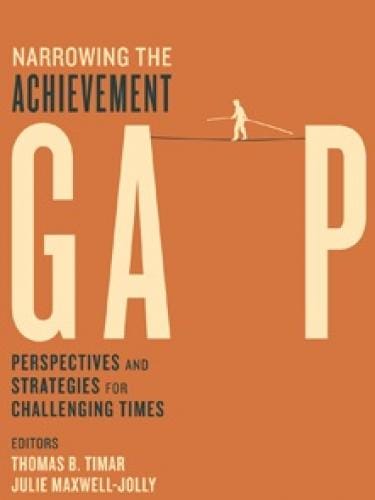
Since the 1966 Coleman report, pundits and policymakers have thrown theories, programs, and umpteen dollars at the wall separating black and white student achievement. Yet the divide between the two (as well as those we find between other key demographic groups) remains just as firm as ever. This edited volume from Harvard Education Press offers an overview of the societal and educational factors that have created the achievement gap—and some tepid potential solutions. Much of what the book presents is old hat to the weathered edu-reformer: Schools are not solely to blame and no single solution exists, for example. Still, the volume offers a few refreshing ideas. One chapter, for example, expends much ink dispelling the unyielding belief that more money pumped into education coffers leads to better student outcomes. Instead, W. Norton Grubb offers cost-cutting strategies meant simultaneously to narrow the achievement gap, eliminate waste, improve resource allocation, and identify and replicate successful state policies. While not profound, this is a worthy message, indeed.
Thomas Timar and Julie Maxwell-Jolly, Narrowing the Achievement Gap: Perspectives and Strategies for Challenging Times (Cambridge, MA: Harvard Education Press, 2012).

While waiting for the ESEA waiver announcement, Mike and Janie get to look at the week’s more entertaining edu-news, from trials for tardiness to a pot problem in the Rockies. Amber talks pensions and Chris wonders if “walking it off” isn’t always the best idea.
Pension-Induced Rigidites in the Labor Market for School Leaders
Tune in next week to find out the answer!

While business leaders rue the lack of American workers skilled enough in math and science to meet the needs of an increasingly high-tech economy, the situation may be growing even grimmer. The latest installment of TIMSS showed stagnation in U.S. science achievement, and the 2009 NAEP science assessment found that only 21 percent of American twelfth-graders met the proficiency bar. Yet while the gravity of the problem is clear, the root cause is not. Is our science curriculum lacking? Is it being squeezed out by an emphasis on math and reading? Is there a problem with our pedagogy? Are our teachers ill-prepared? Or are we simply expecting too little of teachers and students alike?
Coinciding with its new review of state science standards, The Thomas B. Fordham Institute will bring together experts with very different perspectives to engage this crucial question: "What's holding back America's science performance?"
Watch the discussion with UVA psychologist Dan Willingham, NCTQ President Kate Walsh, Fordham's Kathleen Porter-Magee, Project Lead the Way's Anne Jones, and Achieve, Inc.'s Stephen Pruitt and join the conversation on Fordham LIVE!
The bold move by Cleveland Mayor Frank Jackson in unveiling his “Plan for Transforming Schools” is a significant step forward for Cleveland, its schools, and, most importantly, its children. The Jackson Plan has the potential to make Cleveland one of the nation’s school reform leaders.
In time, it would help all of Cleveland’s schools to better provide the high quality education that every child in the city deserves. By focusing laser-like on school performance, regardless of school type (district and charter alike), it would reward and encourage the expansion and replication of great schools while putting much needed pressure on those schools that don’t (district and charter alike) to improve or get lost.
|
|
The Jackson Plan’s sense of urgency is well warranted. Despite laudable school reform efforts in Cleveland over the years - including a highly touted transformation plan in early 2010 put forth by then superintendent Eugene Sanders, and largely crafted by current district head Eric Gordon – the city has struggled to educate its children to a high standard. In fact, student achievement in Cleveland is still painfully low (only 30 percent of fifth graders are proficient in math, for example), and more than half of the city's schools (charter and district) were rated D or F by the state in 2011. Tellingly, more than 30,000 children have abandoned the city's schools in the last decade alone for other places. (To be sure, the city’s population is also shrinking, but it is unclear what’s cause and what’s effect.)
No city can survive such a perfect storm of economic weakness, demographic decline and educational failure and Mayor Jackson and his team have said with their plan that “enough is enough” at least as regards the education piece.
Their plan resembles ongoing efforts in reform-minded places as diverse as New York City, New Orleans, Indianapolis and Denver. Like in those cities, Cleveland’s plan focuses on strategies apt to have the greatest impact on student achievement in the shortest amount of time. Specifically, the plan seeks a portfolio approach to school management that includes:
Not surprisingly, self-interested critics are already taking shots at the mayor’s plan. From one side, the Cleveland Teachers Union complains that they were not included in its development and as such might not support the plan. Further, because the Jackson Plan contains some elements of the controversial Senate Bill 5 that the teacher unions found most objectionable it would come as no surprise if they worked to kill the effort. One early clue is the chilly reception that some Democratic legislators – including those from Cleveland – gave the mayor’s proposal.
From the other side, the Ohio Coalition for Quality Education – one of the state’s two charter school associations – objects to the plan because it would lead to the forced closure of charter schools that have also failed to meet the academic needs of Cleveland’s kids. Five of the seven lowest performing schools in Cleveland, for example, last year were charter schools yet continue in business as usual. Again, such broken schools fail children and Mayor Jackson is absolutely right to no longer tolerate such failure for his city’s children.
Mayor Jackson’s plan needs and deserves the support of lawmakers in Columbus. Fortunately, initial public comments from the Governor and key Republican legislative leaders who control both the House and Senate seem supportive and downright encouraging. The Jackson Plan offers Cleveland the opportunity to help turn around that city’s long-suffering schools. Its success or failure will resonate throughout the state and likely beyond. It is brave because it puts the interest of children first, and it should be supported by all who want to see Cleveland improve the education and life-chances of its youngest citizens.
 The feds may need to check their definition of "flexibility" Photo by Greeblie. |
As of this writing, the Administration’s announcement on education waivers is just hours away. The White House is gearing up for a Kumbaya moment, as state officials gleefully accept the leeway bestowed upon them by President Obama. But as the news settles in over the next few days, don’t expect the reactions to be entirely positive, for it appears that the President and his education secretary have reneged on their promise of true “flexibility” for the states. Mostly what they seem to have done is substitute one set of rigid prescriptions for another.
This is a big change in a short period. Through most of 2011, the Obama Administration reaped accolades for its intention to allow states to take a new course vis-à-vis the Elementary and Secondary Education act (a.k.a. NCLB). In September, the President got wall-to-wall coverage of the official announcement of his plan to offer waivers to the states to give them “more flexibility to meet high standards.”
Set aside the debate about the conditions he attached to those standards. Set aside the small matter of Constitutionality and separation of powers. On the issue of flexibility itself, virtually everyone seemed to be in agreement (at least in theory): The 10-year-old law is broken and it’s time to fix it. In particular, Adequate Yearly Progress needs to go the way of the dinosaurs and be replaced by something very different. Even on Capitol Hill, for all the misgivings about Duncan’s unilateralism, there was broad consensus that states should be given much greater leeway to design next-generation accountability systems. (Leeway that both Republican and Democratic governors asked for in an NGA policy statement released last week, as did a broader set of state groups this week.)
The idea of flexibility is so popular, in fact, that the President reiterated it in his State of the Union address:
So far so good. It certainly appeared from the rhetoric that the Administration would make every effort to approve reasonable proposals from states, including the 11 that applied in November for the first round of waivers (the round for which results are now imminent). The era of “Washington knows best” in education would come to an end.
But no. Thanks to excellent reporting by Associated Press correspondent Christine Armario, we recently gained access to letters the U.S. Department of Education sent to these states in December. Which document that federal micromanagement is still the order of the day.
Consider the missive sent to Massachusetts—the first-place finisher in the Race to the Top, the state with the highest achievement in the land, the one that has seen dramatic gains across all subgroups of students, a strong supporter (for better or worse) of the Common Core standards. One might assume that the Bay State would be given the benefit of the doubt. But no. Here’s an excerpt from the Department’s response to the Massachusetts waiver request:
Please address concerns identified by peers regarding subgroup accountability, including:
And another:
(That’s
just the tip of the iceberg; read the whole thing yourself.)
All of these issues can be debated ad nauseam by policy wonks. For example, when creating an A to F rating system, what should qualify a school for an A? Strong achievement? Strong growth over time? If the school misses an achievement or growth target for one subgroup (say, special education kids) should that disqualify it for an A? What if all subgroups are doing well but there’s still a big achievement gap?
Whatever your view on these arcane matters, the real issue at stake is whether the feds, or the states, should make such calls. How can the President promise a state like Massachusetts “flexibility to meet high standards” and then second-guess its attempt to rationalize its accountability system?
How this is going to end: 3 predictions
So how will this go down?
In other words, don’t expect “Kumbaya” to last very long.
A version of this essay appeared on Fordham's Flypaper blog on Monday.
While business leaders rue the lack of American workers skilled enough in math and science to meet the needs of an increasingly high-tech economy, the situation may be growing even grimmer. The latest installment of TIMSS showed stagnation in U.S. science achievement, and the 2009 NAEP science assessment found that only 21 percent of American twelfth-graders met the proficiency bar. Yet while the gravity of the problem is clear, the root cause is not. Is our science curriculum lacking? Is it being squeezed out by an emphasis on math and reading? Is there a problem with our pedagogy? Are our teachers ill-prepared? Or are we simply expecting too little of teachers and students alike?
Coinciding with its new review of state science standards, The Thomas B. Fordham Institute will bring together experts with very different perspectives to engage this crucial question: "What's holding back America's science performance?"
Watch the discussion with UVA psychologist Dan Willingham, NCTQ President Kate Walsh, Fordham's Kathleen Porter-Magee, Project Lead the Way's Anne Jones, and Achieve, Inc.'s Stephen Pruitt and join the conversation on Fordham LIVE!
While business leaders rue the lack of American workers skilled enough in math and science to meet the needs of an increasingly high-tech economy, the situation may be growing even grimmer. The latest installment of TIMSS showed stagnation in U.S. science achievement, and the 2009 NAEP science assessment found that only 21 percent of American twelfth-graders met the proficiency bar. Yet while the gravity of the problem is clear, the root cause is not. Is our science curriculum lacking? Is it being squeezed out by an emphasis on math and reading? Is there a problem with our pedagogy? Are our teachers ill-prepared? Or are we simply expecting too little of teachers and students alike?
Coinciding with its new review of state science standards, The Thomas B. Fordham Institute will bring together experts with very different perspectives to engage this crucial question: "What's holding back America's science performance?"
Watch the discussion with UVA psychologist Dan Willingham, NCTQ President Kate Walsh, Fordham's Kathleen Porter-Magee, Project Lead the Way's Anne Jones, and Achieve, Inc.'s Stephen Pruitt and join the conversation on Fordham LIVE!
Earlier this week, the Koret Task Force of Stanford’s Hoover Institution, which I have the privilege of chairing, issued a bold proposal (primarily crafted by Russ Whitehurst) for totally rebooting the federal role in primary-secondary education.
Washington insiders will, of course, dismiss it as “politically unrealistic” precisely because it is so sweeping and radical. Maybe it will turn out to be. But with ESEA reauthorization in stalemate, the parties at loggerheads, and a total breakdown of the former “consensus” painfully visible, perhaps a sweeping, radical reboot is precisely what is most needed. States that find this reboot appealing can follow the Task Force’s proposal. States that prefer some version of the status quo may stick with it.
The Task Force begins by explaining why neither top-down accountability (à la NCLB) nor total devolution of authority to states and districts can rekindle American education and boost student achievement. Both have been tried—and both have been found sorely wanting.
What to do instead? The Task Force offers a very different approach grounded on two time-honored (and well-proven) American principles: federalism and choice.
But federalism doesn’t mean traditional “local control,” because so many school districts are captives of special interests. Rather, “vibrant, open competition among the providers of education services for students and the funds that accompany them must go hand in hand with federalism.”
And parents must have quality education choices for their children, choices about which they’re well informed. They also must be able to afford these choices, possible if the public dollars (all of them, not just federal ones) devoted to their children’s educations accompany those selfsame children to the schools of their choice and are “weighted” to acknowledge the special needs and higher costs of educating some children.
It’s up to the states, however. Those that cannot or will not embrace the competition-and-choice route may remain with some sort of reauthorized top-down federal arrangement akin to NCLB (and other categorical programs, such as IDEA and Headstart, that would be combined into the choice option).
Indeed, the self-styled “political realists” may turn out to be quite wrong, for the Task Force proposal allows for states to take or leave its ideas—and this choice given to states is a powerful thing.
Have a look—and reflect on whether this might not be better than stalemate.
The Koret Task Force on K-12 Education, Choice and Federalism: Defining the Federal Role in Education, (Stanford, CA: The Hoover Institution, 2012)
Since the 1966 Coleman report, pundits and policymakers have thrown theories, programs, and umpteen dollars at the wall separating black and white student achievement. Yet the divide between the two (as well as those we find between other key demographic groups) remains just as firm as ever. This edited volume from Harvard Education Press offers an overview of the societal and educational factors that have created the achievement gap—and some tepid potential solutions. Much of what the book presents is old hat to the weathered edu-reformer: Schools are not solely to blame and no single solution exists, for example. Still, the volume offers a few refreshing ideas. One chapter, for example, expends much ink dispelling the unyielding belief that more money pumped into education coffers leads to better student outcomes. Instead, W. Norton Grubb offers cost-cutting strategies meant simultaneously to narrow the achievement gap, eliminate waste, improve resource allocation, and identify and replicate successful state policies. While not profound, this is a worthy message, indeed.
Thomas Timar and Julie Maxwell-Jolly, Narrowing the Achievement Gap: Perspectives and Strategies for Challenging Times (Cambridge, MA: Harvard Education Press, 2012).
Long overshadowed by sexier education-reform topics, pension
reform has gained allure in recent months. This paper—written by
University of Missouri economist Mike Podgursky and colleagues—adds yet more
intrigue to the pension-reform debate: It examines the impact of “pension
borders” (lines dividing districts or states with variant pension benefits) on
the mobility of school leaders. In other words, does leaving one pension system
for another—and thus incurring substantial pension loss—discourage principals
from swapping posts? In a word, yes. Using simulation techniques, analysts
examine eighteen years of panel data from Missouri (1992 to 2010) and find that
pension borders represent a substantial impediment to principal mobility. (Missouri was chosen as the case study because the state
has three distinct pension systems: for Kansas City,
for St. Louis,
and for the rest of the state. With no reciprocity among these systems, they
are as distinctly different as systems are across state lines.) Removing a
pension border between two groups of schools, the analysts found, would roughly
double leadership flows among them. This paper
offers both valuable insight into this budding issue and a smart warning
to states and districts: How retirement benefits are structured is at odds with
making the principal labor market more fluid. It’s high time we fix that.
Cory Koedel, Jason A. Grissom, Shawn Ni, and Michael Podgursky, “Pension-Induced Rigidities in the Labor Market for School Leaders” (Washington, D.C.: National Center for Analysis of Longitudinal Data in Education Research, January 2012.)