

How to widen the achievement gap
Mayor de Blasio's education initiatives: Right target, lousy aim. Robert Pondiscio
Mayor de Blasio's education initiatives: Right target, lousy aim. Robert Pondiscio
The sweetest and shiniest word in the progressive lexicon is “universal.” It connotes equity, equality, and above all fairness. As a practical matter, however, these lofty ideals are undermined when we give everyone the same even if some need more. This is a truth universally acknowledged.
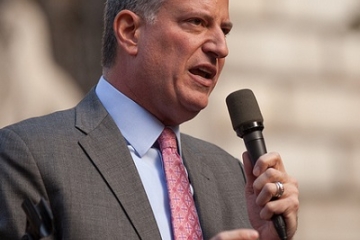
It also seems lost upon New York City’s uber-progressive mayor, Bill de Blasio, who seems oddly determined at times to make worse, not better, the “Tale of Two Cities” dichotomy between rich and poor New York that he rode into office two years ago.
The second year of de Blasio’s signature education initiative, a $300 million program to provide free, full-time pre-K to all New Yorkers, began this fall with troubling data suggesting that it is badly misfiring. Using census data and information from the mayor’s office, Bruce Fuller—a professor of education and public policy at University of California, Berkeley (Berkeley!)— estimates that there are 103,000 four-year-olds eligible for the program. In many instances, however, those who need it most are not being reached.
Children from low-income homes make up the largest share of program participants, accounting for roughly one-third of the sixty-five thousand registrations. But Fuller calculates that more than twelve thousand kids in the poorest two-fifths of the city’s ZIP codes remain unenrolled in any preschool. According to a report in ProPublica (ProPublica!), Fuller’s data indicates that Mayor de Blasio’s pre-K program added a mere 195 kids from the bottom 20 percent of ZIP codes this fall. Middle-income neighborhoods are showing the greatest gains in registration, while enrollments have actually fallen in nineteen of the city’s thirty-four poorest zip codes.
“We just don’t have the evidence to back why we would heavily finance pre-K in middle class and upper class communities,” Fuller told ProPublica. “I think the mayor has virtuous intentions, but I think once he made this ambitious campaign promise, he sort of charged ahead with blinders on.”
It is no exaggeration to say that the battle for literacy is largely won and lost in early childhood. Children who grow up in well-off homes reap all the benefits of educated parents who speak in full sentences, read to them nightly, and engage them in conversation. They live lives of concerted cultivation, and to them accrue all the blessings of knowledge and language. Low-income children, by contrast, reap few or none of these benefits. Thus a sensible approach, if you were serious about your own Dickensian rhetoric, would be focus your energies—and the public’s tax dollars—on those who need it most. Previous work by Fuller has shown that upper-middle income communities benefit disproportionately from de Blasio’s initiative. There are many words to describe this, but one prevails above all: predictable.
Less attention has been given to the mayor’s speech last week, in which he announced a plan to spend an additional $75 million per year to ensure (here comes that word again) “universal second-grade literacy” by 2026. “To boost literacy, every elementary school will receive support from a dedicated literacy specialist,” the mayor announced.
Well, bravo…sort of. There's a clear and strong correlation between early reading struggles and long-term academic failure. About 90 percent of struggling first graders are still struggling by fourth grade. One in six children who are not reading proficiently in third grade don't graduate from high school on time. Many never do. So it’s encouraging that de Blasio wants all students reading at their grade level by the end of second grade. His focus on early reading makes more sense than his headline-grabbing announcements of “computer science for all” and “AP classes for all” in the same speech.
That said, it’s hard to have faith that the mayor or Chancellor Carmen Farina know what it takes to get kids reading successfully by third grade. Farina is notoriously in the thrall of Lucy Calkins of Teachers' College, a literacy guru whose approach to reading failed a generation of city kids and was wisely dumped by the New York City Department of Education before Farina took over and resurrected it. If Gotham is about to invest $75 million in the same occupying army of “TC” trainers and staff developers who were ubiquitous in city schools ten years ago, it's an occasion for tears, not cheers.
A DOE spokesperson tells me that an implementation plan for the mayor’s early reading initiative is coming later this year, and that the city will work with “national experts and universities” to train the seven hundred new reading specialists they plan to hire. “To already claim these reading specialists will be trained by TC is premature and not accurate,” the spokesperson insists. Here’s hoping that plan starts by examining an important analysis by the Manhattan Institute’s Charles Sahm from earlier this year, which catalogued the K–2 curricula used in the city’s 1,168 elementary and middle schools. The mayor’s initiative promises to prioritize “schools with students that need the most support.” Bravo again. But a premium should be placed on helping teachers rigorously implement the curricula that schools have already purchased and are using. A plan to hire boxcar numbers of “literacy specialists” seems oblivious to that notion and likely to fail.
In sum, the de Blasio administration “has not devised a coherent strategy for addressing the needs of schools in high-poverty neighborhoods,” says Pedro Noguera of UCLA’s Graduate School of Education. “They have to know at a very granular level the academic and social needs of [low-income] kids, and then they have to have a staff that’s trained and resources in place to meet those specific needs.” Doesn’t sound “universal,” does it?
The bottom line: Mayor de Blasio has shown a good instinct for identifying the right targets—early childhood education and reading. But it’s hard to be encouraged that either he or chancellor knows how to hit them.
Kevin Case/Flickr

During his time in the United States, Pope Francis will make a quiet stop at East Harlem’s Our Lady Queen of Angels. His visit to this 120-year-old elementary school, which educates an overwhelmingly low-income and minority student body, underscores the Church’s centuries-long commitment to the disadvantaged. But it will also shine a light on an unreported story in urban education: the budding renaissance of Catholic schools.
For fifty years, inner-city Catholic schools have been shuttering, victims of shifting city demographics, changes in the workforce, the advent of charter schooling, and much more. Impoverished families have too few accessible school options to begin with, so this erosion of parochial schools has been especially painful. A substantial body of evidence shows that Catholic schools have an unusual ability to help underserved kids succeed. Newer research suggests that longstanding urban Catholic schools foster social capital outside their walls, helping to decrease crime and other societal ills.
In the early 1970s, Daniel Patrick Moynihan (a White House adviser at the time) saw a looming crisis and warned President Nixon about the tragic consequences if these schools disappeared. Little was done; as a White House aide thirty-five years later, I was part of an effort to re-sound the same alarm, organizing a White House summit and authoring a report on the worsening threat to faith-based urban schools.
The prognosis then was ominous. It looked as if divine intervention would be required. But less than a decade later, America’s miracle-working civil society is beginning to come to the rescue. Thanks largely to the energy of social entrepreneurs, the generosity of donors, and—counterintuitively—the lessons of charter schooling, urban Catholic education may be on the rebound.
In hindsight, it’s becoming clear that Catholic education’s foundational virtue, its steady adherence to venerable principles and practices, was also holding it back. Yes, it was right to serve the underserved, stubbornly believe in every child, set the highest standards, and teach character. But many of its approaches to staffing, leading, organizing, governing, and funding its schools had become anachronistic. A rejuvenation was needed.
Like the European Renaissance, this rebirth blends the old and the new. There are new networks of Catholic schools modeled after successful charter management organizations (think Catholic versions of the Knowledge Is Power Program, such as the Faith in the Future Foundation). There are Notre Dame’s ACE program, often called the “Catholic Teach For America,” and other new pipelines of teachers and leaders. There are new tech-driven school models using virtual and “blended” strategies for instruction. There are innovative approaches to financing, including the Drexel Fund (the first-ever venture philanthropy fund for Catholic and other private schools) and Cristo Rey’s work-study program, which sends high schoolers into offices one day every week to help pay for their education.
Though many of these innovations put some distance between schools and the old parish- and diocesan-based systems that used to control them, they are dedicated to preserving the authenticity of Catholic education.
So on Friday, Pope Francis won’t simply be touring a high-performing, high-poverty school that’s been part of Harlem’s social fabric for over a century. Our Lady Queen of Angels is also part of Partnership Schools, one of the nation’s new independent Catholic-school networks. The Partnership’s superintendent, Kathleen Porter-Magee, isn’t just a former Catholic school student and teacher; she was also an executive of one of the nation’s best charter school organizations. The network’s board includes representatives from the New York archdiocese as well as business and philanthropic leaders.
There’s more reason for optimism now about the future of Catholic education than at any time in the last half-century. Those hoping to learn more might check out my guidebook for Catholic school donors, soon to be published by the Philanthropy Roundtable (excerpted here).
But for those interested in K–12 education more broadly, there’s also an important lesson to be learned. The revitalization of this sector of schools is a modern-day barn-raising. It’s a quiet triumph of civil society: collective action with public benefits but absent centralized government direction.
Through the loosely coordinated collaboration of parents, educators, faith leaders, social entrepreneurs, colleges, and philanthropists, an organic movement has developed. It’s growing sturdier while evolving to meet an array of needs in a variety of locations.
This is precisely how education reform was described ten years ago. But because of the field’s growing technocratic tendency—the view that brainy central administrators know best—the public education version is increasingly seen by many as top-down. Indeed, Washington has inserted itself into accountability, standards, tests, teacher evaluations, and more, provoking a backlash.
It is highly instructive that perhaps the world’s most famous hierarchical organization, the Roman Catholic Church, has made substantial progress with its schools by preserving its principles and devolving power to civil society. The next White House occupant should take note.
Editor’s note: This post was originally published in a slightly different form at National Review Online.
Louis-Paul St-Onge/iStock/Thinkstock

If KIPP were a geographic school district, it would roughly be the nation’s sixty-fifth largest, somewhere between Boston and El Paso. With 162 schools and nearly sixty-thousand students, it’s also growing like kudzu, courtesy of a five-year, $50 million scale-up grant awarded in 2010 through the U.S. Department of Education’s Investing in Innovation (i3) program. At that time, KIPP’s stated goal was to double in size while maintaining its positive impact on kids.
Taxpayers seem to be getting a solid return on that investment. A new report from Mathematica, which contracted with the KIPP Foundation under the terms of the i3 grant, finds that “network-wide, KIPP schools have positive, statistically significant, and educationally meaningful impacts on student achievement, particularly at the elementary and middle school grades.” The picture is murkier at the high school level, where KIPP had “educationally meaningful impacts” on students who were new to the network. No statistically significant effects were found among students continuing from KIPP middle schools, however. Still, the high schools have positive effects on “several aspects of college preparation, including discussions about college, applying to college, and course taking.”
The study is based on both lottery-based and quasi-experimental designs in eight KIPP elementary schools, forty-three middle schools, and eighteen high schools across twenty cities. It looks at outcomes in math, ELA, science, and social studies up to four years after students enter a KIPP school, as well as student and parent surveys.
No single study is conclusive, and KIPP continues to support a cottage industry of detractors who question its results and its approach. On the other hand, KIPP parents—particularly those of elementary and middle school children—were found to be pleased with their kids’ schooling, especially at the elementary and middle school levels.
While the Mathematica report is largely positive, the KIPP “brand” might have taken a hit with one surprising finding: The research team generally found “no impacts of KIPP schools on measures of students’ motivation, engagement, educational aspirations, or behavior.” It’s much easier to measure performance character traits than to alter or grow them. But KIPP has long worshipped at the altar of “grit.” Paul Tough wrote an entire book about it. Clearly, much is going right at KIPP; just as clearly, grit is not.
In addressing the question of whether KIPP could double in size while maintaining quality—short answer: “yes”—the report raises a second question: Can they do it again? KIPP’s i3 scale-up grant was specifically aimed at building its leadership pipeline. Does the supply of talent impose a speed limit on growth at some point? One veteran KIPP official I spoke with believes that a growth rate of 15–20 percent each year is possible without diminishing quality—if the network continues to invest in recruiting and training would-be school leaders. If it doubles in size over the next five years, as is planned, KIPP might be large enough to crack the list of the nation’s twenty largest school districts. That’s a tantalizing proposition, so long as quality isn’t made secondary to quantity.
SOURCE: Christina Clark Tuttle et al., “Understanding the Effect of KIPP as it Scales: Volume I, Impacts on Achievement and Other Outcomes,” Mathematica (September 2015).
Since 2003, Florida has required that schools retain third graders who fail to demonstrate proficiency on the state reading test. A new study by Martin West and colleagues examines the impact of this policy by rigorously comparing the results from students who are just above or below the cutoff for retention. The first cohort to be affected by the new policy entered the third grade in 2002, and West et al. track it through high school graduation. They also track five additional cohorts, the last of which entered third grade in 2008.
Unsurprisingly, they find that the policy increased the number of third graders retained. It started with 4,800 kids in the year prior to the policy introduction (2002) and jumped to nearly twenty-two thousand the next year. The numbers retained have fallen steadily over time, however, as more students have cleared the hurdle. The study’s key finding is that third-grade retention substantially improves students’ reading and math achievement in the short run. Specifically, reading achievement improves for retained students by 23 percent of a standard deviation after one year—and by as much as 47 percent of a standard deviation after two years—when compared to students of the same age. In math, it’s 30 percent of a standard deviation after one year and 36 percent after three years.
Unfortunately, these achievement bumps are short-lived. The effects of third-grade retention on reading achievement are reduced in the third and fourth years and become statistically insignificant in years five and six. In math, the effects are statistically insignificant after six years.
The authors also examined results for students in the same grade versus the same age. The impacts are also positive and manage to persist through middle school, though with the caveat that these estimates also capture the effects of being a year older and receiving another year of schooling.
Finally, they find that retention reduces the probability that students at the cutoff will repeat another grade in the future, although it has no impact on the probability of graduating from high school.
The study uncovers a great deal about retention, but in the end, the practice produces a mixed bag of results—at least in the relatively short term. The authors acknowledge that we still don’t know enough about retention’s long-term benefits. And based on some rigorous studies (particularly in early childhood) that retention boosted downstream metrics like college enrollment and future earnings, it’s a safe bet to assume West and company will be back in Florida in due course.
SOURCE: Guido Schwerdt, Martin R. West, and Marcus A. Winters, "The Effects of Test-Based Retention on Student Outcomes Over Time: Regression Discontinuity Evidence from Florida," National Bureau of Economic Research, Working Paper 21509 (August 2015).
In the fall of 1996, Chicago Public Schools (CPS) implemented a new accountability system that placed 20 percent of its schools on “probation.” Poor reading test scores made up the sole criterion for censure, and those scarlet-lettered schools were plastered on the front page of both Chicago newspapers. A new study by Peter Rich and Jennifer Jennings of NYU takes a look at enrollment changes in these “probation schools,” both before and after the imposition of the new accountability system. The authors attempt to determine if the addition of new information (“This school is not performing up to par”) motivated more or different school change decisions among families.
1996 may seem like ancient history to education reformers, but the study illustrates the perennial power of information to motivate school choice decisions. In 1996, CPS had (as it still does) an open enrollment policy that allows any family to choose any school in the district other than their assigned one, provided there is space available. Since the district provided no transportation to students either before or after the policy was imposed, that issue was moot. The number of schools and seats within the district also stayed the same. In other words, access to buildings remained unchanged after implementation of the probation system. The study’s methodology also controlled for the effect of other accountability-related tweaks that CPS made at the same time. The sole variable under study was the provision of information.
The new information was simple and binary. Schools were either on probation for poor reading scores, or they weren’t: no gradations of bad or good, no value-added information, and only minimal ideas of what changes would be made to try to improve the schools on probation. It was a far cry from today’s report card data extravaganzas and “scary” talk of automatic closure and parent triggers. The only new piece of data for CPS families in 1996 was the big red X of probation.
So what happened in light of this new information? Kids left probation schools in higher numbers after the probation designation than before it. Students attending schools that were placed on probation had 19.3 percent higher odds of transferring schools and 16.1 percent higher odds of leaving the district altogether in the summer following initial assignment. Unsurprisingly, higher-income students were more likely to leave the system—the researchers suppose that they went to private schools, but heading for the ‘burbs is just as likely.
Those students who stayed in CPS and moved from a probation school were no more likely to end up in non-probation schools (i.e., to upgrade) after the policy was implemented than before. Keeping in mind that the difference in quality between probation and non-probation schools could be very slim, the alarm set off by the new accountability system resulted mainly in lateral moves.
Does this mean that accountability-based choice was fatally flawed even before the NCLB era began? No, but it does show that a closed system is not the optimal way to go about using that particular tool. Without a mechanism to assist low-income families in leaving a low-performing district just like high-income families can (vouchers, inter-district open enrollment, ESAs), or a plethora of high-quality seats to transfer into (magnets, charters, STEM schools) just like those who can “work the system” have, bad news about school quality is simply bad news. In Chicago in 1996, families heard the alarm and did what they could. The results were not encouraging. In 2015, we know better. Information, options, and access must be part of the same system in order to truly leverage accountability into better outcomes for students.
SOURCE: Peter M. Rich and Jennifer L. Jennings, “Choice, Information, and Constrained Options: School Transfers in a Stratified Educational System,” American Sociological Review (September 2015).