
On Constitution Day, in search of the public mission of schools
When school boards describe their missions, they often overlook citizenship. Robert Pondiscio and Kate Stringer
When school boards describe their missions, they often overlook citizenship. Robert Pondiscio and Kate Stringer

Tomorrow is Constitution Day, when all schools receiving federal funds are expected to provide lessons or other programming on our most important founding document. But when only one-quarter of eighth graders score “proficient” on the most recent NAEP civics exam, it’s also a reminder of how rarely civics and citizenship take center stage in America’s public schools.
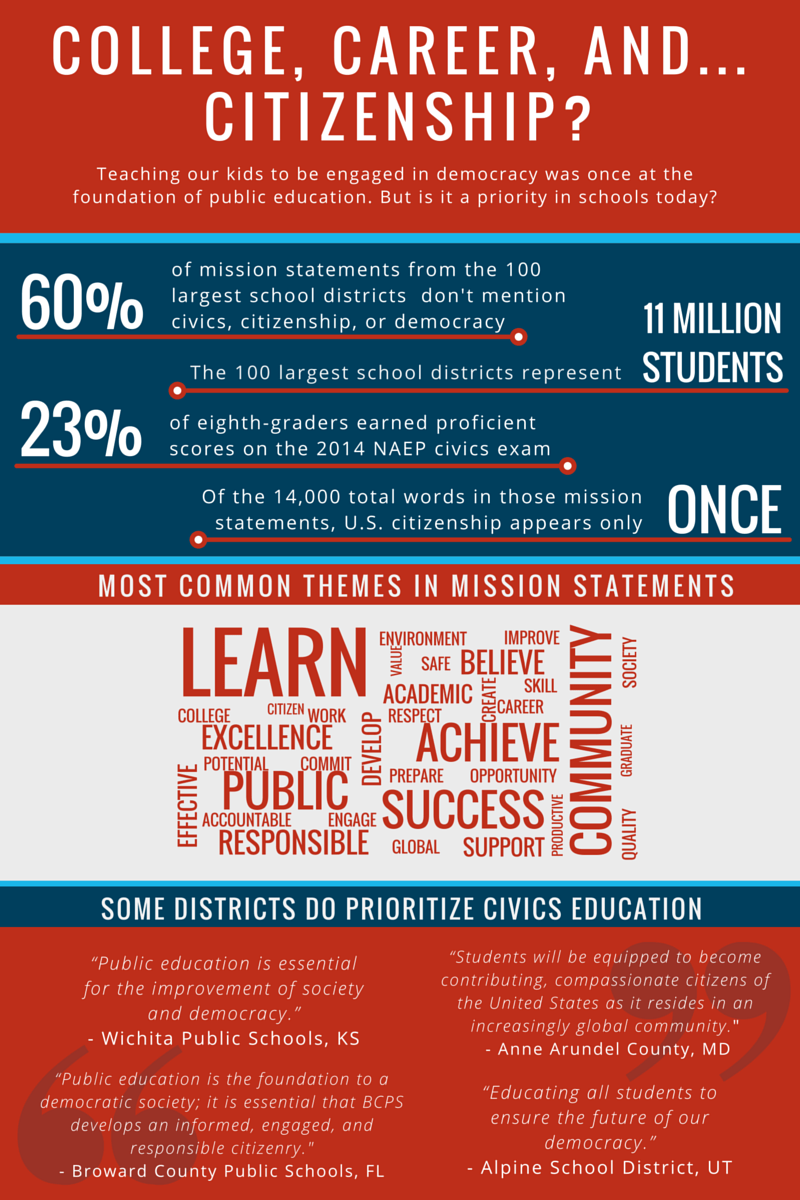
The public-spirited mission of preparing children for self-government in a democracy was a founding ideal of America’s education system. To see how far we have strayed from it, Fordham reviewed the publicly available mission, vision, and values statements adopted by the nation’s hundred largest school districts to see whether they still view the preparation of students for participation in democratic life as an essential outcome. Very few do. Well over half (fifty-nine) of those districts make no mention of civics or citizenship whatsoever in either their mission or vision statements.
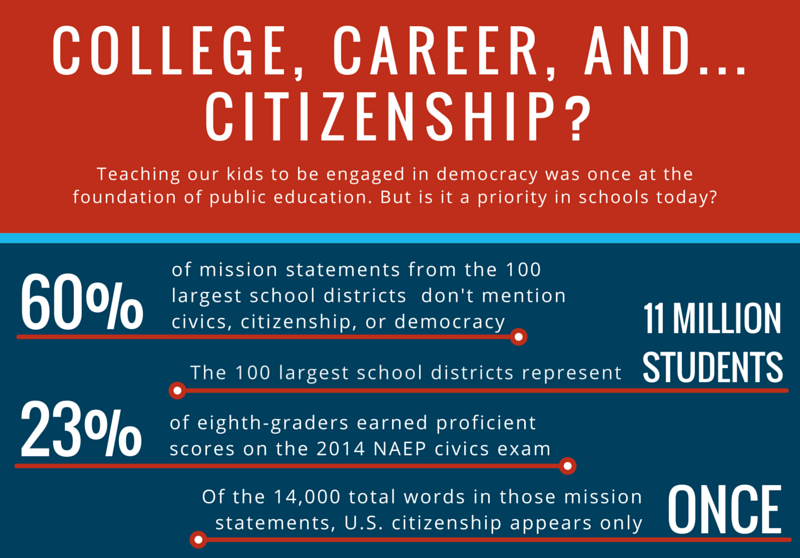
The personal and private reasons for education—preparation for college and career, for example—are much more on the minds of school district officials who write and adopt these statements and goals than the public virtue of citizenship. The words “college” (thirty-seven occurrences) and “career” (forty-six), for example, easily outnumber “civic” (eight) and “citizen” (twenty-eight). For comparison, the most commonly occurring words are, unsurprisingly, “student” (433), “school” (250) and “learn” (175).
The fourth-most-used word, “community” (141), could be viewed as a proxy for citizenship. However, that term most frequently occurs in bromidic phrases like “community of learners,” or refers to what the community can do for students rather than what the students are expected to do for the community. The San Diego Unified School District mission statement, for example, includes this phrase: “Engages parents and community volunteers in the educational process.” Nurturing a supportive community is not a bad goal; it’s simply not the same as preparing students for active participation as citizens.
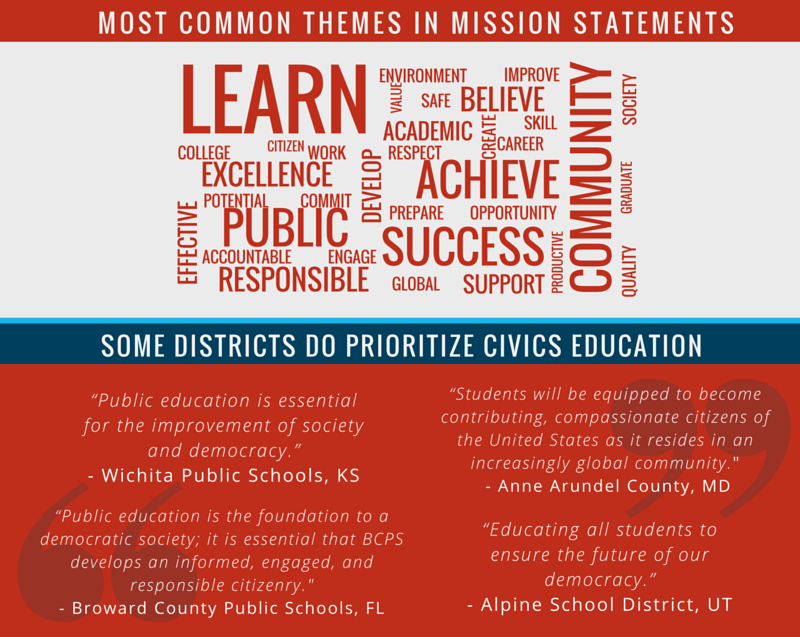
To be sure, some districts’ mission statements demonstrate a clear focus on preparing students for citizenship, or establish it as an equal priority with more personal goals:
By contrast, Montgomery County, Maryland, doesn’t even acknowledge a civic role. Its mission statement reads, “Every student will have the academic, creative problem solving, and social emotional skills to be successful in college and career.” Neither is there any mention of civics or citizenship in the vision statement or the district’s “core purpose,” which is this: “Prepare all students to thrive in their future.”
Unsurprisingly, a substantial number of mission and vision statements are either meaningless homilies or bland statements seemingly calculated to be inoffensive.
Some terms are conspicuous in their absence. The words “patriotic” and “patriotism” do not appear at all in any of the hundred districts’ public statements that we reviewed. Only two districts—Wichita Public Schools in Kansas and Utah’s Alpine School District—include the word “democracy” (Eight mention the word “democratic.”). Maryland’s Anne Arundel County is the only district that specifically mentions U.S. citizenship in its mission or vision statement. (“Students will be equipped to become contributing, compassionate citizens of the United States as it resides in an increasingly global community.”) Perhaps most surprising of all: The words “America” and “American” appear in none of the hundred mission and vision statements. However, “global” appears in the statements of twenty-eight districts—usually in phrases like “global society,” “global economy,” or “global citizens.”
In fairness, a district’s mission statement may not offer much insight into the nature of its instructional practices, the civic values that are communicated to students, or the full range of outcomes sought by each school system. But at some point, leaders and stakeholders in each district sat down and attempted to craft and approve a set of ideals, values, and goals that ostensibly reflect the aspirations of their communities. Thus mission statements offer a window into our evolving view of the purpose of education.
The mission statement of the Alpine, Utah, school district, which serves twelve municipalities outside Provo, is a good example. It was approved by its board of education in 2003 and places a premium on “educating all students to ensure the future of our democracy.” A set of goals adopted more recently includes “civic preparation and engagement.” District administrator David Stephenson says that the mission “is aligned with what we do in the classroom. We obviously follow state core curriculum civics instruction. We follow state law on what we teach. It’s really aligned well with that curriculum.”
“The mission statement is not made by random people on a Tuesday afternoon. It’s the community, building principals, school administrators, parents, teachers, superintendents. All of our adult stakeholders were represented in crafting a mission that best represents our community,” says Andy Jenks, a spokesman for Henrico County Public Schools in Virginia. “We do think it’s important. In some cases it might be the first thing somebody reads about our organization.”
The National Assessment of Educational Progress lists five dispositions it says are “critical to the responsibilities of citizenship in America's constitutional democracy.” These are active, not passive roles: respecting human worth, responsible participation, promoting a healthy democracy. If these aren’t priorities of a school district, are they priorities of their students? The data says no. Of the eighth graders who took the NAEP’s civics exam in 2014, only 23 percent scored proficient marks.
If a school districts’ mission and vision statements are any indication, such uninspiring results are also unsurprising. They simply mirror the priorities established at the local level for K–12 education, where preparation for citizenship is not a high priority.
On Constitution Day, it’s worth asking whether it is time to restore the public mission of public education to its rightful status as a priority for our schools.
Robert Pondiscio is Fordham’s vice president for external affairs. Kate Stringer is an editorial intern.
___________________________________
Download the full infographic:

Remember all those pitched battles and screaming matches over Common Core? The furious charges of federal overreach? The demands to "repeal every word" of it? As children return to school across the country this week, Common Core remains largely intact in more than forty states. At the same time, new evidence suggests that the much tougher Common Core challenges—the ones emanating from inside classrooms—have only just begun.
Results from the initial round of Common Core-aligned tests (administered last spring) have been trickling out for the past few weeks in more than a dozen states. The results have been sobering, but not unexpected. Recall that the No Child Left Behind years were an era of rampant grade inflation. States whose students performed poorly on the benchmark National Assessment of Educational Progress (NAEP) routinely rated the vast majority of their students on or above grade level, simply because states were allowed to set their own bar for success and thus had a perverse incentive to declare ever-greater numbers of kids proficient. The result was a comforting illusion of student competence that was shattered when "proficient" kids got to college and needed remediation, or entered the workforce with substandard skills. Common Core testing, if nothing else, is supposed to make it harder to tell self-serving lies about where kids actually stand.
A report last week from the Education Trust didn't command as much attention as the test scores, but it's arguably even more important. An examination of assignments given by middle school teachers appears to show that most of the work asked of students does not reflect the higher, more rigorous standards set by Common Core. Fewer than 40 percent of assignments examined were aligned with grade-appropriate standards. If the study sought to show where teachers are in their understanding of the higher standards, the answer appears to be "not very far along."
"This is why we support college- and career-ready standards to begin with," says Education Trust's Sonja Santelises, one of the report's authors. "We knew we needed more cognitive, intellectual challenges in what we're asking kids to do."
A couple of caveats are needed. First, the report is a small-scale pilot study of assignments at six middle schools in two urban districts—a tiny and unrepresentative sample. Additionally, more than half of the assignments reviewed came from science and social studies classes, where teachers might have had learning goals that were not readily apparent to reviewers looking for examples of students grappling with complex texts. Thus, the Education Trust may be inadvertently painting an overly pessimistic view.
Still, the dour findings ring true with those who have worked with school districts training teachers to understand and adopt the instructional shifts expected under Common Core. One veteran public school teacher and staff developer worries that we are paying the price for years of "de-professionalizing" the teacher work force. "'Do these things, use these moves and you'll be successful'—that's been the message to teachers for the past fifteen years," she says. "Many teachers throw up their hands and say, 'Just tell me what you want me to do,' or, 'Is this the right way?'"
The challenge is complicated further when elected leaders lack the political will to hold the line on higher standards, sending mixed signals to teachers. New York Governor Andrew Cuomo recently announced a "review" of Common Core, which he insists is "not working and must be fixed." The announcement left proponents of the standards scratching their heads, since New York's Common Core implementation has been held up as a national model. Cuomo's move appears to be an attempt to mollify angry parents who have refused to let their children take the new Common Core tests. However, that discontent almost certainly has more to do with Cuomo's double-whammy policy of insisting that teachers be held accountable for test scores when they're already struggling to meet higher standards. It's simply unreasonable to expect teachers to change their practices dramatically and demand an instant boost in test scores at the same time.
Adopting higher standards is easy. Complaining about them is even easier. The bottom line is that while the overheated debate over Common Core has raged on, far too little attention has been paid to the heavy lift being asked of America's teachers—and the conditions under which they are being asked to change familiar, well-established teaching methods. Meeting those higher standards is agonizingly difficult work. It requires patience and realism, two things that have never been particularly abundant in American education.
Editor's note: This post was originally published in a slightly different form at U.S. News & World Report.
gjohnstonphoto/iStock/Thinkstock

A new report by the Fiscal Research Center at Georgia State University seeks to quantify how much families were willing to pay for a greater likelihood of receiving access to a charter school between the years 2004 and 2013.
Author Carlianne Patrick examines thirteen metro Atlanta start-up and conversion charter schools that have priority admission zones within their designated attendance zones. Each school has three “priority zones.” The rules governing when a priority zone comes into play and how it interacts with the lottery are quite complex, but the idea is basically this: You get a higher chance of getting into a particular charter school if you reside in priority zone one.
Patrick limits the analysis to home sales within close proximity of the border between priority-one and priority-two attendance zones because they represent a change in admission probability. She claims that residences close to the border—in this case, less than half a mile—should be similar in both observable and unobservable ways, including access to jobs and amenities, styles of houses, foreclosures in the area, etc.
Patrick measures the effect of being on the priority-one side of the border between zones one and two. She also controls for transaction date, which helps with housing value fluctuations over time and limits the sample to “arm’s-length,” single-family residential transactions.
Her key finding is that households are willing to pay a 7–13 percent premium to live in zone one instead of zone two.
The analysis, however, has some flaws. For starters, the sample is very small, and important information is missing. Patrick says nothing about the quality of the schools, the relative difference in the probability of gaining admission between zones one and two, or how familiar parents are with the rules surrounding the zones. She also provides little information on which schools have had to make use of the zone preference and how often they may have done so. Unfortunately, there is no methods appendix to hunt for these answers.
In the end, more evidence is needed to be confident that the zone comparison takes care of other possible unobservable variables. But this is a creative analysis and a cool way to measure how the public may value charter schools. Here’s hoping Caroline Patrick dives deeper in a follow-up study.
SOURCE: Carlianne Patrick, "Willing to Pay: Charter Schools’ Impact on Georgia Property Values," Fiscal Research Center, Georgia State University (August 2015).
The possible existence of a gender bias in the classroom is not a new controversy. Research has shown that, consciously or not, some teachers treat students differently according to gender; they may give boys more (or different types of) attention, encourage boys more in certain subjects and girls in others, and otherwise interact with each gender differently.
Economists Victor Lavy and Edith Sand bring us an important continuation of that work with a National Bureau of Economic Research paper that explores whether students are exposed to gender bias during elementary school. It then examines whether that exposure has an impact on students’ later academic achievement.
Their study follows approximately three thousand elementary school students and eighty teachers from twenty-five different elementary schools in Israel. They first ask: Is there gender bias? In other words, do teachers believe one gender is academically stronger than the other when there’s actually no difference (or even if the preferred gender is actually doing worse)? The answer to this question is yes. By comparing a teacher’s assessment of a student’s performance in a variety of subjects to the student’s scores on external exams in the same subject, the researchers find that girls outscore boys on external math exams, but boys outscore girls on teachers’ own math tests. The researchers find similar results at the classroom level. (In English, girls are over-assessed relative to boys, but the difference is not statistically significant; in Hebrew, the researchers found no signs of bias at all.)
Second, the authors estimate the impact of that math gender bias. The findings are stark—the more positive bias a male student received in elementary school, the higher his eighth-grade test scores; the more negative bias a female student received, the lower her scores. And the effects persist throughout high school. Positive bias for male students increased the likelihood of graduation; negative bias for female students decreased it. The same goes for secondary test scores, the likelihood of a given student enrolling in advanced science and math courses, and even postsecondary enrollment, attainment, and wages. (Two important notes: There were a lot of insignificant results amidst the significant ones, and the effects of a biased classroom seem to be much more important than the effects of a biased student-teacher interaction.)
These are weighty (and troubling) results. A student’s exposure to bias in elementary school can have a lasting effect on not just that student, but ultimately the labor market and economy. Male students are not only on the positive receiving end of bias in math, but are also more likely to “shake off” negative bias, while female students tend to internalize negative feedback.
Interestingly, while the researchers found that older single teachers are more likely to favor boys, they did not report the impact of teachers’ respective genders on bias. This last point would be a particularly interesting line of analysis. As a female math teacher, I was very aware of gender bias against girls in math and science and went out of my way to consciously avoid it. (But would an analysis of my behavior actually show overcompensation and a negative bias toward my male students? Given that my male students had probably experienced positive bias in previous classes, would it have mattered?)
The researchers found classroom effects especially significant—perhaps teacher training programs should explicitly include gender in their courses on teaching in diverse classrooms. My own training for secondary math included instruction on teaching students of different ethnicities, language skills, and cognitive abilities…but never different genders. Clearly, it should have.
SOURCE: Victor Lavy and Edith Sand, “On The Origins of Gender Human Capital Gaps: Short and Long Term Consequences of Teachers' Stereotypical Biases,” National Bureau of Economic Research, Working Paper 21393 (January 2015).
This report examines the impact of the Gates Foundation “collaboration grants” in seven cities: Boston, Denver, Hartford, New Orleans, New York, Philadelphia, and Spring Branch (Texas). In each of these cities, districts and charters have signed a “compact” committing them to closer cooperation (and making them eligible for grants). These compacts have many goals, including the increased sharing of facilities, the creation of common enrollment systems, and other changes in policy; however, this report focuses on activities that “target specific staff participants,” such as school partnerships, cross-sector training, and professional development.
Based on conversations with teachers, principals, and central office administrators, the authors conclude that “overall progress in increasing collaboration has been limited.” In particular, while collaboration between principals has increased as a result of the grants, it is still concentrated among those already “predisposed to cross-sector work.” Moreover, in schools not led by such principals, collaboration between teachers is still “minimal to nonexistent.” More progress is evident at the central office level; but even there, some administrators are skeptical that these efforts can lead to “systematic change.” According to respondents, barriers to collaboration include “limited resources, teachers’ unions, and cross-sector tensions.” However, the report also identifies a few promising strategies, including “purposeful” co-location and cross-sector residency programs for aspiring principals.
According to the authors, “the theory of action driving the collaboration grants is that strategic collaboration will advance innovative strategies and practices and promote the transfer and spread of knowledge and effective practice across schools, ultimately resulting in increased school effectiveness.”
This theory can be questioned. After all, since teacher and principal quality are as likely to vary within the district and charter sectors as between them, the notion that sharing “best practices” across sectors is a cost-efficient way to improve outcomes rests on the assumption that the sectors have something to learn from one another that they cannot easily learn from their own high-performers.
Perhaps they do. According to the authors, the practices that district schools were most likely to share with charters were different from those that charters were most likely to share with district schools. Specifically, district schools were most likely to share practices related to ELA and disability instruction, community and family engagement, small group instruction, and guided reading; charters, on the other hand, were most likely to share practices related to culture and behavior, teacher coaching, interim assessment, and strategic data use.
These lists are suggestive of the relative strengths of each sector. Unfortunately, many respondents felt that the goals of the specific collaboration activities in which they took part were fuzzy. Such is the gap between theory and reality.
SOURCE: Moira McCullough, Luke Heinkel, Betsy Keating, “District-Charter Collaboration Grant Implementation: Findings from Interviews and Site Visits,” Mathematica (August 2015).