
High Expectations
Truth and consequences
States shouldn’t sugarcoat the bad news when reporting Common Core test results to parents. Chester E. Finn, Jr.
States shouldn’t sugarcoat the bad news when reporting Common Core test results to parents. Chester E. Finn, Jr.
Amid way too much talk about testing and the Common Core, not enough attention is being paid to what parents will actually learn about their children’s achievement when results are finally released from the recent round of state assessments (most of which assert that they’re “aligned” with the Common Core).
Ever since states adopted more rigorous standards—and the two assessment consortia began to develop next-generation tests that will faithfully gauge pupil performance in relation to those standards—there’s been vast anxiety about the bad news that’s apt to emerge. How will people react when informed that their kids aren’t doing nearly as well academically as the previous standards-and-testing regime had led them to believe? Will more parents “opt out” of testing? Will the political backlash cause more states to repudiate the Common Core, change tests yet again, or lower the “cut scores”?
We know the Common Core standards are more challenging than what preceded them in most places. That was the point. We know that the new assessments—at least those custom-built by PARCC and Smarter Balanced—are supposed to probe deeper and expect more. We understand that this reboot of America’s academic expectations is indeed like moving the goal posts. There’s ample reason for such a move, but we know this means that it will be harder to score without additional training and conditioning. Finally, we know that changing from one test to another generally yields an initial drop in scores.
Acknowledging all that: What exactly are states going to tell parents (and others) about how their kids are doing?
There’s reason to worry, as early evidence indicates that the ways student performance will be reported will soft-pedal the truth, playing into parents’ innate conviction that their kids are fine even if others aren’t. This kind of sugarcoating threatens to undermine the fundamental rationale for the Common Core itself.
Recall—as if it could possibly have slipped your mind!—that CCSS arose from the awareness that far too many young Americans were leaving school ill-prepared for either college or career, while too few states had set their K–12 expectations anywhere close to college and career readiness. That’s why so many young people graduate from high school having met teacher expectations, taken required courses, attained a decent GPA, and reached a respectable class rank, only to find themselves shunted into remedial courses at college. That also explains why so many employers complain that those hired after high school lack the fundamental competence to do the job well (and why many employers look overseas for skilled workers.)
Dating back at least to Achieve’s (with Fordham’s encouragement) launch of the “American Diploma Project,” the idea that K–12 standards ought to be geared toward college and career readiness has gained momentum, strongly boosted by funders, business leaders, and governors and state education chiefs. The central mission of Common Core is to design English and math standards from kindergarten through twelfth grade such that a young person fully meeting those standards will actually be prepared to succeed in college without remediation, or to succeed in a job with good future prospects. Paramount to the idea of vertically aligning standards and assessments that way is the expectation that parents and teachers will know from the primary years whether a given child is, in fact, “on track” to college and career readiness. Once off-track, it’s really hard to get back on; parents and educators are therefore best served by being advised early about problems so they can take action and avoid painful surprises later.
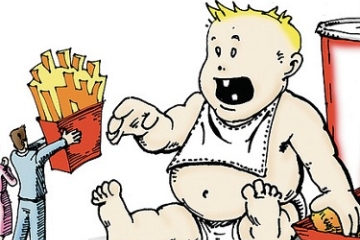
It’s no secret that parents (and many teachers) really do tend to view their own children as doing fine, even when they’re not. (And not only in education: A team at the NYU Medical Center recently reported that the vast majority of parents with obese kids actually believe their children are “about the right weight.”)
Causing parents and other caregivers to instead see things clearly, grasp reality, and understand the implications is no small feat. It must begin with accurate information. But what if reality is fuzzed up and its implications glossed over? What if this is done so that parents don’t become upset, whether with their kids or with the bearer of bad tidings? What if education officials, worried about backlash, can’t bring themselves to say that elementary and middle school pupils are not on track for college? Who ultimately benefits from this kind of partial cover-up? Not the kids, certainly.
Yet the sample score reports for parents now being promulgated by PARCC appear to tap dance around the concept of college readiness, at least until high school. Check them out yourself. They talk about children’s test score performance in relation to being prepared for “further studies” and “the next grade level,” but they don’t say a word about college and career—or help parents (particularly those who haven’t graduated from college themselves) parse the meaning and implications of “further studies.”
Only in a sample report for the algebra II assessment (for hypothetical eleventh grader Leonard Jarvis) does the phrase “College & Career Ready” appear at all, and then it’s in small print, related to how PARCC’s five cut scores are calibrated. It’s not tied directly to Leonard’s performance; his parents are simply told that he will “likely need academic support to engage successfully in further studies.”
PARCC states aren’t required to use these reports. But when I mentioned my concern to an official in one of those states, he replied that all this had been carefully worked out by the consortium—implying that his state agreed with the cautious approach—and added that it would cost the state extra to report results differently.
Over at Smarter Balanced, they expect participating states to design their own reports. They have also supplied models, and these do offer “college and career readiness information for students in eighth and eleventh grades,” but not in earlier grades.
Admittedly, it’s harder to make college readiness predictions about nine- and eleven-year-olds, and nobody wants to be deterministic. But parents who erroneously suppose that their child’s academic performance, like his BMI, is “about right” deserve a wake-up call much earlier than eighth grade.
It’s hard to know what Smarter-Balanced states will actually do, but the hypothetical fifth grader report recently approved for use in California makes no mention of college or career—nor even readiness for further study, as shown on the PARCC reports.
Bottom line: It’s looking as if parents may not actually be told anything explicit as to whether or not their daughters and sons are on track for college and career, at least not until they’re in high school (or maybe eighth grade)—and even then, they’re not likely to have this information pushed hard.
I understand the reluctance to agitate parents regarding their children, and the fear of triggering an even bigger political backlash against standards and testing. But if the point of these standards is to prepare kids for college and career, how can we not tell those closest to children whether such preparation is actually happening? If a fourth grader weighs two hundred pounds, is it not the obligation of responsible adults to let his parents know that this is a problem that menaces his future? Isn’t the same true for parents of a seventh grader whose reading and math skills are at the fourth-grade level, or worse?

Darned USPS.
It appears that back in 2001 or so, now-Governor of Delaware Jack Markell wrote an opinion piece about private school choice. Because of some snafu at the post office, his letter just recently made it to Education Week.
Though some education issues are evergreen (say, the importance of highly effective teachers and strong content standards), much has changed over the last decade-plus in the world of private school choice. Unfortunately, for Markell (well, and for all of us), his out-of-date column was published.
If the governor could call a do-over, I’m sure he’d make adjustments in at least four areas.
First, he argued for limiting choice to the public system—“among traditional, charter, and magnet schools.” Obviously, 2001 Markell couldn’t have known that the public schools sector would be unable to create the number of seats needed. Indeed, as of last year, more than a million students were on charter waitlists nationwide.
Moreover, there’s no way he could have foreseen that future governors who claimed to support public school choice would actually take action to inhibit charter growth. For example, the Markell of 2001 never would have predicted that the Markell of 2015 would sign a law establishing a moratorium on charters in Delaware’s largest city.
Second, he claimed that there’s no accountability in choice programs. But as a recent report from the National Conference of State Legislatures explains, that has changed in major ways since Markell put pen to paper in the heady days of budget surpluses and the AOL-Time Warner merger. As NCSL notes, nearly all states with choice require some combination of assessments, accreditation, seat-time requirements, and indicators of financial strength.
2001 Markell claimed that private school students aren’t required to take state tests. But as we now know, the voucher programs in Indiana, Louisiana, and Wisconsin mandate precisely that. In fact, if a private school underperforms in Louisiana, it’s barred from accepting additional program students. Participating schools in Indiana get letter grades from the state’s accountability system and are prohibited from taking in new program students if they receive a D or F. If a participating Wisconsin school loses accreditation, it’s removed from the program. Moreover, eight other states require participating private schools to administer a nationally norm-referenced test.
Importantly, private school accountability continues to advance. Some advocate authorizers for schools participating in voucher programs, an approach that would respect private school independence while maintaining public accountability. And all of this is on top of the ultimate accountability lever: parental choice. No student is assigned to a private school. Private school enrollment reflects the affirmative decisions of the most discriminating consumers, families.
Third, while making a legal case against the inclusion of faith-based schools, Markell wrote that “the government should not be in the business of funding programs or institutions that promote one religion over all others.” I suppose Markell can be forgiven for not knowing back in 2001 that the U.S. Supreme Court, the very next year, would declare voucher programs constitutional. The court explained that families independently exercising choice is different from the government preferencing a religion. It found the program in question “entirely neutral” on the issue of religion: “It provides benefits directly to a wide spectrum of individuals….It permits such individuals to exercise genuine choice among options public and private, secular and religious.”
This decision is just one of many (at the state and federal levels) that have upheld choice programs. Indeed, courts, legislatures, and voters have so internalized the constitutionality of private school choice that there are now fifty-six programs in twenty-nine states today.
We might wonder, however, whether Ally McBeal-era Markell was so concerned about government aid reaching private schools that he would’ve opposed Delaware’s students using Pell Grants to attend the religiously affiliated Notre Dame or Emory—or, say, his private school alma maters, Brown and the University of Chicago.
Lastly, Markell wrote of the “unsettled and uneven” performance history of choice programs. Again, unfortunate timing for the governor, as much has happened in the last fourteen years. As one recent brief put it, “Twelve studies using a method called random assignment, the gold standard in the social sciences, have found statistically significant gains in academic achievement from school vouchers. No such study has ever found negative effects.”
I hope Education Week gives Governor Markell a chance to revisit this subject and write a column that reflects all we’ve learned since the early days of the Bush presidency. Perhaps he could engage with those, like Mike McShane, exploring how to best expand the number and quality of private school options. Maybe he wants to consider how faith-based urban schools contribute to social capital or how choice empowers low-income families. Maybe he wants to discuss the burgeoning effort to increase the number of low-income kids in great schools via the “three-sector” approach.
Fortunately, with e-mail now so ubiquitous and reliable, he won’t have to worry about his new piece getting lost in the mail.

Achieve has spent a decade relentlessly tracking and reporting on states’ progress in adopting “college- and career-ready” (CCR) policies and practices across multiple fronts. Sometimes we’ve found their reports too rosy, or at least too credulous, with a tendency to credit state assertions that they’re doing something rather than looking under the surface to see whether it’s really happening.
This year’s report is more solid, more fact-based—and more worrying. Consider, for example, its list of fourteen states that “still do not have any form of statewide graduation requirements that require or even suggest (as states with opt-in CCR courses of study do) that students take particular courses (or the content) so that they can graduate college and career ready.”
Pretty grim, no, this deep into the era of standards-based reform and mindful of our multi-year fixation on everybody emerging from the K–12 system ready for something respectable after high school?
Also worrying: Only thirteen states even collect district-level course requirements for high school graduation, and just three make public “the number of credits by subject area by district” required for graduation.
And this: “35 states use end-of-course exams [for some high-school subjects] to help ensure rigor and consistency statewide. However, these…assessments often fall short of measuring higher-level ELA/literacy or advanced algebra content.”
There’s plenty more here, much of it mildly encouraging by way of trends, but almost none of it truly reassuring when it comes to state-level seriousness about graduating kids from high school who are actually prepared for what follows.
Credit is due to Achieve for this year’s clear lens.
SOURCE: “Closing the Expectations Gap 2014,” Achieve, Inc. (January 2015).
In the age of college- and career-ready standards, the education reform community is finally jumping on the career and technical education (CTE) bandwagon—and with good reason. As Mike Petrilli recently noted, “The best CTE programs, like Career Academies, tend to do a better job with both career skills and academic skills, and create a glide path for students into postsecondary education of the technical variety. Long-term outcomes are very promising, especially for low-income students and African American boys.” But what makes a good CTE program, and how can we ensure that students are benefiting from them?
Reading Visher and Stern’s policy brief is a good place to start. The authors meticulously describe existing CTE programs across the country, focusing on two approaches to CTE: systemic approaches and discrete programs. The former are usually state-driven, less rigid, partner-focused (typically with colleges and communities), and reach a large number of students. Examples are Linked Learning and California Partnership Academies. The latter are usually school-based, such as Career Academies and small schools of choice in New York City
CTE has the benefit of being the “both/and” of education reform: It can be for both college and career, and for all students. “The debate about high school reform is increasingly focused on the role of career-technical education in helping to prepare all students for success in both postsecondary education and the workforce,” write the authors. Back in 1982, only 28 percent of students who completed occupational work sequences also completed academic coursework expected for college. That number jumped to a whopping 88 percent by 2000.
As effective as good CTE has the potential to be, these programs are struggling to take hold and expand in states and districts, in part because of a lack of resources and rigorous research. (Stay tuned for an upcoming Fordham study to add to literature reviews.)
The authors cite several important policy challenges to consider when creating and implementing high-quality CTE programs. First, ensuring that students have a choice to participate in CTE, while also ensuring that enrollment does not skew to students of one particular race, income, or prior academic achievement. This is a significant challenge, as too many naysayers cite vocational education’s sordid history of pushing low-income and minority students off the college track as a reason to oppose today’s CTE. Second, and equally critical, ensuring that CTE programs are using and delivering an integrated curriculum. The authors write that “there is still much work to be done to ensure that teachers have the skills and knowledge they need to teach interdisciplinary content.” The Common Core State Standards should help with the emphasis to “overcome the inertia of standard curriculum.”
CTE is gaining traction in policy discussions. Let’s make sure the programs in states, districts, and schools deliver on that promise.
SOURCE: Mary G. Visher and David Stern, “New Pathways to Careers and College: Examples, Evidence, and Prospects,” MDRC (April 2015).
The National Center for Education Statistics released the fourth study in a series designed to evaluate high school students’ transition to postsecondary education. The primary focus of the report is a nationally representative sample of roughly fifteen thousand students whom researchers surveyed three times: in 2002, when the students were high school sophomores; in 2006, two years after graduation; and again in 2012, eight years after graduation. Researchers also obtained high school transcripts and, if applicable, at least one postsecondary transcript for every member of the cohort, and disaggregated the data by a variety of factors, including demographics, parent education level, and the number of remedial undergraduate courses taken.
The most compelling findings reconfirmed the stark but all-too-familiar achievement gap. If a student was white or Asian, grew up in a two-parent home, had educated parents, or belonged to one of the top three socioeconomic quartiles, that student was more likely than their less advantaged peers to enroll in a postsecondary program of some kind, more likely to earn better grades, less likely to require remedial classes, more likely to graduate, and more likely to earn a bachelor’s or master’s degree instead of an associate’s degree or undergraduate credential.
More generally, the researchers found that 84 percent of the 2002 high school sophomores surveyed enrolled in some sort of postsecondary institution within eight years of graduating high school. Forty-one percent of those who did engage in postsecondary education attended a four-year institution only; 28 percent only attended a two-year school; 13 percent moved from a two-year school to a four-year school; and 12 percent switched from a four-year to a two-year school. Unfortunately, over 42 percent of those who enrolled in postsecondary education failed to earn a degree or certificate of any kind—and again, those students were disproportionately disadvantaged. (No doubt the fact that only 40 percent of U.S. high school students graduate ready for college is an important factor.)
There was a time when policymakers worried about a “college aspiration gap”—that too many kids weren’t gunning for postsecondary education. No longer. These new data indicate that virtually all kids who graduate from high school give college a shot, either right away or in their twenties. But the fact that so many young people leave college without a credential indicates to us that the “college readiness gap” is now a much more pressing challenge.
SOURCE: Erich Lauff, Steven J. Ingels, and Elise Christopher, “Education Longitudinal Study of 2002 (ELS:2002): A First Look at the Postsecondary Transcripts of 2002 High School Sophomores,” U.S. Department of Education, Institute of Education Science, National Center for Education Statistics (April 2015).